As an affiliate, we may earn a commission from qualifying purchases. We get commissions for purchases made through links on this website from Amazon and other third parties.
Yes. Heat cables in gutters can work, but they have a narrow job. They use electric heat to keep a small drainage path open so melting snow can move through the gutter and downspout instead of freezing solid.
They are most useful on homes that have repeat winter icing problems. But a gutter heat cable does not fix the main cause of an ice dam on the roof. Ice dams often start when heat escaping from the house melts roof snow, then that water refreezes at the colder eaves. Improving air sealing, insulation, and the roof assembly may be the better long-term fix.
What a Gutter Heat Cable Actually Does
A gutter heat cable, also called a roof and gutter de-icing cable, is an electrical cable made to produce heat outdoors.
Depending on the system, cable may run through:
- The gutter
- The downspout
- Roof valleys
- The lower edge of the roof
- Other spots where meltwater tends to freeze
The goal is usually not to melt every bit of snow and ice.
Instead, the cable creates a path where liquid water can drain. That distinction matters. A gutter can still have some ice in it while the cable is doing its job.
Do Heat Cables Prevent Ice Dams?
They can help manage ice dams, but they do not always prevent them from forming.
An ice dam is a ridge of ice near the lower part of a roof. Water from melting snow collects behind that ridge. If the water backs up far enough, it may work beneath the roofing and cause leaks.
Ice dams often form because part of the roof is warm enough to melt snow while the overhanging eave stays below freezing. The U.S. Department of Energy's Building Science Education program recommends air sealing, suitable attic insulation, and proper roof or attic ventilation as ways to reduce the heat transfer that causes this cycle.
A heat cable attacks the problem from a different direction. It provides a route for the meltwater.
That can be very useful when the underlying roof problem cannot be corrected easily, such as around complicated roof sections or certain finished attic spaces. But it should not automatically be treated as a substitute for fixing a major insulation, air-leakage, or roof-design problem.
Heating Only the Gutter Has Limits
Putting cable only inside the gutter can keep the gutter from becoming a solid block of ice.
However, the roof above it may still develop an ice dam.
If the home has ice forming on the roof edge itself, a roof-and-gutter system may need to cover more than the gutter. The correct layout depends on the roof, eave, valleys, downspouts, cable type, and manufacturer's instructions.
Do not simply move a general-purpose heating cable onto the roof. The U.S. Consumer Product Safety Commission has specifically warned against using heating products designed for pipes on gutters or other applications for which they were not designed.
Use cable specifically listed or identified by its manufacturer for roof and gutter de-icing.
When Gutter Heat Cables Make Sense
Heat cables are most useful when there is a known freezing problem rather than as an automatic addition to every gutter.
They may make sense when:
- Gutters repeatedly freeze solid.
- Downspouts freeze and stop roof drainage.
- Meltwater refreezes near the roof edge.
- A roof valley develops repeat ice buildup.
- The house has a known ice-dam problem that cannot be fully corrected right away.
- A winter drainage path must remain open during freeze-thaw weather.
They are much less useful when the real problem is leaves, sagging gutters, poor gutter slope, undersized drainage, or a blocked downspout. Heat will not correct those problems.
The Downspout Matters Too
Keeping the gutter open does little good if the water reaches a frozen downspout and stops.
A properly designed de-icing system may therefore continue into the downspout. The exact cable arrangement depends on the system instructions and drainage layout.
The water also needs somewhere safe to go after leaving the downspout.
For example, melting ice in the gutter only to let that water freeze across a walkway can create a new problem. Likewise, a buried drainage pipe that is frozen or blocked may prevent the heated gutter from draining properly.
Think about the complete water path:
roof → gutter → downspout → final drainage point
Every part needs to work.
Heat Cables and Rainwater Harvesting
Heat cables can be used on some gutters that also serve a rainwater harvesting system, but winter operation needs extra planning.
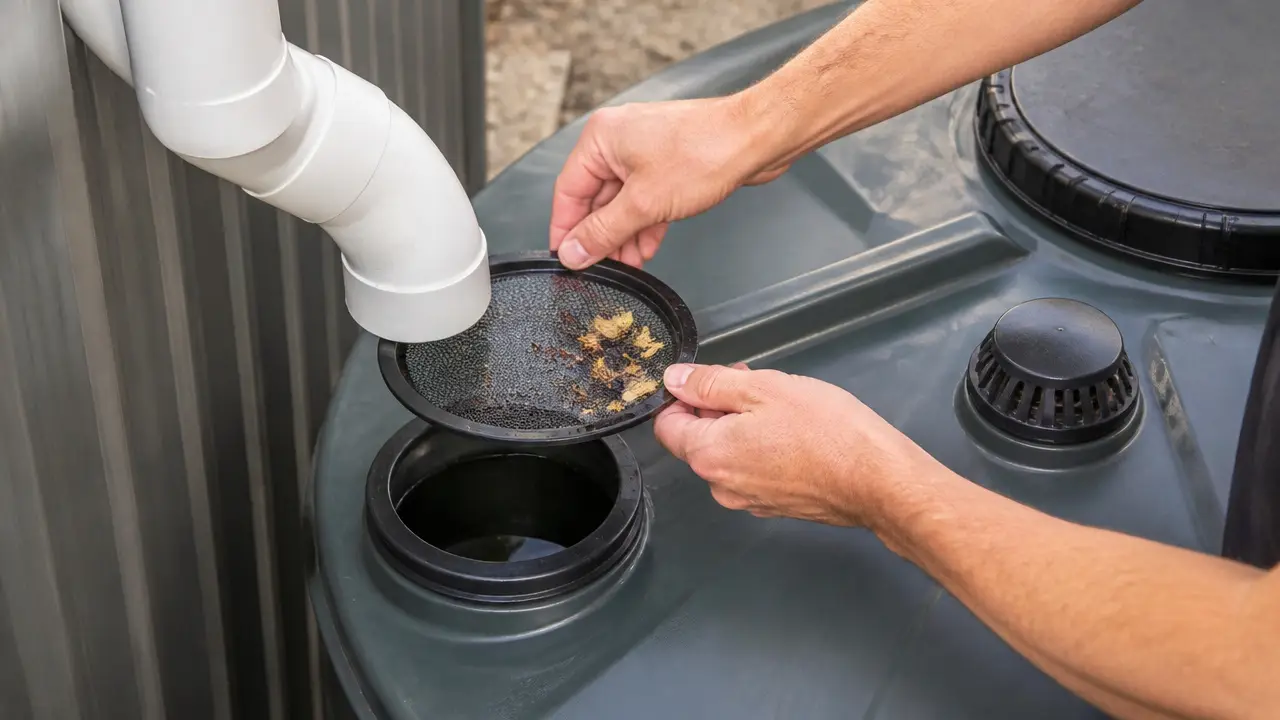
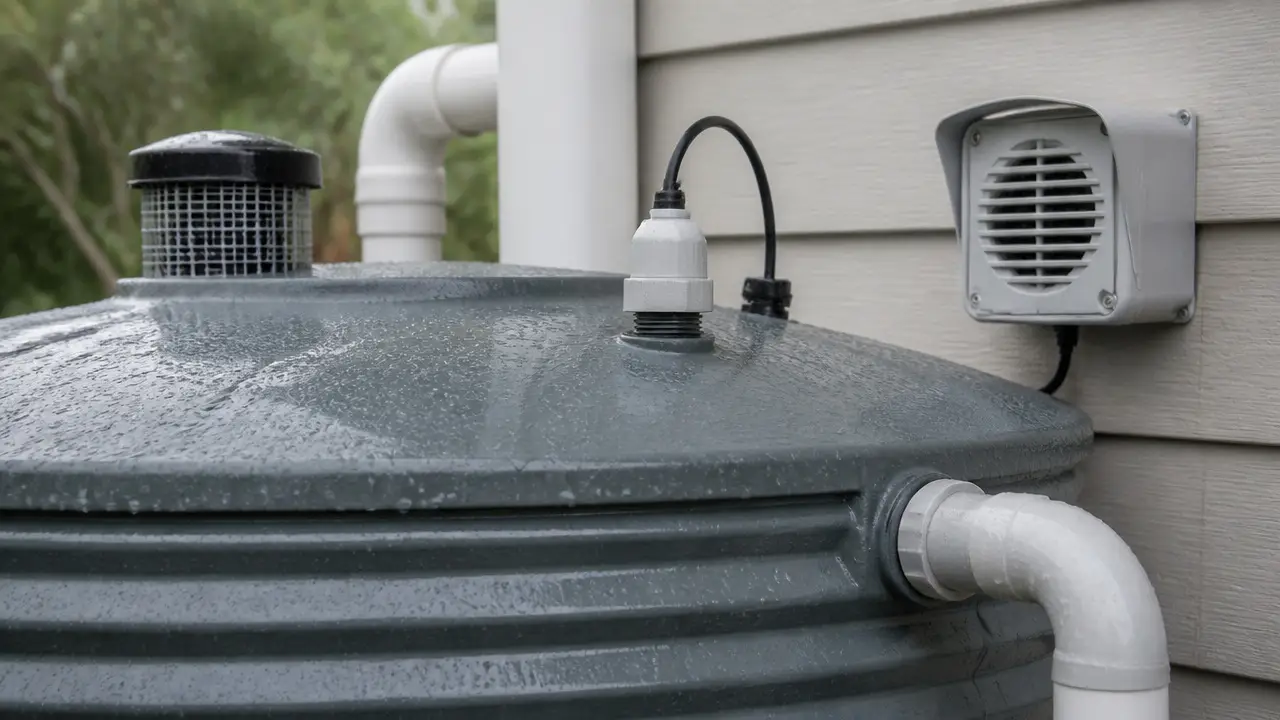
During normal rain, your system may send water from the gutter through a screen, first-flush device, filter, and then into a rain barrel, IBC tote, or cistern.
Winter is different.
A first flush device diverts the first portion of roof runoff, which often carries a heavier load of dust and debris. Heat cable does not replace this or any other water-quality control.
More importantly, keeping the gutter unfrozen does not mean the rest of the rainwater system can safely operate below freezing. Meltwater can reach:
- A frozen diverter
- A frozen filter
- A closed valve
- A frozen hose
- A full rain barrel
- A frozen overflow pipe
- An exposed fitting that may crack
If your collection system is normally winterized, keep following its winter shutdown plan. Do not assume a heated gutter makes the storage and plumbing freeze-safe.
For rainwater collection, also confirm that the de-icing cable and its attachment method are allowed for your specific roofing and gutter materials.
Constant-Wattage and Self-Regulating Cables
Two broad cable types are commonly used.
Constant-wattage cable
This type produces a set amount of heat while powered.
Because its heat output is relatively fixed, installation details are important. Crossing, overlapping, shortening, covering, or modifying cable in a way the manufacturer does not allow can create a hazard.
Self-regulating cable
Self-regulating cable changes its heat output as surrounding conditions change.
It generally produces more heat when colder and less as temperatures warm. This can make it useful for larger or more complex de-icing systems.
"Self-regulating," however, does not mean maintenance-free or automatically safe in every installation. It still needs to be correctly selected, connected, protected, and installed according to its listing and instructions.
Electrical Safety Is a Major Part of the Installation
Regarding the safe use of pipe heating cables, understand installation details that support reliable daily use.
Roof and gutter heat cables combine electricity, water, snow, ice, and outdoor exposure. Treat the electrical side as part of the system, not as an afterthought.
Use only a cable designed for the application. Follow the manufacturer's instructions for power supply, circuit size, ground-fault protection, controls, connections, cable spacing, and attachment.
Do not assume an extension cord is an acceptable permanent power source. Some roof-deicing manufacturers specifically prohibit extension-cord use for their systems.
CPSC guidance for electric heating cables also stresses correct product selection, following installation instructions, protecting against ground faults, and replacing cable that has cuts, exposed wiring, charring, or other deterioration.
If a new outdoor circuit, hard wiring, controller, breaker, or other electrical work is needed, that is a good point to use a qualified electrician. Local electrical requirements may also apply.
Do Not Let the Cable Cross or Overlap Unless Allowed
Heating cables are not ordinary electrical cords.
Some types can overheat when they touch or overlap. Others have different installation rules.
Do not guess.
Follow the exact instructions for your cable concerning:
- Crossing and overlapping
- Cutting cable to length
- Splicing
- Attachment clips
- Gutter material
- Roofing material
- Downspout use
- Controllers and sensors
- Electrical protection
CPSC has warned that heating cable should not be overlapped unless its manufacturer specifically permits it.
Can Heat Cable Damage a Gutter?
The correct cable installed on a compatible gutter should be designed for that use.
Problems are more likely when the wrong heating product is used or when installation ignores the manufacturer's requirements.
Plastic gutters and downspouts deserve particular attention. Do not assume every de-icing cable can touch plastic. Check that the cable manufacturer specifically allows your gutter and downspout material.
The attachment method matters too. Avoid improvised fasteners that could damage roofing, puncture the gutter, cut the cable jacket, or create leak points.
Heat Cables Still Need Inspection
Heat cables live in a harsh location.
They face water, sun, ice, temperature changes, moving snow, leaves, roof debris, and sometimes animals. Inspect accessible parts according to the manufacturer's maintenance instructions, preferably before winter conditions arrive.
Look for problems such as:
- Cracked or damaged cable covering
- Loose clips
- Exposed conductors
- Burn or discoloration marks
- Damaged plugs or connections
- Cable pulled out of position
- Leaves or debris packed around the cable
- Damage from previous roof or gutter work
Do not energize visibly damaged cable. CPSC recommends replacing heating cable that shows deterioration such as cuts, bare wires, or charring.
Avoid climbing onto a snowy or icy roof to inspect or repair cable. Roof work in winter has a serious fall risk.
Heat Cable or Fix the Roof?
If ice dams happen year after year, it is worth finding out why.
Repeated ice dams can point to heat escaping into the roof assembly. Air leaks around attic penetrations, poor insulation, or other roof conditions may contribute.
In those situations, heat cable may manage the symptom while building-envelope improvements address the cause.
A useful order is:
- Check whether gutters and downspouts are clean and draining correctly.
- Look for obvious roof drainage problems.
- Have repeat ice-dam problems evaluated for air leakage and insulation issues.
- Use de-icing cable where a heated drainage path is still needed.
- Make sure the electrical installation and roof attachment are suitable for the location.
In cold climates, roof construction itself can also include measures intended to limit water intrusion from ice dams.
Are Gutter Heat Cables Worth Using?
They can be.
Heat cables work best when you expect them to do one specific job: keep a drainage route open during freezing conditions.
They are not a universal cure for winter roof problems. A cable in the gutter cannot correct heat loss through the roof, bad gutter slope, blocked drainage, or a poorly designed rainwater system.
For a home with repeat gutter or downspout icing, however, the right roof-and-gutter de-icing cable can be a practical part of the solution.
Frequently Asked Questions
Do gutter heat cables actually melt ice?
Yes. They warm the area immediately around the cable and can melt enough ice to create an open drainage path. They are not normally intended to melt all snow and ice from the entire gutter or roof.
Will heat cable stop my gutters from freezing?
It can greatly reduce freezing around the cable when the system is correctly selected, installed, powered, and operated. It cannot guarantee that every part of the gutter will remain ice-free.
Do heat cables prevent roof ice dams?
They can help water drain through an ice-prone area, but they do not correct the roof-temperature differences that often cause ice dams. Air sealing, insulation, and suitable roof design may still need attention.
Can I put pipe heat tape in my gutter?
No, unless its manufacturer specifically identifies it for that application. CPSC guidance warns against using pipe-heating products on gutters when they were not designed for that purpose.
Should heat cable go inside the downspout?
Some roof-and-gutter de-icing systems are designed to continue into downspouts so meltwater has an open route away from the gutter. Follow the specific cable manufacturer's design and installation instructions.
Can I use gutter heat cable with a rain barrel?
Possibly, but keeping the gutter warm does not protect the rain barrel, diverter, valves, filters, hoses, or overflow from freezing. If your rainwater system requires winterization, a gutter heat cable does not remove that need.
Can I leave gutter heat cable plugged in all winter?
Operation depends on the cable and its control system. Some systems use temperature or moisture controls, while others have different operating instructions. Follow the manufacturer rather than assuming the cable should stay powered continuously.
Can I install gutter heat cable myself?
Some listed plug-in systems are intended for homeowner installation when suitable power is already available and the roof can be accessed safely. Complicated roofs, new electrical circuits, hard-wired systems, steep or high roof access, and uncertain electrical protection are better handled by qualified professionals.