As an affiliate, we may earn a commission from qualifying purchases. We get commissions for purchases made through links on this website from Amazon and other third parties.
High turbidity usually means water contains a lot of suspended material, so it can reasonably be described as dirty or cloudy water. But turbidity does not tell you exactly what the material is, and it does not prove whether the water is safe or unsafe to drink.
Turbidity is a measure of how much particles in water scatter light. These particles can include soil, silt, organic matter, algae, and microorganisms. The U.S. Environmental Protection Agency uses turbidity as an important indicator of water quality and filtration performance.
For a rainwater system, high turbidity is a sign that you should find the source of the cloudiness rather than assuming one filter will solve the problem.
What Does High Turbidity Look Like?
Water with higher turbidity may look:
- Cloudy
- Hazy
- Muddy
- Brownish or gray
- Full of very fine floating particles
The particles may be too small to settle quickly. Water can therefore remain cloudy even after sitting in a container for several hours.
Turbidity is normally measured in NTU, or nephelometric turbidity units. A turbidity meter shines light through the water and measures how strongly suspended material scatters that light.
A higher NTU reading generally means more cloudiness.
Does High Turbidity Mean the Water Is Contaminated?
Not necessarily.
High turbidity tells you that particles are present. It does not identify them.
For example, cloudy rainwater might contain harmless mineral particles washed from a roof. But similar-looking water could contain organic debris, animal waste, algae, or microorganisms.
This is why turbidity is an indicator, not a complete water-quality test.
The EPA notes that higher turbidity can be associated with higher levels of disease-causing microorganisms. Suspended particles can also make water treatment more difficult.
The reverse is also important:
Clear water is not necessarily clean water.
Many bacteria, viruses, dissolved chemicals, and other contaminants can be present without making water visibly cloudy.
You cannot decide whether rainwater is potable, meaning safe for drinking, just by looking at it or measuring turbidity.
What Causes High Turbidity in Rainwater?
Roof-collected rainwater can become cloudy at several points between the roof and the tap.
Roof Debris
Dust, pollen, soil, soot, leaves, insect material, and bird or animal waste can collect on a roof between storms.
Rain washes some of this material into the gutter system.
Screens and other prefilters can catch larger debris, but very fine particles may continue into the tank.
Poor First-Flush Control
A first-flush diverter sends away some of the initial roof runoff at the beginning of a rain event.
That early runoff often carries more roof debris than the water arriving later.
A first-flush system does not remove every contaminant, but poor or neglected first-flush control can contribute to more suspended material reaching storage.
Tank Sediment
Fine particles eventually settle at the bottom of many rainwater tanks.
The water may look clear while the sediment remains undisturbed.
Strong incoming water, moving the tank, pumping near the bottom, or cleaning work can stir this sediment back into the water and cause a sudden rise in turbidity.
Algae or Organic Growth
Light entering a tank can encourage algae growth. Leaves and other organic material can also break down inside poorly protected storage.
Both can contribute to cloudy water.
Keeping the tank covered, screened, and protected from sunlight helps reduce these problems.
Recent Heavy Rain
A strong storm can wash an unusually large amount of dust and debris from the roof.
Water collected immediately after a long dry period may also contain more roof material than water from later storms.
Why High Turbidity Matters for Water Treatment
Cloudiness is more than an appearance problem when you intend to treat rainwater.
Particles can interfere with later treatment stages.
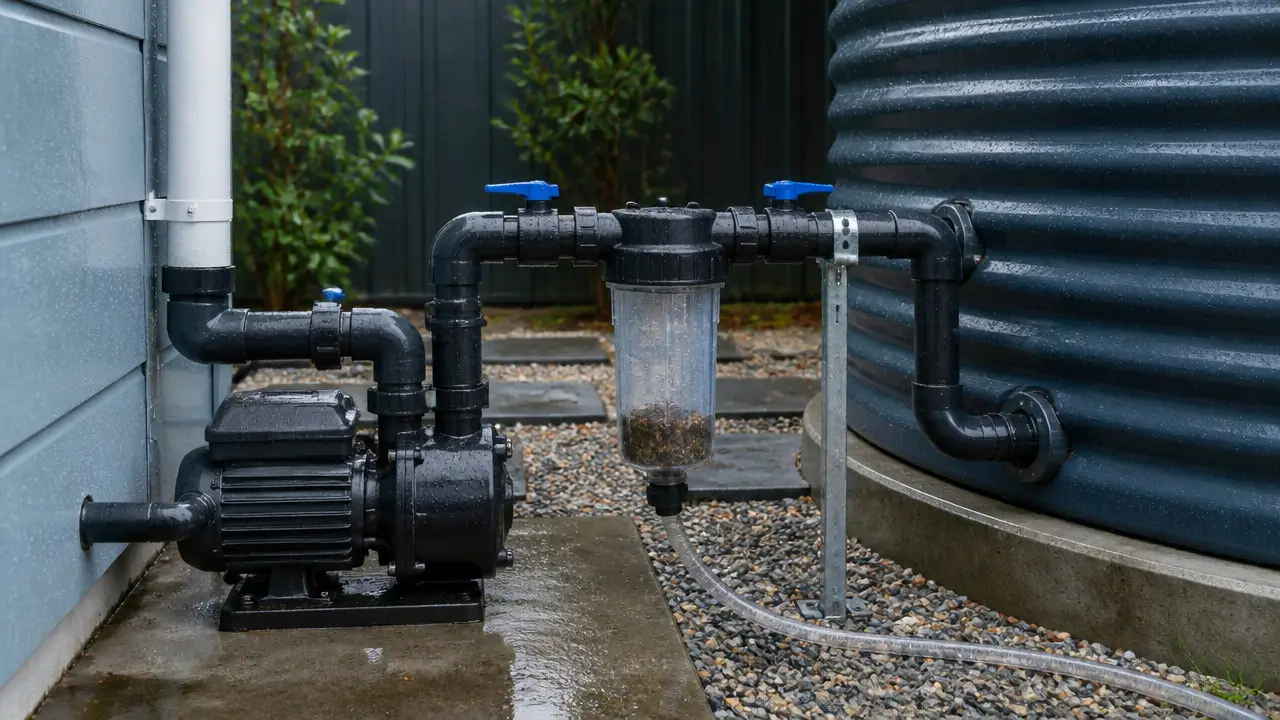
Sediment Filters Can Clog Faster
A sediment filter catches suspended particles.
The micron rating describes approximately how small the particles are that the filter is designed to capture. A smaller micron number means finer filtration.
Very turbid water can load a filter quickly. This may:
- Reduce flow
- Lower water pressure
- Increase filter changes
- Overload finer treatment stages
Removing larger particles before fine filtration can make the whole system easier to maintain.
Turbidity Can Reduce UV Effectiveness
Guidance on risks of drinking high-turbidity water helps assess testing scope appropriate to the planned level of human contact.
UV treatment uses ultraviolet light to inactivate microorganisms.
The water needs to be sufficiently clear for the light to reach microorganisms effectively. Suspended particles can shield microbes from UV exposure. CDC guidance likewise recommends filtering cloudy water before UV treatment because particles can block the light.
A UV unit therefore should not be treated as a substitute for adequate pretreatment.
Disinfection Can Be More Difficult
Suspended material can also interfere with some disinfection processes or provide places where microorganisms are protected.
That is one reason public drinking-water treatment pays close attention to turbidity.
This does not mean public-water turbidity limits should simply be copied as a design standard for every private rainwater system. The correct treatment approach depends on the water source, equipment, intended use, and applicable local requirements.
Is Turbid Rainwater Okay for the Garden?
Sometimes, but the cause still matters.
Slightly cloudy rainwater containing ordinary roof dust may be usable for many garden applications. However, highly turbid water can cause problems in irrigation systems.
Fine particles may clog:
- Drip emitters
- Small irrigation valves
- Sprayers
- Fine screens
- Pump strainers
If the system uses drip irrigation, filtration often matters more than it does when water is simply being emptied from a rain barrel with a hose.
Also investigate unusual changes. Water that suddenly becomes very cloudy, develops an odor, changes color, or contains obvious biological growth deserves attention before continued use.
What Should You Do if Tank Water Suddenly Turns Cloudy?
Start by looking for the reason.
Check whether:
- A recent storm washed heavy debris from the roof.
- Gutters or screens need cleaning.
- A first-flush device is blocked or overdue for maintenance.
- Incoming water is disturbing sediment at the bottom of the tank.
- The pump intake is pulling from the sediment layer.
- Light is entering the tank and encouraging algae.
- Leaves, insects, or other organic material have entered storage.
If sediment was simply disturbed, allowing the tank to remain still may let some particles settle again. That can improve clarity, but settling alone should not be treated as water treatment for drinking purposes.
Persistent turbidity usually calls for correcting the source and improving particle removal rather than continually replacing clogged fine filters.
Can a Turbidity Meter Tell You if Rainwater Is Safe?
No.
A turbidity meter measures cloudiness. It does not directly tell you whether water contains:
- E. coli
- Other disease-causing microorganisms
- Heavy metals
- Pesticides
- Dissolved chemicals
- PFAS
- Other contaminants that may be relevant locally
Similarly, a low turbidity reading does not prove that the water is safe to drink.
If rainwater is intended for drinking, water quality needs to be considered as a complete system: suitable collection surfaces, debris control, storage, prefiltration, appropriate treatment, maintenance, current laboratory testing, and applicable local requirements.
High Turbidity vs. High TDS
Turbidity and total dissolved solids are different measurements.
Turbidity mainly relates to particles suspended in the water.
Total dissolved solids, or TDS, refers to dissolved substances such as minerals and salts.
A sediment filter may substantially reduce turbidity while doing little to dissolved solids.
Likewise, water can have very low turbidity but relatively high TDS because dissolved material does not necessarily make the water cloudy.
Neither measurement by itself determines whether water is safe to drink.
The Practical Rule
Treat high turbidity as a warning that something is suspended in the water and needs investigation.
For a rainwater system, the best response is usually to control debris as early as possible, prevent tank sediment from being stirred up, and provide appropriate filtration for the intended use.
For drinking-water applications, clarity is only one part of water quality. Do not assume that clear water is safe, or that removing visible cloudiness makes collected rainwater potable.
Frequently Asked Questions
Does high turbidity always mean polluted water?
No. Turbidity only shows that suspended material is making the water cloudy. The material could be soil, organic matter, algae, microorganisms, or other particles. Testing is needed to identify specific contaminants.
Can you drink water with high turbidity?
High-turbidity rainwater should not be assumed safe to drink. Suspended particles can be associated with microorganisms and can interfere with treatment. Drinking-water use requires appropriate treatment, maintenance, laboratory testing, and compliance with applicable local requirements.
Can a sediment filter lower turbidity?
Yes. Sediment filtration is designed to remove suspended particles and can reduce turbidity when the filter is suitable for the particle load and flow requirements. It does not remove every dissolved or microbial contaminant.
Will letting cloudy water sit make it clear?
Larger particles may settle when water remains undisturbed. Very fine particles can stay suspended much longer. Even if the water becomes visibly clear, settling does not establish that it is safe to drink.
Does high turbidity damage a water pump?
Turbidity itself does not necessarily damage a pump, but abrasive sediment such as sand or grit can increase wear. Heavy sediment can also clog strainers, filters, valves, and irrigation equipment.
Does clear rainwater mean the tank is clean?
No. Clear water can still contain microorganisms or dissolved contaminants. Sediment may also be sitting at the bottom of the tank without making the water above it cloudy.
Is turbidity the same as TDS?
No. Turbidity measures cloudiness caused mainly by suspended particles. TDS measures dissolved substances in the water. A water sample can be low in turbidity but high in TDS, or the reverse.