As an affiliate, we may earn a commission from qualifying purchases. We get commissions for purchases made through links on this website from Amazon and other third parties.
A rainwater tank should be big enough to hold the water your roof can collect between periods when you use it or when rain is scarce. For many homes, the right size depends more on roof area, local rainfall, and daily water use than on the size of the house.
A small tank may be enough for occasional garden watering. A much larger tank may be needed for irrigation, toilet flushing, laundry, or year-round household use.
Start With What You Want the Rainwater For
Tank sizing should begin with demand.
Think about how you plan to use the stored water:
- Watering a few garden beds
- Supplying drip irrigation
- Washing tools or vehicles
- Flushing toilets
- Supplying laundry
- Providing water at a cabin
- Supporting several household uses
- Providing drinking water after suitable treatment
The more water you use, the more storage usually makes sense.
A large tank does not create more water. It only lets you save more of the rain that falls on your roof.
How Much Rainwater Can Your Roof Collect?
In U.S. units, a useful estimate is:
Gallons collected = roof area in square feet × rainfall in inches × 0.623
For example, a 1,500-square-foot roof receiving 1 inch of rain has a theoretical collection of:
1,500 × 1 × 0.623 = about 935 gallons
That does not mean all 935 gallons will reach the tank.
Some water may be lost because of:
- Wetting the roof
- Gutter overflow
- First-flush diversion
- Screens and filters
- Leaks
- Splashing
- Tank overflow
A first flush device diverts some of the first runoff from a storm so dirt, dust, bird droppings, and other roof debris are less likely to enter storage.
For planning, it is better to allow for collection losses rather than sizing a tank around the theoretical maximum.
Tank Size Depends on Rainfall Timing
Annual rainfall alone can be misleading.
Imagine two locations that each receive 40 inches of rain per year.
One may get rain regularly throughout the year. The other may receive most of its rain during a short wet season followed by several dry months.
The second location usually needs more storage if the goal is to keep supplying water through the dry season.
That is why these three questions matter:
- How much rain falls?
- How often does it fall?
- How long are the dry periods?
A smaller tank can work well where rain arrives often. A larger cistern may be useful where long dry periods are common.
Estimate Your Water Demand
Next, estimate how much water you expect to use.
For irrigation, you might estimate demand by:
- Garden area
- Number of irrigation zones
- Flow rate
- Watering duration
- Watering frequency
For household uses, estimate how many gallons you expect to draw from the rainwater system each day.
For example, if your system uses about 40 gallons per day:
- 7 days requires about 280 gallons
- 30 days requires about 1,200 gallons
- 60 days requires about 2,400 gallons
This gives you a rough idea of how much storage would be needed to carry the system through different dry periods.
A Simple Tank-Sizing Method
A practical first estimate uses both supply and demand.
Step 1: Find your roof collection area
Use the horizontal footprint of the roof section draining into the tank.
You generally do not need to measure the sloped roof surface itself.
If only half of your roof drains to the tank, use only that portion.
Step 2: Estimate rainwater collection
Use:
Roof area × rainfall × 0.623
Then allow for normal collection losses.
Step 3: Estimate water use
Calculate how many gallons you expect to use per day, week, or month.
Step 4: Look at dry periods
Determine how long you want the tank to supply water without meaningful rainfall.
Step 5: Compare storage with supply
There is little benefit in installing a very large tank if your roof rarely produces enough runoff to fill it.
Likewise, a small tank may overflow frequently if you have a large roof and regular heavy rain.
The best size balances both.
Example: Small Garden System
Suppose a homeowner has:
- 800 square feet of roof feeding the tank
- Regular seasonal rain
- A garden using about 100 gallons per week
One inch of rain could theoretically produce:
800 × 0.623 = about 498 gallons
A 50-gallon rain barrel would capture only a small part of that storm.
A tank holding several hundred gallons could capture much more water and provide several weeks of garden watering, depending on actual use and rainfall.
The exact size should still be based on local rainfall patterns and available space.
Example: Larger Household Collection System
Suppose 2,000 square feet of roof drains into a cistern.
One inch of rain provides a theoretical:
2,000 × 0.623 = about 1,246 gallons
A 500-gallon tank could fill during less than one inch of effective rainfall if it started empty.
A 2,000-gallon tank would require considerably more rain to fill but could store water for a longer dry period.
Whether the larger tank makes sense depends on how quickly the household uses the water and how frequently rain returns.
Common Tank Sizes and Where They Fit
There is no universal tank size, but these general ranges help show how storage scale changes with use.
| Approximate storage | Common use |
|---|---|
| 50-100 gallons | Small garden or rain-barrel system |
| 200-500 gallons | Larger garden or occasional irrigation |
| 500-1,500 gallons | Substantial irrigation or several non-potable uses |
| 1,500-5,000+ gallons | Larger household, homestead, cabin, or long dry-period storage |
These are not sizing rules. A 500-gallon tank could be oversized for one property and far too small for another.
Non-potable means water that is not intended for drinking.
Bigger Is Not Always Better
Buying the largest tank that fits the property can create problems.
A larger tank:
- Takes more space
- Needs a stronger foundation
- Holds more weight
- May require larger or more carefully planned overflow piping
- Can be difficult to clean or inspect
- May rarely fill if the collection area is small
Water weighs about 8.3 pounds per U.S. gallon.
That means approximately:
- 500 gallons weighs more than 4,000 pounds
- 1,000 gallons weighs more than 8,000 pounds
- 2,500 gallons weighs more than 20,000 pounds
Explore a suitable size water tank for a home to evaluate storage materials appropriate for the planned application.
This is one reason large tanks need suitable ground preparation and structural support.
Do not place a large filled tank on a deck, platform, roof, or questionable foundation unless the structure has been designed for the load.
Watch for Tank Overflow
Your tank should have a safe way to handle water after it becomes full.
Overflow should be directed away from:
- Building foundations
- Septic systems
- Slopes that may erode
- Neighboring property
- Electrical equipment
- Areas that already drain poorly
Tank overflow can move a surprising amount of water during a heavy storm.
A larger tank reduces how often overflow occurs, but it does not eliminate the need for proper overflow drainage.
Tank Shape Matters Too
Capacity is not the only consideration.
Measure the installation area before choosing a tank.
Check:
- Width
- Height
- Doorway or gate access
- Clearance around the tank
- Gutter and inlet height
- Overflow height
- Pump connection location
- Drain access
- Space for cleaning and maintenance
A tall narrow tank may fit beside a house where a wide round tank will not.
An underground cistern can save surface space, but excavation, structural loading, groundwater conditions, access, and installation become much more important.
Make Sure the Connections Fit
Tank fittings should match the rest of the system.
Common connections include:
- Rainwater inlet
- Overflow
- Drain
- Pump outlet
- Tank-to-tank connection
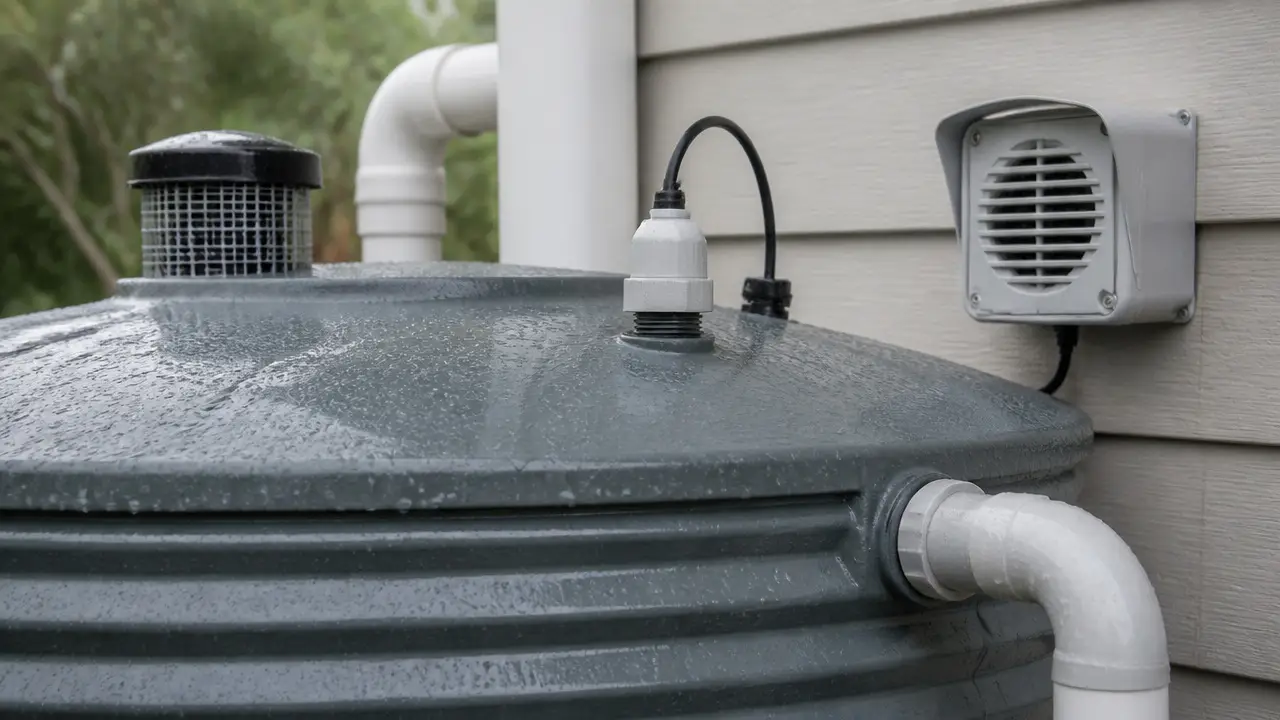
A bulkhead fitting is a fitting that passes through the tank wall and creates a sealed connection for pipe or hose.
Check fitting sizes before buying pumps, filters, hoses, or irrigation equipment. A large tank with small or poorly placed connections can still create flow problems.
Do You Need Enough Storage for the Whole Dry Season?
Not necessarily.
Trying to store every gallon needed for an entire dry season can require an enormous tank.
For many garden systems, a more practical goal is to store enough water to:
- Bridge normal gaps between storms
- Reduce municipal water use
- Capture runoff that would otherwise be lost
A household that depends heavily on rainwater may need a different approach. In that case, monthly rainfall, roof yield, household demand, backup water, and the longest expected dry period should be considered together.
A monthly water-balance calculation is more useful than simply choosing a tank based on annual rainfall.
Multiple Tanks Can Work Better Than One Large Tank
Several tanks can sometimes be easier to install than one large cistern.
Multiple tanks may help when:
- Access is narrow
- Storage needs may grow later
- Water is collected from different roof sections
- Space is split around a building
The tanks need suitable connections so water fills, drains, vents, and overflows as intended.
Poorly connected tanks may fill unevenly or leave water trapped in one tank.
Remember the Pump When Planning Tank Size
If you will pump water from the tank, storage volume is only part of the design.
The pump must also match:
- Required flow rate
- Required pressure
- Vertical lift
- Pipe length
- Pipe diameter
- Irrigation or household demand
Flow rate describes how much water moves through the system over time, usually in gallons per minute.
A large tank does not automatically provide high water pressure.
Plan for Sediment and Cleaning
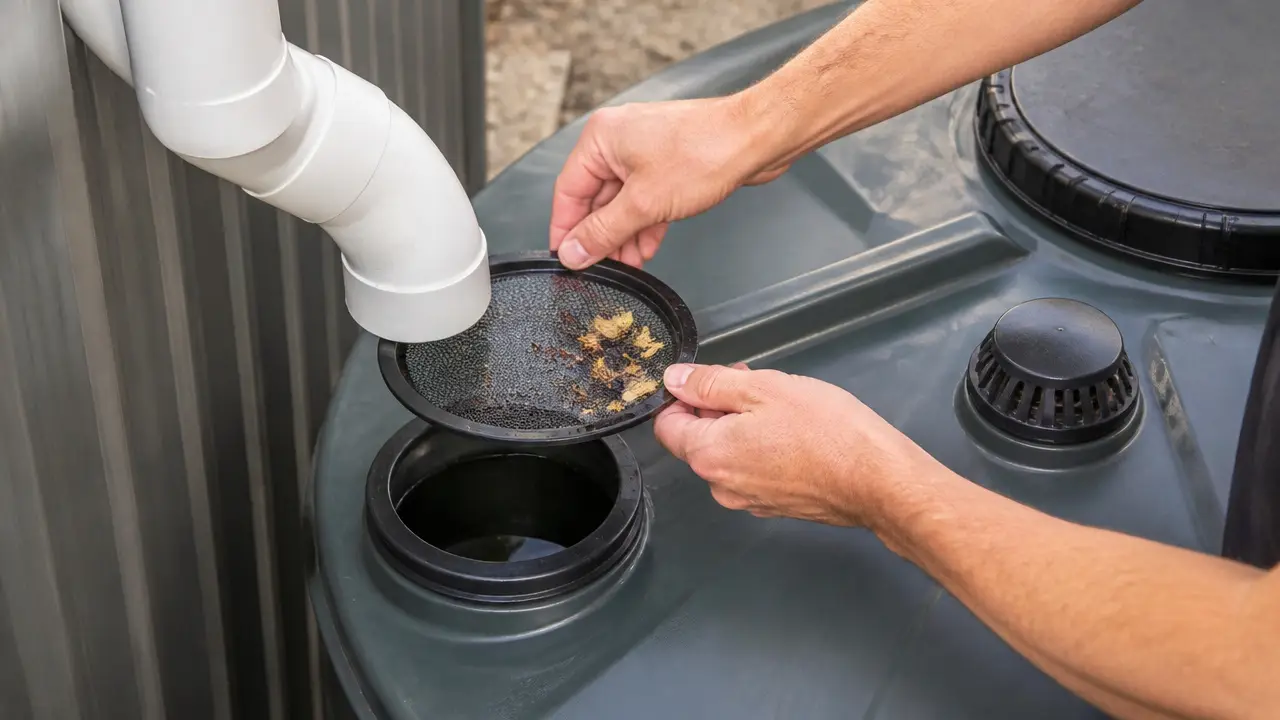
Rainwater tanks collect some sediment over time even when the system has leaf screens and other prefiltration.
Tank design should allow practical maintenance.
Useful features may include:
- Accessible inlet screening
- Serviceable filters
- Drain or clean-out access
- Mosquito-resistant screening
- A protected overflow
- Access for inspection
Avoid sizing and placing a tank so tightly that important fittings cannot be reached.
Consider Freezing Conditions
Outdoor tanks and exposed plumbing can freeze in cold climates.
A larger tank does not guarantee freeze protection.
Freeze planning may affect:
- Tank location
- Pipe routing
- Drain-down design
- Pump placement
- Valve placement
- Seasonal use
Buried or insulated components may reduce exposure, but frost depth and local conditions vary.
If freezing could damage buried pipes, pumps, pressure equipment, or a large cistern, use a design suitable for your climate.
What About Drinking Water?
Tank size alone has nothing to do with whether rainwater is safe to drink.
Roof runoff can contain microorganisms, animal waste, dust, metals, chemicals, and other contaminants.
A drinking-water system should be treated as a complete water-supply system. That can involve suitable collection surfaces, debris control, first-flush management, storage design, treatment stages, current laboratory testing, ongoing maintenance, and applicable local requirements.
Do not assume a filter, UV unit, purifier, test strip, or water-quality meter by itself makes stored rainwater potable.
Potable means suitable for drinking.
For drinking-water systems, professional system design and qualified water testing may be appropriate.
A Good Rule for Choosing Tank Size
Choose a tank large enough to store a useful amount of water during your normal dry periods, but not so large that your roof rarely fills it.
For a basic system, work through these four numbers:
- Roof area feeding the tank
- Rainfall during typical storms and dry periods
- Expected water use
- Desired number of days of storage
Those numbers will give you a much better answer than choosing a tank based only on house size.
Frequently Asked Questions
Is a 500-gallon rainwater tank big enough?
It can be. A 500-gallon tank may work well for garden watering or moderate non-potable use. Whether it is enough depends on roof size, rainfall frequency, and how quickly you use the water.
How much rain does it take to fill a 1,000-gallon tank?
It depends on roof area. A 2,000-square-foot roof has a theoretical collection of about 1,246 gallons from 1 inch of rain. Real collection will be lower because of system losses.
Is a 1,000-gallon tank too big for a house?
Not necessarily. A large roof in a rainy climate may fill it quickly. A small roof in a dry climate may not. Available space, foundation requirements, water demand, and rainfall patterns matter more than house size alone.
Should I size my tank using annual rainfall?
Annual rainfall is useful, but it is not enough. Monthly rainfall and the length of dry periods are usually more important for storage sizing.
Can I connect several smaller rainwater tanks together?
Yes. Multiple tanks can provide substantial storage when they are connected correctly. The inlet, balancing connections, vents, outlets, and overflow arrangement should be designed so the tanks operate together properly.
How much does a full rainwater tank weigh?
Water weighs about 8.3 pounds per U.S. gallon. A 1,000-gallon tank therefore contains more than 8,000 pounds of water, not including the weight of the tank itself.
Does a larger rainwater tank give better water pressure?
No. Pressure mainly depends on tank elevation or the pump and pressure system. Tank capacity determines how much water you can store.