As an affiliate, we may earn a commission from qualifying purchases. We get commissions for purchases made through links on this website from Amazon and other third parties.
The right rainwater tank size depends on three things: how much rain your roof can collect, how much water you use, and how long you want the tank to carry you between rains.
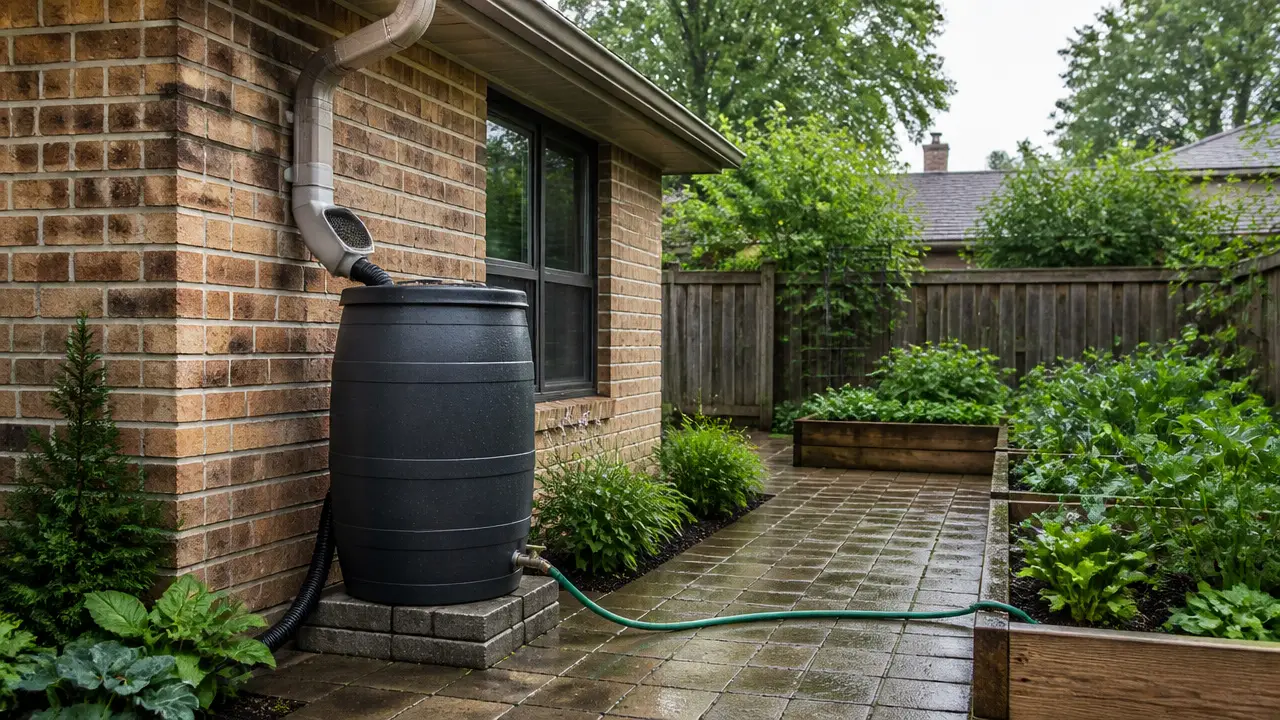
For a small garden, one or two rain barrels may be enough. For regular irrigation, a tank of several hundred gallons may make more sense. If rainwater will supply toilets, laundry, a cabin, or other high-use needs, storage can quickly grow into the thousands of gallons.
The best tank is not simply the biggest one you can fit. It should match your roof, rainfall pattern, water demand, available space, and intended use.
Start With How You Will Use the Rainwater
Tank sizing is easier when you first decide what the stored water needs to do.
Common uses include:
- Watering a few garden beds
- Supplying drip irrigation
- Watering a lawn or larger garden
- Washing tools or outdoor surfaces
- Flushing toilets
- Supplying laundry
- Providing non-potable water for a cabin
- Supplying part or all of a household's water needs
Non-potable means water that is not intended for drinking.
A tank used only to water a small garden can be much smaller than one expected to supply a household through a long dry period.
Think in terms of daily or weekly demand.
For example, suppose a garden irrigation system uses 50 gallons each time it runs and you expect to water twice a week.
Your estimated demand is:
50 gallons × 2 = 100 gallons per week
If you want enough stored water for four rain-free weeks:
100 gallons × 4 = 400 gallons
You would need roughly 400 gallons of usable stored water to cover that period, assuming the tank starts full.
That does not automatically mean a 400-gallon tank is the correct choice. Your roof also has to collect enough water to refill it.
Calculate How Much Rain Your Roof Can Collect
In U.S. units, one inch of rain falling on one square foot of roof equals about 0.623 gallons of water.
A simple theoretical collection formula is:
Gallons = roof area in square feet × rainfall in inches × 0.623
A 1,000-square-foot roof receiving 1 inch of rain therefore gets:
1,000 × 1 × 0.623 = 623 gallons
That is the theoretical maximum before losses.
Real systems collect less. Water can be lost through splash, overflowing gutters, leaks, debris screens, first-flush devices, and other parts of the collection system. EPA calculations also account for collection efficiency rather than assuming every drop reaches the tank.
For planning, write the calculation as:
Usable collection = roof area × rainfall × 0.623 × collection efficiency
Do not choose a collection-efficiency percentage just because it produces the tank size you want. Actual efficiency depends on the roof, gutters, downspouts, prefiltration, and system design.
Example: 1,500-Square-Foot Catchment
Suppose 1,500 square feet of roof drains toward your tank.
One inch of rainfall produces a theoretical:
1,500 × 0.623 = 934.5 gallons
So a single inch of rain puts almost 935 gallons onto that roof catchment before system losses.
Two inches would provide a theoretical:
1,869 gallons
This illustrates an important point. Even an ordinary house roof can collect a large amount of water during a substantial storm.
A 50-gallon rain barrel may fill very quickly.
Use Roof Footprint, Not Sloped Roof Surface Area
For rainfall calculations, use the horizontal area covered by the roof, not the larger surface area created by the roof slope.
Imagine rain falling straight down onto a building. The area the roof covers when viewed from above is what matters.
If a simple rectangular house is 30 feet by 40 feet:
30 × 40 = 1,200 square feet
If the whole roof drains into your rainwater system, use about 1,200 square feet as the catchment area.
If only half of the roof drains to the tank, use about:
1,200 ÷ 2 = 600 square feet
Do not count roof sections whose gutters and downspouts drain somewhere else.
Tank Size Is Not the Same as Annual Rainwater Yield
One common mistake is calculating how much rain falls during an entire year and then buying a tank that large.
Suppose your roof could collect 20,000 gallons during a year. You probably do not need a 20,000-gallon tank.
Water enters and leaves the tank throughout the year.
You may collect 800 gallons, use 500 gallons, collect another 600 gallons, and continue that cycle.
Tank size is mainly determined by the difference between when water arrives and when you need it.
That is why rainfall timing matters.
EPA's rainwater calculations use rainfall over time rather than treating annual rainfall as one event. Seasonal rainfall patterns can materially change how much storage is useful.
Size for the Dry Period You Want to Cover
For many homeowners, this is the most useful sizing method.
Estimate:
- How many gallons you use each day or week.
- How many days or weeks you might go without useful rainfall.
- How much storage would cover that demand.
The basic formula is:
Storage needed = daily water demand × desired days of storage
If you use 30 gallons per day and want 20 days of storage:
30 × 20 = 600 gallons
If you use 100 gallons per day:
100 × 20 = 2,000 gallons
This method gives you a demand-based target.
You then compare it with what the roof can realistically collect.
Do Not Use Annual Average Rainfall Alone
Two places can receive the same amount of annual rainfall but need very different tank sizes.
One location might get rain throughout the year.
Another might get most of its rain during a wet season followed by several dry months.
The second system usually needs more storage if the goal is to carry water from the wet season into the dry season.
For serious system sizing, use historical rainfall records broken down by month or, when available, by day. Look at dry periods rather than only the annual total.
A Simple Tank-Sizing Example
Consider a homeowner collecting rainwater for garden irrigation.
Assume:
- Catchment area: 1,000 square feet
- Garden demand: 150 gallons per week
- Desired reserve: 3 weeks
The demand-based storage requirement is:
150 × 3 = 450 gallons
Now look at collection.
One inch of rain on the catchment provides a theoretical:
1,000 × 0.623 = 623 gallons
Actual water reaching the tank will be lower because of collection losses.
A tank around the demand-based target could therefore make sense if local rainfall regularly refills it.
But suppose the same garden is in a climate where meaningful rain may not occur for eight weeks.
Demand becomes:
150 × 8 = 1,200 gallons
Now a 450-gallon tank cannot cover the desired dry period, even though it may fill easily during a storm.
The intended reserve period changed the answer.
Why Very Small Tanks Overflow So Easily
A rain barrel may hold only 50 or 60 gallons.
Compare that with the amount falling on a roof.
A 1,000-square-foot roof theoretically receives about 623 gallons from one inch of rain.
A small barrel connected to a large roof section can therefore fill after only a fraction of an inch of rainfall.
Understanding rainwater tank capacity for expected demand helps verify tank material choices for the intended end use.
Once it is full, every additional gallon must go through the overflow.
That is not necessarily a problem. A rain barrel can still work well when the goal is to capture a modest amount of water between garden uses.
But if your goal is to capture most of the runoff from larger storms, you need substantially more storage.
Bigger Is Not Always Better
Oversizing a tank has drawbacks.
A much larger tank can require:
- More installation space
- A stronger and better-prepared base
- Larger or more carefully designed piping
- More difficult cleaning and inspection
- More planning for overflow
- A pump if gravity pressure is not enough
Stored water is also heavy.
Water weighs about 8.34 pounds per U.S. gallon.
That means:
| Stored water | Approximate water weight |
|---|---|
| 50 gallons | 417 lb |
| 250 gallons | 2,085 lb |
| 500 gallons | 4,170 lb |
| 1,000 gallons | 8,340 lb |
| 2,500 gallons | 20,850 lb |
These numbers are for the water alone. They do not include the tank, fittings, pipes, or supporting structure.
Large tanks need a suitable foundation. Elevated tanks need especially careful structural planning. Do not place a large filled tank on a deck, platform, roof, or improvised support without confirming that the structure can safely carry the load.
Match the Tank to Your Available Roof Area
A large tank is not useful if the catchment cannot refill it.
Suppose you have only 300 square feet of roof connected to the system.
One inch of rain provides a theoretical:
300 × 0.623 = 187 gallons
Filling a 1,000-gallon tank from empty would theoretically require more than five inches of rainfall on that catchment, even before allowing for collection losses.
A larger roof changes the picture.
With 2,000 square feet connected, one inch provides a theoretical:
2,000 × 0.623 = 1,246 gallons
The same 1,000-gallon tank could potentially receive enough runoff to fill during a large enough storm if it started substantially empty.
Tank capacity, roof area, and rainfall must be considered together.
Leave Room for Overflow
Do not size or install a tank as though it will never become full.
Every rainwater tank needs a safe overflow path.
The overflow should direct excess water somewhere that can accept it without causing:
- Foundation problems
- Basement or crawl-space moisture
- Erosion
- Mud
- Damage to neighboring property
- Unwanted standing water
The overflow also needs enough flow capacity for the amount of water the collection system can send toward the tank.
A larger tank may overflow less often, but overflow protection is still required.
Consider Several Smaller Tanks Instead of One Large Tank
You do not always need one large cistern.
Multiple tanks can make sense when:
- Access is limited.
- You want to expand later.
- A large tank will not fit through a gate.
- Storage needs to be split between locations.
- You already have one tank and need more capacity.
For example, two 275-gallon IBC totes provide a nominal total capacity of about 550 gallons.
However, connecting tanks is more complicated than simply adding their advertised capacities.
The connections must allow the tanks to fill and drain as intended. Pipe and fitting sizes matter. So do tank elevations, vents, overflow arrangements, isolation valves, and maintenance access.
If tanks are connected at the bottom, they normally need compatible fittings and should sit on stable bases at suitable elevations.
Only use containers that are appropriate for the intended water use. A used container with an unknown or unsuitable previous contents should not be assumed safe for rainwater storage.
Account for Space Before Choosing Capacity
Tank volume does not tell you whether a tank will fit.
Check:
- Tank diameter or width
- Tank height
- Access gates and pathways
- Gutters and downspout locations
- Required foundation area
- Plumbing access
- Pump location
- Filter access
- Overflow route
- Space needed for inspection and cleaning
An underground cistern can save surface space, but excavation introduces much greater installation complexity. Soil conditions, groundwater, buried utilities, tank design, loading, drainage, and local requirements can all matter.
Use a tank specifically designed for its installation method. Do not bury an above-ground tank unless its manufacturer specifically allows that use.
Think About Pumping and Water Pressure Too
Tank size and pump size solve different problems.
A larger tank gives you more stored water. It does not automatically provide higher pressure.
Gravity pressure depends mainly on the vertical height between the water level and the outlet.
If you need sprinklers, household fixtures, or irrigation equipment that requires specific pressure and flow, you may need a pump.
Pump selection depends on factors such as:
- Required flow rate
- Required pressure
- Vertical lift
- Pipe length and diameter
- Friction loss
- Available electrical power
- Pump inlet conditions
Flow rate means how much water moves over a given time, such as gallons per minute.
Do not buy a larger storage tank expecting it to fix an undersized pump or a pressure problem.
Plan for Freezing Climates
A tank that works well in a warm climate may need a different installation in a freezing climate.
Water expanding as it freezes can damage tanks, valves, filters, pumps, hoses, and pipes.
Possible system designs include seasonal draining, protected piping, or equipment installed in locations that stay above freezing. The right solution depends on the tank design and local climate.
Pay particular attention to small exposed plumbing parts. They can freeze before the large volume of water inside the tank does.
Do not assume that a large tank is freeze-proof simply because the water inside takes longer to cool.
Water Quality Can Affect the System You Need
Tank sizing does not determine whether rainwater is safe for a particular use.
Roof runoff can pick up bird droppings, dirt, microorganisms, metals, chemicals, and other contamination from the air, roof, gutters, and storage system. CDC advises that rainwater is not necessarily safe to drink without appropriate treatment.
For basic non-potable collection, a system may include gutter screening, inlet screening, a first-flush device, a covered tank, and mosquito protection.
A first-flush diverter sends some of the first roof runoff from a storm away from the tank. That early runoff often carries a larger amount of dirt and contamination from the roof.
Drinking-water use is a different level of system planning. Do not assume that a large tank, clean-looking water, or one filter makes roof runoff potable.
Potable means suitable for drinking.
A rainwater system intended for drinking, cooking, or other higher-risk household uses needs suitable collection materials, appropriate prefiltration and treatment, ongoing maintenance, current water testing, and compliance with applicable local requirements. CDC recommends regular testing for germs and chemicals when rainwater is used for drinking and advises contacting the local health department about testing and treatment.
Rainwater plumbing should also be kept from contaminating treated drinking-water plumbing.
A Practical Way to Choose Your Tank Size
You can narrow down your tank size with five numbers:
- Catchment area: How many square feet of roof actually drain into the system?
- Rainfall: How much rain falls, and when does it fall?
- Collection losses: How much of that roof runoff realistically reaches storage?
- Water demand: How many gallons will you actually use?
- Dry-period target: How long do you want stored rainwater to last without useful rainfall?
Calculate both sides of the system.
Supply:
Roof area × rainfall × 0.623 × collection efficiency
Storage demand:
Water use per day × desired days of reserve
Then compare the results with your rainfall pattern and available space.
For a garden system, an approximate calculation may be enough.
For a large cistern supplying regular household uses, a month-by-month water balance is much better. It tracks water entering and leaving storage over time and shows how often different tank sizes are likely to become empty or overflow.
The EPA National Stormwater Calculator can also estimate runoff for a specific site and model rainwater harvesting storage.
Frequently Asked Questions
What is a good rainwater tank size for an average house?
There is no single standard size. Roof area, rainfall timing, water demand, and intended use matter more than house size. A garden-only system may use a few hundred gallons, while a system intended to cover substantial household demand may require thousands of gallons.
How much rainwater can I collect from a 1,000-square-foot roof?
One inch of rain falling on 1,000 square feet produces about 623 gallons theoretically. Actual collection will be lower because some water is lost before reaching the tank.
How much rain does it take to fill a 500-gallon tank?
If 1,000 square feet of roof feeds the tank, one inch of rain provides about 623 theoretical gallons. In practice, more than the theoretical amount required may be needed because of collection losses. The answer changes with roof area and system efficiency.
Is a 55-gallon rain barrel big enough?
It can be enough for a small garden or occasional outdoor watering. It is small compared with the amount of runoff a typical roof produces, so it may fill quickly during a storm. Larger or linked storage is better when you want to capture more runoff.
Can my rainwater tank be too big?
Yes. An oversized tank costs space, adds substantial weight, and may rarely fill if the catchment is too small. Size storage around both available rainfall and actual water demand rather than choosing capacity alone.
Should I size my tank using annual rainfall?
Annual rainfall is useful for estimating total collection potential, but it is not enough for good storage sizing. Monthly or daily rainfall patterns tell you much more about how long the tank may need to carry you between storms.
Do I need a bigger tank during a dry season?
Often, yes. If you want stored rainwater to cover a long dry period, capacity needs to reflect your water demand during that period. A climate with long seasonal gaps between rains can require much more storage than one with rain spread throughout the year.