As an affiliate, we may earn a commission from qualifying purchases. We get commissions for purchases made through links on this website from Amazon and other third parties.
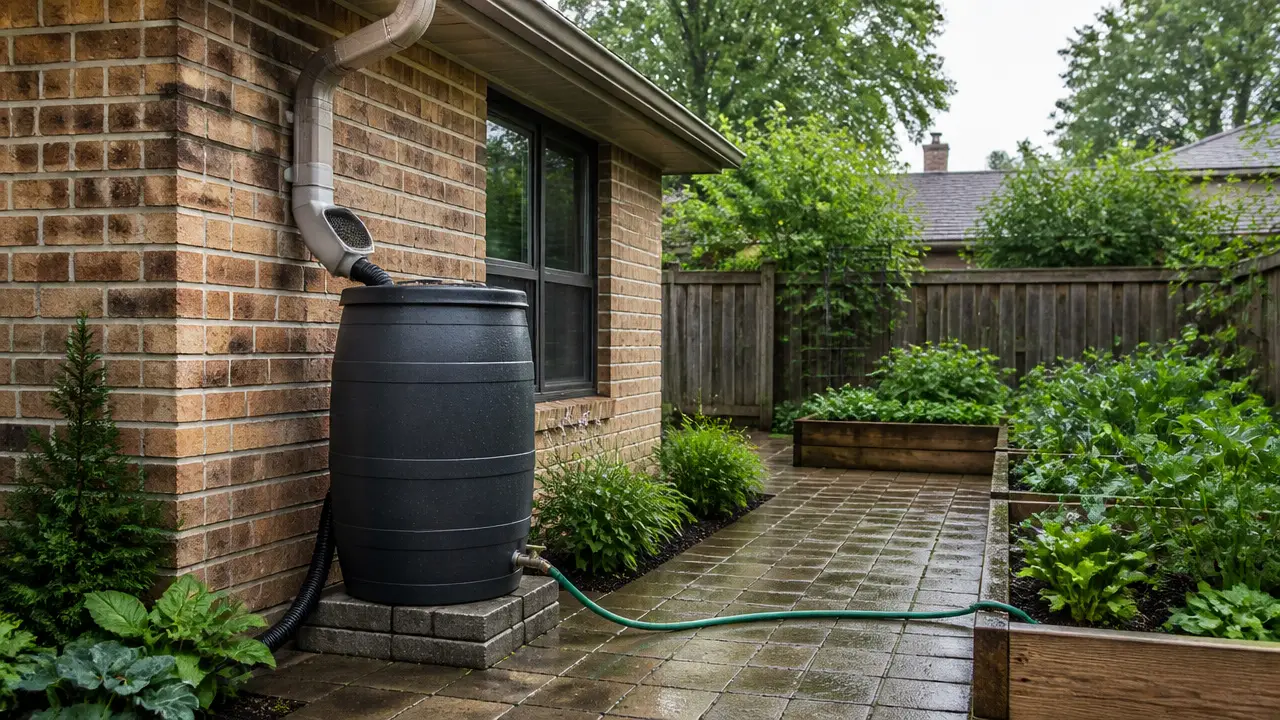
Rainwater collection tanks come in many sizes, from small barrels that hold a few dozen gallons to large cisterns that hold several thousand gallons. The right size depends on how much rain you can collect, how much water you use, how much space you have, and how long you want the stored water to last.
A bigger tank is not always better. An oversized tank may cost more, take up valuable space, and stay partly empty in a dry climate. A tank that is too small may overflow often and run dry between storms.
Common Rainwater Tank Sizes
Rainwater tanks can be grouped into several practical size ranges.
| Tank size | Typical use |
|---|---|
| 30-100 gallons | Small gardens, patios, hand watering |
| 100-300 gallons | Garden beds, greenhouse watering, limited outdoor use |
| 300-600 gallons | Larger gardens, multiple downspouts, small irrigation systems |
| 600-1,500 gallons | Regular landscape irrigation, cabins, larger roof areas |
| 1,500-5,000 gallons | Large gardens, household non-potable uses, long dry periods |
| 5,000+ gallons | Large properties, farms, whole-building systems, large seasonal storage |
These ranges are only starting points. Two homes with the same roof size may need very different tanks if one gets frequent rain and the other has a long dry season.
Small Rain Barrels: About 30 to 100 Gallons
Small rain barrels are usually the easiest way to start collecting rainwater.
They work well for:
- Watering container plants
- Filling watering cans
- Small garden beds
- Collecting water from a shed or garage
- Testing whether rainwater harvesting fits your needs
A common limitation is capacity. Even a modest roof can produce more runoff during one storm than a small barrel can hold.
For example, about 1 inch of rain falling on 100 square feet of roof represents roughly 62 gallons of water before losses. That means a small barrel can fill quickly.
Rain barrels should have a screened inlet, controlled overflow, and a secure cover that helps keep out mosquitoes, animals, and debris.
Medium Tanks: About 100 to 600 Gallons
Medium tanks are useful when a single rain barrel does not provide enough storage.
They may work well for:
- Vegetable gardens
- Raised beds
- Greenhouses
- Drip irrigation
- Several connected downspouts
- Moderate outdoor water use
A tank in this range may still fit beside a house, garage, or shed, although its dimensions matter just as much as its gallon capacity.
Check the tank's actual width, height, and outlet location before choosing a site. A tall, narrow tank may fit beside a wall where a round tank will not.
Large Tanks: About 600 to 1,500 Gallons
Tanks in this range provide more useful storage between storms.
They can be a good fit for:
- Larger gardens
- Small orchards
- Landscape irrigation
- Cabins
- Workshops
- Properties with several roof collection areas
At this size, the weight of the stored water becomes especially important.
Water weighs about 8.34 pounds per gallon. A full 1,000-gallon tank therefore contains more than 8,000 pounds of water, not including the weight of the tank itself.
The tank needs a stable base designed for the load. Follow the tank manufacturer's installation requirements. Do not place a large tank on a deck, raised platform, or questionable foundation without appropriate structural planning.
Very Large Tanks: About 1,500 to 5,000 Gallons
Large storage tanks are often used when rainwater is needed through longer periods without rain.
Uses may include:
- Large irrigation systems
- Livestock watering where appropriate
- Toilet flushing
- Laundry systems
- Other household non-potable uses
- Larger cabins or rural properties
Non-potable means water that is not intended for drinking.
Systems connected to building plumbing are more complicated than a basic garden tank. They may require pumps, backflow protection, separate piping, controls, treatment, and compliance with local plumbing rules.
Check local requirements before connecting rainwater to household plumbing.
Cisterns Over 5,000 Gallons
Large cisterns can hold thousands or even tens of thousands of gallons.
They are more common for:
- Large homes with significant rainwater demand
- Farms
- Commercial buildings
- Large irrigation systems
- Properties with long dry seasons
- Centralized collection from large roof areas
Large cisterns may be installed above ground or below ground.
Underground tanks require careful planning for soil conditions, excavation, groundwater, vehicle loads, access, venting, overflow, and maintenance. Excavation and confined-space hazards can make these installations unsuitable for casual DIY work.
Never enter a rainwater tank or cistern unless the work is handled under appropriate confined-space safety procedures.
IBC Tote Sizes
Intermediate bulk containers, commonly called IBC totes, are sometimes used for rainwater storage.
A common tote size is around 275 or 330 gallons, although other capacities exist.
Their rectangular shape can make them easier to place in some locations than round tanks.
If an IBC tote is being considered for rainwater storage, its previous contents matter. Do not assume a used container is suitable just because it looks clean. Containers that previously held unknown, hazardous, or unsuitable substances should not be used for storing water intended for household or food-related uses.
The container should also be protected from sunlight if its material allows enough light through to encourage algae growth.
How Much Rainwater Can Your Roof Collect?
Tank sizing starts with the amount of water available from the roof.
A useful U.S. estimate is:
Gallons collected = roof area in square feet × rainfall in inches × 0.623 × collection efficiency
The 0.623 factor converts one inch of rain on one square foot into gallons.
For example, suppose you have:
- 1,000 square feet of effective roof area
- 1 inch of rainfall
The theoretical runoff is:
1,000 × 1 × 0.623 = 623 gallons
You will usually collect less than the theoretical amount. Some water is lost through roof wetting, splash, leaks, gutter overflow, debris screens, and first-flush devices.
A first flush device diverts some of the first roof runoff from a storm because it may carry more dirt and debris.
Do not assume every inch of rainfall will produce the full theoretical yield.
Tank Size Should Match Your Water Use
Available rainfall is only half of the sizing problem. You also need to know how quickly you use the stored water.
Suppose a garden uses about 40 gallons per day.
A 300-gallon tank could theoretically provide:
300 ÷ 40 = 7.5 days
In practice, you may not want to plan on using every gallon. Outlet height, sediment space, pump requirements, and other system details may leave some water unavailable.
A household using rainwater for several purposes will usually need much more storage than someone watering a few garden beds.
Consider the Time Between Rainstorms
Two places receiving the same yearly rainfall may need very different tank sizes.
Imagine two locations that each receive 40 inches of rain per year.
One receives regular rain throughout the year.
The other receives most of its rain during a short wet season followed by several dry months.
The second location may need much more storage because the tank must carry water across the long dry period.
For tank sizing, monthly or seasonal rainfall patterns are often more useful than annual rainfall alone.
Roof Size Can Limit Useful Tank Capacity
A very large tank will not help much if the roof cannot supply enough water to fill it.
Examine choosing an appropriate rainwater tank size to compare available volume relative to demand and refill timing.
For example, a small shed roof may only produce a modest amount of runoff during normal storms. Connecting a 5,000-gallon tank to that roof could leave much of the storage unused.
On the other hand, a large house or barn roof may fill several hundred gallons of storage during a single storm.
Match the storage capacity to the collection area as well as your water demand.
Physical Tank Dimensions Matter
Tank capacity does not tell you whether the tank will actually fit your property.
Before choosing one, check:
- Diameter or width
- Length
- Height
- Access around the tank
- Distance from walls and property boundaries
- Downspout location
- Overflow route
- Pump and filter space
- Access for cleaning
- Delivery access
Slimline tanks can fit narrow spaces. Round tanks often provide a lot of capacity but need more ground area.
Underground tanks save surface space but require a tank specifically designed for burial and a suitable installation.
Think About Inlet and Outlet Connections
Tank fittings need to work with the rest of the rainwater system.
Check the size and location of the:
- Inlet
- Overflow
- Outlet
- Drain
- Vent
- Pump connection
A bulkhead fitting is a fitting that passes through the tank wall and creates a sealed connection for a pipe or valve.
An undersized overflow can become a problem during heavy rain. Once the tank fills, incoming water needs a safe route away from the tank, building foundation, and neighboring property.
Do not rely on the tank simply overflowing from an open lid.
Tank Height Affects Gravity Pressure
A raised tank can provide some water pressure without a pump, but the pressure is usually low.
The important measurement is head height, which is the vertical distance between the water level and the point where the water is being used.
Roughly 2.31 feet of water height produces 1 psi of pressure.
That means a tank with only a few feet of elevation may work for filling a watering can or feeding some low-pressure drip systems, but it may not provide enough pressure for standard sprinklers.
Do not choose a tall tank only for pressure without also considering stability and foundation requirements.
Should You Use One Large Tank or Several Small Tanks?
Either approach can work.
One large tank
A single tank can simplify:
- Plumbing
- Overflow management
- Pump installation
- Level monitoring
It also concentrates a lot of weight in one location.
Several smaller tanks
Multiple tanks may help when:
- Space is divided around a building
- Several downspouts need collection
- Access for a large tank is limited
- Storage will be expanded gradually
Connected tanks need properly designed plumbing. Small connection pipes can restrict how quickly water moves between tanks.
The tanks should also be installed on suitable level bases so unexpected height differences do not cause filling or overflow problems.
Allow Space for Overflow
A rainwater tank will eventually fill during a large enough storm.
Overflow planning is part of tank sizing.
The overflow should carry excess water to an appropriate drainage area without causing:
- Foundation problems
- Soil erosion
- Flooding
- Damage to neighboring property
- Unwanted standing water
A larger tank can reduce how often overflow occurs, but it cannot eliminate the need for a proper overflow system.
Consider Freezing Climates
Tank size alone does not determine whether a system can handle freezing weather.
Water expands as it freezes. Tanks, valves, pumps, filters, and exposed pipes may be damaged if water freezes inside them.
Some seasonal systems are drained before winter. Other installations require tank placement, insulation, buried piping, or other freeze-protection measures designed for the local climate.
Follow tank and equipment manufacturer guidance. Do not assume a large volume of water prevents freezing.
Storage Size Does Not Make Rainwater Safe to Drink
A larger tank gives you more storage. It does not improve water safety by itself.
Roof runoff can contain dirt, microorganisms, animal waste, roofing contaminants, and other pollutants.
If rainwater is intended for drinking, tank size is only one part of the system. Safe planning may involve suitable roof collection materials, debris control, first-flush management, protected storage, treatment stages, regular maintenance, current laboratory testing, and compliance with applicable health and plumbing requirements.
Do not assume a filter or UV unit alone makes stored rainwater potable.
Potable means suitable for drinking.
For drinking-water systems, consult current local health requirements and qualified water-treatment professionals where appropriate.
A Simple Way to Choose a Tank Size
A practical sizing process is:
- Decide what the water will be used for. Garden watering needs are very different from household reuse.
- Estimate your water demand. Work out roughly how many gallons you expect to use each day or week.
- Measure the roof collection area. Only include roof areas that actually drain into the system.
- Review local rainfall patterns. Monthly rainfall can show how long the tank may need to supply water between storms.
- Estimate collection yield. Account for real-world losses instead of using theoretical runoff alone.
- Check available space. Confirm tank dimensions, access, foundation needs, and delivery clearance.
- Plan the connections. Make sure inlets, outlets, pumps, filters, and overflow plumbing can work together.
- Plan for maintenance. Leave enough room to inspect, clean, repair, and eventually replace components.
For a simple garden system, these steps may be enough. Larger household or underground systems may benefit from professional design.
Frequently Asked Questions
What is the most common size for a rainwater tank?
There is no single standard size. Small garden systems often use tanks or barrels holding a few dozen to a few hundred gallons. Larger irrigation and household systems may use tanks holding 1,000 gallons or more.
Is a 55-gallon rain barrel big enough?
It can be useful for small gardens and container plants, but it fills quickly. About one inch of rain on 100 square feet of roof represents roughly 62 gallons before collection losses, so even a small roof can fill a 55-gallon barrel during a good storm.
Is a 1,000-gallon rainwater tank enough?
It may be enough for a moderate garden or some non-potable uses, depending on rainfall, roof area, and water demand. A 1,000-gallon tank could still run dry quickly if daily use is high or dry periods are long.
Can I connect several small tanks together?
Yes. Multiple tanks can be connected, but the plumbing needs to let water move between them at an adequate rate. The tanks also need stable bases and properly planned overflow connections.
How much does a full rainwater tank weigh?
Water weighs about 8.34 pounds per gallon. A tank holding 500 gallons contains about 4,170 pounds of water. A 1,000-gallon tank contains about 8,340 pounds, before adding the tank's own weight.
Should I buy the largest tank that fits?
Not necessarily. The best size balances roof runoff, rainfall patterns, water demand, available space, and installation needs. An oversized tank may rarely fill, while an undersized tank may overflow frequently and run dry between storms.
Are underground rainwater tanks available in different sizes?
Yes. Underground cisterns are available in many capacities, including very large sizes. Only tanks designed for burial should be installed underground. Soil conditions, excavation, groundwater, access, and structural loading need to be considered.
Does a larger tank keep rainwater cleaner?
Not automatically. Water quality depends on the collection surface, debris control, storage design, maintenance, contamination risks, and any required treatment. Tank capacity alone does not make rainwater safe for drinking.