As an affiliate, we may earn a commission from qualifying purchases. We get commissions for purchases made through links on this website from Amazon and other third parties.
Rainwater tanks come in many sizes, from small tanks that hold a few hundred gallons to large cisterns that hold several thousand gallons. For most homes and gardens, common capacities fall between about 200 and 5,000 gallons (750 to 19,000 liters).
The right size depends less on what is “standard” and more on your roof area, rainfall, available space, and how you plan to use the water.
Common Rainwater Tank Sizes
Rainwater storage can be grouped into a few practical size ranges.
| Tank size | Approximate liters | Common uses |
|---|---|---|
| 50–100 gallons | 190–380 L | Small gardens and patio watering |
| 200–500 gallons | 750–1,900 L | Garden irrigation and basic outdoor use |
| 500–1,000 gallons | 1,900–3,800 L | Larger gardens and regular rainwater collection |
| 1,000–2,500 gallons | 3,800–9,500 L | Irrigation, cabins, and larger roof areas |
| 2,500–5,000 gallons | 9,500–19,000 L | Large properties and higher water demand |
| More than 5,000 gallons | More than 19,000 L | Large-scale storage or whole-property systems |
These are general ranges rather than fixed industry standards. Tank makers often offer several capacities within each range.
Small Rainwater Tanks
Small tanks generally hold less than about 500 gallons.
They work well when you only want rainwater for jobs such as:
- Watering a few garden beds
- Filling watering cans
- Running a short drip-irrigation line
- Washing outdoor tools
- Collecting water from a shed or small roof
A small tank is easier to fit beside a house, garage, greenhouse, or shed. It also fills quickly during a good rain.
The disadvantage is that it can empty quickly during dry weather.
A 200-gallon tank, for example, may sound large until you start watering a vegetable garden several times each week.
Medium Rainwater Tanks
Tanks from roughly 500 to 2,500 gallons are common for homeowners who want more useful storage.
This range can make sense for:
- Medium or large gardens
- Drip irrigation
- Greenhouses
- Orchard watering
- Cabin water systems
- Other non-potable household uses where local rules allow them
Non-potable means water that is not intended for drinking.
Medium tanks need more planning than a small rain barrel. You need enough room for the tank, a stable base, an overflow route, and suitable connections.
You may also need a pump if gravity cannot provide enough water pressure.
Large Rainwater Tanks
Large tanks usually hold several thousand gallons.
They are useful when a property has:
- A large roof
- High irrigation demand
- Long dry periods
- Several buildings feeding one system
- A need to store water between major rain events
Large tanks may be installed above ground or underground.
As capacity increases, the weight becomes important. Water weighs about 8.3 pounds per U.S. gallon, so thousands of gallons create a very heavy load.
Large tanks need a properly prepared foundation or support system. Underground tanks also require careful excavation and must be designed for burial.
These jobs can go beyond a simple DIY installation.
What About IBC Totes?
IBC totes are also sometimes used for rainwater storage.
Common IBC tote capacities include roughly 275 and 330 gallons in the United States, although sizes and fittings vary.
One tote may work for a modest garden system. Some people connect several totes together to increase storage.
If you use an IBC tote, make sure you know what it previously contained. A container that held an unknown or unsuitable chemical should not be reused for water where contamination could create a risk.
Also check the outlet connection before buying fittings. IBC valve threads and adapters are not all interchangeable.
How Much Rainwater Can Your Roof Supply?
Tank size should match how much water your roof can actually collect.
In U.S. units, a useful starting estimate is:
Gallons collected = roof area in square feet × rainfall in inches × 0.623
For example, a 1,000-square-foot roof receiving 1 inch of rain has a theoretical yield of about:
1,000 × 1 × 0.623 = 623 gallons
You will normally collect somewhat less than the theoretical amount.
Water can be lost through:
- Gutter overflow
- Splashing
- Leaks
- A first-flush system
- Debris screens
- Water left on the roof and in plumbing
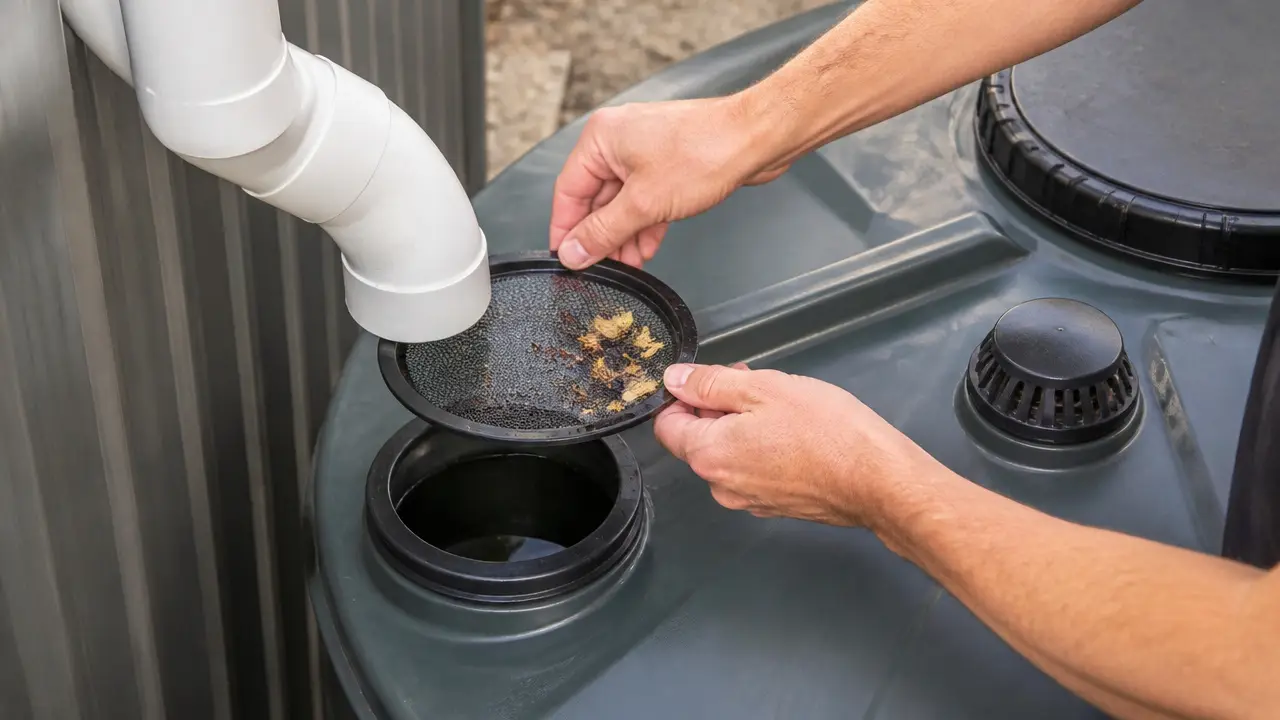
A first flush device diverts the first part of a rainfall away from the tank. That early runoff can carry dirt, leaves, bird droppings, and other material from the roof.
Tank Size Should Match Your Water Use
Collection is only one side of the calculation. You also need to know how quickly you use the stored water.
Suppose your roof could collect 600 gallons during a storm, but you normally use only 50 gallons each week. A huge tank may provide little extra benefit unless your area has long gaps between rain.
The opposite can also happen.
If your garden uses several hundred gallons each week, a small tank may empty long before the next rainfall.
A useful sizing process is to compare three things:
- How much rain your roof can collect.
- How much water you expect to use.
- How long you may need the stored water to last between rains.
Local historical rainfall records can help with this calculation.
Tank Dimensions Matter Too
Account for a suitable size water tank for a home to understand storage materials appropriate for the planned application.
Two tanks with the same capacity can have very different shapes.
You may find:
- Tall round tanks
- Short, wide tanks
- Slimline tanks
- Rectangular tanks
- Underground cisterns
- Modular tank systems
Measure your installation area before choosing a capacity.
Check more than the tank's basic width and height. Leave space for:
- The inlet
- Overflow pipe
- Outlet valve
- Filters or screens
- Pump connections
- Inspection openings
- Cleaning and maintenance
A tank that technically fits into a narrow space may still be difficult to service.
Check the Inlet, Outlet, and Overflow Size
Tank capacity is not the only size that matters.
The plumbing connections also need to fit your system.
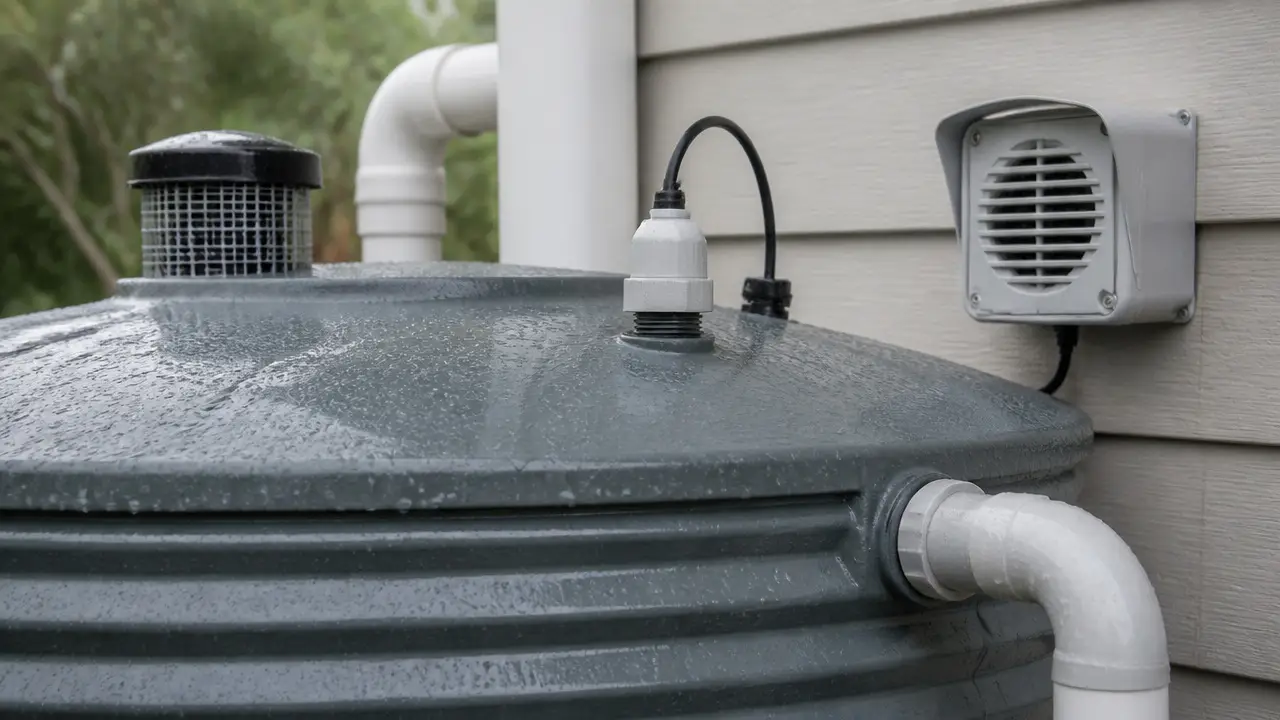
A tank typically needs an inlet for rainwater, an outlet for use, and an overflow for excess water.
The overflow is especially important. Once the tank is full, all new rainwater must have somewhere safe to go.
A poorly planned overflow can cause erosion, foundation problems, or standing water around the tank.
A bulkhead fitting is a fitting that passes through the tank wall and creates a sealed connection for a pipe or valve. If you add one yourself, it must be compatible with the tank material and installed where the tank manufacturer allows it.
Bigger Is Not Always Better
It can be tempting to buy the largest tank that fits your property.
That does not always produce a better system.
A very large tank can mean:
- More space used
- More difficult installation
- Greater foundation requirements
- More water sitting unused
- More difficult cleaning and inspection
On the other hand, a tank that is too small may overflow during nearly every storm and run dry between rains.
The best tank is usually one that balances collection, water demand, space, and rainfall patterns.
Remember Water Quality When Choosing Storage
A larger tank does not make rainwater cleaner.
Roof runoff can contain dirt, animal waste, insects, roofing material residue, microorganisms, and other contaminants.
For garden irrigation and other non-potable uses, screens and good tank maintenance may be important parts of the system.
Drinking-water use requires much more care. Do not assume stored rainwater is safe to drink because it looks clear.
A potable rainwater system should be treated as a complete water-safety system. That may involve suitable collection surfaces, debris control, first-flush management, treatment stages, current laboratory testing, routine maintenance, and compliance with applicable local requirements.
Potable means suitable for drinking.
If drinking water is the goal, qualified water-treatment or public-health guidance is appropriate.
How to Choose a Practical Tank Size
Start with your intended use.
For occasional garden watering, a few hundred gallons may be enough. For regular irrigation, a tank around 500 to several thousand gallons may make more sense.
Then check:
- Roof collection area
- Local rainfall pattern
- Expected weekly water use
- Length of dry periods
- Available installation space
- Tank dimensions
- Foundation requirements
- Inlet and overflow plumbing
- Pump requirements
- Freezing conditions
- Maintenance access
In freezing climates, exposed pipes, valves, pumps, and tanks may need special planning. Do not assume a tank or plumbing system can safely freeze while full.
For very large tanks, buried tanks, structural supports, pressure systems, or complex household plumbing, professional help may be appropriate.
Frequently Asked Questions
What is the most common rainwater tank size?
There is no single standard size. For residential systems, tanks from several hundred gallons to a few thousand gallons are common. The best capacity depends on roof area, rainfall, water use, and available space.
Is a 500-gallon rainwater tank enough for a garden?
It can be enough for many small or medium gardens, but irrigation demand varies widely. Plant type, weather, soil, irrigation method, and garden size all affect how quickly 500 gallons will be used.
How much rain does it take to fill a 1,000-gallon tank?
It depends on roof area. A 1,000-square-foot roof has a theoretical collection potential of about 623 gallons for every inch of rainfall. Actual collection will be lower because of normal system losses.
Can I connect several smaller tanks instead of using one large tank?
Yes. Multiple tanks can sometimes be connected to create more storage. The connections need to be sized and arranged so the tanks fill, drain, vent, and overflow properly. Each tank also needs adequate support.
Is a 275-gallon IBC tote large enough for rainwater collection?
A 275-gallon tote can be useful for a small garden or other limited outdoor uses. It may fill quickly from a large roof and may not provide enough storage for long dry periods.
Does a larger rainwater tank improve water pressure?
Not by itself. Gravity pressure mainly depends on the vertical height of the water above the outlet. A larger tank can hold more water, but a pump may still be needed when higher pressure is required.
Should I buy the largest rainwater tank I can afford?
Not necessarily. Choose capacity based on how much water your roof can supply, how much you use, the rainfall pattern, and your available space. Oversizing can add installation and maintenance needs without providing much benefit.