As an affiliate, we may earn a commission from qualifying purchases. We get commissions for purchases made through links on this website from Amazon and other third parties.
A rain barrel irrigation system can water garden beds, shrubs, and other plants without carrying water by hand. The basic setup is simple: collect roof runoff in a covered barrel, connect a hose or low-pressure irrigation line to the outlet, and let gravity move the water.
The main challenge is pressure. A rain barrel usually produces much less pressure than a household faucet. Your irrigation layout needs to work with that low pressure, or you will need a pump.
How a Rain Barrel Irrigation System Works
A basic system has four parts:
- A gutter and downspout collect rain from the roof.
- A screened inlet sends water into the barrel.
- The barrel stores the water.
- A hose or irrigation line carries water to the plants.
Water can leave the barrel by gravity or with help from a pump.
Gravity is the simplest option. It has no electrical parts and little to maintain. It works best when the garden is close to the barrel and the watering system does not need much pressure.
A pump is useful when you need to move water farther, uphill, or through equipment that needs more pressure.
Start With the Watering Job
Decide what you want the rain barrel to water before buying tubing, fittings, or irrigation parts.
Rain barrels work well for uses such as:
- Raised garden beds
- Flower beds
- Shrubs
- Trees
- Container plants
- Short low-pressure irrigation lines
The size of the garden matters. So does the distance between the barrel and the plants.
A small barrel beside one raised bed is a very different system from several barrels feeding irrigation lines across a large yard.
Also consider how quickly you want to use the water. A gravity system may deliver water slowly. That can be fine for irrigation as long as the system distributes it where you need it.
Choose a Good Location for the Barrel
Place the barrel close to both the downspout and the area you want to water.
The site should be firm and level. A full rain barrel is heavy, so do not place it on loose soil, an unstable stack of blocks, or a platform that was not designed for the load.
The barrel also needs a safe overflow path. Once it fills, additional rain must go somewhere.
Route overflow away from:
- Foundations
- Crawl spaces
- Basements
- Septic components
- Areas that already drain poorly
Do not block the original drainage system unless the replacement overflow can safely handle excess runoff.
Raise the Barrel Only When It Can Be Done Safely
Raising the barrel increases the pressure available to your irrigation system.
Water pressure from gravity increases by about 0.43 psi for every foot of vertical height between the water surface and the outlet below it.
For example, two feet of elevation adds less than 1 psi.
That explains why a rain barrel does not behave like a pressurized outdoor faucet. Even when the barrel is raised, the pressure is still fairly low.
Also remember that pressure changes as the barrel empties. A full barrel has a higher water level than an almost-empty barrel, so gravity pressure gradually drops during watering.
Never build an unstable platform just to gain pressure. The support must safely carry the full weight of the barrel, water, and hardware.
Install a Screened Rainwater Inlet
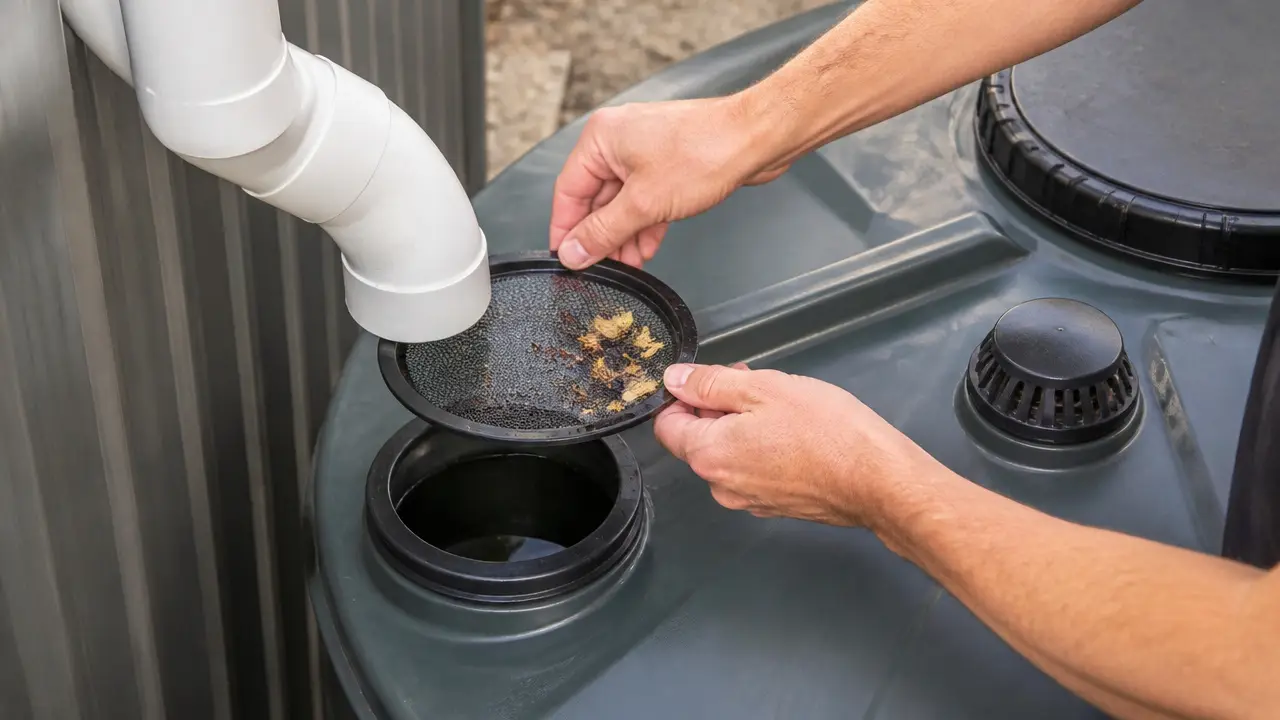
Roof runoff can carry leaves, twigs, insects, grit, bird droppings, and other debris.
Keep larger material out of the barrel with screens or other suitable prefiltration.
A typical collection path may include:
roof → gutter → debris screen → downspout → barrel
Some systems also use a first-flush device.
A first flush device diverts part of the first runoff from a storm before water enters the main storage tank. This can reduce some of the material washed from the roof at the start of rainfall. It does not make the stored water automatically safe to drink.
Keep all openings screened so mosquitoes and larger pests cannot easily enter the barrel.
Make Sure the Barrel Has a Proper Outlet
Many rain barrels have a threaded outlet or spigot near the bottom.
Other containers may use a bulkhead fitting.
A bulkhead fitting creates a sealed connection through the wall of a tank or barrel. It provides a secure place to attach valves, hoses, or pipe.
Check the connection size before buying irrigation parts. A common mistake is buying tubing first and discovering that it does not connect to the barrel outlet.
You may need:
- A shutoff valve
- A threaded adapter
- A hose adapter
- Irrigation tubing
- Clamps or suitable compression fittings
Use fittings intended for the tubing and connection type you have. Avoid forcing mismatched threads or relying on excessive tape or sealant to make incompatible fittings work.
Add a Filter Before Small Irrigation Passages
Stored rainwater often contains fine debris even when the barrel has an inlet screen.
That matters when water must pass through narrow irrigation openings.
A simple irrigation filter installed between the barrel and the distribution tubing can reduce clogging. The correct filter depends on the irrigation equipment downstream.
If a filter has a micron rating, that number describes the approximate size of particles it is intended to capture.
A smaller micron rating means finer filtration.
Filtration also creates resistance to flow. This is especially important in gravity systems because very little pressure is available to begin with.
Do not assume that adding several filters will automatically improve a rain barrel irrigation system. Fine filters that are not needed can reduce flow and require frequent cleaning.
Choose Irrigation That Can Work at Low Pressure
This is one of the most important parts of the setup.
Many irrigation products are designed to operate from a pressurized household water supply. A gravity-fed rain barrel may not provide enough pressure for them to work as intended.
Simple Open Tubing
One of the easiest approaches is to run tubing from the barrel and let water discharge through larger outlets near the plants.
This avoids very small passages that can clog or require higher pressure.
Drip Irrigation
Drip irrigation can work with rainwater, but do not assume every drip system will work directly from a barrel.
Some emitters and pressure-regulating components are designed for higher inlet pressure than a gravity-fed barrel provides.
If you want gravity-fed drip irrigation, choose components specifically suited to the available pressure and flow.
Soaker Hoses
A soaker hose may seem like an easy choice, but performance can be poor at very low pressure. Water may seep heavily near the barrel while little reaches the far end.
Results depend on the hose, length, elevation, and available pressure.
Sprinklers
Most conventional lawn sprinklers need considerably more pressure than a normal gravity-fed barrel can provide.
If your goal is sprinkler irrigation, a properly selected pump is usually more practical.
Keep the Irrigation Run Short and Simple
Every fitting and length of tubing adds resistance to water flow.
A gravity-fed system usually performs better when you:
- Keep tubing reasonably short
- Avoid unnecessary elbows and restrictions
- Limit very small tubing runs
- Avoid sending water uphill
- Divide large gardens into smaller watering zones
The diameter of the tubing matters too. Very narrow tubing can restrict the flow available from the barrel.
Do not judge the system only by the outlet size. The entire water path matters, including the valve, adapters, filter, tubing, elevation, and irrigation outlets.
Set Up the System Step by Step
1. Prepare a Stable Barrel Location
Choose a firm, level spot near the downspout.
If the barrel will be elevated, use a support designed for the full loaded weight. Make sure you can still reach the lid, screens, filter, and valves for maintenance.
2. Connect the Downspout
Direct rainwater into the barrel through a screened inlet or suitable downspout diverter.
Make sure the system can handle overflow when the barrel reaches capacity.
3. Install the Outlet Valve
Attach the valve or spigot using the connection method intended for the barrel.
Check for leaks before connecting the rest of the irrigation system.
4. Add the Irrigation Filter
Install a cleanable filter if your irrigation outlets can be clogged by sediment or debris.
Position it where you can remove and clean it without taking apart the entire system.
5. Connect the Main Irrigation Line
Run the line from the barrel toward the garden.
Avoid sharp bends, crushed tubing, and unnecessary uphill sections.
6. Add Distribution Lines
Split the main line where needed to reach individual beds or planting areas.
For a large garden, consider separate zones rather than trying to water everything from one long network.
7. Flush the Tubing
Before installing small outlets or closing line ends, allow water to flow through the tubing.
Flushing removes dirt and small pieces of material left from installation.
8. Test With the Barrel Partly Full
Open the valve and check the entire system.
Look for:
- Leaks
- Loose fittings
- Clogged outlets
- Uneven watering
- Very slow flow
- Water failing to reach distant plants
Also test the system as the barrel level drops. A layout that works with a completely full barrel may perform differently as the available pressure decreases.
When a Pump Makes Sense
Look closely at drip irrigation supplied by a rain barrel to compare vessel capacity and fittings within the available space.
A pump can solve problems that elevation alone cannot.
Consider a pump when you need to:
- Move water uphill
- Cover a larger garden
- Run equipment that requires more pressure
- Maintain more consistent flow
- Move water a long distance
Pump selection should be based on both flow rate and head height.
Flow rate is the amount of water the pump can move over time.
Head height describes the vertical lift and resistance the pump must overcome while moving water through the system.
Do not choose a pump based only on its maximum flow number. Pump output falls as the amount of head increases.
The pump also needs suitable connections, power, controls, and protection from running dry when the barrel empties.
Electrical equipment used around water should be installed and powered in a safe way. When permanent outdoor wiring or unfamiliar electrical work is required, use a qualified professional.
Do You Need a Pressure Regulator?
Not always.
Pressure regulators are common in drip irrigation connected to household water because normal plumbing pressure can be too high for the irrigation equipment.
A gravity-fed rain barrel has the opposite problem. Pressure is often already very low.
Adding an unnecessary regulator can make flow worse.
If you use a pump, however, pressure control may become necessary. Match any regulator or other control to the requirements of the irrigation equipment rather than automatically copying a faucet-fed drip setup.
Prevent Clogs
Clogging is one of the most common rainwater irrigation problems.
The best approach is to stop debris at several practical points instead of waiting until tiny irrigation outlets become blocked.
Keep:
- Gutters reasonably clean
- Inlet screens clear
- The barrel covered
- Irrigation filters clean
- Sediment from building up indefinitely in storage
- Open tubing ends capped or screened as appropriate
Inspect the system more often during periods of frequent use.
If flow suddenly drops, check the filter and barrel outlet before assuming the irrigation tubing has failed.
Keep the Barrel Covered
A rain barrel should not be an open container.
A secure cover helps keep out:
- Mosquitoes
- Leaves
- Animals
- Larger debris
- Accidental contact
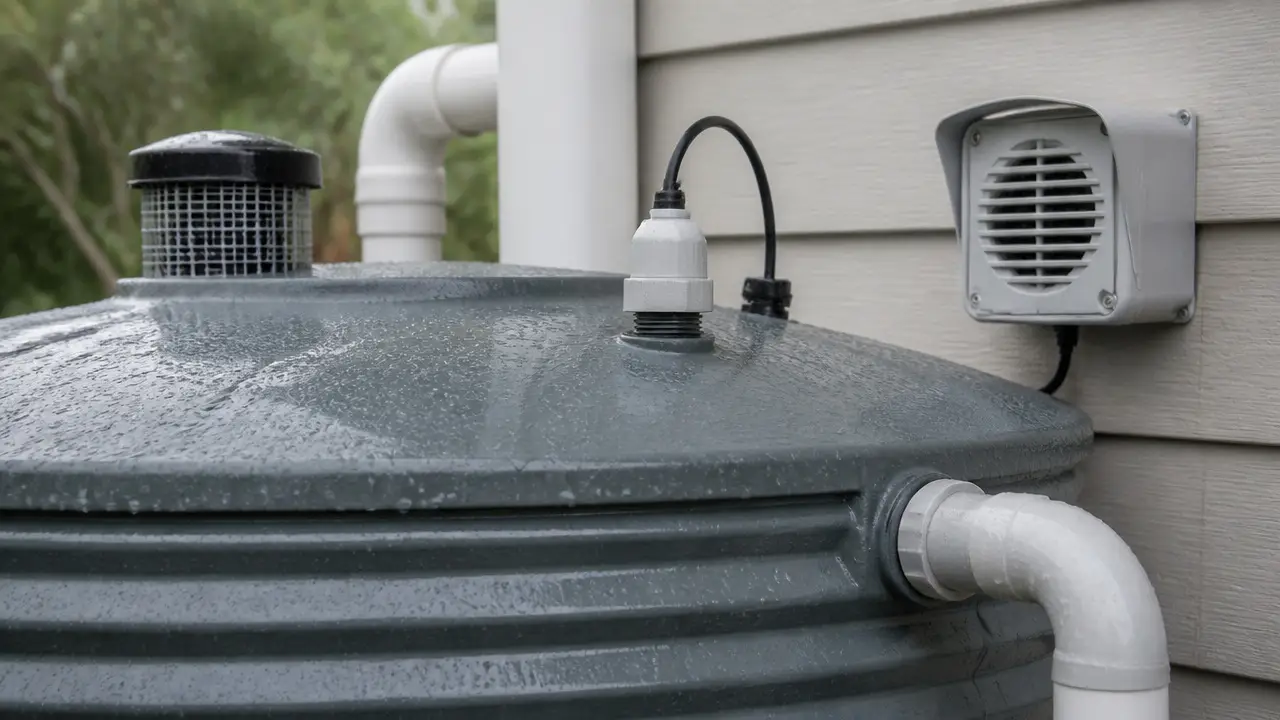
Screen ventilation and overflow openings as needed while still allowing the system to drain and breathe correctly.
Avoid creating a tightly sealed container unless it was designed to operate that way.
Be Careful When Watering Food Gardens
Roof runoff is not the same as treated drinking water.
Its quality can be affected by roofing materials, animal waste, airborne debris, chemicals, storage conditions, and other contamination sources.
For food gardens, a conservative approach is to deliver untreated rainwater to the soil rather than spraying it directly onto the edible parts of plants.
Local guidance may place additional limits on how collected rainwater can be used.
Do not assume that an irrigation filter makes roof runoff potable. A sediment filter may help protect irrigation equipment, but it does not provide a complete drinking-water treatment system.
Plan for Overflow
A barrel can fill quickly during a storm.
When the barrel is full, the irrigation line usually cannot dispose of incoming rain nearly as fast as a roof and downspout can collect it.
That means the barrel still needs a dedicated overflow route.
A good overflow setup sends excess water toward an appropriate drainage area without causing erosion or directing water toward the building.
If several barrels are connected, the final barrel still needs adequate overflow handling.
Consider Connecting Multiple Barrels
A second barrel can increase storage capacity when one barrel regularly fills before the garden needs the water.
Barrels can be connected in different ways, but the connections must allow water to move as intended without creating uncontrolled leaks or overflow.
If barrels are linked near the bottom, connections must remain watertight and protected from damage.
If they are linked near the top, water typically fills one barrel before overflowing into another.
The best arrangement depends on the barrel design, site elevation, and how you plan to draw water from storage.
Check How Much Water Your Garden Actually Gets
Do not judge irrigation by how long the valve stays open.
Look at the soil around the root area.
Water can behave differently in sandy, loamy, compacted, and clay soils. A slow system may work very well if the water reaches the root zone without running off.
Mulch can also help reduce evaporation and keep soil moisture more stable.
If one part of the system receives much more water than another, shorten the lines, divide the irrigation into zones, or reconsider the outlet layout.
Maintain the System
A rain barrel irrigation system is simple, but it is not maintenance-free.
During the Watering Season
Periodically:
- Clean inlet screens
- Check the filter
- Inspect tubing for leaks
- Check valves and connections
- Clear clogged irrigation outlets
- Check the overflow
- Look for mosquito access points
- Remove excessive sediment when needed
After Long Dry Periods
Inspect the stored water and system before restarting irrigation.
Debris may have settled around the outlet or collected in filters.
In Freezing Climates
Water trapped in barrels, valves, filters, hoses, and fittings can freeze and damage them.
Follow the barrel and irrigation-component manufacturer's winterizing instructions. Depending on the system and climate, that may mean draining and disconnecting parts before freezing weather.
Do not rely on insulation alone to guarantee that a water-filled barrel or exposed fitting will not freeze.
Common Problems
Water Barely Comes Out
Possible causes include:
- Low water level
- Too little elevation
- A clogged filter
- A blocked outlet
- Long or narrow tubing
- Too many fittings
- An uphill irrigation run
- Irrigation equipment that needs higher pressure
Start with the simplest checks. Disconnect the irrigation line briefly and check whether water flows freely from the barrel outlet.
Water Reaches the First Plants but Not the Last
The line may be too long or restrictive for the available gravity pressure.
Try dividing the garden into shorter zones.
Emitters Keep Clogging
Improve debris screening, clean the irrigation filter, flush the tubing, and inspect the barrel for sediment buildup.
Do not solve every clogging problem by installing an extremely fine filter. A finer filter can also reduce flow.
The Barrel Empties Too Quickly
Check for leaks first.
If there are none, the irrigation system may simply be using more water than the barrel stores. Divide watering into zones or reduce unnecessary discharge.
Additional barrels can increase stored supply, but only when the roof and rainfall provide enough runoff to refill them.
The System Works Only When the Barrel Is Full
That usually points to a low-pressure problem.
As the water level falls, gravity pressure falls with it. Shorter tubing, larger flow passages, fewer restrictions, or a suitable pump may help.
A Simple Gravity-Fed Layout
For a small garden, a practical setup might look like this:
roof → gutter → screened downspout connection → covered rain barrel → shutoff valve → irrigation filter → main tubing → garden distribution lines
Keep the layout simple at first.
Test one small watering zone before building a large network. It is much easier to find pressure, flow, and clogging problems in a short test line than after installing tubing across the entire garden.
Frequently Asked Questions
Can I connect drip irrigation directly to a rain barrel?
Sometimes. The drip components must be able to operate at the low pressure available from the barrel. Many drip systems made for household faucets need more pressure than a gravity-fed barrel supplies.
How high should a rain barrel be for irrigation?
Extra height increases pressure, but only gradually. Each foot of water elevation provides about 0.43 psi. Raise a barrel only on a stable structure designed to support its full loaded weight.
Do I need a pump for rain barrel irrigation?
Not for every system. A short, low-pressure gravity system may work without one. A pump becomes more useful when you need greater pressure, longer runs, uphill movement, or equipment that cannot operate on gravity pressure.
Should I install a filter between the barrel and irrigation line?
A filter is useful when debris could clog small irrigation passages. Choose one that suits the irrigation equipment and clean it regularly. Remember that every filter also adds resistance to flow.
Can I use a regular lawn sprinkler with a rain barrel?
A normal gravity-fed barrel usually does not provide the pressure expected by conventional lawn sprinklers. A suitable pump may be needed.
Can rain barrel water be used on vegetables?
Roof runoff can contain contaminants. A conservative approach is to apply untreated collected rainwater to the soil rather than directly spraying edible plant parts. Follow any applicable local guidance for rainwater use.
Why does my rain barrel irrigation slow down as the barrel empties?
Gravity pressure depends partly on the height of the water above the outlet. As the water level falls, the available pressure decreases, so flow through the irrigation system may also decrease.