As an affiliate, we may earn a commission from qualifying purchases. We get commissions for purchases made through links on this website from Amazon and other third parties.
Yes. Bluetooth water tank level indicators are available, including models made for rainwater tanks, freshwater tanks, RV tanks, and other water storage systems.
Instead of walking out to the tank and checking a sight tube or mechanical gauge, you can open an app on a nearby phone or tablet and see the estimated water level. Some systems also show tank percentage, estimated volume, history, or low-level alerts.
As of August 31, 2026, dedicated water-tank systems such as the Tank Level Pro Bluetooth are being sold for rainwater and general water tanks. Other Bluetooth sensors, including the Mopeka Pro Check Water sensor, use different sensing methods for suitable plastic or metal water tanks.
How a Bluetooth Water Tank Level Indicator Works
A Bluetooth tank monitor has two basic jobs:
- A sensor measures how much water is in the tank.
- A transmitter sends that reading to a nearby phone or tablet.
The important part is that Bluetooth describes the communication method, not the way the water level is measured.
Two Bluetooth tank gauges can look similar in an app but use very different sensors.
Submersible pressure sensors
A pressure sensor can sit near the bottom of the tank. It measures the pressure created by the water above it.
The deeper the water, the greater the pressure.
A controller converts that measurement into a water depth or percentage. You normally enter the tank height and capacity in the app so it can estimate how much water remains.
For example, the Tank Level Pro Bluetooth uses an internal transducer connected to an external Bluetooth unit. Its app lets the user enter tank information and calibrate the reading.
This type can work well for:
- Large rainwater tanks
- Corrugated tanks
- Cisterns
- Tanks with unusual shapes
- Some underground installations
The Bluetooth transmitter still needs to be positioned where its radio signal can reach your phone.
Through-wall ultrasonic sensors
Some sensors attach to the outside bottom of a tank and send ultrasonic signals through the tank wall.
Ultrasonic means the sensor uses sound waves above the range people can hear.
The Mopeka Pro Check Water sensor is one example. It attaches beneath a suitable flat-bottom water tank and sends readings to the Mopeka app using Bluetooth Low Energy. The manufacturer information supplied for the water version specifies compatible flat-bottom plastic or metal water tanks within its stated height limits.
This approach has one useful advantage: the sensor does not need to hang inside the stored water.
However, tank material, wall thickness, tank shape, mounting surface, and maximum water depth can all affect compatibility.
External non-contact sensors
Some smaller freshwater tank monitors place a sensor against the outside of the tank rather than inside the water.
For example, Bluetooth freshwater systems are currently sold for plastic RV and boat tanks. Some are designed around specific tank shapes and electrical systems rather than large household rainwater tanks.
That is why a device described simply as a "Bluetooth water level sensor" should not automatically be assumed to fit a 5,000-gallon cistern or an IBC tote.
Bluetooth Does Not Usually Mean Internet Monitoring
This is one of the biggest points to understand before buying.
A basic Bluetooth tank monitor normally communicates directly between the tank transmitter and your phone.
If you leave home, the phone may no longer be close enough to receive the reading.
That is different from a Wi-Fi or cellular tank monitor.
| System | Typical use |
|---|---|
| Bluetooth | Check the tank while you are nearby |
| Wi-Fi | Check the tank through your home or property network |
| Cellular | Monitor remote tanks where cellular service is available |
| RF with indoor display | Send tank readings to a dedicated display rather than a phone |
Some Bluetooth systems can be connected to an optional Wi-Fi gateway. For example, Mopeka offers a bridge that can forward compatible sensor readings through Wi-Fi, while Fully Tanked Up also offers separate remote-connectivity options for its tank monitoring system.
If you only want to check a tank from the house, Bluetooth may be enough.
If you want to check a cabin tank while you are hundreds of miles away, Bluetooth alone is usually the wrong connection method.
How Far Will Bluetooth Reach?
Do not choose a tank monitor based only on its advertised maximum Bluetooth range.
Actual range depends heavily on the installation.
A signal may need to pass through:
- A steel water tank
- A shed wall
- Concrete
- Earth around an underground cistern
- Trees
- Vehicles
- House walls
Metal is particularly important because it can block or weaken radio signals.
One current dedicated rainwater monitoring system specifies an initial Bluetooth connection range around 50 meters, but that does not mean every property will achieve that distance.
Think about where the transmitter will sit and where you normally plan to check the level.
A tank 30 feet from a kitchen window is a much easier Bluetooth installation than an underground concrete cistern 150 feet behind a metal barn.
What to Check Before Buying a Bluetooth Tank Gauge
The best sensor is not simply the one with the most app features. It must physically work with your tank.
Tank material
Find out whether the sensor supports:
- Polyethylene
- Fiberglass
- Steel
- Stainless steel
- Concrete
An external sensor designed to read through plastic may not work correctly through steel.
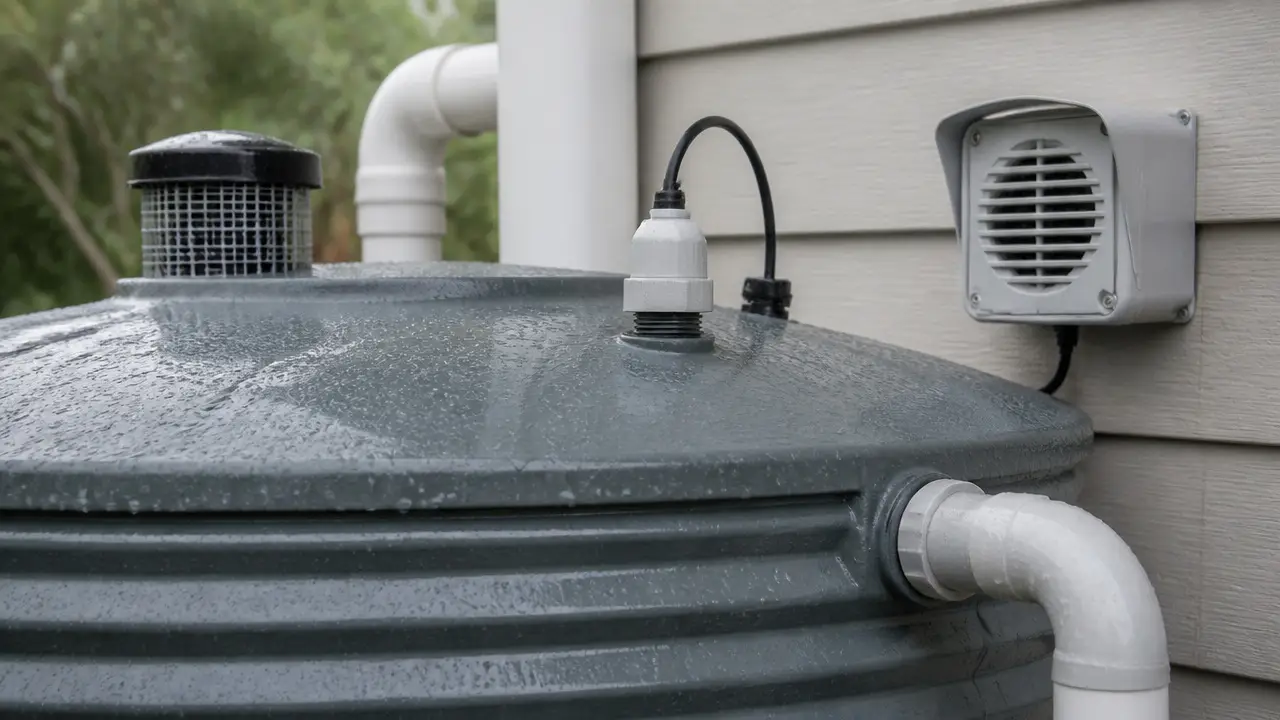
Some systems solve this problem by putting the measuring sensor inside the tank while keeping the Bluetooth transmitter outside.
Tank height
Check the sensor's supported measuring depth.
A sensor designed for a shallow RV freshwater tank may not measure a tall household cistern correctly.
Do not assume the manufacturer's "tank capacity" tells you everything. Two tanks can hold the same amount of water while having very different heights.
Tank shape
An app may estimate gallons or liters from the measured water depth.
That calculation is easy for a simple vertical cylinder or rectangular tank. It becomes more complicated for:
- Horizontal cylindrical tanks
- Tapered tanks
- Irregular underground cisterns
- Joined tanks
Check whether the app lets you enter your actual tank dimensions or shape.
Otherwise, the water-depth reading may be useful while the calculated volume is not.
Sensor mounting
Find out exactly where the sensor goes.
It may require:
- A hole through the tank lid
- A sensor lowered into the water
- A fitting through an existing opening
- Attachment under the tank
- Attachment to an outside wall
For example, installation instructions for the Tank Level Pro describe routing its sensor through an existing opening on some corrugated tanks or making an opening in the upper tank area where necessary.
Explore practical considerations for there an app that can measure water levels to compare the benefits and drawbacks at this design stage.
Avoid drilling a tank until you understand the manufacturer's installation method. A poorly placed hole can create leaks, allow insects or debris into the tank, or weaken part of the tank.
Power source
Bluetooth tank monitors may use replaceable batteries, vehicle DC power, or another power source.
Battery-powered units are convenient for remote rainwater tanks because there is no electrical cable to run.
However, batteries still need inspection and replacement.
Cold weather can also reduce battery performance.
Weather protection
A water tank sensor may spend years outside.
Check the manufacturer's specifications for exposure to:
- Rain
- Direct sun
- Heat
- Freezing weather
- Condensation
Do not assume that a water-level sensor is waterproof simply because it measures water.
The part that goes underwater and the Bluetooth transmitter may have very different environmental limits.
Can You Use One on a Rainwater Tank?
Yes, provided the sensor is compatible with the tank.
A Bluetooth level monitor can be useful when a rainwater tank is difficult to see into or when checking it manually is inconvenient.
It can help you decide whether you have enough stored water for:
- Garden irrigation
- Toilet flushing
- Washing
- Livestock watering
- Other non-potable uses appropriate for your system
A level monitor tells you how much water you have. It tells you nothing about whether that water is safe for a particular use.
It does not measure bacteria, viruses, chemicals, sediment, or other contaminants.
For drinking-water applications, water safety still depends on the entire collection and treatment system, suitable materials, maintenance, current laboratory testing, and applicable local requirements.
What About IBC Totes?
Bluetooth monitoring is possible on an IBC tote, but check the installation method carefully.
A standard IBC has a relatively shallow plastic inner container surrounded by a metal cage.
That cage can affect wireless signals, and some external sensors may need a flat mounting area that the tote does not provide.
Before buying, check:
- Whether the sensor supports polyethylene tanks
- Minimum and maximum tank depth
- Required sensor location
- Whether the metal cage affects the sensor or Bluetooth signal
- How the app calculates volume
For a single garden IBC that is easy to walk past, a simple mechanical level indicator may be enough.
Bluetooth becomes more useful when the tote is hidden behind a building, part of a larger irrigation setup, or difficult to inspect.
What About Underground Cisterns?
An underground tank presents a different problem.
The level sensor may work perfectly while the Bluetooth connection does not.
Soil, concrete, steel covers, and tank construction can greatly reduce radio range.
A system that keeps its Bluetooth transmitter above ground is generally easier to use than one trying to transmit from inside a buried tank.
The Tank Level Pro documentation, for example, describes underground-tank use with the sender positioned above ground.
For a tank far from the house, Wi-Fi with a suitable network connection, cellular monitoring, or another long-range system may make more sense than Bluetooth.
Bluetooth vs. a Traditional Wireless Tank Gauge
Traditional wireless gauges are still useful.
Many use a tank sensor and a separate indoor LCD display instead of a smartphone.
Choose Bluetooth when you prefer:
- Phone-based readings
- App history
- Multiple tank profiles
- Easy percentage or volume estimates
- No separate indoor display
A traditional wireless display can be better when:
- Several people need to see the tank level
- You do not want an app
- Phones are not always nearby
- You want a permanent display in the house
Neither approach is automatically more accurate. Accuracy depends mainly on the measuring sensor, installation, tank dimensions, and calibration.
Is a Bluetooth Tank Monitor Worth Installing?
It can be.
Bluetooth monitoring makes the most sense when you regularly need to know how much stored water remains but the tank is inconvenient to inspect.
It is particularly useful for a large rainwater tank where the level affects decisions about garden watering or other household water use.
It is less useful when the tank is easy to see, the level rarely matters, or you need true remote monitoring from outside the property.
The main buying decision should therefore be:
First choose a sensor that works with your tank. Then choose Bluetooth if nearby phone access fits the way you want to monitor it.
Frequently Asked Questions
Are Bluetooth water tank level indicators actually available?
Yes. Dedicated Bluetooth water-level systems are available for rainwater tanks, freshwater tanks, RV tanks, and other storage tanks. They use a phone or tablet app to display the sensor reading.
Can I check my rainwater tank level from inside my house?
Possibly. Bluetooth may work through normal walls over a reasonable distance, but tank material, building construction, metal objects, and distance can reduce the signal. Check the manufacturer's range specifications and consider the actual path between the tank and your house.
Can Bluetooth show my tank level when I am away from home?
Not by itself. Standard Bluetooth requires you to be within radio range. Some systems support a Wi-Fi gateway or another remote connection that forwards the reading to the internet.
Do I have to put a sensor inside the water?
Not always. Some systems use a submerged pressure sensor. Others attach an ultrasonic or non-contact sensor to the outside of a compatible tank. The correct method depends on the tank material, depth, shape, and sensor design.
Will a Bluetooth sensor work on a metal water tank?
Some will, but not every type will. A sensor designed to read through a plastic tank wall may not work through metal. Systems using an internal pressure sensor or another suitable measurement method may be a better fit.
Can one app monitor several rainwater tanks?
Some Bluetooth systems allow multiple tank sensors to be added to the same app. Check the manufacturer's stated limit and whether you must be close enough to each sensor to receive its Bluetooth signal.
Is a Bluetooth water level monitor accurate enough to show gallons or liters?
It can estimate volume if the sensor accurately measures water depth and the app has correct tank dimensions. Irregular tank shapes can make volume estimates less precise. Treat the displayed volume as a monitoring tool rather than an exact custody measurement unless the system is designed and calibrated for that purpose.
Does a Bluetooth tank monitor tell me whether rainwater is safe to drink?
No. A tank-level sensor only measures the amount of water stored. It does not establish microbiological or chemical water quality and should not be treated as a drinking-water safety test.