As an affiliate, we may earn a commission from qualifying purchases. We get commissions for purchases made through links on this website from Amazon and other third parties.
DIY gutter work often looks simple: hang a channel along the roof edge, connect a downspout, and send the water away. Most problems come from small setup errors that affect drainage, leaks, roof protection, or rainwater collection.
The most common DIY gutter mistakes are using the wrong slope, installing too few supports, placing downspouts poorly, sealing joints incorrectly, and sending water too close to the foundation. For rainwater harvesting, undersized outlets, poor screening, and badly placed tank connections can cause extra problems.
1. Installing Gutters Without Enough Slope
Gutters need a slight slope toward the downspout so water can drain.
A gutter that is perfectly level may hold standing water. A gutter that slopes the wrong way can send water toward the opposite end.
Too much slope can also be a problem. It may look uneven along the roofline and does not necessarily improve drainage.
The important part is consistent fall toward each outlet. Check the manufacturer's installation guidance for the gutter system you are using rather than guessing at the slope.
For long roof sections, one downspout at one end may not be the best layout. Dividing the run between two drainage points can sometimes work better.
2. Using Too Few Gutter Hangers
Gutter hangers support the weight of the gutter and the water inside it.
Spacing them too far apart can allow the gutter to sag. Once a low spot develops, water collects there instead of reaching the downspout.
The load can become much greater when gutters contain:
- Wet leaves
- Ice
- Snow
- Standing water
- Debris
Follow the gutter manufacturer's recommended hanger spacing. Areas that receive heavy snow or ice may need a more conservative installation.
Do not assume the gutter itself is strong enough to bridge long gaps between supports.
3. Attaching Gutters to Weak or Damaged Fascia
The fascia is the board along the lower edge of many roofs. Gutter hangers are often attached to it.
If that board is rotten, split, loose, or badly damaged, adding a gutter does not solve the problem. The fasteners may eventually pull out.
Check the mounting surface before installation.
Soft wood, peeling material, previous water damage, or loose sections should be investigated and repaired first. Significant roof-edge or fascia damage may be better handled by a roofer or carpenter.
4. Putting the Gutter in the Wrong Position
A gutter must be positioned so runoff from the roof actually enters it.
Mounting it too far away from the roof edge can let water pass behind or between the roof and gutter. Mounting it incorrectly relative to the roof covering can create other drainage problems.
The exact placement depends on the roof and gutter design.
Do not force flashing, shingles, or roof-edge materials out of position just to make the gutter fit. Improper changes at the roof edge can create leaks that are much harder to fix than a gutter problem.
5. Using Too Few Downspouts
A large gutter does little good if the outlets and downspouts cannot move water away fast enough.
During heavy rain, an overloaded gutter may overflow even when it is clean.
Downspout needs depend on several factors, including:
- Roof drainage area
- Local rainfall intensity
- Gutter size
- Outlet size
- Number of roof sections feeding the gutter
- Length and layout of the gutter run
For a rainwater harvesting system, this matters twice. The gutter must carry the roof runoff, and the piping after the downspout must also be able to move that water toward storage.
A narrow fitting downstream can become the bottleneck.
6. Sending Downspout Water Next to the Foundation
A downspout that ends directly beside the house can concentrate roof runoff where you may least want it.
Water should normally be directed to a suitable drainage location away from the building, subject to the site's grading and local drainage requirements.
Simply adding a short elbow at ground level may not be enough.
Watch where the water goes after leaving the downspout. It should not immediately flow back toward the foundation, basement, crawl space, neighboring property, or another problem area.
If drainage around the home is already poor, professional assessment may be worthwhile.
7. Forgetting About Overflow
Every gutter and rainwater system needs somewhere for excess water to go.
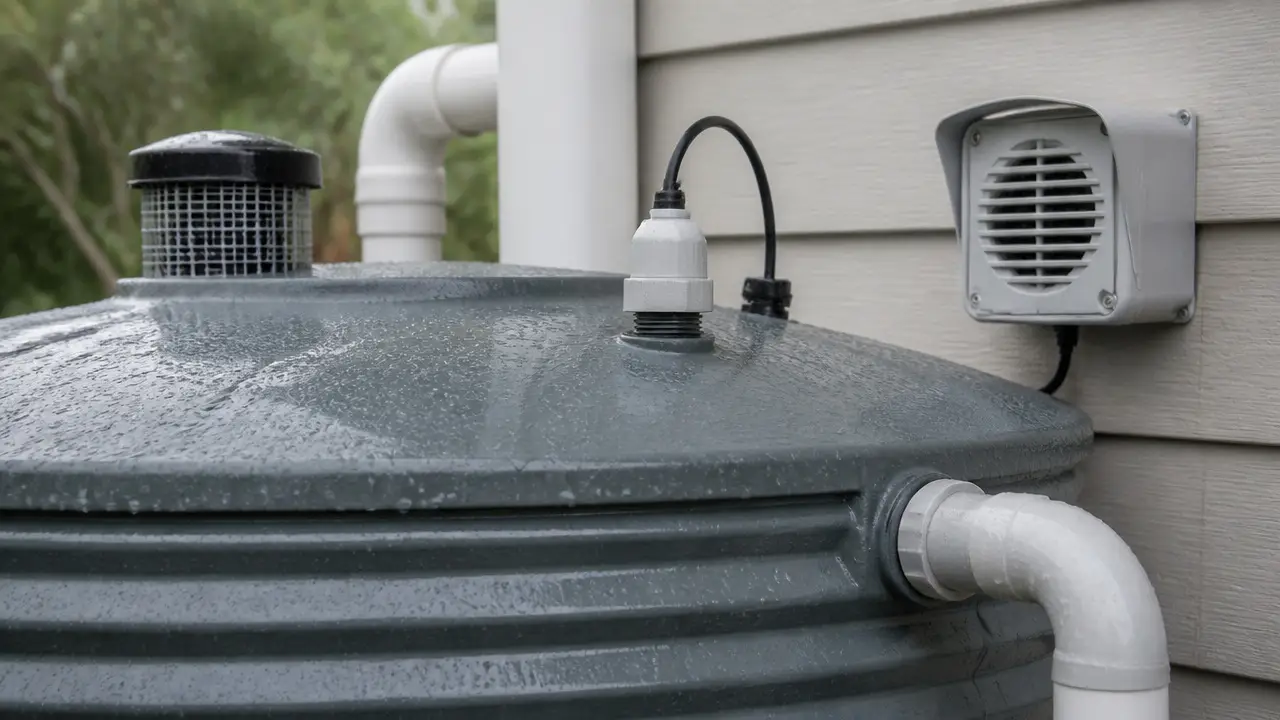
During a storm that exceeds the system's capacity, water will find another route. Without a planned overflow path, it may spill behind the gutter, beside the foundation, or over the top of a storage tank.
For rain barrels and cisterns, the overflow connection is especially important.
An overflow should be large enough to handle incoming water and discharge to an appropriate location. A tiny overflow tube on a system receiving a large roof area can become a restriction.
8. Sealing Gutter Joints Poorly
Leaks often appear at:
- End caps
- Corners
- Outlet fittings
- Section joints
- Downspout connections
One common mistake is assuming that more sealant always means a better joint.
Good sealing starts with properly fitting parts and clean surfaces. Sealants also have material and application requirements. A sealant intended for one type of construction may not perform well on another gutter material.
Follow the gutter manufacturer's joining and sealing instructions.
Do not rely on sealant to compensate for badly aligned sections or oversized gaps.
9. Mixing Incompatible Gutter Parts
Not every gutter component fits every system.
Nominal sizes can be misleading. Two products may both be described with similar dimensions but use different profiles, connector shapes, outlet styles, or fastening methods.
Check compatibility before buying:
- Gutters
- Corners
- End caps
- Hangers
- Outlets
- Downspouts
- Elbows
- Downspout adapters
This becomes especially important when connecting the downspout to rainwater harvesting equipment.
A gutter outlet, rectangular downspout, round pipe, first-flush device, and tank inlet may all require different adapters.
10. Creating Too Many Sharp Downspout Turns
Every elbow changes the direction of the water and creates another place where leaves and debris can collect.
A complicated downspout route may also be harder to clean.
Use a simple route where practical. If bends are unavoidable, make sure the system can still be inspected and cleared.
This is particularly important when the downspout feeds buried pipe or a rainwater tank. A blockage hidden behind several elbows can be difficult to locate.
11. Ignoring Leaves and Roof Debris
Gutters carry much more than water.
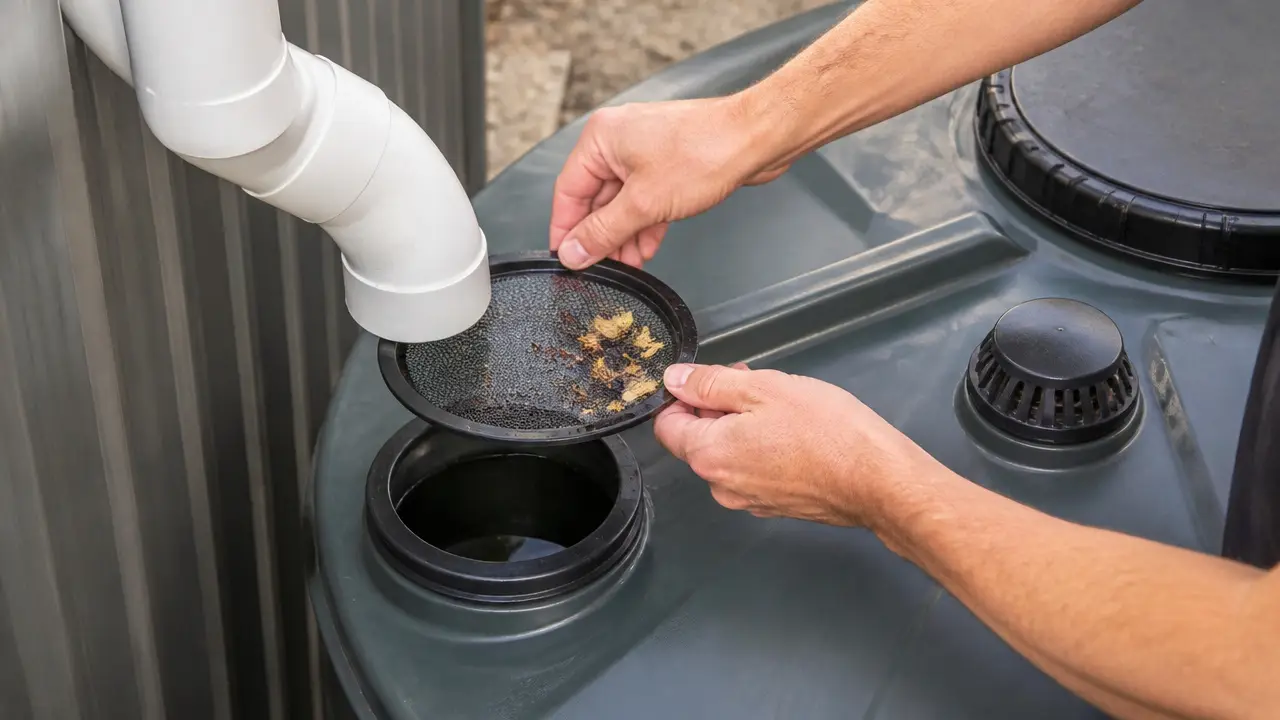
Leaves, needles, seeds, roofing grit, insects, and other debris can enter the system. Without reasonable debris control and cleaning, gutters and outlets can clog.
For installing a DIY rain chain without gutters, first evaluate the drainage path linking roof runoff with storage.
Screens and guards can reduce some debris, but they do not make gutters maintenance-free.
They also need to match the conditions around the house. Fine screens may catch small material but can clog themselves. Larger openings may pass more debris downstream.
Inspect the whole water path instead of assuming that a gutter guard eliminates maintenance.
12. Treating a Gutter Screen as Water Treatment
This mistake matters when gutters feed a rain barrel or cistern.
A leaf screen removes larger debris. It does not make roof runoff clean or safe to drink.
Roof runoff can contain material from:
- Birds and other animals
- Roofing surfaces
- Dust
- Pollen
- Smoke and airborne pollution
- Leaves and organic matter
A first-flush diverter is sometimes used to divert an initial portion of runoff that may contain concentrated roof debris. It can be one useful collection-stage measure, but it does not make water potable.
Potable means suitable for drinking. Non-potable means it is not intended or established as drinking water.
Using rainwater for drinking requires a suitable collection system, treatment designed for the water and intended use, proper maintenance, current laboratory testing, and compliance with applicable local requirements.
13. Making the Tank Inlet the Narrowest Part of the System
A DIY rainwater system may have a good gutter and large downspout but then reduce the water through a small hose or fitting before it reaches the tank.
That restriction can cause water to back up during strong rain.
Look at the entire path:
roof → gutter → outlet → downspout → debris control → diversion equipment → pipe → tank inlet
Water movement is limited by restrictions along that route, not simply by the largest component.
Check the opening sizes and flow path before building the system.
14. Forgetting Mosquito Protection
Open downspouts, tanks, and poorly screened overflows can provide access for insects.
Rainwater storage should be designed so mosquitoes cannot easily enter and breed.
Use suitable screening on openings where required, and keep lids and access covers securely fitted. Screens still need inspection because damaged or clogged mesh may stop working as intended.
Do not leave an open barrel beneath a downspout.
15. Ignoring Winter Conditions
Water trapped in gutters, downspouts, hoses, valves, and rain barrels can freeze.
Freezing water expands and may damage components.
Cold-climate systems need a winter plan. Depending on the setup, that may involve draining, disconnecting, bypassing, or protecting vulnerable components according to their design.
Also consider snow and ice loads on the gutter itself.
Do not assume a rain barrel or filter is freeze-safe simply because it is outdoors.
16. Putting Heavy Loads on the Gutter
Gutters are designed to carry runoff, not to serve as structural supports.
Avoid using them as attachment points for equipment unless the specific system is designed for that purpose.
Extra loads can distort the gutter or pull the mounting hardware away from the building.
This is particularly important with large hoses, rigid pipes, filters, or first-flush devices connected to a downspout. Support heavy components independently when their installation instructions call for it.
17. Building a System That Cannot Be Cleaned
A good gutter installation should be serviceable.
Common DIY problems include placing joints where they cannot be reached, permanently sealing sections that need cleaning, or running pipes through inaccessible areas.
Before finishing the installation, think about how you will:
- Remove gutter debris
- Clear a blocked outlet
- Open downspout sections
- Clean screens
- Service a first-flush device
- Inspect tank inlets
- Clear overflow piping
A slightly simpler system that is easy to maintain often works better over time than a complicated system that is difficult to access.
18. Working on the Roof Without Enough Safety Planning
Gutter installation involves one risk that has nothing to do with water: falling.
Much of the work occurs at roof-edge height. Reaching sideways from a ladder, working on unstable ground, carrying long gutter sections while climbing, or working near overhead electrical lines can be dangerous.
Follow proper ladder safety practices and equipment instructions. Avoid roof-edge work that exceeds your experience or safe access.
A professional installer is a better choice when the gutters are unusually high, the ground is uneven, power lines are nearby, the roof edge is damaged, or the job requires working directly on a steep roof.
A Simple DIY Gutter Check
Before calling the job finished, follow the water from beginning to end.
Check that:
- Roof runoff enters the gutter.
- The gutter slopes toward its outlets.
- Hangers provide adequate support.
- Joints and end caps do not leak.
- Outlets are not obvious restrictions.
- Downspouts have a clear path.
- Water leaves the building safely.
- Rainwater tanks have suitable inlet screening and overflow.
- Every important part can still be inspected and cleaned.
A controlled water test can reveal low spots, leaks, poor drainage, and connection problems before the next storm.
Frequently Asked Questions
Should DIY gutters be perfectly level?
Usually no. Gutters generally need a slight, consistent slope toward their downspouts so water drains instead of sitting in the channel. Follow the gutter manufacturer's installation guidance for the required fall.
Why does my gutter hold water after it rains?
Common causes include insufficient slope, a sag between hangers, a blocked outlet, or debris in the gutter. Check the physical alignment and drainage path rather than simply adding another downspout.
Why does water overflow a clean gutter?
The gutter, outlet, or downspout may not have enough capacity for the amount of roof runoff arriving during heavy rain. A restriction farther downstream can also cause water to back up.
Can I connect a rain barrel directly to a downspout?
You can route downspout water to a rain barrel designed for that purpose, but the setup should include appropriate debris control, mosquito protection, and a safe overflow path. Make sure the fittings and water-flow capacity are compatible.
Do gutter guards mean I never have to clean my gutters?
No. Guards may reduce some debris, but gutters, screens, outlets, and downspouts still need inspection and cleaning. The maintenance frequency depends heavily on nearby trees and roof conditions.
Is rainwater from a clean gutter safe to drink?
A clean-looking gutter does not establish that collected rainwater is safe to drink. Roof runoff may contain microorganisms, chemicals, and other contaminants that cannot be judged by appearance. Drinking-water use requires a suitable whole-system approach to collection, treatment, maintenance, laboratory testing, and applicable local requirements.
When should I hire a professional instead of installing gutters myself?
Professional help is sensible when the work involves a high or steep roof, difficult ladder access, nearby electrical lines, damaged fascia or roof edges, complicated drainage, or installation conditions you cannot safely handle from proper access equipment.