As an affiliate, we may earn a commission from qualifying purchases. We get commissions for purchases made through links on this website from Amazon and other third parties.
Plastic water tanks can use several types of fittings, including bulkhead fittings, threaded adapters, flanges, hose barbs, camlock fittings, valves, unions, overflow fittings, and pipe adapters.
The right fitting depends on what you want the connection to do. A garden outlet may only need a valve and hose adapter. A pump line may need a larger threaded outlet, union, and shutoff valve. An overflow usually needs a large fitting that can move water away as fast as it enters the tank.
Just as important, the fitting must match the tank wall, pipe size, thread type, and intended water use.
Common Fittings for Plastic Water Tanks
Bulkhead fittings
A bulkhead fitting, sometimes called a tank fitting, passes through a hole in the tank wall and creates a sealed connection.
A typical bulkhead fitting has:
- A fitting body
- A gasket
- A locking nut
- Internal or external threads for connecting pipe
Bulkhead fittings are commonly used for:
- Tank outlets
- Inlets
- Overflow lines
- Drain connections
- Level tubes
- Pump suction lines
They are useful when a plastic tank does not already have a connection where you need one.
The tank wall normally needs to be reasonably flat around the hole so the gasket can seal evenly. Curved, ribbed, or heavily textured sections can make sealing difficult.
Do not assume any part of a tank is safe to drill. Tank makers often provide designated fitting areas or specific instructions.
Molded threaded outlets
Many water tanks come with an outlet already molded or installed near the bottom.
This is often the best place to connect:
- A valve
- A pump
- An irrigation line
- A drain hose
Factory outlets reduce the need to cut another hole in the tank.
Check the outlet carefully before buying adapters. You need to know both its diameter and thread standard.
A fitting that appears to be the right size can still have incompatible threads.
NPT and BSP Threads
Two common pipe-thread systems are NPT and BSP.
NPT stands for National Pipe Thread and is common in the United States.
BSP stands for British Standard Pipe and is widely used in many other countries and on some imported tanks and equipment.
They are not automatically interchangeable.
Even when an NPT and BSP fitting seem to screw together, the thread shape or pitch may be different. Forcing mismatched threads can damage plastic fittings or create leaks.
Before buying an adapter, confirm:
- Nominal pipe size
- Male or female thread
- NPT or BSP thread standard
This is especially important when connecting a tank to pumps, valves, filters, or irrigation equipment from different manufacturers.
Flanged Tank Fittings
A flange creates a connection using broad mating surfaces rather than relying only on threaded pipe.
Flanged connections are often found on larger tanks and larger pipe systems.
They can be useful for:
- High-flow outlets
- Large pump connections
- Commercial irrigation systems
- Large cistern plumbing
A gasket sits between the mating flange surfaces and bolts hold the connection together.
Flanges can support larger pipe sizes better than small threaded fittings, but the tank and flange still need proper support. Heavy valves, pumps, or long pipes should not hang from a plastic tank wall without support.
Hose Barb Fittings
A hose barb has raised ridges that grip flexible tubing or hose.
They are convenient for small water lines such as:
- Garden hoses
- Drip irrigation supply
- Transfer hoses
- Level-indicator tubes
The hose normally slides over the barb and is secured with an appropriate clamp when required.
Make sure the hose's inside diameter matches the barb size.
A 1-inch barb, for example, is generally intended for hose with about a 1-inch inside diameter rather than a 1-inch outside diameter.
Hose barbs are simple, but they may become restrictive when a system needs high flow.
Camlock Fittings
Camlock fittings allow hoses and pipes to be connected and disconnected quickly.
Instead of threading the fitting together each time, two cam arms lock the connection.
They can be useful when you frequently:
- Connect a transfer pump
- Move water between tanks
- Attach a temporary irrigation line
- Fill or drain an IBC tote
- Connect a tanker or transfer hose
Camlocks come in several configurations with male, female, threaded, or hose-tail ends.
The nominal size still needs to match the rest of the system.
A large camlock attached through a much smaller tank outlet will not increase the amount of water that can pass through the smaller restriction.
Compression Fittings
Compression fittings connect certain types of plastic pipe without requiring glued or threaded joints.
They are commonly used with polyethylene water pipe and irrigation pipe.
A compression fitting may connect a tank outlet to:
- Underground water pipe
- Irrigation mains
- Garden supply lines
- Pump plumbing
The fitting must match the pipe's outside diameter and pipe type.
Do not select compression fittings based only on a rough measurement. Pipe identified by nominal size can have dimensions that differ between systems and regions.
PVC and Poly Pipe Adapters
Plastic tanks are often connected to PVC or polyethylene pipe.
Adapters allow you to change between connection styles such as:
- Male thread to socket
- Female thread to socket
- Thread to compression
- Thread to hose barb
- Thread to camlock
These adapters make it possible to build a tank connection without changing the tank fitting itself.
For example, a common arrangement might be:
Tank outlet → threaded adapter → valve → union → PVC pipe
A polyethylene irrigation line might instead use:
Tank outlet → threaded adapter → valve → compression fitting → poly pipe
The exact arrangement depends on pipe type, pressure, and how often you need to disconnect the system.
Unions
A union lets you separate a pipe connection without cutting the pipe.
This small fitting can make tank systems much easier to maintain.
A union is especially useful near:
- Pumps
- Filters
- Valves
- Tank outlets
- Equipment that may need winter removal
Without a union, servicing a pump or valve may require cutting and rebuilding part of the plumbing.
A union normally has three main sections that tighten together to form a sealed joint.
Shutoff Valves
Most tank outlets benefit from a shutoff valve.
The valve lets you stop water flow before working on downstream equipment.
Common options include:
Ball valves
Ball valves are widely used because they open and close with a quarter turn.
They work well for:
- Tank drains
- Pump isolation
- Irrigation supply
- General water control
A full-port ball valve has an opening close to the size of the connecting pipe, which helps reduce flow restriction.
Gate valves
Gate valves use an internal gate that moves up and down.
They can provide a relatively open flow path when fully opened, but they normally take several turns to operate.
For many small residential rainwater systems, a ball valve is simpler.
Garden Hose Adapters
A garden hose adapter is useful when tank water will be used directly for hand watering.
A typical setup might be:
Tank outlet → shutoff valve → garden hose adapter
Be aware that ordinary garden hose threads are different from standard pipe threads.
Use the correct adapter rather than forcing a hose fitting onto a pipe thread.
Also remember that water pressure from a tank depends largely on the height of the water above the outlet. A low rain barrel may provide enough flow for filling a watering can but not enough pressure for equipment designed around household water pressure.
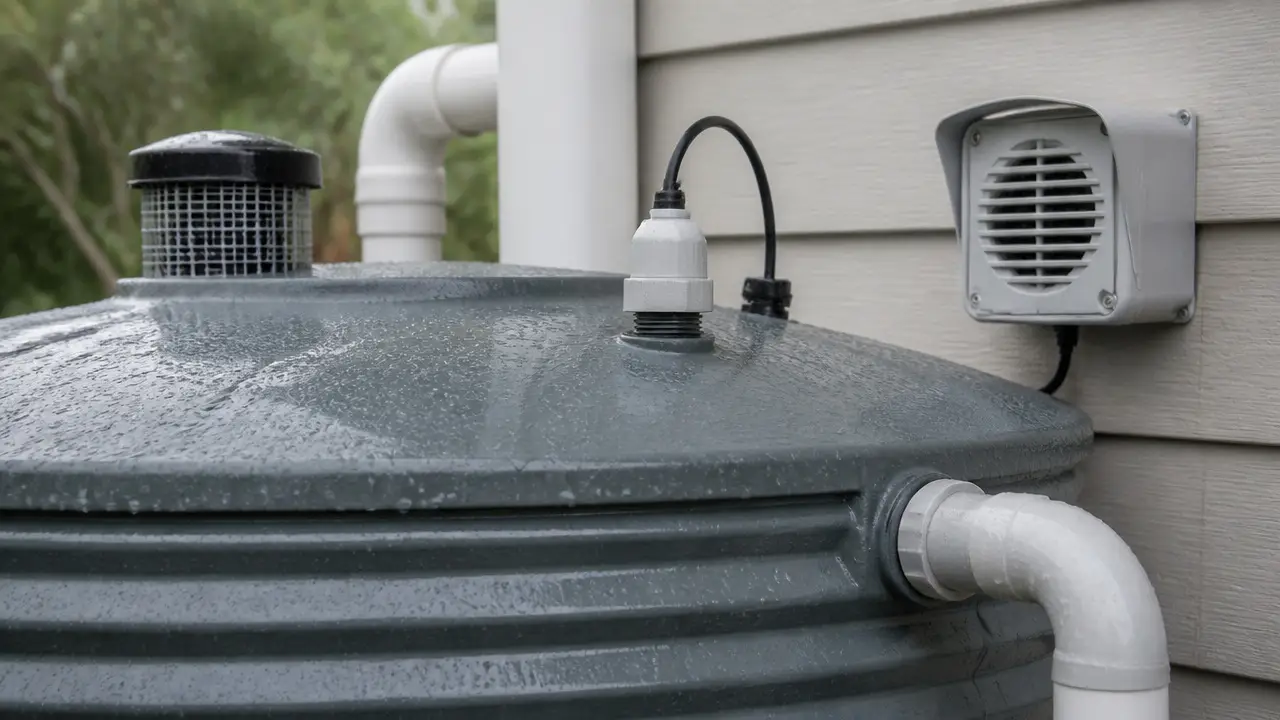
Overflow Fittings
An overflow fitting allows excess water to leave the tank once it reaches a certain level.
It may include:
- A bulkhead fitting
- Pipe or flexible hose
- An insect screen
- An elbow or downward-facing outlet
Overflow capacity matters.
If the overflow pipe cannot carry water away as quickly as the roof and gutters send it into the tank, water may back up or spill from unintended places.
The overflow should discharge somewhere that will not cause erosion, foundation problems, flooding, or repeated pooling around the tank base.
Inlet Fittings
Tank inlets can be simple pipe connections or larger screened openings.
Consider rain barrel and tank plumbing to compare cleaning access that supports sediment and odor management.
Depending on the collection system, an inlet may connect to:
- A downspout
- A rain head
- A prefilter
- A first-flush device
- Transfer pipe from another tank
A first flush device diverts some of the initial roof runoff before water enters the tank. That early runoff can carry accumulated debris and contaminants from the roof.
The inlet should not become a bottleneck during heavy rain.
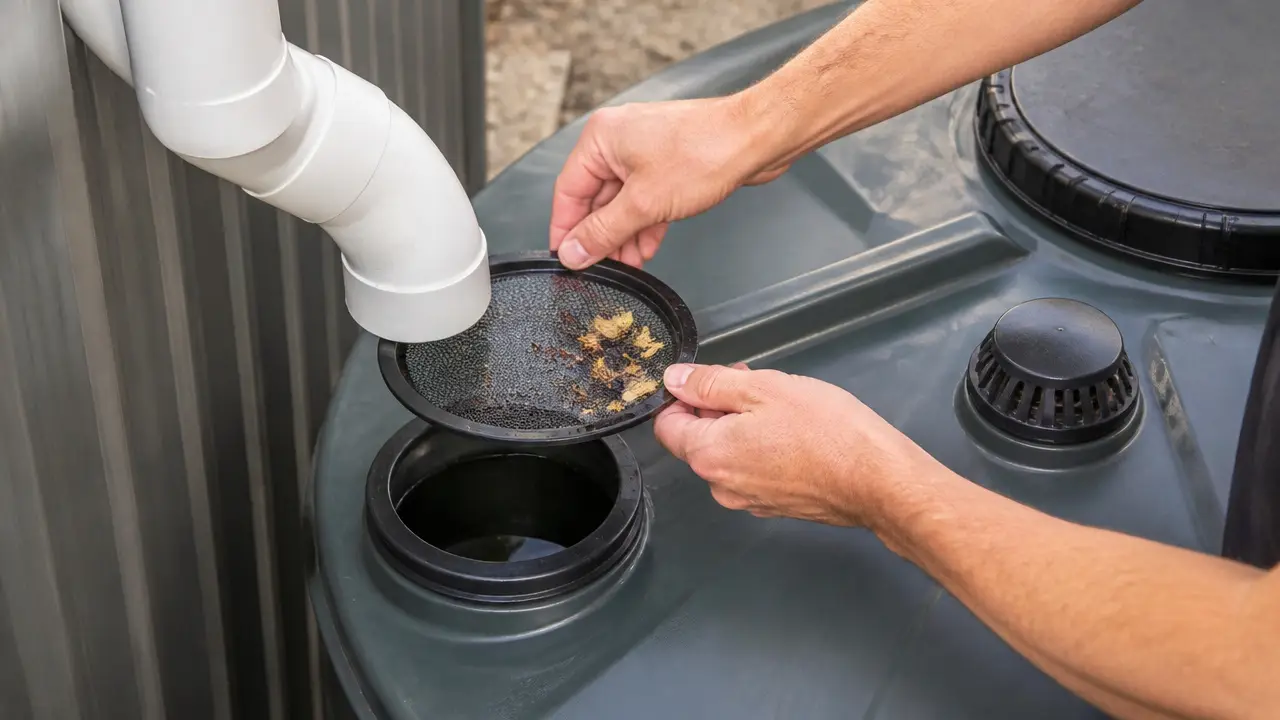
Tank Screens and Strainers
Screens are often installed at tank openings to help keep out:
- Leaves
- Large debris
- Insects
- Small animals
A screen is useful, but it is not a complete water-treatment system.
It removes relatively large material. It does not make roof runoff safe to drink.
Screens also need cleaning because accumulated debris can restrict flow.
Tank-to-Tank Connectors
Multiple tanks can be connected so they fill or drain together.
Common connections use:
- Bulkhead fittings
- Flexible hose
- Poly pipe
- PVC pipe
- Unions
- Isolation valves
Connecting tanks near their bottoms can allow water levels to equalize.
The connecting pipe should be large enough for the needed transfer rate. A very small connection between two large tanks may cause one tank to fill or empty much faster than water can move between them.
Flexible sections can also help when tanks may move slightly as they fill and empty.
Do not rigidly connect tanks in a way that transfers excessive stress into their walls.
IBC Tote Fittings
IBC totes often have larger outlet valves with threads that do not match ordinary household plumbing.
Adapters are available that convert some IBC outlets to:
- Garden hose thread
- NPT pipe thread
- BSP pipe thread
- Camlock fittings
- Hose barbs
- Poly pipe connections
IBC outlet designs vary, so measure and identify the actual valve before buying an adapter.
Do not assume every tote uses the same thread.
For harvested-water use, also consider what the tote previously contained. A used container with an unknown or unsuitable history should not be assumed safe for water use simply because a new fitting can be attached.
Spin-Weld Fittings
Some polyethylene tanks can use fittings installed by a process called spin welding.
The fitting is rapidly rotated against the tank wall. Friction generates heat that fuses compatible plastic surfaces together.
This method can create a strong permanent connection when performed correctly with suitable materials and equipment.
It is not the same as installing a threaded bulkhead fitting.
For a homeowner adding a connection to an existing tank, following the tank manufacturer's approved fitting method is safer than assuming a tank can be spin welded.
What Materials Are Tank Fittings Made From?
Common fitting materials include:
- Polypropylene
- Polyethylene
- PVC
- ABS
- Nylon
- Stainless steel
- Brass
Material choice depends on the water, pressure, environment, and connected plumbing.
For ordinary non-potable rainwater systems, several plastic fitting materials may work well when they are compatible with the tank and pipe.
For drinking-water systems, fittings, seals, pipe, storage tanks, and other wetted components need to be suitable for that intended use. A fitting being physically compatible with a tank does not by itself make the complete rainwater system suitable for potable water.
Potable means suitable for drinking. Non-potable means water intended for uses other than drinking, such as some irrigation or cleaning applications.
Gaskets and Seals
The gasket is one of the most important parts of a tank fitting.
Common gasket materials include different types of rubber and elastomers.
The correct gasket depends on:
- Fitting design
- Stored liquid
- Temperature
- Intended water use
- Manufacturer requirements
Installing extra sealant is not always the solution to a leaking bulkhead fitting.
Leaks can also come from:
- A crooked fitting
- An uneven tank wall
- A damaged gasket
- A damaged sealing surface
- Incorrect tightening
- Cracked threads
- Stress from unsupported pipe
Bulkhead gaskets should normally be installed according to the fitting manufacturer's instructions rather than rearranged based on guesswork.
How to Choose the Right Fitting Size
Start with the amount of water you need to move.
Small connections may be fine for:
- Filling watering cans
- Drip irrigation
- Level tubes
Larger connections may be needed for:
- Pump suction
- Tank transfers
- Large irrigation systems
- Rapid drainage
- Overflow handling
The smallest part of the water path can restrict the whole system.
For example, connecting a 2-inch pipe to a 3/4-inch tank outlet still leaves the 3/4-inch outlet as a major restriction.
Also check the fitting's actual internal opening. Two fittings sold under the same nominal pipe size can have different internal passages.
What Should Connect to a Pump?
A typical tank-to-pump arrangement may include:
Tank outlet → full-port valve → union → pump suction line
Some systems also require strainers, check valves, or other components depending on pump design.
The suction line should be sized according to the pump manufacturer's requirements rather than simply matching whichever tank fitting is easiest to find.
Pump performance depends on both flow and pressure requirements.
Flow rate is how much water moves during a period of time, such as gallons per minute.
Head height describes the vertical height and system resistance a pump must work against. Higher lifts and greater pipe resistance generally make the pump work harder.
Do not reduce the pump's inlet size unless its manufacturer allows it. A restricted suction line can contribute to poor performance and pump problems.
Do Plastic Tank Fittings Need Pipe Support?
Yes, especially when the connected plumbing is heavy.
Plastic tank walls should not be expected to support the full weight of:
- Long pipe runs
- Large valves
- Pumps
- Filters
- Heavy metal fittings
Support the plumbing independently where needed.
This becomes more important as fitting and pipe size increases.
Flexible connectors can sometimes reduce stress caused by movement or alignment differences, but they still need to be appropriate for the water system.
Can You Add a New Fitting Anywhere on a Plastic Tank?
Usually not.
Before drilling a tank, check its manufacturer's instructions.
Potential problems include:
- Reinforcing ribs
- Strongly curved walls
- Thin sections
- Areas that cannot be reached from inside
- Structural stress
- Molded features
- Insufficient clearance for the fitting nut
- Warranty restrictions
A large hole in the wrong location can weaken the tank or create a connection that will not seal properly.
If the tank has a factory connection that can do the job, using that outlet is often the simpler choice.
A Practical Way to Plan Tank Connections
Before buying fittings, trace the water path from the tank to its final use.
For example:
Roof → inlet → tank → outlet → valve → pump → filter → irrigation line
Then identify every point where the connection changes.
Check:
- Tank fitting size
- Thread standard
- Male or female thread
- Pipe material
- Pipe diameter
- Required flow
- Pump connection size
- Valve size
- Need for a union
- Need for flexible pipe
- Overflow size
- Freeze exposure
Planning the entire path prevents a common problem: buying several fittings that individually look correct but will not connect to each other.
Frequently Asked Questions
What is the best fitting for a plastic water tank?
A bulkhead fitting is one of the most common choices when adding an outlet or inlet to a plastic tank. Factory-installed outlets are usually preferable when they already provide the location and size you need.
Can I screw PVC fittings directly into a plastic water tank?
Sometimes. The tank outlet and PVC adapter must have compatible thread sizes and thread standards. Do not force fittings together. An NPT fitting, BSP fitting, and garden hose fitting may all have different threads.
What fitting should I use for a rain barrel hose?
A common setup uses a bulkhead or factory outlet, a shutoff valve, and a garden hose adapter. Make sure the hose adapter matches standard garden hose thread rather than ordinary pipe thread.
What fitting should I use between a water tank and pump?
Many systems use a tank outlet followed by a full-port shutoff valve, union, and appropriately sized pump suction pipe. Follow the pump manufacturer's inlet-size and suction-piping requirements.
Can I connect two plastic water tanks together?
Yes. Tanks can be connected with bulkhead fittings and suitable hose or pipe so water can move between them. The connection needs enough flow capacity, and the piping should not place excessive mechanical stress on either tank.
Do bulkhead fittings need sealant?
The main seal on many bulkhead fittings is provided by a gasket. Thread sealant may still be needed on threaded plumbing connected to the fitting, depending on the fitting type. Follow the manufacturer's instructions rather than applying sealant to every surface.
Are all IBC tote fittings the same size?
No. IBC tote valves and thread styles vary. Identify the outlet diameter, thread type, and valve design before ordering an adapter.
Can tank fittings be used for drinking water?
Only if the individual components are suitable for potable-water use and the complete collection, storage, treatment, testing, and maintenance system is appropriate for drinking water. A potable-rated fitting alone does not make harvested rainwater safe to drink.