As an affiliate, we may earn a commission from qualifying purchases. We get commissions for purchases made through links on this website from Amazon and other third parties.
What Diameter Should a Rainwater Tank Overflow Pipe Be?
A rainwater tank overflow pipe should be large enough to carry away water as fast as it can enter the tank during heavy rain.
For many home rainwater tanks, 3-inch to 4-inch (about 75 to 100 mm) overflow pipe is a practical range. A 4-inch or 100 mm overflow is common on larger tanks and systems receiving water from several roof downpipes.
There is no single correct diameter for every tank. The overflow size depends mainly on:
- How much roof drains to the tank
- How hard rain can fall in your area
- The size and number of inlet pipes
- The length and slope of the overflow pipe
- Bends, screens, and fittings that can restrict flow
- Local plumbing and stormwater requirements
A good basic rule is not to make the overflow smaller than the system's inlet capacity. Australian roofwater harvesting guidance, for example, says overflow pipes should at least match the combined inflow pipe capacity. Some local design rules go further. One New South Wales council guideline requires a minimum 100 mm overflow for the systems covered by that guideline.
Local requirements can differ, so do not treat 100 mm as a universal rule.
Why Overflow Pipe Size Matters
The overflow starts working when the tank is full. At that point, almost every extra gallon or liter entering the tank must leave through the overflow.
An undersized overflow can cause water to back up.
That can lead to:
- Water spilling around the tank lid
- Water backing into inlet pipes
- Gutters or downpipes overflowing
- Water collecting around the tank base
- Erosion near the tank
- Water being directed toward a house foundation
- Extra stress on tank fittings
The problem is most likely during a short, heavy storm. Annual rainfall does not tell you much about overflow sizing. What matters is the peak flow during intense rain.
Common Overflow Pipe Sizes
These sizes are useful starting points, not universal design requirements.
| Rainwater setup | Typical overflow size to consider |
|---|---|
| Small rain barrel | About 1.5 to 2 inches (40 to 50 mm) |
| Tank collecting one downspout | About 3 to 4 inches (75 to 100 mm) |
| Larger household rainwater tank | About 4 inches (100 mm) is common |
| Several downpipes feeding one tank | Size for their combined peak flow |
| Large cistern or commercial catchment | Hydraulic sizing may be needed |
A small rain barrel may work with a 2-inch overflow because its catchment area is often small.
A 2-inch pipe is much less suitable when several large downpipes feed a tank. The tank may fill slowly during light rain but receive a very large amount of water during a thunderstorm.
Tank capacity itself does not fix this problem. Once a 500-gallon tank and a 5,000-gallon tank are both full, the overflow still has to handle the incoming roof runoff.
Should the Overflow Be the Same Diameter as the Inlet?
It should generally be at least large enough to handle the full inlet flow.
Avoid feeding a tank through a large inlet and then installing a much smaller overflow without checking its capacity.
For example, a system may have a 4-inch inlet pipe carrying water from several downpipes. Reducing the overflow to 1.5 or 2 inches can create a bottleneck.
Multiple inlets need extra attention. Two pipes do not automatically have the same flow capacity as one pipe whose diameter equals their combined diameters. Pipe capacity depends on cross-sectional area, slope, water depth, fittings, and other hydraulic factors.
For a simple home system, using a generously sized overflow is often easier than trying to make a small pipe work at its limit.
Roof Area and Rainfall Determine How Much Water Can Arrive
You can estimate the maximum amount of roof runoff entering a tank with:
Flow in liters per second = rainfall intensity in mm/hour × roof area in m² ÷ 3,600
For example, suppose:
- Roof area draining to the tank = 100 m²
- Heavy-rain intensity = 100 mm/hour
The theoretical runoff rate is:
100 × 100 ÷ 3,600 = about 2.8 liters per second
That is about 168 liters per minute.
Real systems have losses, but an overflow should not depend on those losses to prevent flooding.
When sizing drainage, use the design rainfall intensity required for your area, not average monthly or yearly rainfall. Local building, plumbing, or stormwater authorities may specify what rainfall intensity must be used.
For a large roof, several downpipes, underground pipework, or a system where an overflow could damage a building, having the drainage sized by a qualified professional is sensible.
Pipe Diameter Is Not the Only Restriction
A large pipe can still overflow poorly if the rest of the installation restricts it.
Screens
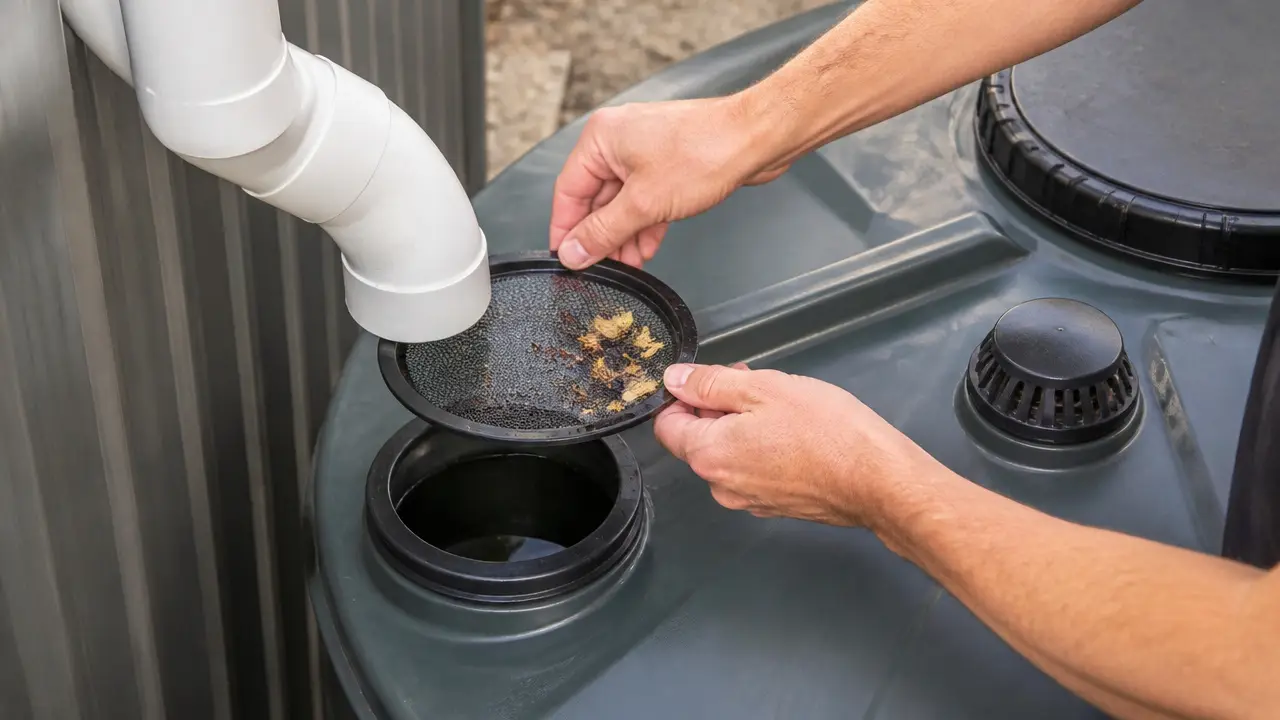
A rainwater overflow normally needs protection from mosquitoes, insects, and animals.
However, fine mesh can collect leaves, algae, or sediment. A clogged screen can reduce the effective overflow opening far below the pipe's normal capacity.
Keep the screen accessible for cleaning.
Bends
Every bend adds resistance.
A short overflow with a gentle route usually moves water more easily than a long pipe with several tight turns.
Horizontal runs
A nearly flat pipe does not drain as freely as one installed with suitable fall.
If the overflow must travel a long distance, pipe slope and hydraulic capacity become more important.
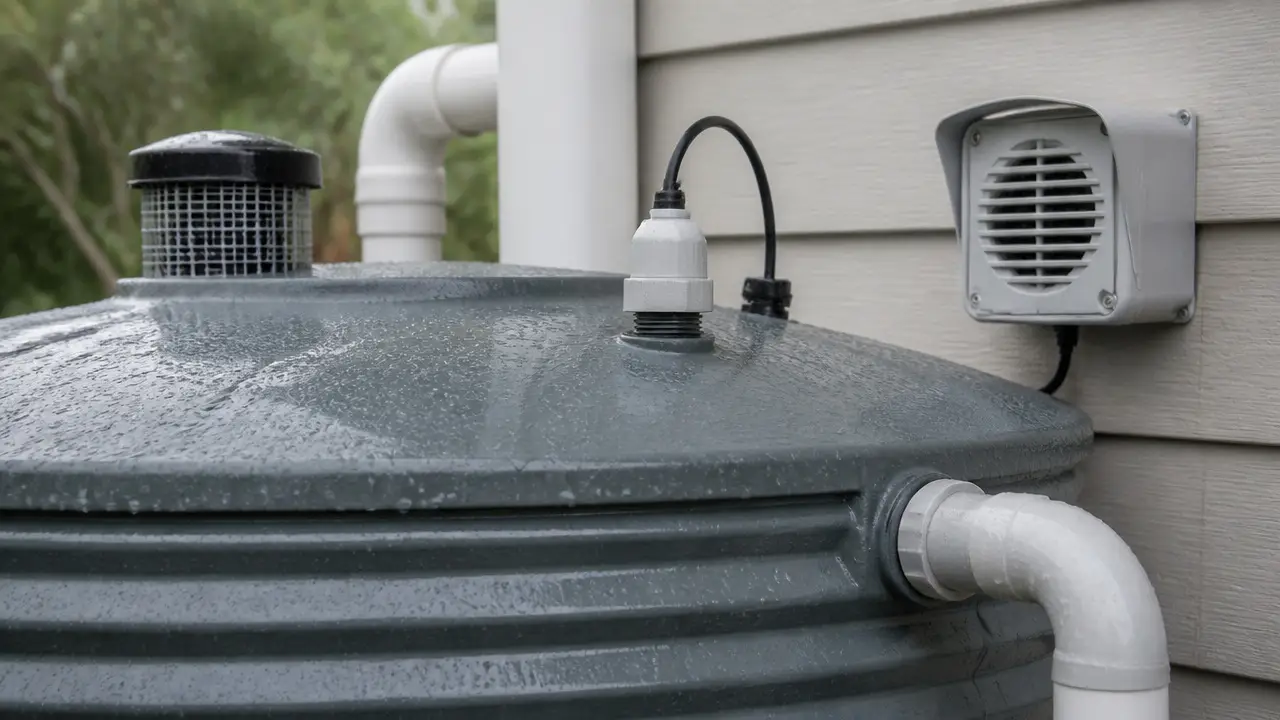
Tank fittings
Planning around practical considerations for overflows standard sizes helps evaluate likely upkeep demands over the system’s service life.
The hole through the tank must also be large enough.
An overflow may connect through a bulkhead fitting, which is a sealed fitting installed through the tank wall. A 4-inch pipe connected through a much smaller opening will still be limited by the smaller opening.
Use a fitting intended for the tank material and follow the tank manufacturer's instructions. Cutting an unsupported opening in a plastic, metal, or fiberglass tank can weaken it or cause leaks.
Do Not Size the Overflow From Tank Capacity Alone
A common mistake is assuming a small tank needs a small overflow.
Overflow size is controlled more by the catchment and rainfall rate than by storage volume.
Consider two tanks connected to the same roof:
- Tank A holds 500 gallons.
- Tank B holds 2,500 gallons.
The larger tank will take longer to fill. But once either tank is full, both may receive the same amount of water from the roof.
They may therefore need similar overflow capacity.
Tank volume affects how often the overflow operates. It does not determine the maximum flow the overflow may have to carry.
Where Should Overflow Water Go?
The overflow needs a safe discharge point.
Do not simply let a large tank overflow beside its foundation. Repeated heavy flows can wash soil away and may affect the support beneath the tank.
Depending on the property and local rules, overflow may go to:
- An approved stormwater drain
- A drainage swale
- An infiltration area
- Another rainwater tank
- Another approved drainage location
Keep discharged water away from places where it could damage buildings, neighboring property, septic systems, slopes, or tank foundations.
Do not connect rainwater overflow to a sanitary sewer unless local authorities specifically allow that arrangement. Australian roofwater harvesting guidance, for example, directs overflow toward stormwater rather than sewerage systems.
What About an Overflow Between Two Tanks?
When two tanks are connected in series, an overflow can move excess water from the first tank to the second.
The connecting pipe still needs enough capacity for peak inflow.
A small balance pipe near the bottom of two tanks is different. It allows water levels to equalize, but it may not be capable of carrying the full flow from a roof during heavy rain.
The final tank in the system should also have a properly sized overflow to a safe discharge point.
Keep the Overflow Protected and Maintainable
A good overflow setup should:
- Carry peak incoming water without backing up
- Keep mosquitoes and animals from entering
- Limit light entering the tank
- Be accessible for inspection
- Have fittings that match the tank
- Discharge water safely
- Avoid easy blockage by leaves and debris
Inspect the overflow before wet seasons and after major storms.
Check the screen, outlet, pipe, and surrounding drainage. Remove leaves, nests, sediment, and other material that could slow the flow.
When a 4-Inch Overflow Is a Good Starting Point
A 4-inch, or roughly 100 mm, overflow is a sensible starting point for many full-size residential rainwater tanks, especially when a large section of roof drains into the tank.
But it is not automatically large enough for every system.
You may need a more detailed calculation when:
- Several downpipes enter one tank
- The roof catchment is large
- Local storms are very intense
- The overflow has a long horizontal run
- There are many bends
- Water must travel through underground drainage
- The tank is close to a building
- Overflow failure could cause property damage
- Local rules specify drainage sizing
In those cases, size the complete drainage path rather than looking only at the fitting on the tank.
Frequently Asked Questions
Is a 2-inch overflow pipe big enough for a rainwater tank?
It can be enough for a small rain barrel or small catchment, but it may be too restrictive for a full-size tank receiving water from a large roof. The pipe must be able to handle peak incoming flow during heavy rain.
Should the overflow pipe be the same size as the inlet?
The overflow should normally be able to handle at least as much water as the inlet system can deliver. Avoid reducing a large inlet to a much smaller overflow unless the system has been properly sized.
Is a 4-inch overflow pipe enough?
A 4-inch, or about 100 mm, overflow is common for residential rainwater tanks and is a useful starting point. Large roofs, multiple downpipes, intense rainfall, or restrictive pipe runs may require more capacity.
Does a larger rainwater tank need a larger overflow pipe?
Not necessarily. Overflow size depends mostly on roof catchment, rainfall intensity, and inlet flow. Tank capacity mainly affects how quickly the tank becomes full.
Can I install two smaller overflow pipes instead of one large pipe?
It is possible to use multiple overflows, but their combined hydraulic capacity must be adequate. Two smaller pipes are not automatically equivalent to one large pipe, especially when screens, bends, and pipe slopes differ.
Should a rainwater tank overflow have a screen?
Usually, yes. A suitable screen can help keep mosquitoes, insects, and animals from entering the tank. It must also be kept clean because a blocked screen can greatly reduce overflow capacity.
Can the overflow empty onto the ground beside the tank?
That is often a poor location. Large amounts of water can erode soil around the tank base or flow toward nearby buildings. Route overflow to a suitable drainage location that complies with local requirements.