As an affiliate, we may earn a commission from qualifying purchases. We get commissions for purchases made through links on this website from Amazon and other third parties.
The best pH meter for both soil and water testing is a digital meter with two-point calibration, automatic temperature compensation, and a replaceable glass electrode. For most gardeners and rainwater users, it is better to test soil as a measured soil-and-water mixture than to push a cheap metal probe straight into the ground.
A good meter should also use standard calibration buffers, usually pH 4 and pH 7 for garden and irrigation work. Penn State Extension recommends a temperature-compensating digital meter with two-point calibration when accurate irrigation-water adjustment matters.
What Type of pH Meter Is Best?
For one meter that can handle several jobs, look for these features:
- Digital pH measurement
- A glass pH electrode
- At least two-point calibration
- Automatic temperature compensation
- Replaceable electrode, if possible
- Calibration with standard pH buffer solutions
- A probe that can be stored wet as required by its manufacturer
- Enough water resistance for outdoor or greenhouse use
You do not need a meter that claims to measure every possible soil and water value. A simple, well-maintained pH meter is often more useful than a multi-function device with questionable sensors.
The U.S. Geological Survey uses calibrated electrode-based meters for water pH measurements and emphasizes proper calibration, maintenance, and storage.
The Best Choice for Testing Water
For rainwater, irrigation water, tank water, and greenhouse water, a standard digital pH meter with a glass electrode is usually the most practical choice.
The probe is placed in a water sample, and the meter measures the activity of hydrogen ions. The result is reported on the pH scale, which runs from 0 to 14. A pH of 7 is neutral. Lower numbers are acidic, while higher numbers are alkaline.
Look for two-point calibration
Calibration is more important than an impressive-looking display.
For garden and irrigation water, calibration around pH 4 and pH 7 usually makes sense because those standards bracket much of the range you are likely to measure. For samples expected to be alkaline, pH 7 and pH 10 buffers may be more suitable.
USGS field procedures commonly use two calibration buffers selected to cover the expected sample range.
Automatic temperature compensation helps
A pH electrode's response changes with temperature. Automatic temperature compensation, often shortened to ATC, allows the meter to compensate for this part of the measurement.
It does not make a poorly calibrated or damaged probe accurate. You still need fresh calibration solution and correct storage.
A replaceable probe is worth having
The electrode is the part of a pH meter that wears out.
Penn State Extension notes that pH electrodes have a limited working life and may eventually stop calibrating correctly. Meters with replaceable electrodes let you replace the probe instead of the entire instrument.
That can be especially useful if you test water throughout the growing season.
The Best Choice for Testing Soil
Soil needs a different approach.
For dependable garden measurements, use a good digital pH meter to measure a prepared soil-and-water sample rather than assuming a probe pushed into the ground will provide an accurate result.
Laboratories also measure soil pH by mixing soil with a controlled amount of water or another specified solution. For example, University of Minnesota Extension describes a method using equal weights of soil and water, while Oregon State University lists a 1-part-soil-to-2-parts-water method for its recommended soil testing procedure.
The exact number can differ because testing methods differ. That is why consistency matters.
Why direct-in-soil probes can be misleading
Inexpensive garden probes often have metal prongs that are simply pushed into damp soil.
They can provide a rough indication, but they are not the best choice when you need to decide whether to add lime, sulfur, or another soil amendment.
Results can change with:
- Soil moisture
- Contact between the probe and soil
- Soil salts
- Soil texture
- Probe condition
- Testing depth
- Testing method
Oregon State Extension recommends laboratory analysis when accurate soil information is needed and notes that home devices generally do not provide the same accuracy as soil testing services.
Should You Buy a Special Soil pH Probe?
A specialized soil or media electrode can make sense if you test soil, compost, or growing media frequently.
Some are designed with a pointed or rugged tip that can tolerate semi-solid samples better than a delicate standard water electrode.
However, the electrode still needs to be compatible with the meter. It must also be designed for the material you intend to test.
Do not push an ordinary thin glass water electrode directly into packed soil. The glass sensing bulb can be damaged.
For occasional home gardening, preparing a soil-and-water mixture is usually simpler and gives you a repeatable method without needing a special probe.
What Accuracy Do You Actually Need?
For gardening, chasing readings such as 6.437 pH is usually not useful.
Soil itself varies from place to place. Sampling technique and the soil-to-water testing method can also affect the result.
Oregon State Extension notes that home soil pH results showing more than one decimal place should be treated cautiously.
A stable and repeatable reading is often more valuable than extra digits on the screen.
For water treatment, greenhouse nutrient management, or controlled irrigation, more precision may matter. In those cases, good calibration and electrode care become even more important.
How to Test Water Correctly
A good meter can still give poor results if it is used incorrectly.
A practical routine is:
- Calibrate the meter. Use fresh standard buffer solutions that bracket the expected sample pH.
- Collect a clean sample. Avoid containers with fertilizer, soap, or chemical residue.
- Rinse the electrode. Follow the meter manufacturer's instructions.
- Place the probe in the sample. Make sure the sensing area is properly submerged.
- Wait for the reading to stabilize.
- Record the result.
- Rinse the probe again.
- Store it correctly.
Do not assume a pH electrode should be stored dry. USGS guidance specifically warns against allowing pH electrodes to dry unless the manufacturer's instructions say otherwise.
How to Test Soil More Reliably
If you want to track soil pH yourself, use the same method every time.
Collect several small portions of soil from the area you want to evaluate. Mix them into one representative sample rather than testing one unusual spot.
Then follow a defined soil-to-water procedure.
For example, a laboratory or Extension method may specify a 1:1 or 1:2 soil-to-water ratio. These ratios describe the amount of soil compared with the amount of water used to prepare the sample.
Do not switch methods between tests and then compare the readings as though they were identical. Different soil pH methods can give somewhat different values.
For the reliability of soil pH meters, first interpret a water-safety plan appropriate for the intended purpose.
For decisions about significant lime or soil-acidification applications, a laboratory soil test is the safer choice. A lab may measure more than active soil pH and can provide amendment recommendations based on the soil and crop.
Calibration Matters More Than Extra Features
A meter that cannot be calibrated reliably is not very useful.
Standard calibration liquids are called buffer solutions. They have a known pH and allow you to check whether the meter is reading correctly.
Common buffers include:
- pH 4
- pH 7
- pH 10
Use fresh buffer in a clean container. Do not pour used calibration solution back into the original bottle because that can contaminate the remaining solution. USGS procedures also call for fresh buffers and calibration appropriate to the expected measurement range.
If the meter repeatedly fails calibration even after cleaning and following the manufacturer's procedure, the electrode may need replacement.
What About pH Test Strips?
Test strips are useful when you only need a rough answer.
They are inexpensive, need no batteries, and require little maintenance. They can be useful for checking whether water is clearly acidic, near neutral, or alkaline.
Their weakness is resolution.
Colors can be difficult to distinguish, and strips generally cannot track small changes as well as a properly calibrated digital meter. Oregon State Extension notes that strips can be useful for trends but are generally not as accurate as meters.
If you routinely adjust irrigation water, a digital meter is the better tool.
Should You Choose a pH and EC Combination Meter?
A combination pH and electrical conductivity meter can be useful for greenhouse, hydroponic, fertigation, and irrigation work.
Electrical conductivity, or EC, measures how well water conducts electricity. It provides information related to the amount of dissolved ions in the water.
Penn State Extension notes that pH/EC combination meters can be useful for evaluating irrigation water.
But EC and pH tell you different things.
A normal pH reading does not mean the water has a suitable salt level. Likewise, an acceptable EC value tells you nothing about microorganisms or many possible contaminants.
pH Is Not the Same as Alkalinity
This is especially important when testing rainwater or irrigation water.
pH tells you how acidic or alkaline the water is at the time of measurement.
Alkalinity describes the water's ability to resist a change in pH.
Two water samples can have a similar pH while behaving very differently when acid is added. Penn State Extension recommends evaluating both pH and alkalinity when determining how irrigation water will respond to acid treatment.
Do not use pH alone to calculate chemical treatment for large tanks or irrigation systems unless you understand the water's alkalinity and the treatment process.
Using a pH Meter With Collected Rainwater
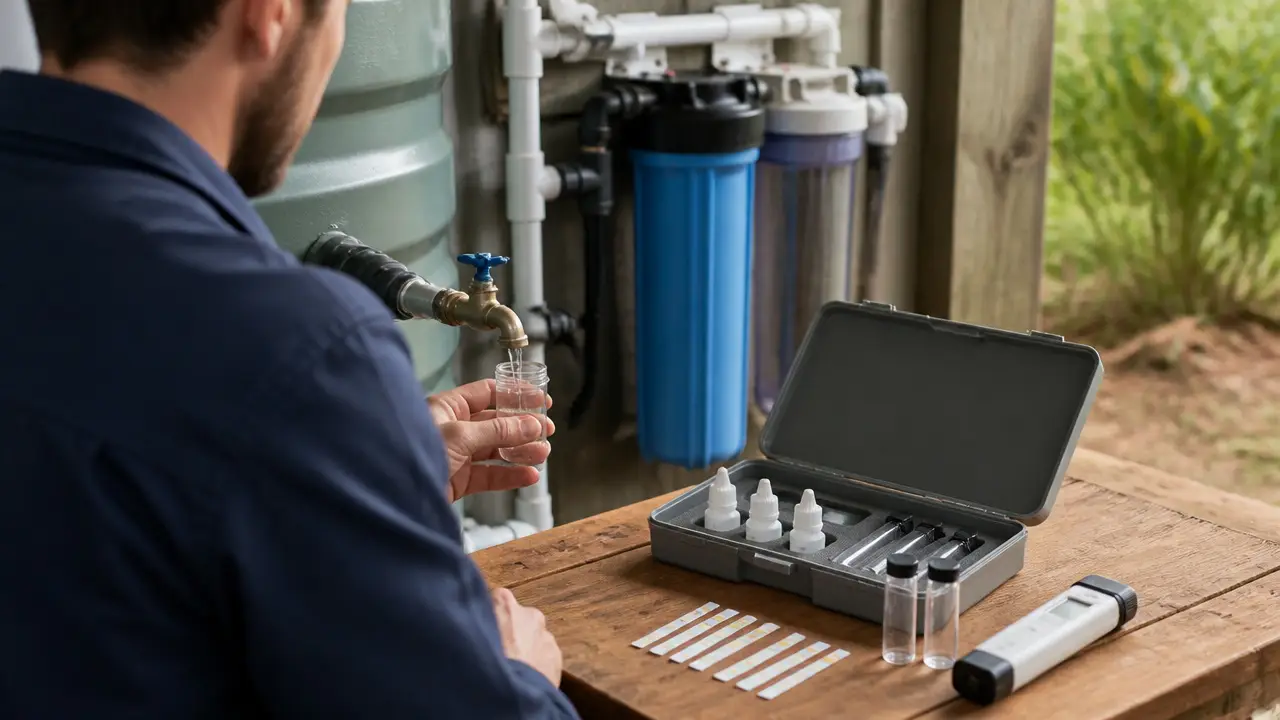
A pH meter can be useful in a rainwater harvesting system.
You might use it to:
- Track changes in stored water
- Compare roof runoff with tank water
- Check irrigation water
- Investigate corrosion concerns
- Monitor water before and after some treatment processes
But pH is only one water-quality measurement.
A meter cannot tell you whether rainwater contains bacteria, parasites, metals, chemicals, or other contaminants.
For drinking-water applications, pH testing does not establish that collected rainwater is potable, meaning safe for drinking. Drinking-water use requires suitable collection, treatment, maintenance, and appropriate laboratory testing.
The EPA lists pH 6.5 to 8.5 as a secondary drinking-water standard related mainly to issues such as corrosion, taste, deposits, and appearance. It is not proof that water within that range is microbiologically or chemically safe.
Best Setup for Most Homeowners
For most people who want to test both garden soil and rainwater or irrigation water, the most useful setup is:
A quality handheld digital pH meter with a glass electrode, automatic temperature compensation, two-point calibration, and preferably a replaceable probe.
Use the meter directly in water samples.
For soil, prepare a consistent soil-and-water sample instead of relying on a basic metal probe pushed into the ground.
If you need soil results to decide how much lime, sulfur, or fertilizer to apply, send a representative sample to a soil laboratory. Your handheld meter is better suited to routine checks and tracking changes over time.
Frequently Asked Questions
Can the same pH meter test soil and water?
Yes. A good digital water pH meter can also be used for soil if you prepare the soil using a suitable soil-and-water testing method. Do not push a delicate glass water electrode directly into compact soil unless the probe is designed for that use.
Are cheap soil pH probes accurate?
They may show broad trends, but they should not be relied on for precise soil amendment decisions. Moisture, soil contact, salts, and probe condition can affect their readings. Laboratory testing is preferable when accurate soil management decisions matter.
What calibration solutions do I need?
For most gardening and irrigation measurements, pH 4 and pH 7 buffers are useful. If you commonly test alkaline water, pH 7 and pH 10 may be more appropriate. Ideally, the calibration points should bracket the expected sample pH.
How often should I calibrate a pH meter?
Follow the manufacturer's instructions. Calibrate often enough that you can trust the reading, particularly before important measurements or after the meter has been stored for a long period. If a probe cannot successfully calibrate, it may need cleaning or replacement.
Can I store a pH probe dry?
Many glass pH electrodes should not be stored dry. Use the storage solution and procedure specified by the manufacturer. Incorrect storage can shorten electrode life and cause slow or unstable readings.
Is a pH meter enough to test rainwater for drinking?
No. A pH meter measures acidity or alkalinity only. It does not detect bacteria, parasites, metals, pesticides, or many other contaminants. Rainwater intended for drinking requires a suitable collection and treatment system plus appropriate current laboratory testing and compliance with applicable local requirements.
Should I buy a pH meter that also measures TDS?
It can be convenient, but the two readings answer different questions. Total dissolved solids, or TDS, estimates the amount of dissolved material in water, while pH measures acidity or alkalinity. Neither measurement by itself establishes whether water is safe to drink.