As an affiliate, we may earn a commission from qualifying purchases. We get commissions for purchases made through links on this website from Amazon and other third parties.
A good spin-down filter is a reusable sediment prefilter with the right screen size, connection size, pressure rating, and flow capacity for your system. For many rainwater systems, a screen around 100 microns is a practical starting point for catching sand, grit, rust flakes, and other visible sediment before finer filtration.
The best choice is not always the filter with the smallest micron number. A screen that is too fine can clog quickly, restrict flow, and require constant flushing. A spin-down filter works best as an early filtration stage, not as the only water-treatment device.
What a Spin-Down Filter Does
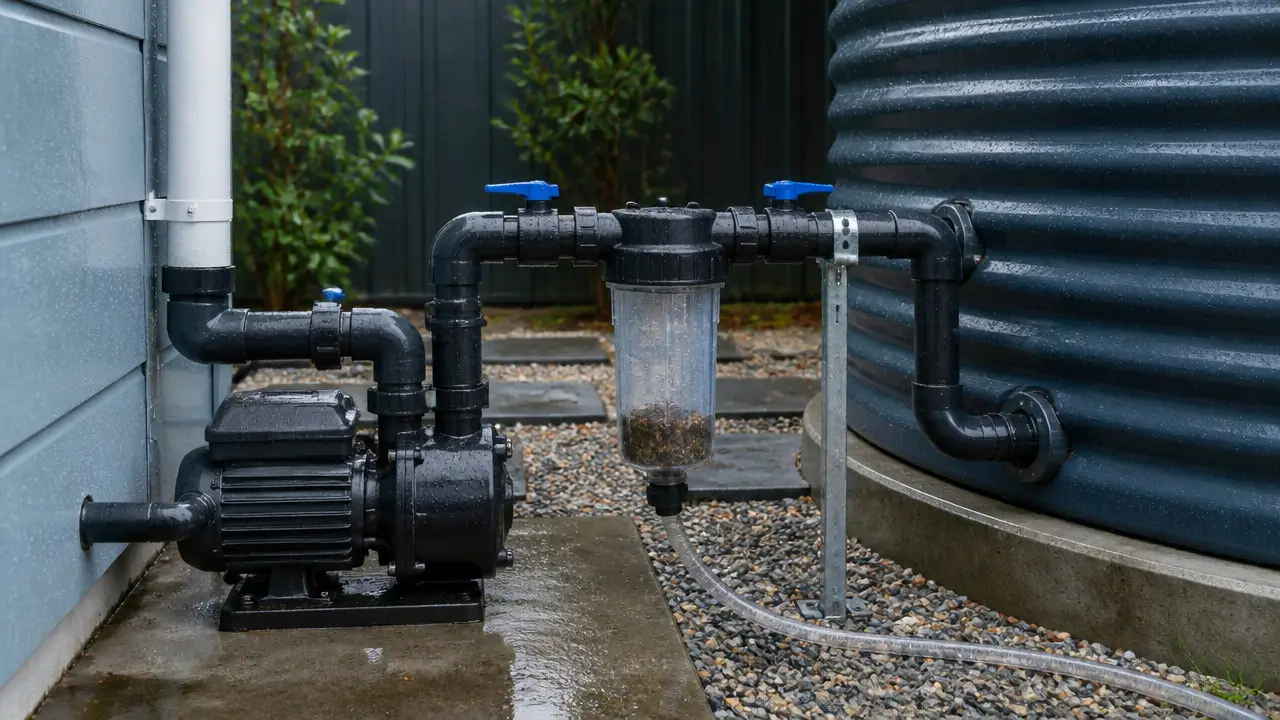
A spin-down filter is a washable sediment filter. Water passes through a reusable screen while heavier particles collect near the bottom of the clear filter housing.
Opening the flush valve lets accumulated sediment drain out.
Spin-down filters are useful for catching particles such as:
- Sand
- Grit
- Rust flakes
- Small pieces of organic debris
- Pipe scale
- Sediment from the bottom of a tank
They are often installed before cartridge filters, irrigation equipment, valves, or other components that can be damaged or clogged by debris.
They are especially useful with rainwater because the screen can usually be cleaned and reused instead of being replaced every time it becomes dirty.
The Best Spin-Down Filter for Rainwater
For most rainwater systems, look for a filter with these features:
- A reusable stainless steel or durable synthetic screen
- A removable screen for deeper cleaning
- A clear housing so sediment buildup is easy to see
- A full-size flushing valve at the bottom
- Connections that match your plumbing
- Enough flow capacity for your pump or irrigation system
- A pressure rating suitable for your system
- Replacement screens and seals that are readily available
The screen size deserves particular attention.
Start With About 100 Microns for General Sediment
A micron is one-thousandth of a millimeter. A lower micron number means the filter catches smaller particles.
For general rainwater prefiltration, roughly 100 microns is often a useful starting point. It can catch noticeable sediment without becoming as restrictive as a very fine screen.
Some spin-down filters use significantly coarser screens. For example, one current sediment spin-down system is designed for particles of about 152 microns and larger. Its manufacturer recommends a separate finer sediment filter when smaller particles need to be removed.
That illustrates the main purpose of a spin-down filter: remove larger sediment first so finer filters do not have to handle all of it.
Choose a Coarser Screen for Dirty Water
A coarser screen can be better when your tank regularly contains:
- Sand
- Heavy roof sediment
- Tank-bottom debris
- Large amounts of rust or pipe scale
- Organic particles
Trying to catch everything with a very fine spin-down screen may cause frequent clogging.
A better arrangement can be:
Tank → coarse sediment control → spin-down filter → finer filtration as needed
Your exact layout depends on your pump, pressure system, and intended water use.
Choose a Finer Screen Only When You Need It
A finer screen may make sense when the water is already fairly clean and you are protecting equipment with small passages.
For example, irrigation emitters may need better sediment control than a hose used for hand watering.
Do not choose a fine screen simply because the lower micron number sounds better. Every filter creates some resistance. As sediment builds up, that resistance increases.
Match the Filter to Your Pipe Size
Connection size matters almost as much as micron rating.
If your main rainwater line uses 1-inch pipe, placing a much smaller filter connection in the middle of it can become a bottleneck.
The decision guide “Is a Spin down Filter Worth It?” shows why intended use matters when choosing treatment.
Ideally, the spin-down filter should match the main line or be sized according to the flow requirements of the system.
Check:
- Inlet size
- Outlet size
- Thread type
- Maximum flow
- Working pressure
- Maximum water temperature
Do not assume that two fittings marked with the same nominal size will automatically connect. Thread standards and fitting types can differ.
Adapters can solve some connection problems, but unnecessary reductions can make a high-flow system harder to operate well.
Check Flow Rate Before Buying
Flow rate is how much water moves through the filter during a given amount of time, usually expressed in gallons per minute or liters per minute.
Your filter should be able to handle the highest flow your system normally requires.
Consider everything that may operate at once.
A garden system running one hose has very different requirements from a pump supplying several irrigation zones or multiple household fixtures.
A filter that is too small can cause:
- Weak flow
- Reduced pressure downstream
- More frequent clogging
- Poor pump performance
- Difficulty flushing the filter
Do not size the filter only according to pipe diameter. Compare the filter's documented flow limits with the actual needs of the system.
Consider Where the Filter Will Be Installed
Filter location affects how well the system works.
In a typical pumped rainwater system, a spin-down filter may be placed on the pressurized side of the pump before finer filtration.
One possible arrangement is:
Rainwater tank → pump → spin-down sediment filter → finer sediment filter → intended use
The exact position depends on the pump and pressure equipment.
Be cautious about putting a restrictive filter directly on a pump's suction line. A clogged filter can make it harder for the pump to draw water. If sediment protection is required before the pump, use components specifically intended for the pump's suction conditions and follow the pump manufacturer's installation requirements.
A spin-down filter also needs enough room below it for flushing and enough space around it to remove the screen.
Make Sure It Can Be Flushed Easily
Easy maintenance is one of the main reasons to use a spin-down filter.
The bottom valve should be accessible. Ideally, you should be able to direct the flushed water somewhere suitable without spraying the surrounding equipment.
Flushing frequency depends on how much sediment reaches the filter.
A new rainwater system may need frequent checks at first. Once you know how quickly sediment collects, you can develop a maintenance schedule based on your actual water conditions.
Flushing alone may not always clean the screen completely. Periodically inspect the screen and clean it according to the manufacturer's instructions.
If flushing no longer restores normal flow, the screen may need deeper cleaning or replacement.
Look for a Clear Housing
A transparent filter housing is especially useful in rainwater systems.
You can quickly see:
- How much sediment has accumulated
- Whether the filter needs flushing
- Whether unusually dirty water is entering the system
- Whether the screen appears coated with fine material
That makes troubleshooting much easier than relying only on changes in pressure.
The walkthrough “How Do I Choose the Right Spin down Filter?” connects the measurement to a practical water-safety decision.
Evaluate recommended sediment filters for rainwater systems to interpret upkeep actions that credible water-quality results support.
A clear housing should still be protected from prolonged sunlight when appropriate. Light can encourage biological growth in water-containing equipment.
Protect the Filter From Freezing
A water-filled spin-down filter can be damaged if it freezes.
If your system operates in a freezing climate, install the filter in a protected location or winterize the system according to the manufacturer's instructions.
Do not assume that a filter labeled for outdoor installation is freeze-proof. For example, one manufacturer specifically warns against outdoor installation of its spin-down system where it will be exposed to freezing temperatures.
The filter bowl, drain valve, fittings, and trapped water all need consideration when planning freeze protection.
A Spin-Down Filter Is Not a Complete Rainwater Treatment System
This distinction is important.
A spin-down filter removes sediment based mainly on particle size. It does not establish that rainwater is safe to drink.
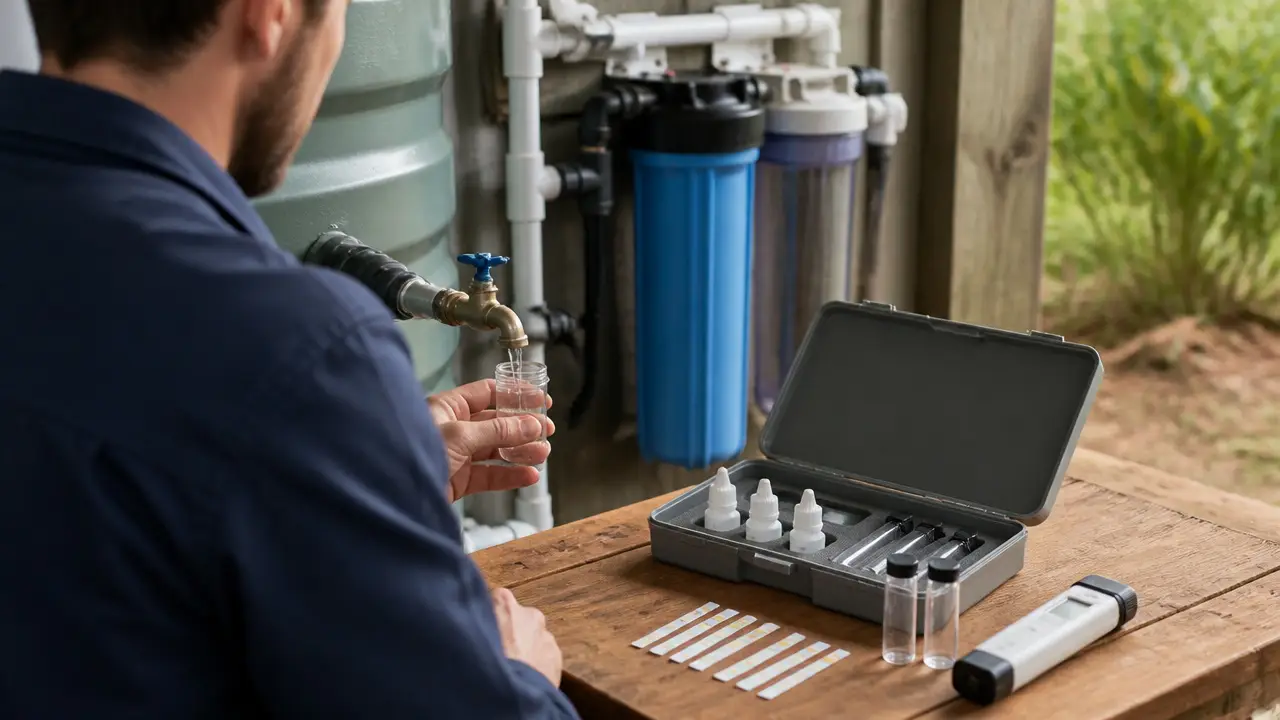
Roof runoff can contain germs and chemicals even when the water looks clear. CDC guidance says collected rainwater is not necessarily safe to drink without appropriate treatment and recommends regular testing when rainwater is used for drinking, cooking, or bathing.
For ordinary non-potable uses such as many garden applications, a spin-down filter may be all the filtration needed to protect certain equipment.
For potable use, the system needs to be considered as a whole. That can include suitable collection surfaces, debris screening, first-flush control, storage management, sediment filtration, treatment matched to identified contaminants, current laboratory testing, maintenance, and applicable local requirements.
A first-flush diverter sends the initial runoff from a storm away from the storage tank. That early runoff can contain a higher concentration of material washed from the roof. CDC recommends considering first-flush control as one way to improve collected rainwater quality.
A spin-down filter should not be treated as a substitute for those other stages.
Spin-Down Filter vs. Cartridge Sediment Filter
These filters do related jobs, but they are not interchangeable.
| Feature | Spin-Down Filter | Cartridge Sediment Filter |
|---|---|---|
| Best at | Coarse sediment | Finer sediment |
| Filter element | Usually reusable screen | Usually replaceable cartridge |
| Cleaning | Flush and periodically wash | Replace or clean depending on cartridge |
| Good first stage | Yes | Sometimes |
| Handles heavy grit | Usually well | Can clog quickly |
| Very fine filtration | Limited | Better suited |
| Drinking-water treatment alone | No | No |
Using both can work well.
The spin-down filter removes larger material first. The finer cartridge then has less sediment to hold, which may extend its useful life.
What About Mesh Size?
Some spin-down filters describe their screens using mesh rather than microns.
Mesh describes the number of openings in a screen over a given distance. Microns describe the approximate size of the openings themselves.
Do not rely on a simple assumption such as "higher mesh always equals a specific micron rating." Wire thickness and screen construction can affect the opening size.
When comparing filters, use the manufacturer's stated micron opening whenever possible.
Best Setup for Garden Irrigation
For rainwater feeding garden irrigation, the best setup depends on the irrigation equipment.
A basic hose can tolerate more sediment than small drip emitters.
For a simple garden system, you might have:
Tank → pump → spin-down filter → hose or irrigation line
For drip irrigation, an additional filter may be needed:
Tank → pump → spin-down filter → irrigation filter → pressure regulator → drip lines
The selection guide “4 Best Rainwater Filters for Debris and Sediment Control” connects the measurement to a practical water-safety decision.
The irrigation equipment manufacturer should specify the filtration required for the emitters.
A spin-down filter is useful here because it removes larger tank sediment before it reaches the finer irrigation filter.
Best Setup for an IBC Tote or Rain Barrel
Small gravity-fed systems need special attention to pressure.
An elevated rain barrel or IBC tote produces only modest pressure. A restrictive filter can noticeably reduce flow.
For these systems, prioritize:
- Large enough connections
- A relatively coarse screen
- Low flow resistance
- Easy flushing
- Accessible installation
If the filter requires substantial pressure to operate or flush effectively, it may not perform well on a low-pressure gravity system.
Check its stated minimum operating conditions rather than assuming every spin-down filter will work with a rain barrel.
When a Spin-Down Filter Is Worth Adding
A spin-down filter is particularly useful when you repeatedly find sediment in:
- Irrigation filters
- Pump strainers
- Hose nozzles
- Valves
- Cartridge housings
- Sprinklers
- Drip emitters
It is also useful when replacing fine sediment cartridges too frequently.
However, heavy sediment entering the filter can point to another problem. You may need to improve roof screening, clean gutters, inspect the storage tank, raise the tank outlet above settled debris, or manage accumulated tank sediment.
Filtration is usually more effective when large debris is stopped earlier in the collection system rather than asking one small filter to handle everything.
The Bottom Line
The best spin-down filter for most rainwater systems is a properly sized, reusable sediment filter with an easy-to-clean screen, a convenient flush valve, and enough flow capacity for the system.
Around 100 microns is a useful general starting point, but it is not a universal requirement. Use a coarser screen for heavy sediment and consider finer downstream filtration when the equipment you are protecting requires it.
Above all, match the filter to your:
- Water use
- Sediment load
- Pump flow
- Pipe and fitting size
- Operating pressure
- Downstream equipment
- Maintenance conditions
- Climate
A well-matched coarse filter that is easy to flush is usually more useful than an extremely fine filter that constantly clogs.
Frequently Asked Questions
Is a 100-micron spin-down filter good for rainwater?
It can be. A screen around 100 microns is a practical general-purpose starting point for catching sand, grit, rust flakes, and other sediment. Very dirty water may work better with a coarser first stage, while some irrigation or treatment systems may need finer downstream filtration.
Is 50 microns better than 100 microns?
Not automatically. A 50-micron screen catches smaller particles, but it may also clog more quickly and create more flow restriction. Choose the micron rating based on the sediment present and the equipment you need to protect.
Can I put a spin-down filter before my rainwater pump?
Only if the filter and pump arrangement are designed for that installation. A dirty filter on the suction side can restrict water entering a pump. Many systems place reusable sediment filtration on the pressurized side instead. Follow the requirements of both the pump and filter manufacturers.
Can a spin-down filter make rainwater safe to drink?
No. A spin-down filter mainly removes particles. It does not provide complete protection against germs or dissolved chemicals. Potable rainwater requires a whole-system approach that includes appropriate collection, treatment, testing, maintenance, and compliance with local requirements.
How often should I flush a spin-down filter?
Flush it when visible sediment accumulates or when flow begins to decline. The required frequency can range widely depending on the amount of sediment in your water. Inspect a new installation frequently until you learn how quickly the filter becomes dirty.
Do I still need a cartridge filter after a spin-down filter?
You may if you need to remove smaller particles. Spin-down filters are most useful as coarse prefilters. A finer cartridge downstream can handle particles that pass through the reusable screen.
Are spin-down filters good for drip irrigation?
Yes, they can be useful as the first sediment stage. However, small drip emitters may require finer filtration than the spin-down filter provides. Follow the filtration requirement specified for your irrigation equipment.