As an affiliate, we may earn a commission from qualifying purchases. We get commissions for purchases made through links on this website from Amazon and other third parties.
A 50-micron sediment particle is very small—about 0.05 millimeter across. One particle may be hard to see clearly with the naked eye. A group of 50-micron particles can look like fine dust, silt, cloudy water, or a thin layer of grit at the bottom of a container.
For comparison, the period at the end of a printed sentence can be about 500 microns across, so 50 microns is roughly one-tenth of that width. EPA guidance uses this kind of comparison to explain how small filter openings can be.
In a rainwater system, a 50-micron sediment filter is mainly a coarse or early-stage filter. It can catch larger suspended particles before the water reaches pumps, smaller filters, irrigation equipment, or other treatment stages.
What Does 50 Microns Mean?
A micron, also called a micrometer, is one-millionth of a meter.
That means:
- 1 micron = 0.001 millimeter
- 10 microns = 0.01 millimeter
- 50 microns = 0.05 millimeter
- 100 microns = 0.1 millimeter
- 1,000 microns = 1 millimeter
A 50-micron particle is therefore only 1/20 of a millimeter wide.
The micron rating on a sediment filter refers to the approximate size of the openings or particles the filter is designed to capture. Sediment filtration works by trapping suspended solids that are larger than the filter's effective pore size. It does not remove dissolved substances simply because they pass through a sediment filter.
What 50-Micron Sediment Looks Like in Water
There is no single appearance for 50-micron sediment. "50 micron" describes size, not the material.
Depending on where the water came from, particles around this size may look like:
- very fine sand
- silt
- clay or soil particles
- roof dust
- tiny mineral particles
- small rust particles
- fine organic debris
Individual particles may be difficult to recognize without magnification. When many particles are present, however, they can be quite noticeable.
Suspended in the water
Fine sediment may make rainwater look slightly cloudy, dull, or hazy. You might not see separate grains moving through the water.
Cloudiness alone does not tell you the particle size. Much smaller particles can also cause cloudy water.
Settled on the bottom
If you leave dirty rainwater in a clear container, some sediment may settle.
It may form a very thin layer that looks like:
- powder
- mud
- fine brown dust
- gray silt
- reddish material if iron or rust is present
Larger, heavier particles normally settle faster than very small particles.
On a filter screen
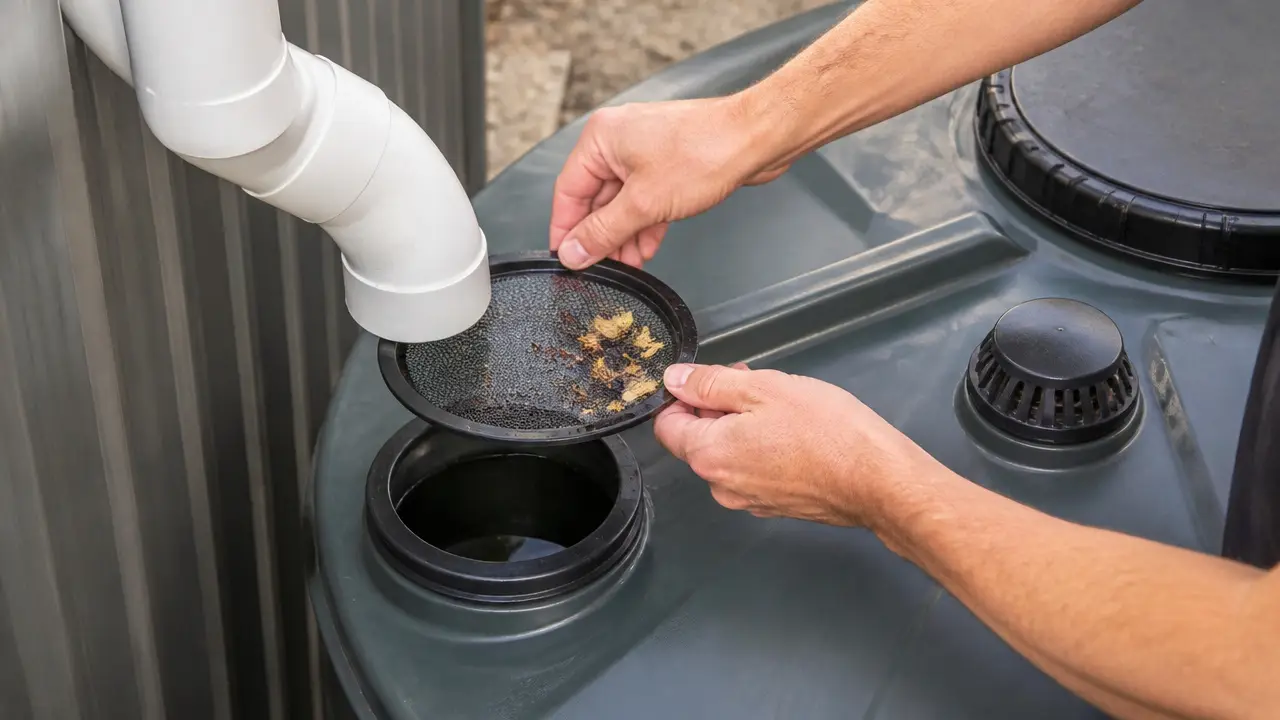
A reusable 50-micron screen may slowly collect a film of brown, gray, black, or greenish material.
You may see very little at first because thousands of tiny particles can collect before the buildup becomes obvious.
The appearance depends much more on the source of the sediment than on its micron size.
Is 50-Micron Sediment Visible to the Naked Eye?
Particles around 50 microns are near the range where seeing an individual particle becomes difficult.
You may see a speck under good lighting, but you usually will not be able to look at it and determine that it is specifically 50 microns wide.
A microscope or other measuring equipment is needed for accurate particle sizing.
What you can often see without magnification is the combined effect of many particles. For example, you may notice:
- cloudy water
- sediment settling in a bucket
- dirt collecting in a clear filter housing
- grit washing from a filter screen
- a thin layer on the bottom of a tank
Seeing sediment does not tell you whether the particles are 20, 50, 100, or several hundred microns.
What Does a 50-Micron Filter Remove?
A 50-micron sediment filter is designed for relatively coarse suspended material.
In a rainwater harvesting system, it may help capture material such as fine grit and some roof or tank sediment before that material travels farther through the system.
However, the exact performance depends on how the manufacturer rates the filter.
Nominal versus absolute ratings
This difference matters when comparing filters.
A nominal micron rating means the filter captures a stated portion of particles around the rated size. Some particles near that size may still pass through.
An absolute micron rating sets a much stricter maximum pore size.
CDC notes that nominal or mean-rated filters can contain openings larger and smaller than their stated rating, while an absolute rating provides a defined maximum opening size.
So two filters labeled "50 micron" may not perform exactly the same way.
What Will Pass Through a 50-Micron Filter?
A 50-micron filter is not a fine water-treatment filter.
Many smaller suspended particles can pass through it. Dissolved substances can also pass through because they are not suspended grains that can simply be strained out.
A 50-micron sediment filter should not be expected to remove:
- dissolved salts
- dissolved minerals
- many dissolved metals
- pesticides and other dissolved chemicals
- very fine sediment
- bacteria reliably
- viruses
- all parasites
For perspective, EPA information lists Giardia at roughly 8 to 12 microns and Cryptosporidium at roughly 4 to 6 microns. Bacteria and viruses can be smaller still.
That makes a 50-micron filter far too coarse to serve as a stand-alone microbial safety barrier.
Where a 50-Micron Filter Fits in a Rainwater System
A 50-micron filter can be useful because not every stage of a rainwater system needs to be extremely fine.
Trying to send dirty roof runoff directly into a very fine cartridge can cause rapid clogging. Removing larger material first can reduce the load on later filters.
A simple system might follow this general path:
Roof → gutter screen → first-flush device → tank → coarse sediment filter → finer treatment as needed
A first-flush device diverts some of the first runoff from a roof. That early runoff can contain more dust, pollen, droppings, and loose debris than later rainfall.
The exact filter arrangement should depend on what you plan to do with the water.
Garden irrigation
A 50-micron filter may be useful for protecting some irrigation equipment from sediment.
Look closely at the performance of whole house sediment filters to understand the practical limits of the reported water-quality measurements.
However, check the required filtration for your specific emitters, valves, and sprinklers. Small drip emitters may require finer filtration than larger irrigation outlets.
Pump protection
A coarse filter can help keep larger suspended material from reaching a pump.
It does not replace proper pump installation, an intake that avoids bottom sediment, or any strainers required by the pump manufacturer.
Before finer filters
This is one of the most useful roles for a 50-micron filter.
For example, a system may use a washable coarse filter before a finer cartridge. The coarse stage catches larger material so the finer stage does not have to handle everything.
The correct sequence depends on water quality, flow requirements, pressure loss, and the intended use.
50 Micron Versus Other Sediment Filter Sizes
The lower the micron number, the smaller the particles a filter is intended to capture.
| Filter rating | General role |
|---|---|
| 100+ micron | Coarse debris and larger sediment |
| 50 micron | Fine grit and coarse suspended sediment |
| 20 micron | Finer sediment |
| 5 micron | Fine suspended particles |
| 1 micron | Very fine particulate filtration |
These are general descriptions rather than guarantees. Filter construction and nominal versus absolute ratings matter.
A finer filter also usually creates more resistance to water flow and can clog sooner when the incoming water contains a lot of sediment.
This is why using the smallest possible filter is not always the best approach.
Can a 50-Micron Filter Make Rainwater Clear?
It can make dirty water look better if much of the visible contamination consists of particles larger than the filter can capture.
But it may not remove all cloudiness.
Very fine clay, organic matter, and other particles below the effective filter size may remain suspended. Dissolved substances also pass through ordinary sediment filtration.
If a 50-micron filter becomes dirty while the water still looks cloudy afterward, that does not necessarily mean the filter has failed. Much of the remaining material may simply be smaller.
Can a 50-Micron Filter Make Rainwater Safe to Drink?
No.
A 50-micron sediment filter should be treated as a prefiltration stage, not as proof that rainwater is potable.
Potable means suitable for drinking.
Roof-collected rainwater can contain microorganisms and chemicals that cannot be judged by appearance and are much smaller than 50 microns. CDC specifically warns that taste, smell, and appearance are not reliable ways to determine whether water contains harmful germs or chemicals. CDC also recommends testing rainwater systems for harmful germs and chemicals.
If rainwater is being considered for drinking, the whole collection and treatment system matters. That includes suitable collection surfaces, debris control, first-flush management where appropriate, storage conditions, treatment stages, maintenance, current laboratory testing, and local requirements.
Do not rely on a 50-micron sediment filter alone to make collected rainwater drinkable.
How to Tell Whether 50 Microns Is Fine Enough
Start with what the water needs to do after filtration.
For a garden hose or some coarse irrigation uses, very fine filtration may provide little benefit.
For small drip emitters, pumps, valves, finer cartridges, UV treatment, or household reuse equipment, the downstream equipment may have specific water-quality or filtration requirements.
Check:
- the smallest passages in downstream equipment
- the manufacturer's required filtration
- how much sediment enters the system
- the available flow rate
- how much pressure loss you can tolerate
- how often the filter can be cleaned
- whether another finer stage follows it
Flow rate means how much water moves through the system in a given time, such as gallons per minute.
A filter that is too small or too fine for the required flow can create a large pressure drop as it gets dirty.
What a Dirty 50-Micron Filter Can Tell You
A dirty screen can provide useful clues about what is entering your rainwater system.
Heavy buildup soon after cleaning may point to:
- dirty gutters
- poor roof-debris screening
- a tank containing settled sediment
- a pump intake positioned too close to the tank bottom
- runoff carrying a large amount of dust or soil
- long periods between system cleaning
Cleaning the filter more often may solve the immediate flow problem, but repeated rapid clogging is a reason to check the upstream system.
Keeping larger debris and sediment out of the tank is usually easier than removing it after storage.
Frequently Asked Questions
How big is 50 microns in millimeters?
Fifty microns equals 0.05 millimeter. It is only 1/20 of a millimeter across.
Can you see a 50-micron particle?
Sometimes you may notice a tiny speck under good lighting, but individual 50-micron particles are difficult to identify with the naked eye. Large amounts are easier to see as haze, silt, or settled sediment.
Is 50 microns smaller than sand?
Many familiar sand grains are larger than 50 microns. Material around 50 microns is very fine and may look more like fine silt or powder than obvious gritty sand.
Is a 50-micron filter good for rainwater?
It can be a useful coarse sediment stage, especially before a pump, finer filter, or some irrigation equipment. Whether it is fine enough depends on the equipment downstream and how you intend to use the water.
Is a 50-micron filter finer than a 100-micron filter?
Yes. A 50-micron filter has a smaller filtration rating, so it is intended to capture smaller particles than a comparable 100-micron filter.
Will a 50-micron filter remove bacteria?
It should not be relied on for bacteria removal. Many bacteria are far smaller than 50 microns, and sediment filtration at this size is not a complete microbial treatment method.
Will a 50-micron filter remove cloudy water?
It may reduce cloudiness caused by particles large enough to be captured. Very fine particles and dissolved substances can remain in the water, so the water may still look cloudy after filtration.
Should I use 50 microns or 5 microns for rainwater?
They usually serve different purposes. A 50-micron filter is useful for coarse prefiltration and normally allows easier flow. A 5-micron filter catches much finer sediment but can clog faster. Many systems use coarse filtration before finer filtration rather than choosing only one stage.