
As an affiliate, we may earn a commission from qualifying purchases. We get commissions for purchases made through links on this website from Amazon and other third parties.
Best Overall
Best for DeWalt 20V Users
Best for Higher Lift
A battery-powered transfer pump is useful when a rain barrel, stock tank, shallow pond, or flooded low spot is too far from an outlet for a corded pump. Drop or place the intake in the water, connect the discharge hose, add the compatible battery, and move water without hand pumping.
The key numbers are flow and lift. Flow tells you how quickly the pump can move water under favorable conditions. Lift tells you how high the pump can push it. Battery platform matters just as much, because a pump that fits batteries you already own is easier to use than one that requires another charger and battery system.
These pumps are for water transfer. They are not substitutes for a properly sized household pressure system, and one pump here is explicitly water-only. Dirty rainwater also deserves attention because leaves, grit, and mud can clog an intake or damage a small impeller.
Battery-Powered Transfer Pumps at a Glance
| Product | Best For | Key Strength | Tradeoff |
|---|---|---|---|
| Milwaukee M12 Stick Transfer Pump | Fast portable barrel and tank transfer | Up to 9 GPM in a lightweight stick format | Can drain batteries quickly during heavy use |
| bellaDimora DeWalt-Compatible Stick Pump | DeWalt 20V battery owners | 720 GPH, 29.5-ft lift, standard garden-hose outlet | Battery and charger sold separately; connection leaks can occur |
| Wallnetic DeWalt-Compatible Stick Pump | Higher vertical lift | Up to 780 GPH and 32-ft head with debris filter | Larger, heavier body and battery-housing fit varies |
| Milwaukee M18 Transfer Pump | Hose-to-hose water transfer | Up to 8 GPM and 18-ft lift in an above-ground format | Water-only use and separate suction/discharge setup |
Match the Pump to the Job Before the Battery
A cordless pump is only useful if its hydraulic limits fit the route. Moving water from a barrel into a nearby lower tank is easy compared with pushing it up a hill, across a long hose, or through restrictive fittings.
Vertical lift reduces real flow. Hose length, hose diameter, filters, elbows, and intake screens add resistance too. Treat the maximum flow figure as an upper limit rather than the amount you will always get at the end of a garden hose.
Battery runtime is also workload-dependent. A pump working near its limits can use a battery much faster than one moving water a short distance. For repeated irrigation, a permanent pump with known duty cycle and controls may be a better system than a portable stick pump.
A Fast M12 Stick Pump for Portable Water Transfer
1 / 4
Milwaukee M12 Stick Transfer Pump

Maximum Flow
9 GPM
Power
Battery
Weight
About 3.8 lb
The Milwaukee M12 Stick Transfer Pump is the strongest all-around choice for moving water out of barrels, tanks, and other open containers. Its long stick format places the intake down in the water while the battery and controls stay at the top, making it easier to use than a separate suction-hose pump for quick jobs.
The documented maximum flow is 9 gallons per minute. That is enough to empty a typical rain barrel quickly under favorable conditions, yet the pump remains light at roughly 3.8 pounds. The stainless-steel construction also suits a tool that will regularly be lowered into water.
Battery consumption is the main tradeoff. Product-specific use describes strong pumping but relatively fast battery drain under load. That makes it best for short transfer jobs rather than unattended all-day pumping. Match the battery capacity to the amount of water you plan to move.
Why It Works
- Up to 9 GPM gives strong portable transfer flow.
- Stick format is convenient for barrels and open tanks.
- Lightweight body is easy to move between water sources.
- Battery operation avoids extension cords around wet areas.
What To Keep In Mind
- Heavy pumping can consume battery capacity quickly.
- Do not use an unsupported pressure claim when sizing downstream equipment.
- Keep debris away from the intake and stop the pump before it runs dry.
A DeWalt-Compatible Stick Pump With Garden-Hose Connection
2 / 4
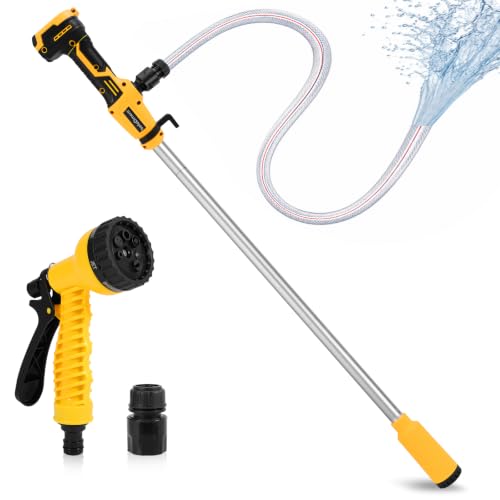
bellaDimora Cordless Stick Water Transfer Pump
Flow
720 GPH / 12 GPM
Maximum Lift
29.5 ft
Battery Platform
DeWalt 20V compatible
The bellaDimora pump is built around DeWalt-compatible 20V batteries, which makes it especially useful if that battery platform is already in your toolshed. It has a documented flow of 720 gallons per hour, or 12 gallons per minute, and a maximum lift of 29.5 feet.
A 3/4-inch outlet connects to a standard garden hose, while the bottom intake includes a removable sediment filter. That combination suits rainwater transfer from a barrel, shallow tank, or pond where some debris may be present. Product-specific use includes fast removal from 50-gallon containers and good resistance to minor dirty-water clogging.
The battery and charger are sold separately. Connection quality also deserves a quick look before you start; isolated use includes leakage where the stick pump joins the hose. Tighten the connection correctly and keep the pump upright during use.
Why It Works
- Compatible with DeWalt 20V batteries.
- 720 GPH gives strong portable flow.
- Maximum lift of 29.5 feet adds useful vertical range.
- 3/4-inch outlet fits standard garden hoses.
- Removable sediment filter helps protect the intake.
What To Keep In Mind
- Battery and charger are sold separately.
- Hose connections should be inspected for leaks.
- Real flow falls as lift and hose resistance increase.
A Higher-Lift DeWalt-Compatible Pump
3 / 4
Wallnetic DeWalt-Compatible Stick Transfer Pump

Flow
Up to 780 GPH
Maximum Head
32 ft
Battery Platform
DeWalt 20V compatible
The Wallnetic stick pump is the better fit when vertical lift is a bigger concern than minimum tool weight. Its documented maximum head is 32 feet, with flow up to 780 gallons per hour. The 3/4-inch outlet is intended for standard garden-hose connections.
A detachable sediment filter at the bottom protects the intake, and the pump includes automatic shutoff after the water runs out for about two minutes. That protection is useful with a barrel or tank that may empty while you are working elsewhere nearby, though portable pumps still deserve supervision.
At about 6.5 pounds and roughly 52 inches long, this is a larger tool than the lightweight alternatives. Battery fit inside the protective housing can also vary with battery size. If you already use DeWalt-compatible 20V batteries, make sure the specific pack physically fits the enclosure before relying on the sealed housing.
Why It Works
- 32-foot maximum head gives the strongest documented lift here.
- Up to 780 GPH provides useful transfer speed.
- Detachable sediment filter helps with rainwater debris.
- Automatic dry-run shutoff adds protection when the source empties.
- Standard 3/4-inch hose outlet simplifies discharge setup.
What To Keep In Mind
- Larger body is less convenient for quick one-bucket jobs.
- Some larger battery packs may not fit inside the protective housing.
- Mud or heavy debris can still clog or damage the pump despite the filter.
An M18 Pump for Hose-to-Hose Water Transfer
4 / 4
Milwaukee M18 Transfer Pump

Maximum Flow
8 GPM
Maximum Lift
18 ft
Use
Water only
The Milwaukee M18 Transfer Pump uses a more traditional above-ground layout. Instead of placing a long pump body into the barrel, you connect a suction hose to the inlet and a discharge hose to the outlet. That is useful when the pump needs to stay on dry ground between two containers.
Its documented maximum flow is 8 gallons per minute with up to 18 feet of lift. Product-specific use includes a roughly 6-foot lift with long discharge hose and sustained pumping from a 5.0Ah battery, showing the format can handle practical water-moving jobs when the suction side is set up correctly.
This pump is water-only. Do not use it for gasoline, diesel, or other petroleum products. For rainwater systems, keep the suction hose and filter suitable for the water quality and avoid letting the pump pull air once the source container empties.
Why It Works
- Up to 8 GPM is useful for tank and barrel transfer.
- Above-ground layout keeps the pump body out of the source water.
- 18-foot maximum lift covers many yard-level transfer jobs.
- M18 platform suits users already invested in compatible batteries.
What To Keep In Mind
- Designed for water, not petroleum transfer.
- Requires a proper suction hose and discharge hose setup.
- Suction leaks or a clogged intake filter can reduce flow sharply.
Stick Pump or Above-Ground Transfer Pump?
A stick pump is easier when the water source is open at the top. Lower the intake into the barrel, attach a discharge hose, and start pumping. It is especially convenient for shallow tanks, rain barrels, and standing water.
An above-ground pump is better when you want the motor to remain dry and can run a suction hose into the source. It can also be easier to connect permanently to hose fittings for repeated transfer between two tanks.
The suction side of an above-ground pump is less forgiving. Air leaks, excessive suction lift, or a clogged intake can stop pumping. Stick pumps avoid much of that because the intake sits directly in the water.
How Much Lift Do You Need?
Measure vertical lift from the water surface to the highest point or discharge elevation the pump must overcome. Do not measure only hose length. A 50-foot hose across level ground is a different load from a 20-foot hose climbing 15 feet uphill.
If the pump will send water to a raised tank, include the final water-level height in your estimate. As the receiving tank fills, the discharge height may effectively increase.
Choose a pump with headroom above the expected lift. Operating at the extreme maximum head usually produces little useful flow.
Battery Runtime and Rainwater Jobs
Runtime depends on battery capacity and pump load. A larger battery can generally move more water, but the pump's battery housing and weight may limit which packs are practical.
For a single 50- or 55-gallon barrel, nearly any suitable battery may complete the transfer if the lift is modest. Moving hundreds of gallons or pumping uphill is a different workload. Keep a charged spare when the job cannot stop halfway through.
Never assume a battery is included unless the specific package says so. Battery-tool products are often sold as bare tools for people who already own the platform.
Protect the Pump From Debris
Rain barrels can collect grit, leaf fragments, roofing particles, insects, and sediment. Even a pump with an intake screen can clog if the bottom of the barrel is dirty.
Keep the intake slightly above heavy sediment when possible. Clean removable filters after use, and stop if flow drops suddenly. Continuing to run a clogged pump can overheat the motor or damage the impeller.
For muddy water, use equipment specifically suited to dirty-water transfer rather than assuming a clean-water stick pump can handle solids.
Frequently Asked Questions
Can a battery-powered pump empty a rain barrel?
Yes. These pumps are well suited to moving water from barrels and tanks when their intake, flow, lift, and battery platform match the job.
How many GPM do I need for a rain barrel?
A 5- to 12-GPM portable pump can empty a typical barrel quickly under low-lift conditions. Higher lift, long hoses, and filters reduce actual flow.
Can I connect a garden hose to a cordless transfer pump?
Several stick pumps here use a 3/4-inch outlet intended for standard garden hoses. Use the connection size specified for the exact pump.
Can I use a water transfer pump for gasoline or diesel?
No unless the pump is specifically designed and approved for that fluid. The Milwaukee M18 transfer pump here is water-only.
Is maximum head the same as hose length?
No. Maximum head mainly describes the vertical lift the pump can overcome. Hose length adds friction but is not the same measurement.
Should I use a battery pump for dirty rainwater?
Only within the pump's debris-handling limits. Use the intake filter, keep heavy sediment away from the pump, and choose a dirty-water pump when solids are substantial.
For no-battery transfer, hand pumps for water barrels work anywhere and give controlled output. When gravity can do the ongoing work, siphon pumps for water barrels are lighter and simpler. If a drill is already part of your tool kit, drill pumps for water transfer turn that motor into a compact transfer setup. For a fixed rainwater system that needs repeatable powered flow, rain barrel pumps are the better next comparison.