

As an affiliate, we may earn a commission from qualifying purchases. We get commissions for purchases made through links on this website from Amazon and other third parties.
Best Overall
Best for Continuous-Duty Transfer
Best for Higher Discharge Head
A transfer pump is useful when gravity will not move rainwater fast enough from one tank to another, from storage to a garden, or out of a container before cleaning. The best pump depends less on the tank size than on where the water starts, where it must go, and what power is available.
The five pumps here cover several distinct jobs. Milwaukee's M18 model is the cordless choice when an outlet is not nearby. Superior Pump 90050 is a heavier corded unit designed for continuous-duty general transfer. Liberty Pumps 331 provides much more documented discharge head and pressure for demanding moves. SumpMarine is a small 115-volt pump for modest flow, while Wayne PC2 is a compact 120-volt option with a low-suction attachment.
Surface transfer pumps are different from submersible pumps. They stay out of the water and pull through a suction hose. That makes hose sealing, priming, and suction lift critical. A tiny air leak on the inlet side can stop a pump from moving water even when no water is visibly leaking out.
Quick Comparison
| Pump | Best For | Power | Useful Performance Detail | Main Tradeoff |
|---|---|---|---|---|
| Milwaukee M18 | Portable tank-to-tank transfer | Battery | About 8 GPM documented maximum; up to 18 ft lift | Battery and tool platform required |
| Superior Pump 90050 | Longer supervised transfer runs | AC | Up to 1,500 GPH; 1/2 HP continuous-duty motor | Heavy and sensitive to hose restriction |
| Liberty Pumps 331 | Higher-head transfer | Corded electric | Up to 40 psi; 105-ft discharge head; 15-ft suction lift | Not intended for permanent installation |
| SumpMarine 330 GPH | Small barrels and controlled transfer | 115V corded | 330 GPH; up to 39-ft discharge lift | Needs priming and can run hot |
| Wayne PC2 | Low-suction portable cleanup | 120V corded | Suction attachment drains down to about 1/8 in | Seal and impeller failures need attention |
Choose the Pump From the Water Path
A transfer pump has two sides. The suction side pulls water to the pump. The discharge side pushes water away. Those sides have different limits.
A pump may push water a long way uphill but still have a modest suction-lift limit. Keep the pump as close to the source water level as practical. A short, airtight suction hose is easier for a surface pump than a long hose trying to lift water several feet before it ever reaches the motor.
The discharge side can usually be longer, but hose diameter matters. Narrow hose creates more friction. If a larger pump seems weak through a long garden hose, the restriction may be the hose rather than the motor.
Cordless Transfer Where AC Power Is Inconvenient
1 / 5
Milwaukee 2771-20 M18 Transfer Pump

Power
M18 battery
Maximum Flow
8 GPM
Maximum Lift
18 ft
The Milwaukee M18 transfer pump has the clearest portability advantage here. It runs from Milwaukee's 18-volt battery platform instead of a cord, so it can move rainwater between tanks, drain a barrel, or feed a temporary hose where an outdoor receptacle is inconvenient. That is especially useful around detached sheds, garden plots, or temporary storage containers.
The pump is documented around an 8 GPM maximum flow and an 18-foot lifting height. A real setup with a suction filter, several feet of lift, and a long discharge hose can still move useful water without being so fast that a small barrel disappears in a minute. Battery runtime depends on pack size, lift, hose restriction, and actual flow.
The key limitation is fluid type. This pump is for water transfer. It should not be repurposed for gasoline, diesel, or other fuels. Impeller damage can follow when the wrong liquid is used. It is also a tool-only style purchase in many configurations, so the value is strongest when you already use the M18 battery system.
Why It Works
- Cordless operation solves the biggest practical problem when tanks are far from AC power.
- About 8 GPM maximum is useful for controlled tank-to-tank transfer and garden-water movement.
- Portable layout makes one pump practical for several storage containers.
What To Keep In Mind
- Battery runtime changes with pack capacity and the difficulty of the water path.
- Intended for water, not petroleum products or other unsupported liquids.
- Suction filtering and airtight connections still matter even though the motor is cordless.
A Heavier Continuous-Duty Transfer Pump
2 / 5
Superior Pump 90050 1/2 HP Transfer Pump
Motor
1/2 HP
Maximum Flow
1,500 GPH
Ports
3/4-in NPT suction and discharge
Superior Pump 90050 is the more substantial corded option for longer general-transfer jobs. Its 1/2 HP motor is documented for continuous duty and can move up to 1,500 gallons per hour under favorable conditions. The suction and discharge ports are 3/4-inch NPT, and the package includes garden-hose adapters, a suction strainer, and spare motor brushes.
The extra motor size is most useful when you regularly transfer larger volumes rather than moving a few gallons from a barrel. It can serve tank-to-tank moves, water-heater draining, and other general clean-water transfer tasks. The built-in handle keeps it portable even though its roughly 17-pound body is much heavier than the compact pumps here.
The pump is sensitive to system resistance. Small hoses and vertical lift can reduce delivered flow dramatically, and the unit still requires correct priming and suction conditions. It is explicitly not recommended as a sprinkler pump or booster pump, so do not choose it expecting household-like pressure at a distant irrigation head.
Why It Works
- 1/2 HP continuous-duty motor suits longer transfer sessions better than tiny portable utility pumps.
- Up to 1,500 GPH provides useful capacity for larger rainwater tanks.
- Garden-hose adapters and suction strainer cover common temporary-transfer connections.
What To Keep In Mind
- Smaller hoses can sharply reduce output.
- Heavy compared with compact 1/10 HP pumps.
- Not intended as a sprinkler or pressure-booster pump.
More Head for Uphill or Longer Discharge Runs
3 / 5
Liberty Pumps 331 1/2 HP Portable Transfer Pump

Motor
1/2 HP
Maximum Pressure
40 psi
Maximum Discharge Head
105 ft
Liberty Pumps 331 stands out when the discharge side is the hard part of the job. Its documented performance includes up to 40 psi, a maximum discharge head of 105 feet, and up to 15 feet of vertical suction lift. Those figures give it a very different role from a small utility pump meant mainly to move water across a level yard.
The cast-aluminum pump and motor housing includes a carry handle and on/off switch, and the bearings are permanently lubricated. This is still a portable transfer pump, not a permanent installed pressure system. It makes the most sense when you occasionally need to move stored water uphill, through a longer run, or into another container at a higher elevation.
Service experience varies. Some units have lasted through repeated work, while others developed early failures or arrived with switch problems. Inspect a new pump and test it with clean water before depending on it for a critical transfer. Because the prepared overall dimension and flow fields are inconsistent, the supported pressure, head, suction-lift, motor, and portable-use details are the safer basis for comparison.
Why It Works
- 105-foot maximum discharge head gives it the strongest documented uphill-transfer role here.
- Up to 40 psi provides more pressure capability than the small barrel-transfer pumps.
- Aluminum housing and integrated handle keep a substantial 1/2 HP pump portable.
What To Keep In Mind
- Not intended for permanent installation.
- Test the switch and pump operation before relying on it for a large move.
- High head capability does not mean maximum flow is available at the highest elevation.
A Small 115-Volt Pump for Controlled Transfer
4 / 5
SumpMarine 115V 330 GPH Water Transfer Pump
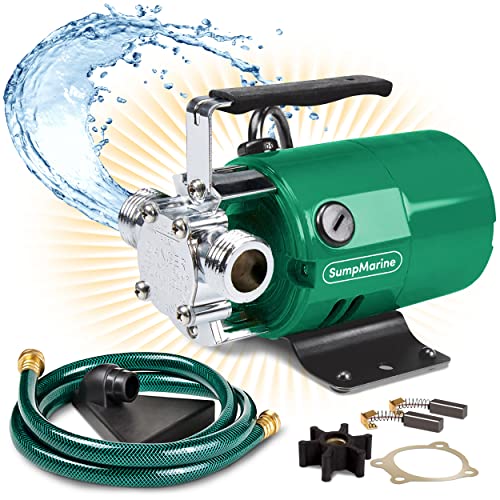
Maximum Flow
330 GPH / 5.5 GPM
Maximum Lift
39 ft
Motor
1/10 HP
SumpMarine is the compact choice when you do not need the flow or weight of a 1/2 HP transfer pump. Its 1/10 HP motor moves up to 330 GPH, or 5.5 GPM, and the documented maximum lift is 39 feet. That combination suits modest barrel draining, small tank transfers, and nearby garden-water movement.
The package includes a six-foot suction hose, water-suction attachment, and replacement impeller. It must be primed according to the directions before operation, and the suction attachment needs to stay submerged. Once the inlet starts pulling air, performance drops quickly.
Heat is the main practical caution. The pump housing can become very hot, and repeated or long operation has caused thermal shutdown or early failure in some uses. Treat it as a compact work pump, not a machine to leave running unattended for hours.
Why It Works
- 5.5 GPM maximum is easy to control for smaller tanks and barrels.
- 39-foot maximum lift provides useful discharge capability from a small motor.
- Included suction hose and impeller kit cover basic portable-transfer needs.
What To Keep In Mind
- Requires priming and must not run dry.
- Housing can become very hot during use.
- Not the best choice for long, high-volume continuous transfers.
A Low-Suction Pump for Draining Close to the Bottom
5 / 5
WAYNE PC2 Portable Transfer Water Pump

Power
120V
Included Suction Hose
6 ft
Low-Water Attachment
Down to about 1/8 in
WAYNE PC2 is a compact 120-volt surface pump with a six-foot suction hose and low-water attachment. Its clearest advantage is the ability to pull water down to roughly 1/8 inch when the attachment can sit flat and remain submerged. That is useful when a tank or barrel needs to be emptied more completely before cleaning.
The pump uses a bronze-plated pump section intended to resist thread damage better than lightweight plastic pump bodies. It remains portable and can be moved between rain barrels, tanks, or other clean-water transfer jobs.
Impeller and seal condition matter. Running dry can damage the small impeller quickly, and leaks around the pump shaft or fittings have occurred in some units. The prepared flow and overall-dimension fields are not reliable enough to use as purchase claims, so this pump belongs here for its supported 120-volt portable layout, six-foot suction kit, and low-water attachment rather than a headline flow comparison.
Why It Works
- Low-water attachment can remove water close to the bottom before tank cleaning.
- Six-foot suction kit is included for a basic portable setup.
- Compact 120-volt motor makes it easy to move between containers.
What To Keep In Mind
- Do not run the pump dry; the impeller can be damaged quickly.
- Watch shaft and hose connections for leakage.
- Choose another pump when dependable flow or high-head performance is the main requirement.
Priming a Surface Transfer Pump
A surface pump cannot move water if the impeller is spinning in air. Follow the manufacturer's priming directions before startup. Some small transfer pumps require water or another specified priming fluid in the pump head.
Keep the suction hose as short and straight as practical. Every threaded joint, hose clamp, washer, and fitting on the suction side has to stay airtight. An air leak can make the pump lose prime without producing an obvious water drip.
Place the pump low and close to the source. It is easier to push water on the discharge side than to pull it a long vertical distance on the suction side.
Hose Size Can Matter More Than Motor Size
A large pump connected to a narrow hose may deliver less useful water than a smaller pump with a better-sized discharge. Friction rises with hose length, narrow diameter, elbows, filters, and restrictive valves.
For a garden hose, accept that the hose itself sets a practical limit. For fast tank transfer, use larger compatible plumbing when the pump supports it.
Do not reduce a high-capacity outlet immediately just because a garden hose is familiar. Decide how quickly the water needs to move and size the temporary discharge path accordingly.
Keep Transfer Pumps Out of Permanent Pressure Roles
A portable transfer pump is made to move water from point A to point B. It may not have automatic pressure control, dry-run protection, an accumulator, or the duty characteristics needed for a household or irrigation pressure system.
If faucets or irrigation zones need automatic start and stop at a set pressure, use a pump and controls designed for that role. Do not leave a portable pump powered and closed against a shut valve unless its instructions explicitly allow it.
Cleaning, Storage, and Freezing Weather
Move reasonably clean water whenever possible. Roof sediment, grit, and organic debris shorten impeller and seal life. A suction strainer helps, but it does not turn dirty tank-bottom sludge into a good pump fluid.
Drain the pump and hoses after use when they will be stored. Freezing water can crack housings and fittings. Keep corded motors dry and protect battery tools from rain according to their instructions.
Frequently Asked Questions
What is a transfer pump used for in a rainwater system?
It moves stored water between tanks, from a tank to a point of use, or out of storage before cleaning when gravity alone is too slow or cannot overcome the elevation.
Is a transfer pump the same as a booster pump?
No. A transfer pump mainly moves water from one place to another. A booster pump is designed to raise and manage pressure for downstream fixtures or irrigation, often with different controls.
Do surface transfer pumps need priming?
Many do. The pump head and suction path must contain water or be primed according to the manufacturer's directions before the pump can move water reliably.
Can I use a transfer pump with a garden hose?
Yes when the pump has compatible adapters, but hose diameter and length can reduce flow. Larger pumps may work much better with larger transfer hose.
Why does my transfer pump lose suction?
Common causes include air leaks on the suction side, a loose washer, cracked hose, clogged strainer, intake above the water level, or too much suction lift.
Can I leave a portable transfer pump installed permanently?
Only if the manufacturer specifically supports that use. Several portable pumps are intended for supervised temporary transfer and lack the controls needed for a permanent pressure system.
Can a transfer pump move potable rainwater?
Only as one suitable component in a complete potable-water system. The pump materials, collection, treatment, plumbing, maintenance, and current water testing all need to be appropriate for drinking-water use.
If the pump can sit inside the tank instead of pulling through a suction hose, compare submersible pumps for rainwater tanks for that simpler intake layout. Smaller backyard storage may be better served by rain barrel pumps. Where mains power is unavailable, battery-powered water transfer pumps cover cordless options in more detail. For no-power backup, hand pumps for water barrels keep the transfer job manual.



