As an affiliate, we may earn a commission from qualifying purchases. We get commissions for purchases made through links on this website from Amazon and other third parties.
A spin-down filter is a reusable sediment filter that catches grit, sand, rust, and other solid particles before they reach smaller filters, pumps, valves, or irrigation equipment.
For a rainwater system, choose one by matching particle size, water flow, pipe size, pressure, and cleaning needs. Do not choose only by the micron number. A very fine screen can clog quickly and reduce flow if the water carries a lot of debris.
A spin-down filter is usually best used as a prefilter, not as the only treatment stage.
What Does a Spin-Down Filter Do?
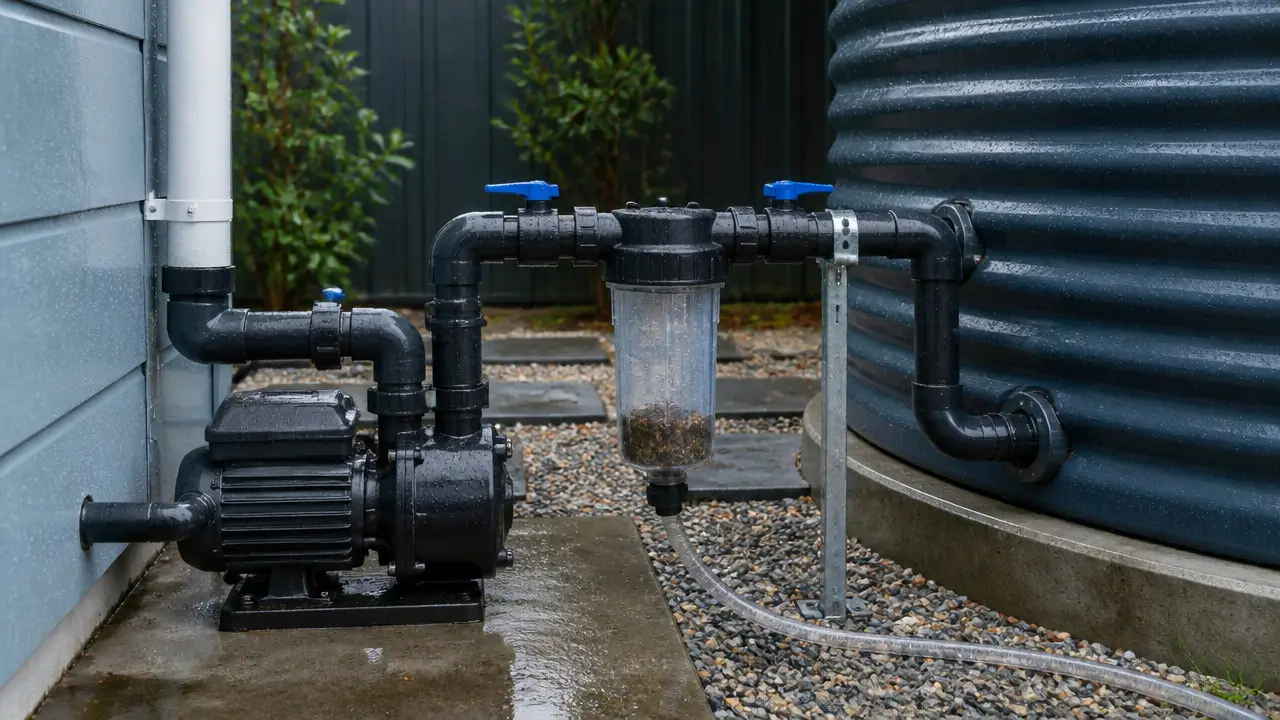
A spin-down filter uses a removable screen inside a clear or enclosed housing. Water passes through the screen while sediment is trapped inside the filter. Many designs direct water in a swirling pattern that helps larger particles collect near the bottom.
A valve at the bottom lets you purge, or flush, some of that collected sediment without taking the whole filter apart.
Spin-down filters work well for particles such as:
- Sand
- Grit
- Rust flakes
- Small pieces of leaves or roofing debris
- Sediment from a tank
- Other suspended solids large enough for the screen to catch
Screen filters are generally better at catching inorganic particles such as sand than they are at handling large amounts of algae or soft organic material. Organic debris can coat a screen and make it clog quickly.
That difference matters with rainwater because tank water may contain both mineral sediment and organic material.
Start With What the Water Will Be Used For
The right filter depends partly on what comes after it.
Garden hoses and general outdoor use
For basic garden watering or washing, the main goal may simply be keeping visible sediment out of hoses, valves, and nozzles.
A relatively coarse spin-down screen may be enough if your water does not need finer filtration downstream.
Drip irrigation
Drip systems need more careful filtration because small emitter passages can clog.
Do not guess at the required mesh or micron rating. Check the emitter manufacturer's filtration requirement. Extension guidance recommends sizing filtration around the smallest particles that could block the emitter.
The spin-down filter may be the main filter when the water is fairly clean, or it may serve as the first stage before a finer screen or disc filter.
Pumps and household reuse systems
A spin-down filter can help protect valves, fixtures, and downstream treatment equipment from larger sediment.
For example, a system might be arranged as:
Tank → pump → spin-down sediment filter → finer treatment → intended use
The exact order can change with the pump design and filter pressure requirements. A filter should not be placed on a pump suction line unless the pump and filter manufacturers allow that arrangement. Too much restriction on the suction side can cause pump problems.
Drinking-water systems
A spin-down filter does not make collected rainwater safe to drink.
It removes certain physical particles. It does not by itself establish that germs, dissolved chemicals, metals, or other contaminants have been removed.
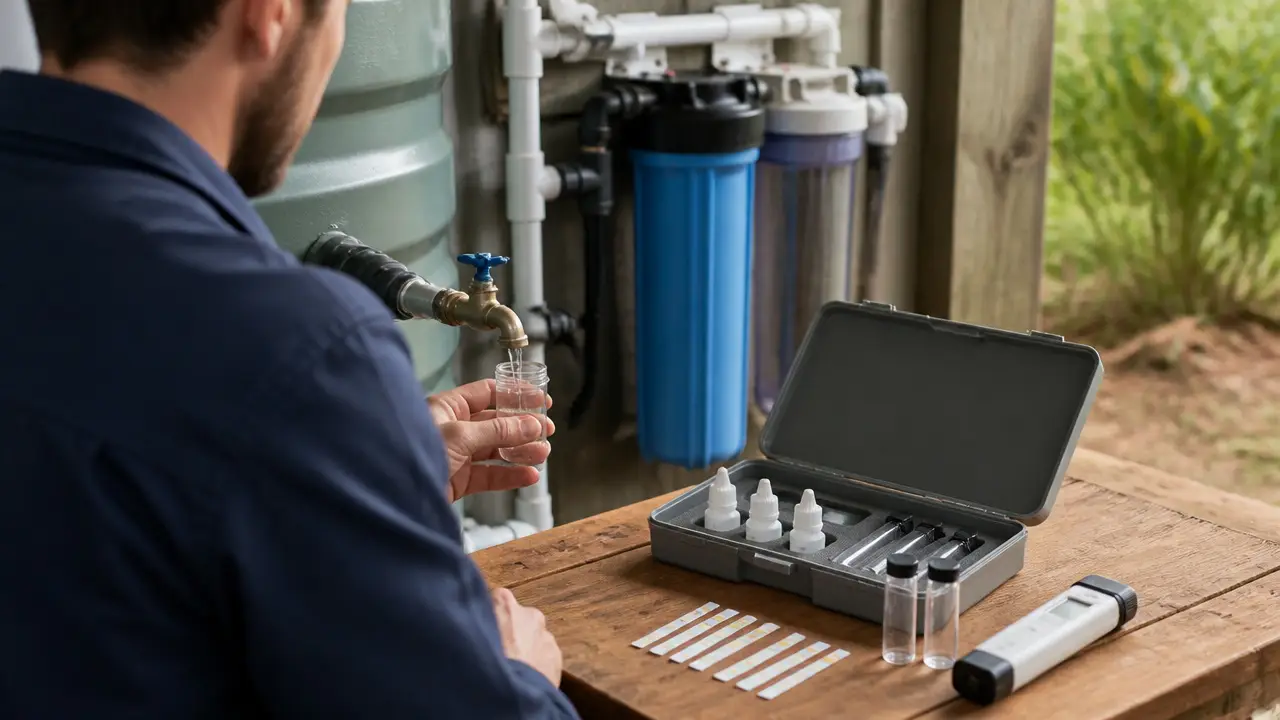
CDC guidance notes that roof-collected rainwater can contain germs and chemicals even when it looks clean. Drinking-water use requires suitable collection, treatment based on the contaminants present, regular testing, maintenance, and compliance with applicable local requirements.
Think of the spin-down filter as one possible prefiltration stage, not a complete drinking-water treatment system.
Choose the Right Micron Rating
The micron rating tells you roughly how small the openings in the filter screen are.
One micron is 0.001 millimeter.
A smaller micron number means finer filtration:
- 500 microns is relatively coarse.
- 200 microns is finer.
- 100 microns is finer still.
- 50 microns catches smaller particles than a 100-micron screen.
The problem with simply choosing the smallest number is that finer screens usually collect debris faster.
A filter that is too fine for dirty rainwater may need constant flushing and can create excessive pressure loss.
Use staged filtration when needed
Instead of asking one screen to catch everything, it is often better to remove sediment in stages.
For example:
Tank → coarse spin-down filter → finer sediment filter → other treatment
The coarse stage catches larger grit. That reduces the load on the finer filter.
If a 50-micron filter keeps clogging with large particles, putting a coarser screen ahead of it may be more practical than repeatedly cleaning the fine screen.
Mesh and Microns Are Not the Same Thing
Spin-down screens may be labeled in either mesh or microns.
Mesh describes the number of openings across an inch of screen. Higher mesh numbers generally mean smaller openings.
Microns describe the actual size of the opening or particle.
Do not rely on a universal mesh-to-micron conversion. Opening size also depends on the wire or screen construction. Check the manufacturer's stated opening size when comparing filters.
For irrigation, use the filtration requirement provided for the emitters rather than choosing a mesh number because it is commonly used on another system.
Match the Filter to Your Sediment
Look at what is actually reaching the filter.
Mostly sand or grit
A spin-down screen is well suited to relatively large mineral particles.
If the system carries a very heavy sand load, another separator or settling stage may make sense before the screen. Irrigation guidance commonly uses centrifugal separators ahead of filters where large amounts of sand are present.
Fine silt
Very fine silt is harder to manage with a basic screen.
Making the screen finer may catch more material, but it can also cause rapid clogging and pressure loss.
If fine sediment is a constant problem, the system may need better settling, tank cleaning, or another type of filtration rather than an extremely fine spin-down screen.
Leaves and roof debris
Large debris should ideally be stopped before it enters the tank.
Gutter screens, inlet screens, and suitable pre-tank debris control keep large material from becoming a downstream filtration problem. A first-flush diverter may also divert some of the initial roof runoff that carries accumulated dirt and contaminants. CDC recommends system design and maintenance measures such as inlet screening and first-flush diversion to improve collected rainwater quality.
A spin-down filter should not have to compensate for poor roof-level debris control.
Algae and soft organic material
A standard screen may clog rapidly when water contains a heavy load of algae or organic debris.
Screen filters are less effective for heavy organic loads than for sand and similar inorganic particles.
If the screen repeatedly becomes coated with soft material, changing to an even finer screen usually will not solve the underlying problem. Check tank light exposure, tank cleanliness, inlet conditions, and whether another filtration method is more suitable.
Check the Required Flow Rate
A filter must be able to pass enough water for everything operating downstream.
Flow rate means how much water moves through the system over a given time, often stated in gallons per minute or liters per minute.
Add up the expected demand when multiple outlets may run together.
For example, a filter serving one garden hose has a different job from a filter serving:
- Several irrigation zones
- A transfer pump
- Toilets and outdoor taps
- Multiple fixtures at once
Do not size the filter only from its pipe connection.
A filter with a 1-inch port does not automatically provide adequate flow for every 1-inch piping system.
Check the manufacturer's flow rating at the filtration level you plan to use.
Pay Attention to Pressure Loss
Every filter creates some resistance to water flow.
As the screen fills with sediment, that resistance increases.
The result can be:
- Lower pressure at sprinklers
- Weak hose flow
- Poor drip-system performance
- Longer pump run times
- Reduced flow through later treatment stages
In pressurized systems, gauges installed before and after the filter can show the pressure difference across it.
Review sizing a water filter for the required flow to verify the difference between a screening result and a safety finding.
Irrigation guidance recommends watching this pressure difference because a rising pressure drop is a useful sign that a screen needs cleaning.
Follow the filter manufacturer's cleaning limit rather than waiting until water flow becomes obviously poor.
Make Sure the Pressure Rating Fits the System
Check the filter's maximum working pressure before installing it.
This is especially important if the filter will be used with:
- A pressure pump
- A pressure tank
- Municipal backup water
- An irrigation pump
- Automatic valves
Do not assume a filter designed for a low-pressure garden system can safely handle a higher-pressure household system.
The housing, bowl, screen, valves, fittings, and connected piping all need appropriate pressure ratings.
For gravity-fed rainwater, the opposite problem can occur. The system may not produce enough pressure or flow for the filter to work or flush as intended.
Match the Connection Size
Choose a filter that fits the plumbing without creating an unnecessary bottleneck.
Check:
- Inlet size
- Outlet size
- Thread type
- Male or female threads
- Pipe material
- Flow direction
- Space needed for adapters
Using a series of reducers to fit a small filter into a large main line can add restriction.
If you have a 1-inch rainwater main, for example, it generally makes sense to start by considering filters intended for that flow and connection range rather than automatically reducing the system to a much smaller filter.
Also verify the actual thread standard. Connections that appear to be the same diameter are not always compatible.
Check the Flush Valve
One of the main advantages of a spin-down filter is easy sediment removal.
Look at how the bottom purge valve will work in your installation.
You need enough room to:
- Operate the valve.
- Direct dirty water somewhere appropriate.
- Remove the screen when deeper cleaning is required.
A flush valve does not mean the filter never needs to be opened.
Sediment can stick to the screen instead of dropping out of the housing. Periodically removing and washing the screen may still be necessary.
Consider a Larger Filter for Dirty Water
Two filters can use the same micron screen but behave very differently if one has much more screen area.
A larger filtering surface can usually hold more debris before restriction becomes severe.
This matters when rainwater contains regular sediment.
Screen-filter sizing guidance considers water quality, flow, filtration area, and allowable pressure loss rather than micron rating alone.
If you are constantly cleaning an appropriately rated screen, the issue may not be the micron size. The filter may simply be too small for the sediment load and water demand.
Decide Where the Filter Should Go
Placement depends on what you are trying to protect.
Before the storage tank
A conventional pressurized spin-down filter is usually not the best device for stopping leaves and large roof debris before storage.
Use suitable gutter and inlet screening for that job.
After the tank
This is a common location when the goal is removing settled sediment before water reaches irrigation equipment or further treatment.
Try to avoid drawing water directly from the deepest sediment layer at the bottom of the tank.
Around a pump
Follow the pump manufacturer's requirements carefully.
Filters installed on a pump's suction side can add restriction. In many systems, sediment filtration is better placed after the pump, where the filter operates under positive pressure.
However, a pump may still need protection from damaging debris on its inlet side. The correct arrangement depends on the pump, tank outlet, water quality, and manufacturer's instructions.
Before fine treatment equipment
A spin-down filter can reduce the sediment load reaching smaller cartridge filters or other treatment equipment.
That can make later stages easier to maintain.
Do not assume, however, that installing a spin-down filter automatically meets the inlet-water requirements of another treatment device. Check the downstream equipment requirements separately.
Think About Cleaning Before You Buy
A filter that is difficult to clean tends to get neglected.
Before choosing one, picture the actual installation.
Can you:
- See the sediment?
- Reach the flush valve?
- Put a bucket or drain below it?
- Remove the screen without dismantling the plumbing?
- Shut off the water easily?
- Clean it safely during freezing weather?
Leave enough clearance around the filter for maintenance.
Do not bury it behind permanent walls or equipment unless you have proper service access.
Plan for Freezing Conditions
Water trapped inside a filter housing can freeze.
Freezing can damage the housing, valves, fittings, or screen assembly.
If your rainwater plumbing is exposed to freezing temperatures, the filter needs to be part of the system's overall freeze plan. Depending on the installation, this may involve locating equipment in protected space or designing piping so exposed sections can be properly taken out of service and drained.
Do not depend on the drain valve alone unless the filter manufacturer specifically states that the unit can be completely winterized that way.
When a Spin-Down Filter Is the Wrong Choice
A spin-down filter is useful, but it cannot solve every sediment problem.
Consider another approach when:
- Heavy algae constantly coats the screen.
- Very fine suspended material passes through.
- The filter needs flushing unusually often.
- Pressure loss is too high for the available water supply.
- The water contains contaminants that sediment filtration cannot remove.
- Your treatment equipment requires finer or different pretreatment.
Disc filters can hold more debris than some simple screens, while media filtration may be more suitable for certain heavy contaminant loads. The right choice depends on the water and the equipment being protected.
A Simple Way to Choose
For most rainwater systems, work through these questions in order:
- What am I protecting? Identify the irrigation emitters, pump, valve, cartridge filter, fixture, or other equipment downstream.
- What particle size needs to be removed? Use the downstream equipment manufacturer's requirement when one is provided.
- What kind of debris is present? Sand and grit behave differently from algae and fine silt.
- How much water must pass through the filter? Size for the highest likely system flow, not just average use.
- What pressure will the filter see? Make sure the housing and fittings are suitable for the system.
- Will the connections fit correctly? Check pipe size and thread type.
- Can the filter be flushed and opened easily? Good service access matters over the life of the system.
A good spin-down filter is not simply the finest one you can find. It is the one that removes the sediment that matters without creating excessive restriction or unreasonable cleaning work.
Frequently Asked Questions
What micron spin-down filter should I use for rainwater?
There is no single micron rating that fits every rainwater system. Choose the rating based on the debris in the water and the equipment downstream. Coarser screens are often useful for first-stage sediment removal, while finer filtration can be added later when needed.
Is a 50-micron filter better than a 100-micron filter?
Not always. A 50-micron screen catches smaller particles, but it can also clog faster and create more restriction. If 100-micron filtration adequately protects the equipment downstream, choosing a finer screen may only increase maintenance.
Can I use a spin-down filter for drip irrigation?
Yes, when its filtration rating, flow capacity, and pressure range meet the irrigation system's requirements. Check the emitter manufacturer's required filtration level. Some systems may need additional filtration, especially when rainwater contains significant organic debris.
Should a spin-down filter go before or after the pump?
Many pressurized filters are installed after the pump because putting a restrictive filter on the suction side can interfere with pump operation. The correct arrangement depends on the pump and filter design, so follow both manufacturers' installation requirements.
How often should I flush a spin-down filter?
Flush it when sediment accumulation or rising pressure loss shows that cleaning is needed. The interval may range widely because it depends on water quality, screen size, filter area, and water use. Inspect a new installation frequently at first so you can learn how quickly your system collects sediment.
Does a spin-down filter remove bacteria from rainwater?
A typical spin-down sediment filter should not be treated as a bacteria-removal device. Its purpose is mainly to remove physical particles. Rainwater intended for drinking requires a complete treatment and testing plan appropriate to the contaminants present.
Can a spin-down filter remove algae?
It may catch some pieces of algae, but screen filters can clog quickly when water contains a heavy organic load. Repeated algae problems are better addressed by checking the storage conditions and choosing filtration suited to the actual contaminant load.
Can I put two spin-down filters in series?
Yes. Staged filtration can be useful when one filter removes coarse sediment and another catches smaller particles. The filters still need enough flow capacity, and the combined pressure loss must be acceptable for the system.