As an affiliate, we may earn a commission from qualifying purchases. We get commissions for purchases made through links on this website from Amazon and other third parties.
The right sediment filter depends on what you need to remove, how much water must flow through it, and where it fits in your system. For most rainwater systems, do not choose a filter by micron rating alone.
Start by checking the dirt in your water. Large grit and leaves need a coarse filter. Fine silt may need a much smaller micron rating. Then make sure the filter housing, pipe size, flow rate, pressure rating, and replacement cartridge all match your setup.
A sediment filter removes suspended particles. It does not make collected rainwater safe to drink by itself.
What Does a Sediment Filter Remove?
Sediment filters are made to catch solid particles such as:
- Sand
- Grit
- Rust
- Dirt
- Fine roof debris
- Some visible silt
They do not normally remove dissolved minerals, salts, chemicals, bacteria, or viruses.
That difference matters. Water can look clear after sediment filtration and still contain contaminants that a sediment filter cannot remove.
For non-potable uses such as garden watering, tank cleaning, or some utility uses, sediment control may be the main goal. Drinking-water systems need a broader treatment plan based on the collection surface, water quality, intended use, current laboratory testing, maintenance, and local requirements.
Start With Your Intended Water Use
The best filter for a garden line may be very different from the best filter for a pump-fed household system.
Garden irrigation
A sediment filter can help keep dirt from clogging valves, small emitters, and spray nozzles.
Drip irrigation usually needs finer filtration than a basic garden hose because its openings are smaller. Check the irrigation equipment manufacturer's filtration requirements before choosing a micron rating.
Washing and other household reuse
If rainwater feeds toilets, a washing machine, or other fixtures, you may want finer sediment filtration so particles do not reach valves and appliances.
The filter must also handle the required household flow without causing a large pressure drop.
Pumps and pressure systems
A filter may help protect downstream equipment, but placement matters.
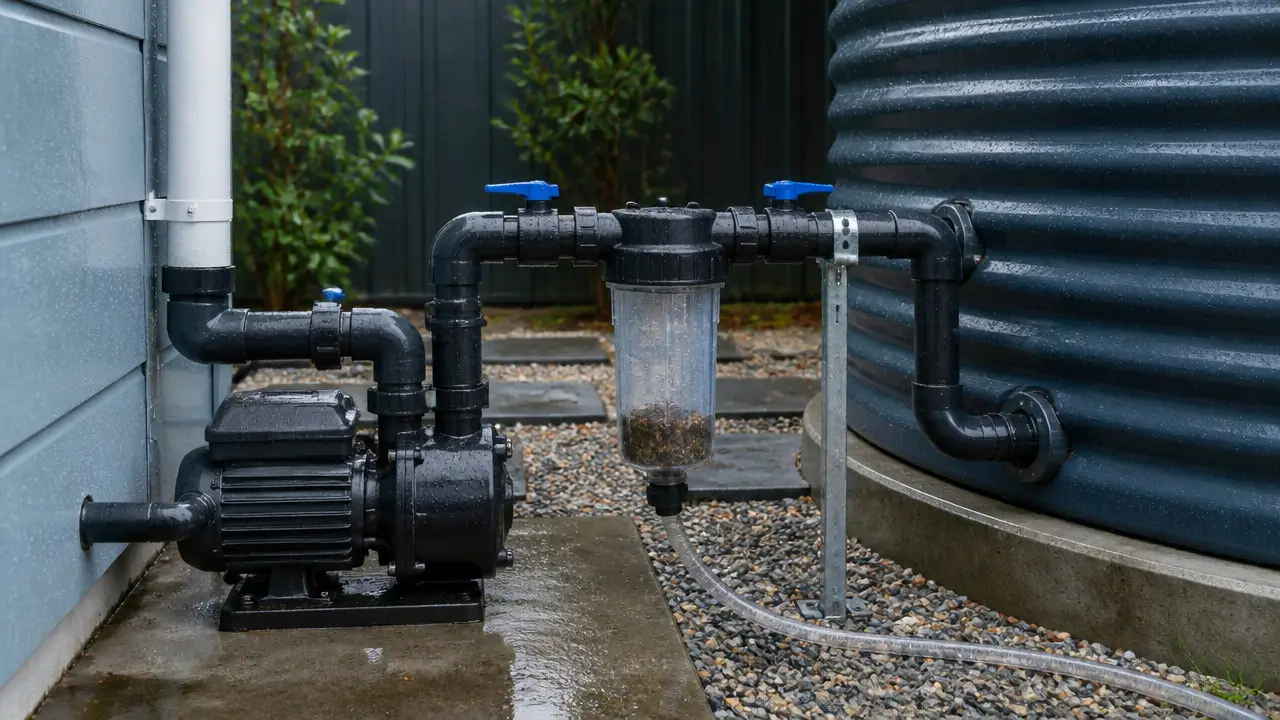
A very restrictive cartridge on the suction side of a pump can starve the pump of water. Many systems are better arranged so coarse debris is removed before the tank, with finer filtration placed where the pump and filter manufacturers allow it.
Drinking-water treatment
Do not select one sediment cartridge and assume the water is potable.
Potable means suitable for drinking.
Sediment filtration may be one stage of a drinking-water system, but safe treatment can also require suitable collection practices, prefiltration, additional treatment stages, proper maintenance, current laboratory testing, and compliance with local requirements.
Understand Micron Ratings
A micron is one-thousandth of a millimeter. A filter's micron rating gives you an idea of the size of particles it is designed to catch.
A lower micron number means finer filtration.
For example:
- A coarse filter catches larger particles.
- A medium filter catches smaller sediment.
- A fine filter catches much smaller particles.
That does not mean the smallest micron rating is automatically best.
A very fine filter can clog quickly if the water contains a lot of dirt. It can also reduce flow and pressure.
The goal is to use the coarsest filter that adequately protects the equipment or water use downstream.
Nominal and Absolute Ratings Are Not the Same
You may see sediment filters described as having either a nominal or absolute micron rating.
A nominal rating means the filter catches a large portion of particles around the stated size, but the exact percentage can vary by manufacturer.
An absolute rating generally refers to a more tightly defined particle-removal level.
Do not assume two cartridges marked with the same micron number will perform exactly the same way. Compare the manufacturer's definition and performance information.
Consider Using More Than One Filtration Stage
Dirty rainwater often works better with filtration in stages rather than forcing everything through one fine cartridge.
A typical approach may look like this:
Roof and gutters → leaf/debris screening → first-flush or inlet treatment where appropriate → storage tank → coarse sediment filtration → finer sediment filtration if needed → intended use
A first flush system diverts an initial portion of roof runoff that may contain concentrated dirt and debris. It can reduce the load entering storage, but it does not make the remaining water safe to drink.
Staged filtration can help a fine filter last longer.
For example, if water carries visible grit and fine silt, a coarse reusable screen or spin-down filter may catch the larger material before a cartridge handles the smaller particles.
Look at What Your Water Is Actually Carrying
Before buying a filter, inspect your system.
Check:
- The bottom of the tank for settled sediment
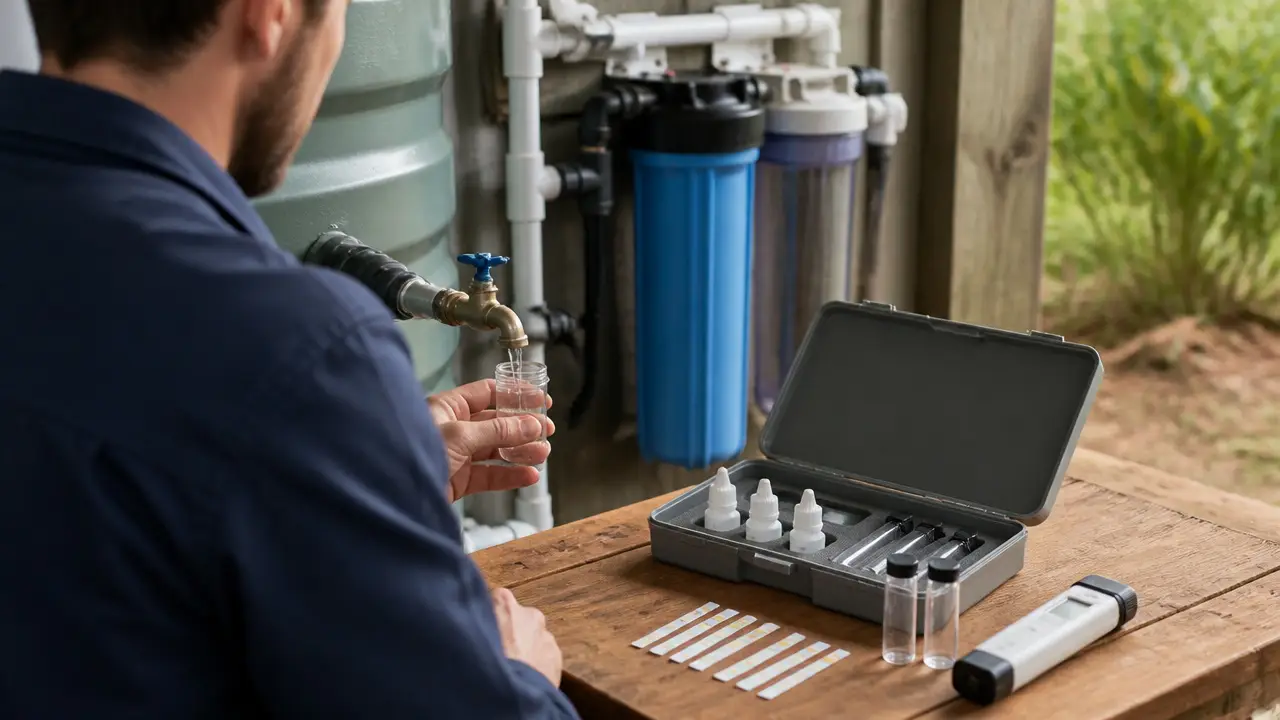
- A clear container of freshly pumped water
- Faucet or irrigation screens for trapped debris
- Existing filters for the type of material they collect
- Roof and gutter screens for excess debris
Visible grains or sand suggest you should remove coarse particles first.
Cloudy water that settles slowly may contain finer suspended sediment.
If cartridges become packed with dirt very quickly, the problem may not be the cartridge itself. The system may need better debris control before storage or a coarse filtration stage ahead of the fine filter.
Match the Filter to Your Required Flow Rate
A filter must pass enough water for everything that may operate at the same time.
Flow rate is the amount of water moving through the system during a given period, often stated in gallons per minute or liters per minute.
A filter that works well on a single garden tap may be too restrictive for a house supplied by a pressure pump.
Check the manufacturer's rated flow for the filter housing and cartridge.
Remember that flow usually gets worse as a sediment cartridge becomes dirty.
Do not size the system based only on how it performs with a brand-new cartridge.
Watch for Pressure Drop
Every filter creates some resistance to water flow.
That resistance causes a difference in pressure between the inlet and outlet of the filter. This is called pressure drop.
Pressure drop generally increases when:
- The micron rating becomes finer
- The cartridge becomes dirty
- The flow rate increases
- The cartridge or housing is undersized
If pressure becomes noticeably weaker after installing a filter, the cartridge may be too restrictive, too small for the required flow, or already clogged.
Pressure gauges before and after a filter can make this easier to diagnose in larger pressure systems.
Choose the Right Filter Size
Sediment cartridges come in different lengths and diameters.
A larger filter can often:
- Hold more sediment
- Support greater flow
- Last longer between changes
- Produce less pressure loss at a given flow
But a bigger housing takes more space and may cost more to maintain.
Choose based on your system demand rather than simply buying the largest filter you can fit.
With putting a sediment filter before the pump, you can interpret a treatment standard based on the final water application.
For a whole-house rainwater system, a small filter designed for one drinking-water tap may be too restrictive.
Check the Connection Size
The filter must connect properly to your plumbing.
Check the inlet and outlet thread size before buying.
A filter housing with very small ports can restrict a high-flow system even if you connect it to larger pipes using adapters.
Also check:
- Thread type
- Pipe material
- Hose or pipe diameter
- Available installation space
- Direction of flow
- Whether shutoff valves can be installed nearby
Avoid building a system from adapters unless you have confirmed that all threads and fittings are compatible.
Make Sure the Housing Can Handle Your Pressure
Filter housings have operating limits.
If your system uses a pressure pump, check the housing's allowable operating pressure and temperature against the actual system.
A pressure switch, pump controller, or pressure tank can allow system pressure to rise much higher than gravity-fed tank pressure.
Do not install an unverified housing in a pressurized plumbing system.
If you are unsure about plumbing pressure, pressure relief, or household connections, have the system checked by a qualified plumber or water-system professional.
Choose a Filter Material That Fits the Job
Sediment cartridges are available in several designs.
Pleated filters
Pleated cartridges have folded filter material that provides a large surface area.
They can work well where sediment loading is moderate. Some models are washable and reusable, although reuse depends on the manufacturer's instructions and the condition of the cartridge.
Spun or melt-blown filters
These cartridges use layers of synthetic material to trap sediment through their depth.
They are often useful for fine particles but are normally replaced rather than thoroughly cleaned.
String-wound filters
String-wound cartridges trap sediment within layers of wound material.
They can handle a range of sediment sizes, depending on their construction.
The best style depends on the type and quantity of sediment, required flow, and how often you are willing to service the filter.
Do Not Ignore Filter Housing Compatibility
Cartridges that look similar are not always interchangeable.
Before buying replacements, verify:
- Cartridge length
- Cartridge diameter
- End style
- Housing type
- Gasket or sealing arrangement
- Maximum operating conditions
- Manufacturer compatibility information
A cartridge that is slightly too short or does not seal correctly may let water bypass the filter media.
Think About Maintenance Before Buying
Sediment filters are maintenance items.
Choose a setup you can easily reach, inspect, drain, and service.
Allow enough room below the housing to remove the filter bowl and cartridge.
It also helps to have shutoff valves so you do not have to drain a large section of the system each time you replace the filter.
Inspect filters more often when:
- A tank has recently collected dirty runoff
- Roof debris is heavy
- Sediment has been disturbed at the bottom of a tank
- Water flow begins to drop
- Pump operating conditions change
Replace or clean cartridges according to the manufacturer's instructions and actual system conditions.
Do not rely only on a fixed calendar schedule. A filter may clog much sooner in a dirty system.
A Simple Way to Choose
For most rainwater systems, work through these questions in order:
- What will the water be used for? A garden line has different needs from household plumbing.
- What particles are causing problems? Identify whether you have grit, sand, visible dirt, or fine silt.
- Can larger debris be removed earlier? Improve gutter screens, tank inlet filtration, or coarse filtration before relying on a fine cartridge.
- What micron rating does downstream equipment require? Follow pump, irrigation, appliance, or treatment-system requirements where provided.
- How much flow do you need? Make sure the housing and cartridge can supply your peak demand.
- What pressure will the filter see? Confirm that the housing is suitable for the system.
- Will it fit your plumbing? Check ports, threads, cartridge dimensions, and installation clearance.
- Can you maintain it easily? Filters that are difficult to reach often get neglected.
If you are unsure between two micron ratings, using a coarse stage followed by a finer stage is often more practical than sending dirty water directly through one very fine cartridge.
Common Sediment Filter Buying Mistakes
Buying the finest filter available
Finer is not always better. An unnecessarily fine cartridge can clog quickly and reduce pressure.
Ignoring flow rate
A filter can have the right micron rating and still be too small for the system.
Filtering dirty water in one step
Heavy sediment can quickly overwhelm a fine cartridge. Remove larger debris first.
Choosing by pipe size alone
Large filter ports do not automatically mean the cartridge can handle a high flow rate.
Assuming sediment filtration makes water safe
Removing visible dirt does not establish drinking-water safety.
Buying cartridges before checking the housing
Similar-looking cartridges may differ in length, diameter, sealing method, or intended operating conditions.
Frequently Asked Questions
What micron sediment filter should I use for rainwater?
There is no single micron rating that works for every rainwater system. Choose according to the particles you need to remove and the requirements of downstream equipment. Dirty water may need a coarse stage before a finer cartridge.
Is a lower micron rating always better?
No. Lower micron filters catch finer particles, but they can also clog faster and reduce flow. Use only as much filtration as the system actually needs.
Can I put a sediment filter before my water pump?
Sometimes, but the filter must not restrict the pump's required inlet flow. Excess suction restriction can cause poor pump performance or damage. Follow the pump manufacturer's installation requirements. Coarse prefiltration may be more appropriate before the pump in some systems.
Why does my sediment filter clog so quickly?
The water may contain more sediment than the cartridge can comfortably handle. Check roof and gutter debris control, tank sediment, inlet filtration, and whether a coarse filter should be installed before the finer cartridge.
Are pleated sediment filters better than spun filters?
Neither type is best for every system. Pleated filters provide a large surface area and some can be cleaned. Spun filters can trap fine sediment through their depth. Choose based on sediment type, flow requirements, maintenance, and manufacturer specifications.
How do I know when to replace a sediment filter?
Reduced flow or a noticeable increase in pressure drop can indicate clogging. Visible dirt is another clue. Follow the cartridge manufacturer's replacement guidance and inspect more often when the incoming water is dirty.
Will a sediment filter make rainwater safe to drink?
No. A sediment filter removes suspended particles but does not provide a complete assessment or treatment for microorganisms, dissolved contaminants, or other drinking-water hazards. Potable rainwater use requires a properly designed whole-system approach, current laboratory testing, maintenance, and compliance with applicable local requirements.