
As an affiliate, we may earn a commission from qualifying purchases. We get commissions for purchases made through links on this website from Amazon and other third parties.
Best Overall
Best Compact Whole-Home
Best Short-Chamber 12 GPM
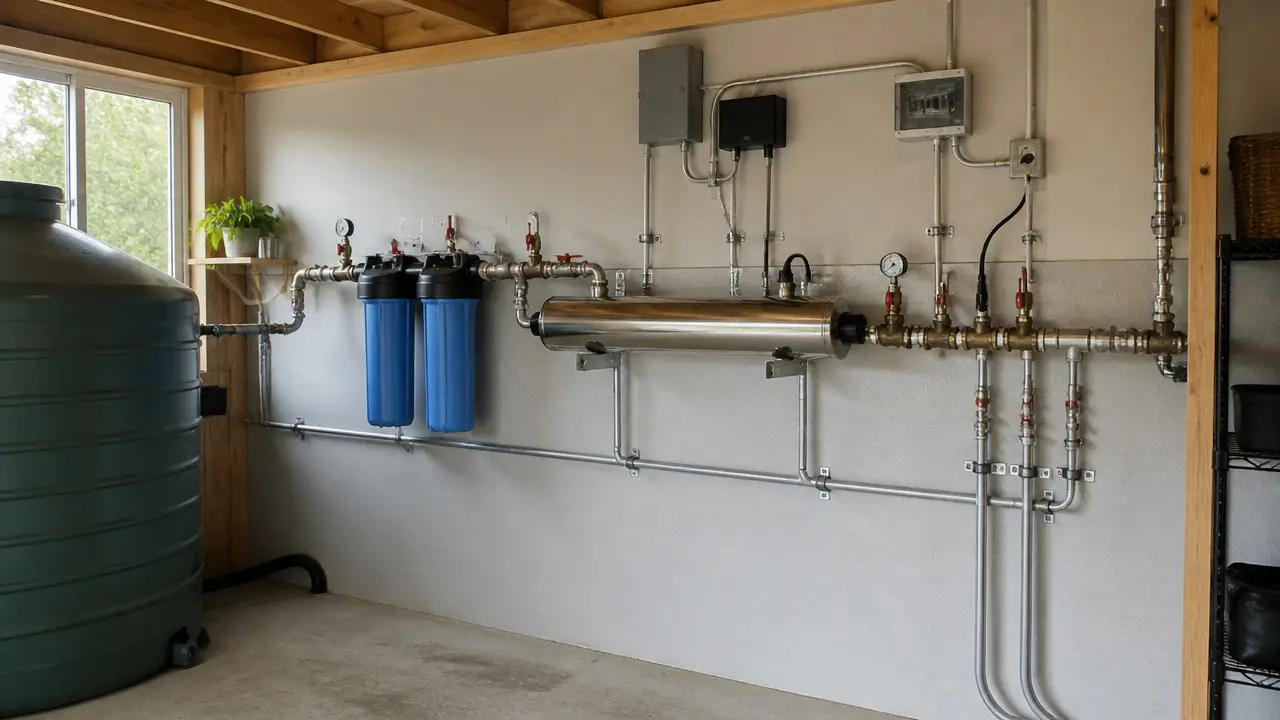
A whole-house UV system belongs near the end of a rainwater treatment train, after the water has already been screened, settled, and filtered enough for ultraviolet light to pass through it effectively. That order is not optional. UV disinfection depends on light dose, and suspended particles, color, scale, or excessive flow can shield microorganisms from the lamp.
For a residential point-of-entry system, the most useful buying questions are therefore practical: Can the reactor handle peak household flow? Do the inlet and outlet sizes match the main line? Is there enough wall clearance to remove a long lamp and quartz sleeve? How will you know the lamp or ballast has failed? And can the upstream filtration keep the sleeve clean enough for UV transmission?
The four systems here cover two broad approaches: longer conventional 12 GPM-class chambers and more compact high-output reactors. None of them removes sediment, dissolved metals, salts, or chemical contaminants. They should be treated as microbial-control stages within a larger rainwater treatment plan.
Whole-House UV Systems at a Glance
| Product | Best For | Key Strength | Main Tradeoff |
|---|---|---|---|
| iSpring UVF55FS | Best overall household installation | 12 GPM design, 1-inch MNPT ports, flow-sensor control | Long chamber and threaded connections need careful installation |
| VIQUA VH200 | Compact whole-home treatment | 9 GPM whole-home flow in a short high-output reactor | Lower flow ceiling than the 12 GPM options |
| HQUA-TWS-12 | Shorter 12 GPM-class layout | 12 GPM claim in a roughly 21-inch chamber with spare lamp and sleeve | Missing parts and immediate-leak reports make setup inspection important |
| HQUA-OWS-12 | Basic 3/4-inch whole-house UV stage | Simple stainless chamber, 120V ballast, spare lamp | Fewer monitoring features and mixed long-term ballast/chamber reports |
Best Overall: iSpring UVF55FS
1 / 4
iSpring UVF55FS Whole House UV Water Filter
Flow Claim
12 GPM
Connections
1 in MNPT
Lamp
55 W UV
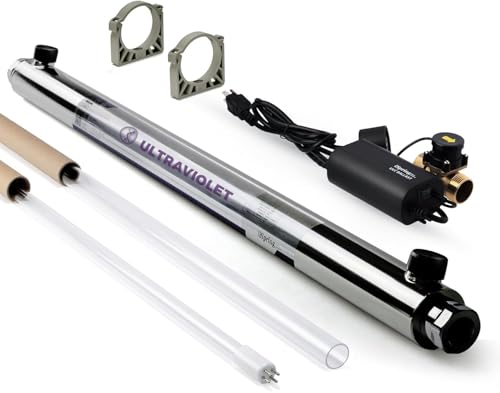
The iSpring UVF55FS is the best all-around fit for a residential rainwater point-of-entry system because it combines a useful 12 GPM flow class with one-inch male NPT connections and a flow-sensor ballast. Those features address three common whole-house concerns at once: enough household flow, less plumbing restriction, and avoiding unnecessary lamp operation when no water is moving.
The reactor uses a long stainless-steel chamber with a 55-watt UV lamp and quartz sleeve. The flow sensor is designed to switch the lamp on when flow reaches about 0.66 gallon per minute. That can reduce the warm stagnant-water effect that continuously powered UV systems may create during long no-flow periods.
Whole-house performance still depends on the water entering the chamber. A 12 GPM rating is only meaningful when the source water meets the conditions required for treatment. Roof grit, tank sediment, tannins, iron staining, or scale on the sleeve can reduce UV transmission even when the pump produces the right flow.
Product-specific installation raises a caution around threaded fittings. Leakage and a cracked fitting appeared after installation in some cases, including damage associated with over-tightening. Support the plumbing so the chamber is not carrying pipe weight, seal threads correctly, and do not use excessive torque as a substitute for a proper fitting match.
Why It Works
- A 12 GPM flow class suits many homes without requiring a very small main line.
- One-inch MNPT ports fit larger household plumbing better than 3/4-inch-only reactors.
- The flow-sensor ballast can reduce no-flow heating and unnecessary lamp runtime.
- The stainless chamber, lamp, quartz sleeve, ballast, and seals form a complete point-of-entry UV stage.
What To Keep In Mind
- The chamber is long, so leave enough wall and service clearance for lamp and sleeve removal.
- Thread sealing and fitting support deserve careful installation.
- iSpring calls for routine lamp replacement and quartz-sleeve cleaning.
- UV status does not prove the water is free of non-microbial contaminants.
Best Compact Whole-Home System: VIQUA VH200
2 / 4
VIQUA VH200 Home UV Water System

Flow Claim
9 GPM
Lamp
35 W high-output UV
Maintenance
Annual lamp change
The VIQUA VH200 is the best choice when mechanical-room space is limited and nine gallons per minute is enough for the household. VIQUA uses a high-output lamp to deliver whole-home UV treatment from a shorter reactor than many traditional 12 GPM chambers.
That smaller footprint can make a major difference around pressure tanks, filters, pumps, and existing plumbing. A long UV chamber needs clearance not only while installed but while the lamp and quartz sleeve are being pulled out. A compact reactor is easier to place where access is constrained.
VIQUA states a nine-GPM whole-home flow role and calls for annual lamp replacement. The system also uses a safety cap and lamp plug intended to reduce unsafe access to the UV lamp. Replacement controller, lamp, and sleeve part numbers are documented, which is useful for long-term maintenance planning.
The prepared “capacity” metadata is not used here because it does not represent a meaningful storage capacity for an inline UV reactor. Flow and treatment conditions are the correct sizing variables.
Product-specific evidence includes a shipment with a broken quartz sleeve and missing internal components. Inspect all fragile parts before plumbing the system permanently into the main line.
Why It Works
- Nine-GPM flow is enough for many smaller or moderate-demand homes.
- High-output lamp technology allows a compact chamber footprint.
- Named replacement parts simplify long-term service planning.
- Annual lamp guidance is clear and easy to schedule.
What To Keep In Mind
- Nine GPM provides less peak-flow headroom than the 12 GPM options.
- Inspect the lamp and quartz sleeve for shipping damage before installation.
- Leave service clearance even though the chamber itself is short.
- Pretreatment must deliver clear water with suitable UV transmittance.
Best Short-Chamber 12 GPM System: HQUA-TWS-12
3 / 4
HQUA-TWS-12 Ultraviolet Water Purifier

Flow Claim
12 GPM
Chamber Length
About 21 in
Lamp Life Claim
9,000 hr
The HQUA-TWS-12 is the most interesting option when you want a 12 GPM-class UV system but cannot dedicate roughly three to four feet of wall length to a conventional chamber. The prepared dimensions list the stainless reactor at about 21 inches long, substantially shorter than HQUA’s OWS model or the long iSpring chamber.
The kit includes the 304 stainless-steel chamber, two UV bulbs, a quartz sleeve, ballast, brackets, and O-rings according to the product material. The lamp life claim is about 9,000 hours, which aligns with the common annual replacement pattern for continuously used residential UV lamps.
There is an important setup warning, however. Product-specific use includes missing instructions and O-rings in one shipment and immediate leakage in another. That makes pre-installation inventory more important than usual. Lay out the chamber, lamps, sleeve, ballast, brackets, and correct seals before cutting into the main line.
UV treatment does not intentionally change taste, odor, pH, conductivity, or general water chemistry. It is a light-treatment stage, not a sediment or dissolved-contaminant filter.
Why It Works
- The 12 GPM claim gives it more peak-flow room than the VIQUA VH200.
- Its shorter chamber can fit installations where long reactors are awkward.
- Spare lamp and quartz-sleeve components support service planning.
- Wall-mounted configuration keeps the reactor off the floor around pumps and tanks.
What To Keep In Mind
- Inspect every seal and kit component before installation.
- Hand-tightening and correct O-ring placement matter more than excessive force.
- The shorter reactor still requires lamp and sleeve removal clearance.
- Use current product instructions to choose the correct connection size and mounting orientation before plumbing.
Best Basic 3/4-Inch System: HQUA-OWS-12
4 / 4
HQUA-OWS-12 UV Water Purifier

Power
120 V / 40 W
Connections
3/4 in MNPT
Chamber
Stainless steel
The HQUA-OWS-12 is the straightforward option for a smaller 3/4-inch point-of-entry layout. It uses a 120-volt, 40-watt lamp in a stainless-steel chamber with 3/4-inch male NPT inlet and outlet connections. The kit includes the ballast, quartz sleeve, UV lamp, brackets, gloves, instructions, and a spare lamp.
Its advantage is simplicity. There is no sophisticated flow sensor or UV-intensity controller to configure. That can reduce setup complexity when the upstream treatment and household demand are already well understood.
The tradeoff is monitoring. A simple ballast gives less information about actual treatment conditions than systems with lamp-life, flow, or intensity sensing. You need a disciplined maintenance schedule and a testing plan rather than relying on a controller to catch every problem.
Long-term product-specific use is mixed. Some systems operated for years before ballast failure, while others had earlier ballast failures, cracked quartz, chamber corrosion, or pinhole leakage. Inspect an aging chamber rather than assuming stainless construction makes it permanent.
Why It Works
- Common 120V power simplifies residential electrical service.
- 3/4-inch MNPT ports fit smaller household plumbing layouts.
- The conventional stainless chamber is easy to understand and service.
- A spare UV lamp is included.
What To Keep In Mind
- Long chamber length requires substantial service clearance.
- Basic controls provide less warning of declining treatment performance.
- Inspect the chamber, quartz sleeve, and ballast as they age.
- Stagnant water can warm when the lamp operates continuously.
How to Size Whole-House UV for Rainwater
Start With Peak Flow, Not Daily Gallons
An inline UV reactor does not store water. Daily-gallon “capacity” fields are less useful than the maximum treatment flow at the required UV dose. Estimate simultaneous fixture demand and make sure the UV system can treat that flow under the manufacturer’s specified water-quality conditions.
A home that normally uses only a few gallons per minute can still create a short peak when a shower, washer, and faucet operate together.
Match the Main-Line Connection
A one-inch main line necked down through 3/4-inch fittings can add unnecessary restriction. A smaller system may still be correct when demand is modest, but make the choice deliberately.
Check whether the reactor has male or female NPT connections and plan unions or service fittings that allow the chamber to be removed without cutting pipe.
Leave Lamp and Sleeve Clearance
The most common mechanical-layout mistake is measuring only the reactor body. Lamps and quartz sleeves often slide out lengthwise. A 37-inch chamber can need substantially more than 37 inches of usable service space.
Choose a mounting orientation allowed by the current manual that still leaves room to remove the lamp safely.
Pretreatment Before Whole-House UV
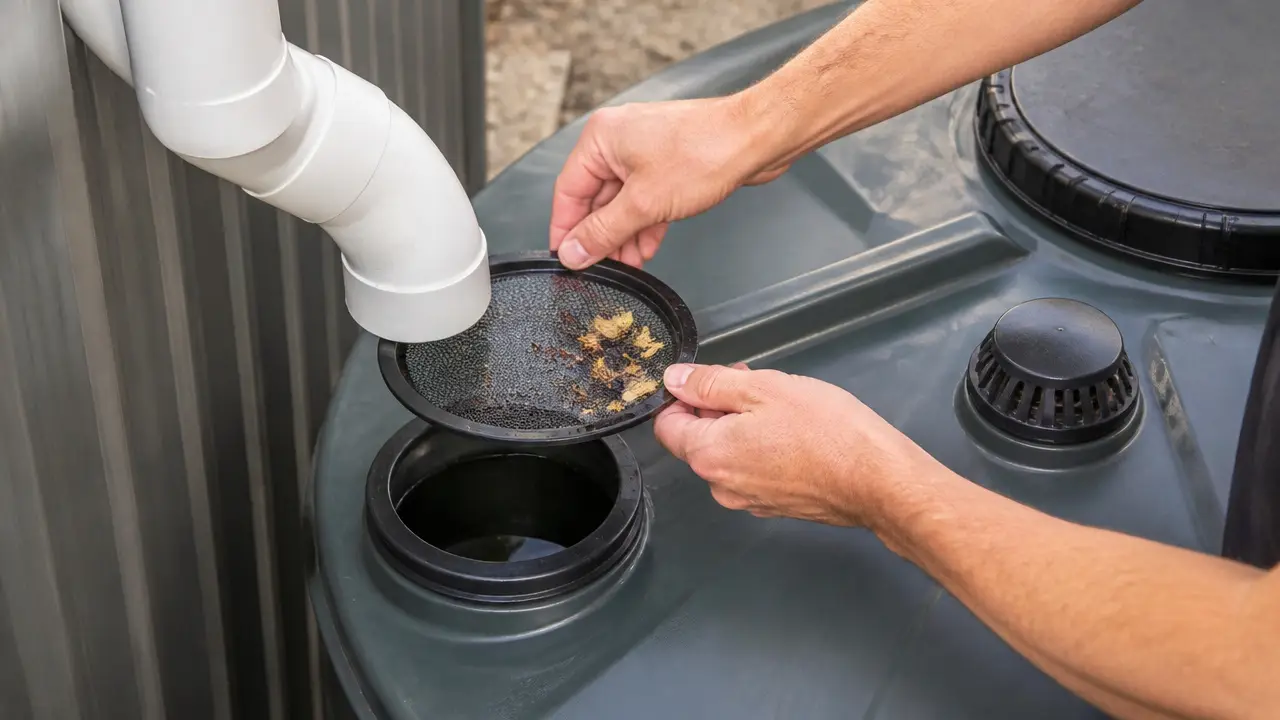
A reliable rainwater UV installation starts at the roof. Keep leaves and large debris out of the tank, use first-flush management where appropriate, keep storage covered, and prevent sediment from being pumped directly into the treatment train.
Fine filtration before UV is especially important. Sediment can shield microorganisms and coat the quartz sleeve. Iron, manganese, hardness scale, tannins, and color may also interfere with UV transmission and need their own treatment.
The correct pretreatment depends on the actual rainwater quality. Test source water, size filters for the required flow, and avoid assuming that clear-looking water automatically has adequate UV transmittance.
Whole-House UV Installation Checklist
Install Isolation Valves
Valves before and after the reactor let you depressurize it for lamp, sleeve, seal, or chamber work. A service bypass can be useful, but it should be arranged so untreated bypass water cannot be mistaken for treated drinking water.
Support the Plumbing
Do not let the UV chamber carry the weight or leverage of long pipe runs. Use appropriate pipe supports and chamber brackets.
Provide Safe Electrical Power
Keep the ballast and controller in the environment specified by the manufacturer. Follow current grounding, GFCI, outlet, surge-protection, and local electrical requirements.
Sanitize Downstream Plumbing After Installation
Installing UV does not automatically disinfect existing plumbing. When the system is intended for higher-risk household use, follow appropriate commissioning and sanitation procedures for downstream piping and fixtures.
Test After Commissioning
A leak-free chamber and glowing lamp show that hardware is operating, not that every treatment goal has been met. Assess finished-water quality with appropriate current testing.
Maintenance That Whole-House UV Requires
Lamp Replacement
Replace the UV lamp at the manufacturer’s specified interval even if it still emits visible light. Germicidal output declines with operating hours.
Quartz-Sleeve Cleaning
Inspect and clean the sleeve before scale or film becomes heavy enough to block UV. Water chemistry and pretreatment determine how quickly fouling develops.
Seal Inspection
O-rings and compression seals are disturbed during sleeve service. Replace damaged or flattened seals and pressure-test slowly after reassembly.
Chamber and Ballast Inspection
Check for corrosion, pinholes, unusual ballast alarms, intermittent lamps, heat damage, or moisture around the electrical components.
Final Recommendations
The iSpring UVF55FS is the best overall whole-house choice here because its 12 GPM flow class, one-inch ports, and flow-sensor ballast fit a wide range of residential rainwater systems. The VIQUA VH200 is a strong alternative when nine GPM is enough and a compact chamber is more important than maximum flow.
The HQUA-TWS-12 is the better fit when you want a shorter 12 GPM-class reactor with spare service parts, while the HQUA-OWS-12 suits simpler 3/4-inch installations that do not need advanced monitoring.
Whichever system you choose, whole-house UV is only as reliable as its pretreatment, flow control, lamp and sleeve maintenance, downstream sanitation, and water-testing program.
Frequently Asked Questions
What flow rate do I need for a whole-house UV system?
It depends on the home’s peak simultaneous demand, not just average daily water use. The UV system must provide the required treatment dose at the highest flow the household can send through it.
Should UV go before or after sediment filters?
After. Sediment and other pretreatment should make the water clear enough for effective UV transmission before it reaches the reactor.
Does a whole-house UV system remove sediment?
No. UV is a disinfection process, not a physical sediment filter. Sediment control belongs upstream.
Does UV remove metals or chemicals from rainwater?
No. Use treatment designed for the contaminants identified in testing. UV does not remove dissolved metals, salts, pesticides, or TDS.
Can a 9 GPM UV system serve a whole house?
Yes, when the household’s actual peak flow stays within the supported treatment flow. Larger homes or high simultaneous demand may need a higher-flow unit.
How often do whole-house UV lamps need replacement?
Many systems specify around 9,000 hours, roughly one year of continuous operation. Follow the current instructions for the exact model.
What happens if the power goes out?
Active UV treatment stops. If drinking-water continuity during outages matters, plan for backup power, stored treated water, or another validated treatment method.