As an affiliate, we may earn a commission from qualifying purchases. We get commissions for purchases made through links on this website from Amazon and other third parties.
Inline water filters do not all last the same amount of time. Their useful life depends on the filter media, water quality, how much water passes through them, and the maker’s rated service cycle.
A filter on clean, pretreated water may work for many months. The same filter can clog much sooner when it handles rainwater with roof grit, sediment, algae, rust, or other debris.
The safest rule is simple: replace an inline water filter when it reaches its rated gallon capacity or its stated time limit, whichever comes first. NSF notes that water filters normally have a service cycle based on gallons, months, or both.
What Determines How Long an Inline Water Filter Lasts?
Five things have the biggest effect.
1. The Type of Filter
“Inline water filter” describes where a filter sits in the plumbing. It does not tell you what the filter actually does.
An inline filter may contain:
- A sediment screen or cartridge
- Pleated filter media
- Activated carbon
- A carbon block
- Specialized media for certain chemicals
- A membrane designed for very small particles
Each type reaches the end of its useful life differently.
A sediment filter usually becomes loaded with trapped material. Water has a harder time passing through it.
Activated carbon works differently. Some substances attach to the carbon's large internal surface. Eventually, that surface becomes used up. Water may still flow normally even though the carbon has reached its rated treatment capacity.
That is why flow alone cannot tell you whether every type of filter is still effective.
2. How Dirty the Incoming Water Is
Water quality can make a large difference in filter life.
Consider two identical inline sediment filters.
One receives clear municipal water. The other receives rainwater directly after a roof collection system with little prefiltration.
The rainwater filter may have to catch:
- Roof grit
- Pollen
- Dust
- Small leaf pieces
- Organic matter
- Sediment from the tank
- Rust or debris from plumbing
It can fill much faster.
This is one reason good rainwater systems often remove larger debris before sending water through finer filters.
3. How Much Water You Use
Filter capacity is often expressed as a certain volume of water.
If a filter has a stated capacity, you can estimate how long that capacity might last:
Estimated days = rated filter capacity ÷ average daily water use
For example, suppose a filter were rated for 5,000 gallons and your system sent about 10 gallons per day through it:
5,000 ÷ 10 = 500 days
That does not automatically mean you should use that filter for 500 days.
If the manufacturer also gives a shorter calendar replacement interval, use the earlier limit. Actual water conditions can also shorten filter life.
4. Filter Size and Micron Rating
A micron is one-thousandth of a millimeter. A filter's micron rating describes the size of particles it is designed to capture under specified conditions.
Finer filtration can put more restriction on water flow and may clog faster if lots of sediment reaches the filter.
For example, sending dirty tank water directly into a very fine cartridge can shorten its service life.
A staged setup may work better:
larger debris removal → sediment filtration → finer filtration or other treatment
The correct stages depend on the water source and intended use.
5. Flow Rate
Flow rate is how much water moves through a system during a certain amount of time, such as gallons per minute.
Higher water use sends more total water through the filter.
At the same time, a filter that is filling with sediment can gradually restrict flow. You may notice:
- A weaker faucet stream
- Lower irrigation flow
- Longer tank-filling times
- Reduced pump performance at the outlet
- A larger pressure difference across the filter
A sudden or severe restriction should be investigated rather than simply accepting weaker flow.
Signs an Inline Water Filter May Need Replacement
Do not rely on only one symptom.
Common reasons to inspect or replace a filter include:
- It has reached its stated gallon capacity.
- It has reached its stated replacement date.
- Water flow has dropped noticeably.
- A pressure gauge shows increasing restriction across the filter.
- A sediment cartridge is heavily loaded.
- Water quality changes in a way the filter normally addresses.
- The filter has been exposed to conditions outside its allowed use.
- The system manufacturer calls for replacement after a specific event.
NSF warns that mechanical filters can eventually become so clogged that water cannot move through them effectively. Carbon and similar media may be harder to judge because their treatment capacity can be exhausted without a dramatic flow change.
Do not wait for bad taste or odor to tell you that drinking water is unsafe. CDC notes that harmful germs and chemicals often do not cause noticeable changes in taste, smell, or appearance.
Inline Filters in Rainwater Systems Can Have Shorter Lives
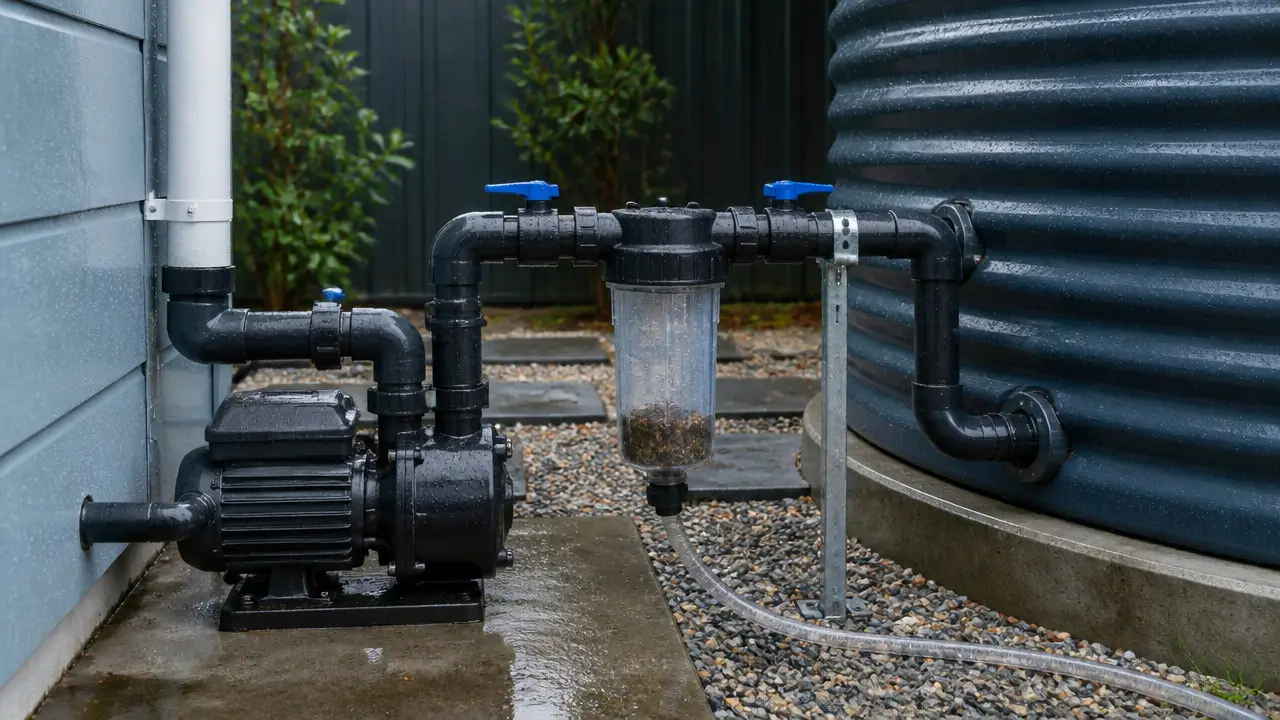
Rainwater systems can be particularly hard on inline filters when debris is not removed earlier in the collection path.
A typical path might include:
roof → gutters → leaf screening → first-flush or debris control → storage tank → sediment filtration → other treatment → point of use
A first-flush device diverts some of the initial runoff from a roof. That early runoff can carry a higher load of dust, pollen, droppings, and other material that collected between rains.
The cleaner the water reaching a fine inline filter, the less material that filter has to hold.
Tank design matters too. Pulling water from the very bottom of a tank can send settled sediment toward a filter, especially if the tank has recently been disturbed.
Garden Rainwater Systems
For drip irrigation or garden hoses, filtration is often mainly about preventing emitters, valves, and small passages from plugging.
A filter may need attention more often during periods when:
- Roof debris is heavy.
- Pollen levels are high.
- The storage tank has sediment.
- Algae or organic material is entering the plumbing.
- Irrigation use increases.
Check the filter before assuming that weak irrigation flow is caused by the pump.
Cabin and Household Rainwater Systems
Indoor rainwater systems deserve more care because filter condition can affect both water quality and equipment.
If rainwater is intended for drinking or cooking, an inline filter by itself should not be treated as proof that the water is potable.
Potable means suitable for drinking.
CDC explains that different filters remove different substances. Many common household filters are not designed to remove germs, and filtration that works against certain organisms may not remove viruses or chemicals.
Review rainwater filtration methods to understand the reliable conclusion supported by the present data.
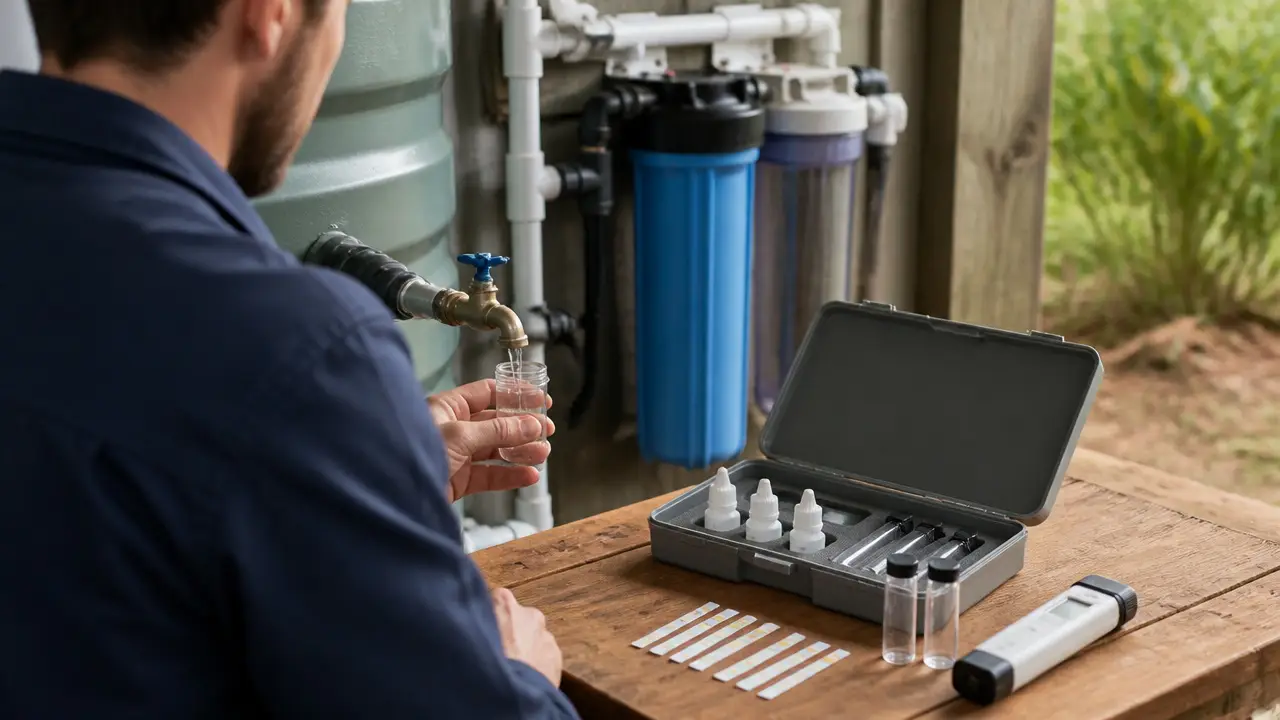
Drinking-water use should be approached as a complete system involving appropriate collection, pretreatment, treatment, maintenance, and current water testing. As of August 2026, CDC guidance recommends testing water from private rainwater collection systems at least annually for harmful germs and chemicals, with additional testing when water characteristics change.
Does Low Water Flow Always Mean the Filter Is Finished?
No.
A dirty sediment filter is a common cause of reduced flow, but other problems can produce similar symptoms.
Check for:
- Partly closed valves
- Kinked flexible tubing
- Clogged inlet screens
- Pump problems
- Low tank level
- Air entering the suction line
- Incorrect filter installation
- A filter installed backward
- Frozen or partly frozen plumbing
- Undersized tubing or fittings
Turn off pressure and follow the equipment instructions before opening a pressurized filter housing.
If changing the filter restores normal flow, the old cartridge was probably creating significant restriction. But frequent clogging means you should also look for the source of the sediment.
Can You Tell Filter Life From Its Color?
Sometimes color provides useful information, but it is not a reliable replacement schedule by itself.
A white sediment cartridge can turn brown as it catches dirt and rust. That makes loading easy to see.
Other filters give little visual warning.
Activated carbon, for example, may look almost the same when its adsorption capacity has been used. A filter's appearance also cannot tell you whether it is still reducing a particular chemical to its certified performance level.
Track the replacement date and water volume when possible.
How to Make an Inline Water Filter Last Longer
The goal should not be to stretch a cartridge beyond its rated life. Instead, reduce unnecessary loading.
Remove Large Debris First
Use suitable gutter screens, inlet screening, or other prefiltration before fine filtration.
Catching leaves upstream is easier than asking a fine cartridge to handle them after they break into smaller pieces.
Keep the Storage Tank Clean
Sediment gradually collects in many rainwater tanks.
Inspect and maintain the tank according to its design rather than allowing large amounts of settled material to continually enter the outlet line.
Tank cleaning can involve fall hazards, heavy equipment, contaminated material, or confined-space risks. Do not enter a cistern or enclosed tank unless the work is being handled under proper confined-space procedures.
Use Filtration in Stages When Needed
If the incoming water contains a lot of sediment, placing the finest filter first can cause rapid plugging.
A suitable coarser stage upstream can remove larger particles before water reaches finer filtration.
Do not choose stages based only on micron numbers. Make sure the housings, cartridges, connections, flow requirements, pressure limits, and intended water use all match.
Avoid Exceeding the Filter's Flow Rating
Forcing more water through a filter than it was designed to handle can reduce performance and cause excessive pressure loss.
A pump does not make a small filter larger.
The filter and its connections need to support the flow your pump or plumbing system requires.
Replace the Correct Cartridge
Two cartridges that look alike are not necessarily interchangeable.
Differences can include:
- Length
- Diameter
- Seal design
- Connection style
- Filter media
- Micron rating
- Flow capacity
- Chemical reduction claims
- Certification
A cartridge that does not seal correctly may allow some water to travel around the filter media instead of through it.
NSF specifically cautions that cartridges are not necessarily universal and that small fit differences can allow water to bypass filtration.
For drinking-water treatment, also check what the filter is actually certified to reduce rather than assuming that every filter with the same physical dimensions performs the same job.
Keep a Simple Filter Maintenance Record
A small maintenance log makes replacement easier to manage.
Record:
- Installation date
- Filter type
- Rated capacity
- Meter reading, if available
- Replacement date
- Reason for replacement
- Unusual sediment or water changes
If you repeatedly replace a filter much earlier than expected, the log may help reveal a pattern.
For example, filters that clog immediately after tank cleaning may be receiving disturbed sediment. Filters that clog during certain seasons may be handling heavier pollen or roof debris.
That information can help you improve the system upstream instead of continually replacing cartridges.
The Bottom Line
An inline water filter might last weeks in heavily sedimented water or many months under cleaner conditions. There is no single replacement interval that applies to every inline filter.
Use the filter's rated gallon capacity and time limit, replacing it when the first limit is reached. Replace it sooner if it becomes clogged, damaged, contaminated, or otherwise fails to perform as intended.
For rainwater systems, good debris removal and sediment control can greatly reduce the load on fine inline filters.
And if the rainwater will be used for drinking, do not use filter age, water clarity, taste, or a single cartridge as proof that the water is safe. Drinking-water safety depends on the entire collection and treatment system, current testing, and proper maintenance.
Frequently Asked Questions
How often should I replace an inline water filter?
Follow the filter maker's stated service cycle. It may be based on gallons, months, or both. If both limits are provided, replace the filter when the first limit is reached. Heavy sediment can require earlier replacement.
Can an inline water filter last a year?
Some filters may have service schedules that extend that long under their specified conditions, while others do not. Check the stated capacity and replacement interval for the exact filter rather than assuming one year is safe for every cartridge.
How do I know when my inline filter is clogged?
Reduced water flow or increased pressure loss across the filter are common signs of sediment loading. Also check valves, tubing, pumps, screens, and other possible restrictions before assuming the filter is the only cause.
Does an activated carbon filter stop working when the flow gets slow?
Not necessarily. Carbon's treatment capacity can become exhausted without a large change in water flow. Follow its rated capacity and replacement schedule rather than waiting for obvious clogging.
Why does my rainwater filter clog so quickly?
The filter may be receiving too much roof debris or tank sediment. Check gutter screening, debris control, tank condition, outlet location, and any upstream sediment filtration before simply installing another fine cartridge.
Can I clean and reuse an inline water filter?
Only if the filter is specifically designed to be cleaned and reused. Many disposable cartridges should be replaced rather than washed. Follow the filter instructions because cleaning can damage some media or affect its performance.
Does replacing an inline filter make rainwater safe to drink?
No. A new filter only performs the functions it was designed and verified to perform. Rainwater intended for drinking requires a suitable whole-system approach that may include collection controls, prefiltration, additional treatment, maintenance, and current laboratory testing.