As an affiliate, we may earn a commission from qualifying purchases. We get commissions for purchases made through links on this website from Amazon and other third parties.
Which Rainwater Pre-Filter Is Best?
The best rainwater pre-filter is usually the one that removes debris before it reaches your storage tank without restricting the flow too much.
For most roof-fed rainwater systems, a coarse screen or rain head at the downpipe is a good first pre-filter. Larger systems may work better with a vortex filter or high-capacity screened filter. A spin-down sediment filter can be useful later in the system, especially before pumps or irrigation equipment, but it usually should not be the only filter protecting a rainwater tank.
There is no single pre-filter that is best for every setup. The right choice depends on:
- What is falling onto your roof
- How much rainwater must pass through the filter
- Your downpipe and pipe sizes
- Whether the tank is above or below ground
- How easy the filter is to clean
- What you plan to use the water for
A good pre-filter keeps leaves, insects, roof grit, and other large debris out while allowing heavy rainfall to reach the tank.
What Does a Rainwater Pre-Filter Do?
A pre-filter removes larger material early in the rainwater collection system.
Roof runoff can carry:
- Leaves
- Twigs
- Seeds
- Insects
- Moss
- Roof grit
- Bird and animal debris
- Dust and dirt
Keeping this material out of the tank reduces the amount of sludge and organic matter that collects inside.
A pre-filter does not make rainwater safe to drink. It is only one part of water-quality management.
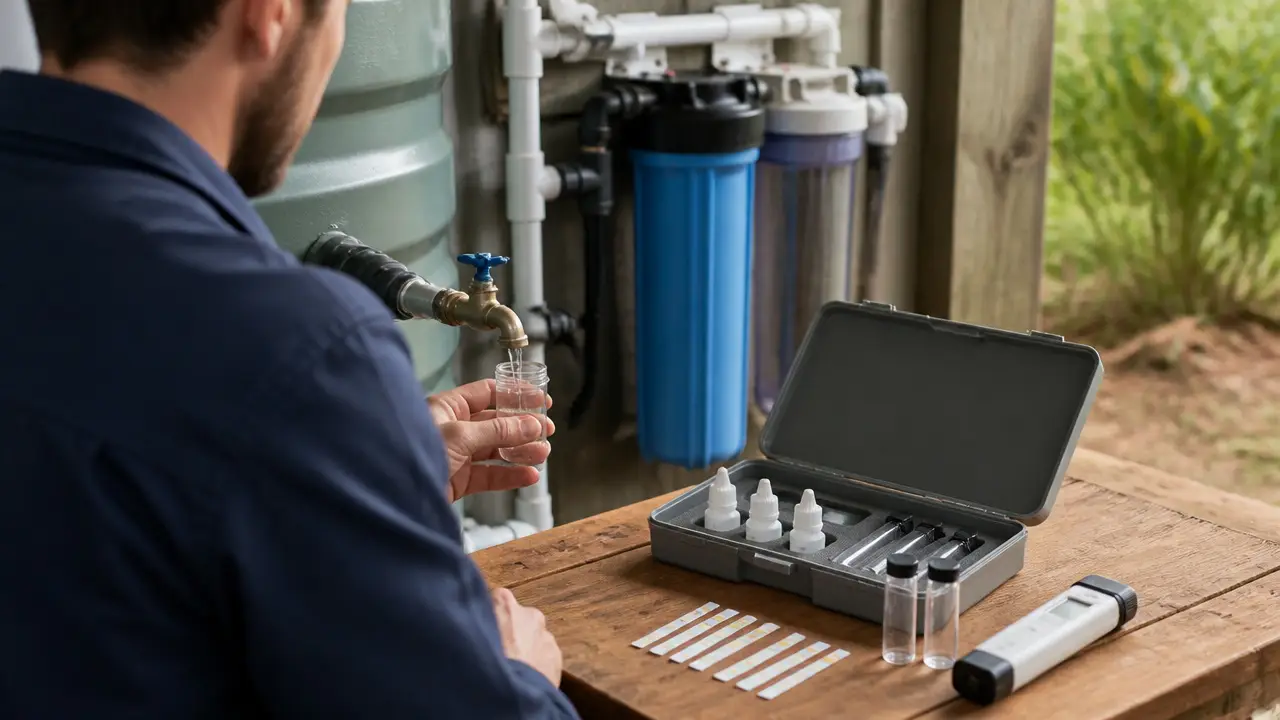
If rainwater will be used for drinking, treatment must be planned as a complete system. Collection surfaces, debris removal, storage, finer filtration, disinfection, maintenance, current laboratory testing, and local requirements can all matter.
The Main Types of Rainwater Pre-Filters
Gutter Screens
Gutter screens or guards stop large leaves and debris from entering the gutter.
They can be useful when the roof is surrounded by trees, but they should not be treated as the only rainwater pre-filter.
Small material can still pass through. Debris can also build up on top of some gutter guards.
Gutter protection works best as the first layer in a system that also includes a filter closer to the downpipe or tank.
Downpipe Rain Heads
A rain head is installed near the top of a downpipe. Water passes through a screen while larger debris is pushed or falls away.
For many home systems, this is one of the most practical choices.
Rain heads can:
- Remove leaves and larger debris
- Keep insects and animals from entering the pipe
- Be inspected without opening the tank
- Handle debris before it travels through long pipe runs
The main limitation is flow capacity. A small or clogged screen may cause water to spill out during a strong storm.
Match the rain head to the expected flow from the roof and the size of the downpipe.
Tank-Inlet Screens
A tank-inlet screen fits where rainwater enters the storage tank.
It acts as a final barrier against larger debris and insects.
An inlet screen is simple and useful, but it has one important disadvantage: debris has already traveled through the pipes before reaching it.
If the screen becomes blocked during heavy rain, water may overflow near the tank.
For many systems, an inlet screen works best when larger debris has already been removed upstream.
Basket Filters
Basket filters collect debris inside a removable screened basket.
They are common on some tanks and underground systems because they can provide a large filtering area in a compact space.
Their main advantage is easy debris collection. Their main disadvantage is that the basket must be emptied.
If the basket fills with leaves during a storm, flow can drop quickly.
They are best where the homeowner can reach and inspect the basket regularly.
Vortex Filters
A vortex filter uses the movement of incoming water to separate debris while directing cleaner water toward storage.
These filters are often useful when:
- The roof area is large
- Several downpipes feed one pipe
- Rainfall can create high flow
- The storage tank is underground
- A larger filtering surface is needed
They can handle more water than some simple screens, but installation usually requires more pipe space and careful sizing.
The filter still needs cleaning.
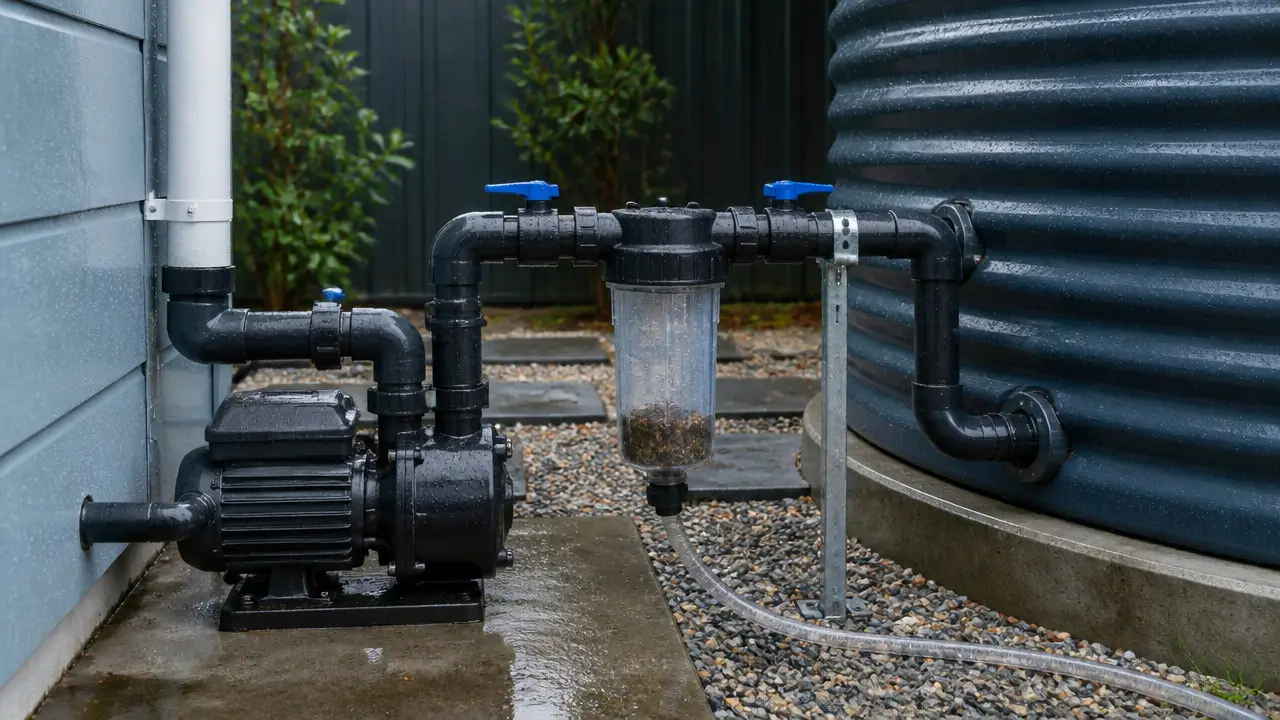
Spin-Down Sediment Filters
A spin-down filter is normally installed in a pressurized or pumped water line rather than directly on an open downpipe.
Water enters the housing and heavier particles settle near the bottom. A screen traps additional sediment.
These filters can protect:
- Pumps
- Irrigation valves
- Hose equipment
- Finer cartridge filters
- Some appliances using non-potable rainwater
A spin-down filter is useful for sediment, but it is usually not a substitute for roof-level debris control.
Leaves and large organic material should ideally be stopped before they enter the tank.
What About First-Flush Diverters?
A first-flush diverter redirects the first portion of roof runoff away from the tank.
The first runoff after a dry period may contain more dust, pollen, animal waste, and loose roof debris.
A first-flush diverter is therefore useful as a form of pretreatment, but it performs a different job from a screen.
A screen removes debris based mainly on size.
A first-flush system diverts an initial volume of runoff.
Many systems can benefit from both.
The correct diverted volume depends on the roof, rainfall pattern, contamination exposure, and system design. Avoid assuming that one fixed first-flush volume is right for every roof.
Which Pre-Filter Is Best for a Rain Barrel?
For a basic rain barrel, a coarse inlet screen is usually the simplest choice.
The screen should:
- Fit securely over the inlet
- Keep mosquitoes and insects out
- Be easy to remove for cleaning
- Provide enough open area for the incoming flow
If leaves regularly enter the downpipe, adding a rain head or upstream leaf screen can reduce how often the barrel screen needs cleaning.
Very fine mesh may sound better, but it can clog faster.
For garden water, stopping leaves and larger debris before they enter the barrel is often more useful than trying to remove very small particles at the inlet.
Which Pre-Filter Is Best for an IBC Tote?
An IBC tote normally benefits from a large screened inlet rather than a tiny filter fitted directly to the original tote opening.
Roof runoff can move much faster than people expect during heavy rain.
A small filter can become the bottleneck in the system.
A practical arrangement may include:
- Gutter debris control
- A rain head or screened downpipe filter
- Optional first-flush diversion
- A screened tote inlet
- Additional filtration after storage if the intended use requires it
Make sure any modification to the tote does not create a weak, poorly sealed, or difficult-to-clean connection.
Only use containers suitable for the intended water use. The previous contents of a used IBC tote matter.
Which Pre-Filter Is Best for a Large Cistern?
Large cistern systems usually need a filter with a large filtering surface and enough flow capacity for the connected roof area.
A small rain-barrel screen may not be suitable.
Depending on the layout, a large screened filter, basket filter, or vortex-style filter may make more sense.
The important question is not simply the filter's pipe connection size.
You also need to consider how much water the filter can actually pass when the screen is partly dirty.
A filter that handles normal rain but overflows during every strong storm wastes collection capacity.
Which Pre-Filter Is Best for Irrigation?
For irrigation, it helps to separate tank protection from irrigation equipment protection.
Before the tank, use a coarse debris filter to keep leaves and organic material out.
After the tank, additional filtration may be needed depending on the irrigation system.
Drip irrigation has small openings that can clog easily. It generally needs finer filtration than a garden hose or open-ended watering line.
A spin-down filter or another sediment filter may be useful before irrigation equipment.
The correct filter depends on the emitter requirements and the sediment present in the water.
How Fine Should the Pre-Filter Be?
Look closely at rainwater filtration methods to interpret maintenance timing based on a meaningful change in performance.
Finer is not always better.
A very fine screen can remove smaller particles, but it also:
- Blocks more easily
- Needs more cleaning
- Can reduce flow
- Can cause overflow during heavy rain
For the first stage of a rainwater system, the goal is normally to remove large debris while keeping the water moving.
Finer filtration can be added later where it can be maintained more easily.
Filters are sometimes described by their micron rating. A micron is one-thousandth of a millimeter. Lower micron numbers mean smaller openings.
Micron ratings become more important with sediment and cartridge filters than with ordinary leaf screens.
Do not assume that a low micron rating means the water is safe to drink. Very small contaminants and microorganisms require a properly designed treatment system rather than just a fine screen.
Flow Capacity Matters More Than It Seems
A pre-filter must handle the water arriving from the roof.
The amount of flow depends mainly on:
- Roof area
- Rainfall intensity
- How many downpipes feed the filter
- Pipe size
- Pipe slope and layout
A large roof can send a large volume of water toward one filter in a short time.
This is why a filter designed for one rain barrel may perform poorly when several downpipes are combined into a large cistern.
When comparing filters, check whether the stated flow capacity is appropriate for your collection system. Do not size the system from pipe diameter alone.
Make the Filter Easy to Clean
The best filter on paper can become a poor choice if cleaning it is difficult.
Pre-filters collect debris by design. That debris has to go somewhere.
Choose a location where you can safely:
- See the filter
- Remove the screen or basket
- Wash away debris
- Check for damage
- Inspect overflow paths
Avoid placing a maintenance item somewhere that requires dangerous roof access.
A filter that can be cleaned from ground level is usually easier to maintain consistently.
Plan for Overflow
Every rainwater pre-filter should have a safe way to deal with more water than it can accept.
Overflow may happen because:
- Rainfall is unusually heavy
- The filter is partially blocked
- The inlet pipe is undersized
- The storage tank is full
Overflow water should drain away from foundations and other areas where uncontrolled water could cause damage.
The filter should not create a sealed blockage in the downpipe unless the system was specifically designed to handle that condition.
Mosquito Protection Matters
Screens around rainwater storage do more than catch leaves. They also help prevent mosquitoes and other insects from entering the tank.
Check:
- Tank inlets
- Overflow pipes
- Vents
- Inspection openings
- Unused fittings
A screened inlet does little good if mosquitoes can enter through an unscreened overflow pipe.
Damaged or loose screens should be repaired.
A Simple Pre-Filter Setup for Many Homes
A practical roof-to-tank system often looks like this:
Roof → gutter → leaf control → downpipe rain head → optional first flush → tank inlet screen → storage
Water used after storage may then pass through additional sediment filtration or treatment depending on its intended use.
This staged approach is usually better than expecting one very fine filter to handle everything.
Each stage removes a different problem.
How to Choose the Right Pre-Filter
Start with the water's intended use and work backward through the system.
For basic garden watering
A coarse rain head or tank-inlet screen may be enough to keep large debris out of the tank.
For drip irrigation
Use coarse filtration before storage and suitable finer filtration after storage to protect emitters.
For a large cistern
Choose a high-flow filter with enough screen area for the connected roof and storm flow.
For tree-covered roofs
Use more than one debris-control stage if necessary. Gutter protection plus a downpipe filter can reduce the amount of organic material reaching the tank.
For drinking-water systems
Do not choose a pre-filter as though it were the complete treatment system.
A pre-filter protects later parts of the system, but drinking-water safety requires a broader approach that considers the collection surface, contamination sources, storage conditions, treatment stages, maintenance, laboratory testing, and applicable local requirements.
Common Pre-Filter Mistakes
Choosing the finest screen available
Fine screens can clog quickly and reduce collection during storms.
Installing the filter where it cannot be reached
If cleaning requires climbing onto a roof, routine maintenance may be skipped or become unsafe.
Ignoring peak rainfall
A filter may work during light rain but overflow badly during a short, intense storm.
Relying on one small screen for a large roof
A large catchment area may need more filtering surface or multiple filtration points.
Forgetting the overflow
Blocked filters need somewhere safe to send excess water.
Expecting a pre-filter to purify rainwater
Removing leaves and sediment is not the same as removing microorganisms, dissolved contaminants, or other water-quality hazards.
The Best Choice for Most Systems
For many small residential rainwater systems, a well-sized downpipe rain head combined with a screened tank inlet provides a good balance of debris removal, flow, and easy maintenance.
For larger collection systems, a high-capacity basket or vortex-style filter may be more suitable.
If sediment needs to be removed after storage, a spin-down filter can be added downstream.
The most important feature is not the filter name. It is whether the filter:
- Handles your expected flow
- Matches your pipe connections
- Removes the type of debris you actually have
- Can be cleaned safely
- Does not create an uncontrolled overflow problem
- Fits the intended use of the stored water
A simple filter that is properly sized and regularly cleaned will usually serve a rainwater system better than a complicated filter that constantly clogs or is difficult to maintain.
Frequently Asked Questions
Is a first-flush diverter the same as a pre-filter?
No. A first-flush diverter sends the first portion of roof runoff away from the tank. A pre-filter usually removes debris by passing water through a screen or other filtering surface. The two can be used together.
Should a rainwater filter go before or after the tank?
Large debris should normally be removed before the water enters the tank. Additional sediment filtration can be installed after the tank when pumps, irrigation equipment, or later treatment stages need cleaner water.
Can I use a very fine filter before my rain barrel?
You can, but very fine filters often clog quickly. A coarse screen with enough surface area is usually more practical at the barrel inlet. Finer filtration can be added later if the water's intended use requires it.
Does a pre-filter stop mosquitoes?
A properly fitted insect-resistant screen can help keep mosquitoes from entering through the rainwater inlet. Tank vents, overflows, inspection openings, and other openings also need protection.
Do I need a pre-filter if I have gutter guards?
Usually, an additional filter is still useful. Gutter guards can stop large leaves, but smaller debris, insects, roof grit, and broken organic material may still enter the downpipe.
Can a spin-down filter be used as the main rainwater pre-filter?
It is generally better suited to removing sediment from water after storage or in a pumped line. Large leaves and roof debris should normally be removed before they reach the tank.
Does a rainwater pre-filter make the water drinkable?
No. A pre-filter removes only certain types and sizes of debris. It does not establish that rainwater is microbiologically or chemically safe to drink. Potable use requires a properly designed and maintained treatment system, appropriate testing, and compliance with applicable local requirements.