As an affiliate, we may earn a commission from qualifying purchases. We get commissions for purchases made through links on this website from Amazon and other third parties.
A good NTU value depends on what the water will be used for. For water that will be disinfected for drinking, below 1 NTU is a useful treatment target, and lower is generally better. The World Health Organization (WHO) recommends turbidity below 1 NTU to support effective disinfection. U.S. public water systems using conventional or direct filtration follow even tighter treatment requirements: filtered water must be at or below 0.3 NTU in at least 95% of monthly measurements and must never exceed 1 NTU.
However, a low NTU reading does not prove that water is safe to drink. Clear-looking rainwater can still contain bacteria, viruses, parasites, metals, chemicals, or other contaminants that a turbidity meter cannot detect.
What Does NTU Mean?
NTU stands for nephelometric turbidity unit. It is a measure of how cloudy water is because of particles suspended in it.
A turbidity meter shines light through a water sample and measures how much of that light is scattered by particles. Those particles can include:
- Clay and fine soil
- Dust
- Roof debris
- Organic matter
- Algae
- Rust or mineral particles
- Very small suspended solids
- Some microorganisms
More suspended material usually means a higher NTU reading.
Turbidity is useful because it can show whether filtration is working well. It does not tell you exactly what the particles are or whether they are harmful.
What Is Considered a Good NTU Value?
There is no single NTU number that defines "good water" for every use. A useful way to interpret readings is to look at what you plan to do with the water.
| NTU reading or target | Practical meaning |
|---|---|
| Below 1 NTU | A useful target before drinking-water disinfection |
| 0.3 NTU or lower | A stringent filtration-performance target used by many conventional U.S. public treatment systems |
| 1-5 NTU | Increasing turbidity; may interfere more with treatment and deserves attention if the water will be disinfected |
| Above 5 NTU | Relatively turbid water that generally needs better particle removal before drinking-water treatment |
These are treatment benchmarks, not a safety scale. For example, water measuring 0.2 NTU is not automatically potable, which means safe and suitable for drinking.
WHO guidance for small drinking-water supplies uses less than 1 NTU as a target for effective disinfection. If that cannot be achieved, WHO advises keeping turbidity below 5 NTU while recognizing that treatment may need greater disinfection doses, contact times, or other adjustments.
Why Low Turbidity Matters Before Disinfection
Particles can make disinfection harder.
Some microorganisms can become associated with particles, reducing their exposure to a disinfectant. High turbidity can also interfere with processes such as chlorination and ultraviolet treatment.
That is why drinking-water treatment does not normally jump straight from cloudy source water to disinfection. Particle removal comes first.
A simplified treatment path might look like:
Collection → debris removal → settling or prefiltration → finer filtration → disinfection
The exact treatment train depends on the water source, contamination risks, intended use, and local requirements.
WHO notes that turbidity should generally be below 1 NTU to support effective disinfection.
Why 0.3 NTU Is Often Mentioned
You may see 0.3 NTU described online as the ideal or safe turbidity level. That needs some context.
In the United States, EPA rules for public water systems using conventional or direct filtration require their combined filtered water to be:
- 0.3 NTU or less in at least 95% of measurements each month
- No higher than 1 NTU at any time
These are filtration-performance requirements for regulated public treatment systems. They are not a rule saying that any household water measuring 0.3 NTU is safe to drink.
A home rainwater system does not become equivalent to a municipal treatment plant simply because its turbidity reading is below 0.3 NTU.
What Is a Good NTU for Rainwater?
For stored rainwater, the useful target depends heavily on its intended use.
Garden irrigation
There is no universal health-based NTU limit for ordinary landscape irrigation. The main practical concerns are usually sediment buildup and clogged filters, valves, drip emitters, or spray heads.
Lower turbidity generally makes an irrigation system easier to maintain. If the water is consistently cloudy, look at the collection and filtration system rather than focusing only on the NTU number.
Possible improvements include:
- Keeping gutters and roof collection surfaces clean
- Using leaf screens
- Diverting the dirty initial roof runoff with a first-flush diverter
- Allowing sediment to settle in the tank
- Drawing water away from the tank bottom
- Adding filtration sized for the irrigation equipment
A first flush is the first portion of runoff from a rainfall event. It often carries more dust, pollen, animal droppings, and roof debris than later runoff.
Toilets and other non-potable uses
For toilet flushing and similar non-potable uses, meaning uses where the water is not intended for drinking, lower turbidity can reduce staining, deposits, sediment, and maintenance.
The acceptable level will depend on the plumbing system and applicable local requirements. Turbidity alone does not determine whether collected rainwater is suitable for indoor reuse.
Drinking-water use
For drinking-water treatment, aim for very low turbidity before the final disinfection stage. WHO's less-than-1-NTU treatment target is a useful reference.
But do not use NTU as a pass-or-fail drinking-water test.
Evaluate the normal range for water turbidity to verify water-testing requirements for the proposed household purpose.
Roof-collected rainwater intended for drinking requires a whole-system approach that considers the collection surface, animal and environmental contamination, first-flush management, storage, prefiltration, appropriate treatment, ongoing maintenance, current laboratory testing, and applicable local requirements.
Is 0 NTU the Best Possible Reading?
A reading near 0 NTU means the instrument detects very little light-scattering material in the sample.
That is useful information, but it does not mean the water is chemically or microbiologically pure.
Many contaminants do not make water cloudy. Clear water could still contain dissolved metals, salts, pesticides, microorganisms, or other substances.
Think of turbidity as one piece of a water-quality picture rather than a complete test.
Why Can Turbidity Suddenly Increase in a Rainwater Tank?
A sudden increase is worth investigating, especially if your system normally produces much clearer water.
Common reasons include:
- A dirty roof or gutter system
- A failed or overwhelmed first-flush system
- Heavy rainfall washing extra debris from the roof
- Sediment being stirred from the tank bottom
- Algae or biological growth
- A damaged filter
- A filter that is overdue for service
- Water entering the tank in a way that disturbs settled sediment
Comparing readings over time can be more useful than looking at one isolated number.
An NTU target should be interpreted alongside the health effects associated with turbidity and the limits of visual clarity.
For example, a tank that normally measures around the same low level but suddenly rises several times above its usual reading may be signaling a change in the system even if the water still looks clear.
How to Get a More Useful NTU Reading
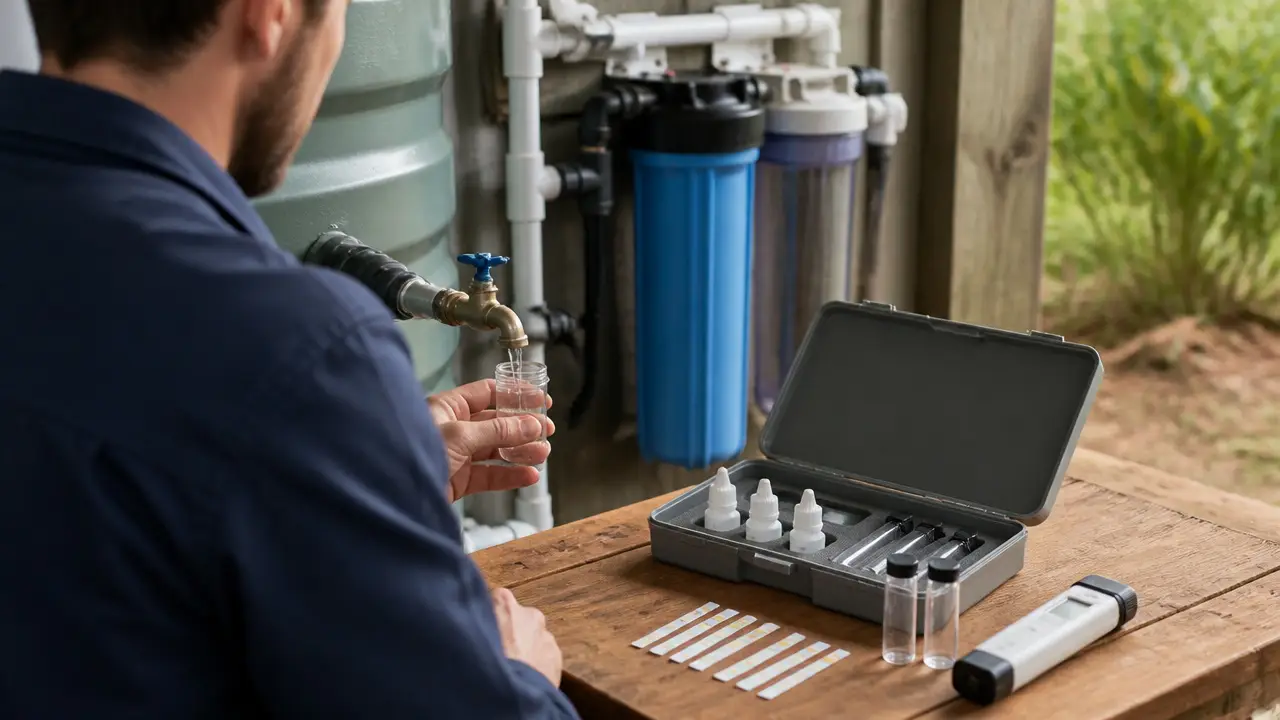
A turbidity meter is most useful when sampling is consistent.
Use a clean sample container or meter vial. Avoid fingerprints on the optical surface and avoid introducing air bubbles, because both can affect light readings.
Follow the meter manufacturer's calibration and cleaning instructions. Take samples from the same point in the system when comparing performance over time.
It can also help to measure at several stages, such as:
- Raw tank water
- Water after sediment filtration
- Water after finer filtration
This can show whether each treatment stage is actually reducing turbidity.
If a filter is supposed to remove suspended material but turbidity remains unchanged or begins rising, check for bypass, poor seals, incorrect installation, an exhausted filter, or a filter that is not suited to the particle size in the water.
NTU Does Not Replace Water Testing
Turbidity meters have a narrow job: they measure how much suspended material scatters light.
They cannot tell you whether water contains specific disease-causing microorganisms or harmful dissolved chemicals.
This distinction matters most when rainwater is intended for drinking. A low NTU number may show that particle removal is working well, but it cannot verify that the complete treatment system is producing potable water.
WHO's current drinking-water guidance uses a broader risk-management approach that covers the water supply from the source through treatment and use, rather than relying on one measurement.
Frequently Asked Questions
Is 1 NTU good for drinking water?
Below 1 NTU is a useful target before disinfection, according to WHO guidance. However, a reading below 1 NTU does not by itself mean water is safe to drink. Drinking-water safety depends on the complete collection and treatment system plus appropriate water testing.
Is 0.5 NTU good?
A turbidity reading of 0.5 NTU indicates relatively low suspended-particle levels and is below WHO's general less-than-1-NTU target for supporting effective disinfection. It still does not prove that the water is free from pathogens or chemical contaminants.
Is 5 NTU safe to drink?
Do not interpret 5 NTU as a drinking-water safety cutoff. WHO says that when less than 1 NTU cannot be achieved, turbidity should generally be kept below 5 NTU and treatment conditions may need adjustment. Water at 5 NTU should not be considered safe simply because it meets that number.
Can clear water have a high NTU?
Small changes in turbidity may not be obvious by eye. WHO notes that turbidity below roughly 4 NTU may only be detectable with instruments. A turbidity meter is therefore more reliable than visual inspection for low-level differences.
Does a low NTU mean rainwater is safe to drink?
No. Turbidity measures suspended particles, not overall water safety. Low-turbidity rainwater can still contain harmful microorganisms or dissolved contaminants. Drinking-water use requires appropriate treatment, maintenance, laboratory testing, and compliance with applicable requirements.
What should I do if my rainwater NTU keeps increasing?
Inspect the roof, gutters, screens, first-flush system, tank, and filters. Look for new debris, sediment disturbance, algae, damaged filters, or treatment bypass. A rising trend can be a useful warning that collection or filtration conditions have changed.
Is lower NTU always better?
For filtration and disinfection, lower turbidity is generally desirable because there are fewer suspended particles to interfere with treatment. But an extremely low NTU reading still tells you only about turbidity. It does not establish microbiological or chemical safety.