As an affiliate, we may earn a commission from qualifying purchases. We get commissions for purchases made through links on this website from Amazon and other third parties.
A level sensor can be a low-cost add-on or a major part of a water monitoring system. The cost depends mainly on the sensor type, tank size, display or controller needs, wiring, and installation.
For a rain barrel or small storage tank, a simple float-style sensor is usually the least expensive option. Ultrasonic, pressure-based, and connected monitoring systems are more complex and usually cost more.
The sensor itself is only part of the budget. You may also need a display, controller, cable, power supply, mounting hardware, tank fitting, or professional installation.
What Does a Level Sensor Do?
A level sensor tells you how much water is inside a tank.
Depending on the design, it may give you:
- A simple full or empty signal
- Several fixed water-level points
- A continuous level reading
- A percentage-full reading
- An alarm when the tank gets too low or too high
- A signal that starts or stops a pump
- Remote readings through an app or monitoring system
The more the sensor needs to do, the more complex the system usually becomes.
Level Sensor Types and Their Relative Cost
Float Switches
A float switch is one of the simplest ways to detect water level.
A floating part moves up or down with the water. When it reaches a certain point, it changes an electrical switch.
Float switches are commonly used for:
- Low-water pump protection
- High-level alarms
- Overflow control
- Automatic filling
- Simple full or empty indicators
They are usually among the least expensive level-sensing options.
The main limitation is that one float normally tells you whether the water has reached one specific height. It does not automatically tell you whether the tank is 37%, 54%, or 82% full.
You can use several floats at different heights if you want multiple level points.
Mechanical Tank Gauges
A mechanical gauge may use a float inside the tank connected to an outside indicator.
These systems can work well when you simply want to walk up to a tank and check its level.
They usually do not require electrical power. That can make them useful for rain barrels, outdoor tanks, cabins, and simple storage systems.
Check that the gauge is suitable for your tank height and mounting location before buying one.
Ultrasonic Level Sensors
An ultrasonic sensor usually sits above the water and measures the distance to the water surface using sound waves.
Because it does not need to sit underwater, it can be useful for larger tanks and cisterns.
These sensors are generally more expensive than basic float switches because they can provide continuous level information.
An ultrasonic system may include:
- The sensor
- A tank-mounted transmitter
- A separate display
- Wireless communication
- High- and low-level alarms
- Pump or valve controls
Tank shape matters. Internal pipes, braces, narrow openings, foam, condensation, or uneven surfaces can affect some installations.
Pressure Level Sensors
A pressure sensor can measure the pressure created by the water above it. The system then converts that pressure into an estimated water depth.
These sensors are often installed near the bottom of a tank or suspended in the water.
Pressure sensors can provide continuous readings and can work in deep storage tanks where other methods are less practical.
They normally cost more than a simple float switch because the sensor and monitoring equipment are more sophisticated.
Make sure any wetted sensor materials are suitable for the water and intended use.
Capacitive and Electronic Sensors
Electronic sensors can detect water level without using a traditional moving float.
Different designs work in different ways. Some detect water at fixed points. Others provide continuous measurements.
Their cost and complexity vary considerably.
Before choosing one, check:
- Tank material
- Tank wall thickness
- Sensor mounting requirements
- Maximum measurement depth
- Power requirements
- Output type
- Whether the sensor touches the water
A sensor that works well on one tank may not work correctly on another.
Smart and Remote Tank Monitors
Remote monitoring systems let you check tank level from another location.
Depending on the system, readings may appear on:
- A wall display
- A phone
- A computer dashboard
- A home automation system
These are generally among the more expensive choices because you are paying for more than the sensing element.
The system may also require wireless hardware, a gateway, batteries, cellular service, or another communication method.
Remote monitoring can be useful when a cistern is difficult to reach or when several tanks need regular checking.
What Makes a Level Sensor More Expensive?
Several features can increase the total system cost.
Continuous Measurement
A switch that tells you "water has reached this point" is relatively simple.
A sensor that constantly measures water depth and converts it into a percentage requires more electronics.
That usually increases cost.
Large Measurement Range
A shallow rain barrel and a deep cistern do not have the same sensing requirements.
Sensors designed for larger measurement ranges may use more specialized technology.
Displays and Controllers
Some sensors only produce an electrical signal. You then need another device to turn that signal into useful information.
A complete setup could include:
- Sensor
- Display
- Controller
- Relay
- Alarm
- Pump control
- Power supply
Check what is included before comparing systems.
Wireless Monitoring
Wireless communication adds convenience but also adds components.
A wireless system may need batteries, a receiver, Wi-Fi, cellular communication, or another network connection.
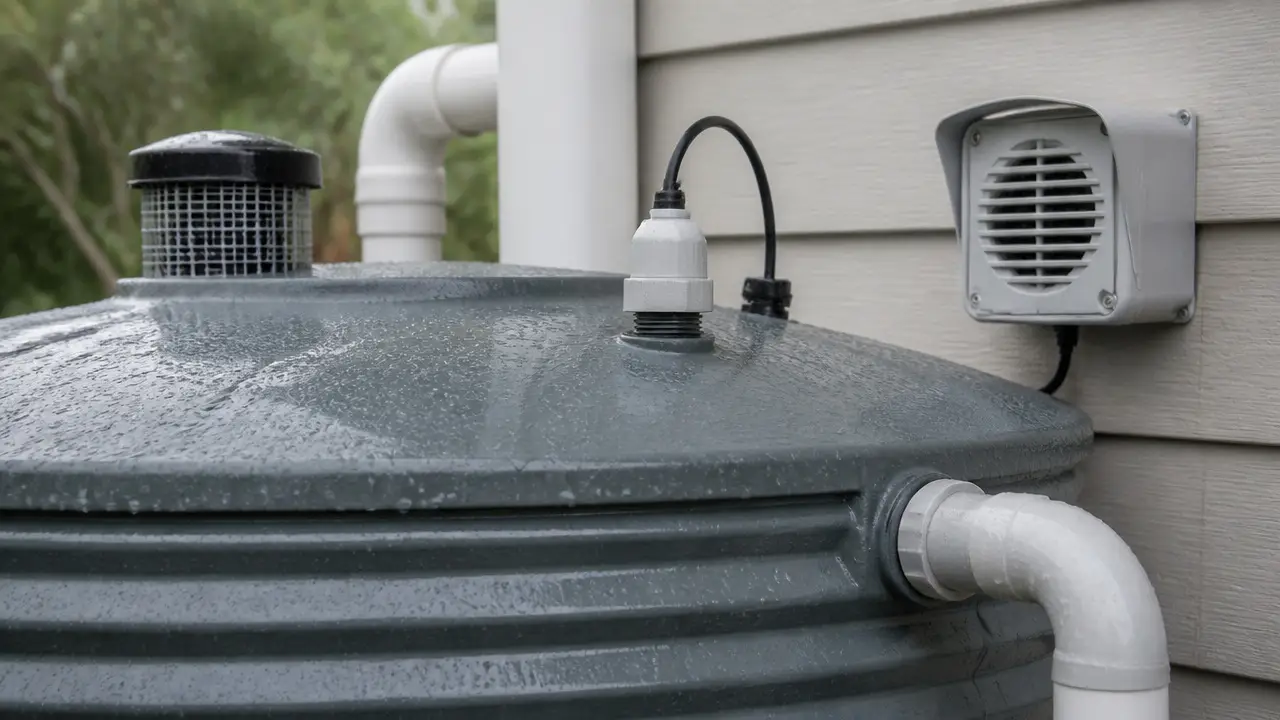
Planning around water-level sensing linked to audible or mobile alerts helps compare the dimensions needed for a leak-resistant connection.
Think about whether you actually need remote readings. A simple local gauge may be enough if the tank is easy to reach.
Outdoor Protection
Rainwater equipment may be exposed to moisture, insects, heat, cold, and sunlight.
Outdoor sensors and electrical equipment should be suitable for the installation environment.
Do not assume a sensor is weatherproof simply because it is meant for a water tank.
Installation
Installation can sometimes cost more than the sensor itself.
A simple mechanical gauge may be an easy DIY project. A pressure sensor connected to a pump controller or building electrical system can be much more involved.
Electrical work should follow the manufacturer's instructions and applicable local electrical requirements.
Don't Forget the Installation Parts
A common budgeting mistake is looking only at the sensor.
Depending on your setup, you may also need:
- Tank fittings
- Cable
- Conduit
- Mounting brackets
- Seals
- Junction boxes
- Displays
- Relays
- Power supplies
- Battery replacements
- Wireless receivers
Tank modifications also deserve careful planning.
For example, drilling a tank may require the correct bulkhead fitting. A bulkhead fitting creates a sealed connection through the wall of a tank.
Do not drill a tank until you know exactly how the sensor mounts and whether the tank manufacturer allows that type of installation.
What Level Sensor Is Best for a Rainwater Tank?
The best choice depends on what you actually need to know.
If you only need to prevent a pump from running when the tank is empty, a low-level float switch may be enough.
If you want a quick visual reading when standing beside the tank, a mechanical gauge may be simpler.
If you want to know the approximate amount of water available at any time, a continuous ultrasonic or pressure sensor may make more sense.
If the tank is far from the house, remote monitoring may justify the extra complexity.
Start with the job the sensor must perform instead of starting with a particular sensor technology.
Consider Tank Shape Before Choosing a Sensor
Water depth is not always the same thing as water volume.
In a straight-sided rectangular or vertical cylindrical tank, the relationship may be fairly simple.
In a tank with curved ends, tapered walls, or an irregular shape, a half-full depth reading may not mean the tank contains exactly half of its usable capacity.
Some monitoring systems can be configured for different tank shapes. Others simply report water depth.
Check how the device calculates percentage or volume if that information matters to you.
Can a Level Sensor Control a Rainwater Pump?
Yes, some level sensors can be used as part of a pump-control system.
For example, a low-level switch can tell a controller to stop the pump before the tank runs dry.
This is called dry-run protection. Running some pumps without enough water can damage them.
However, do not assume every level sensor can directly switch a pump.
The electrical rating of a small sensor may be much lower than the power required by the pump. A controller, relay, or other approved control equipment may be necessary.
Follow the pump and sensor manufacturers' wiring requirements. If the installation involves mains-voltage electrical work, use a qualified professional where required.
Is a More Expensive Sensor More Accurate?
Not automatically.
The right sensor installed correctly is more useful than a sophisticated sensor installed in the wrong location.
Accuracy can be affected by:
- Sensor placement
- Tank shape
- Condensation
- Sediment
- Floating debris
- Turbulence
- Incorrect calibration
- Wiring problems
- Temperature
- Obstructions inside the tank
A basic float switch can be very dependable for a simple high- or low-water signal because it does not need to calculate the exact water volume.
Choose the level of measurement you actually need.
Plan for Maintenance
Level sensors are not maintenance-free.
Inspect the system as recommended by its manufacturer.
Depending on the sensor type, maintenance may include:
- Checking floats for free movement
- Removing sediment or buildup
- Checking cables and connectors
- Replacing batteries
- Inspecting seals
- Checking mounting hardware
- Confirming alarm operation
- Comparing the displayed level with the actual tank level
Rainwater tanks can contain sediment, insects, organic debris, or biofilm. A sensor that works well when new may give poor readings if its sensing area becomes dirty.
Frequently Asked Questions
What is the cheapest type of water level sensor?
A simple float switch is usually one of the lowest-cost options. It works well when you only need to detect whether water has reached a certain height.
Do I need a sensor for a rainwater tank?
No. Many basic rainwater systems work without one. A level sensor becomes more useful when you want easier level checks, low-water pump protection, overflow alarms, automatic controls, or remote monitoring.
Can I install a water level sensor myself?
Some mechanical gauges and low-voltage sensors can be reasonable DIY projects when installed according to the manufacturer's instructions. Tank drilling, mains-voltage wiring, complicated pump controls, and difficult-access installations may require professional help.
Can an ultrasonic sensor measure through a plastic tank?
Some sensor systems are designed for specific non-contact mounting arrangements, but you should not assume an ultrasonic sensor can accurately measure through any tank wall. Follow the manufacturer's mounting requirements and confirm compatibility with the tank material and thickness.
Can a level sensor tell me how many gallons are left?
Some systems can estimate volume if the tank dimensions or shape are entered correctly. Others only report water depth or percentage. Irregular tank shapes may require a more detailed calibration method.
Will a level sensor stop my pump from running dry?
It can if the sensor is designed and correctly connected as part of a dry-run protection system. The sensor may require a compatible pump controller or relay rather than connecting directly to the pump.
Are wireless tank level sensors worth it?
They can be useful when the tank is far away, difficult to access, or checked frequently. For an easily accessible rain barrel or tank, a simple mechanical gauge may provide the information you need with less complexity.