As an affiliate, we may earn a commission from qualifying purchases. We get commissions for purchases made through links on this website from Amazon and other third parties.
Yes. Zero-pressure watering timers are available, and they are made for rain barrels, gravity-fed tanks, and other systems that do not have normal household water pressure. Some use a motor-driven ball valve that opens and closes mechanically rather than relying on water pressure to operate a diaphragm valve.
The important part is choosing a timer that specifically states zero pressure, no minimum pressure, or gravity-fed operation. A normal garden-hose timer may fit the same hose threads but still fail to open or close correctly when connected to a rain barrel.
How a Zero-Pressure Watering Timer Works
Most ordinary hose timers contain a diaphragm valve. Water pressure helps move that valve and seal it when the timer shuts off.
That works well on a household faucet. It can be a problem on a rain barrel.
Some standard irrigation timers need around 10 PSI or more before their valves operate correctly. Other models require considerably more.
A true zero-pressure timer uses a different valve design. Many use a small battery-powered motor to rotate a ball valve. Because the motor physically turns the valve, the timer does not need water pressure to force the valve open or closed.
Current zero-pressure timers are sold specifically for:
- Rain barrels
- Gravity-fed tanks
- IBC totes
- Small cisterns
- Low-pressure drip irrigation
- Soaker hoses designed for gravity systems
Manufacturers and irrigation suppliers currently list timers with operating ranges beginning at 0 PSI or with no stated minimum pressure requirement.
What "Zero Pressure" Really Means
A rain barrel normally produces at least a small amount of pressure if the water level is above the irrigation outlet.
This is called head height. Head height is the vertical distance between the water surface in the tank and the point where the water is being discharged.
Water produces about 0.43 PSI for every foot of vertical height.
For example:
| Water height above outlet | Approximate static pressure |
|---|---|
| 1 foot | 0.43 PSI |
| 2 feet | 0.87 PSI |
| 4 feet | 1.73 PSI |
| 6 feet | 2.60 PSI |
| 10 feet | 4.33 PSI |
These pressures are far below normal household water pressure.
When a timer is called "zero pressure," it generally means its valve does not require a minimum inlet pressure to operate. It does not mean water can move through your irrigation system with no difference in elevation.
Gravity still needs to move the water.
Why Ordinary Hose Timers Often Do Not Work on Rain Barrels
A regular garden timer can look almost identical to a zero-pressure timer.
The problem is inside the valve.
If a diaphragm timer requires 10 PSI and your barrel provides only 1 PSI, several things can happen:
- The valve may not open fully.
- Water flow may be extremely slow.
- The timer may fail to shut completely.
- The barrel may continue draining after watering should stop.
- Irrigation emitters may receive uneven flow.
A timer that fails to close is particularly important with stored rainwater because it can drain an entire barrel or tank.
Do not assume that a battery-powered hose timer is suitable for gravity irrigation. Check its minimum operating pressure before buying it.
Look for a Motorized Ball Valve
For very low-pressure systems, a motorized ball valve is usually the key feature to look for.
Inside this type of timer is a ball with a hole through it. A small electric motor rotates the ball.
When the hole lines up with the water passage, water flows through it. When the ball turns sideways, the passage closes.
This arrangement has two advantages for a rain barrel:
- The valve does not depend on water pressure to move.
- The water path can be relatively open compared with some small diaphragm valves.
Current zero-pressure irrigation timers using mechanical or motor-driven valve designs are specifically sold for gravity-fed rainwater systems.
Check the Timer's Connections
Pressure is not the only compatibility issue.
Most hose-end watering timers use standard garden-hose connections, commonly a female hose-thread inlet and male hose-thread outlet.
Check your rain barrel before assuming everything will screw together.
A typical arrangement might be:
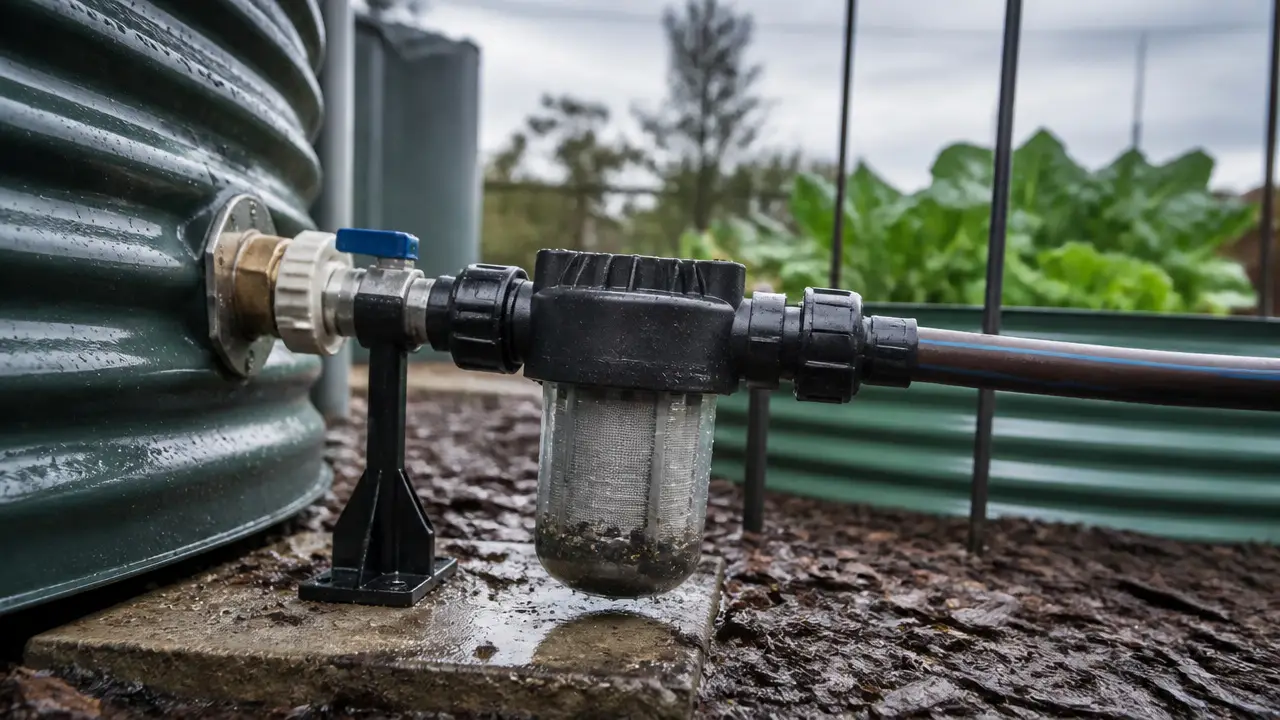
Rain barrel → shutoff valve → filter → zero-pressure timer → irrigation tubing
Your barrel may instead have:
- Pipe threads
- A bulkhead fitting
- A hose adapter
- A larger tank outlet
- An IBC tote valve
A bulkhead fitting is a fitting installed through the wall of a tank so a pipe, valve, or hose can connect without simply passing a loose hose through the tank wall.
Adapters are often available, but every extra fitting also adds some resistance to flow.
Low Pressure Can Still Limit Your Irrigation
Installing a zero-pressure timer solves the timer-valve problem. It does not create additional water pressure.
This distinction matters.
You could have a timer that operates perfectly at less than 1 PSI while the irrigation system attached to it still performs poorly.
Flow may be restricted by:
- A barrel sitting close to ground level
- Long hoses
- Small tubing
- Narrow fittings
- Several elbows
- Fine filters
- Pressure regulators
- Drip emitters designed for pressurized systems
- Elevation changes in the garden
The timer must work at low pressure, but so must everything downstream from it.
Be Careful With Pressure Regulators
A pressure regulator normally reduces pressure.
That can be useful when a pressurized faucet supplies a drip system, but it usually does not help a gravity-fed rain barrel that already has very little pressure.
Installing an unnecessary regulator can reduce flow even further.
If a drip kit normally expects 15, 20, or 25 PSI after its regulator, simply removing the regulator does not guarantee that its emitters will work correctly at 1 PSI. Check the operating requirements of the irrigation tubing and emitters as well.
Choose Irrigation Made for Gravity Flow
A zero-pressure timer works best when paired with irrigation equipment that can also operate at low pressure.
Depending on your garden, that might include:
- Open-ended distribution tubing
- Low-pressure drip tape
- Gravity-compatible drip emitters
- Short irrigation runs
- Carefully selected soaker hose
- Simple basin or container filling
Traditional lawn sprinklers generally need much more pressure than a rain barrel can provide by gravity alone.
If you want to run conventional sprinklers or pressure-dependent drip equipment from stored rainwater, you may need a pump rather than relying solely on elevation.
Tank Height Helps
Raising a rain barrel increases available pressure.
For example, increasing the water surface from 2 feet to 6 feet above the garden raises static pressure from roughly 0.9 PSI to 2.6 PSI.
That is still low pressure, but it can make a noticeable difference to flow.
However, do not raise a full tank on an improvised stand.
Water is heavy. One US gallon weighs about 8.34 pounds. A 55-gallon barrel can therefore hold roughly 459 pounds of water before adding the weight of the barrel itself.
Larger tanks quickly reach thousands of pounds.
Any elevated tank needs a stable base designed for the expected load. Do not trade a small irrigation improvement for a tipping or structural hazard.
Install a Filter Before the Timer
Regarding using a hose timer with a rain barrel, compare cleaning access that supports sediment and odor management.
Rainwater can carry fine debris even when the barrel has a screen.
Possible material includes:
- Roof grit
- Dust
- Small leaves
- Insects
- Sediment
- Organic material
Small particles can interfere with a timer's valve.
Suppliers of zero-pressure rain-barrel timers commonly recommend filtration upstream of the timer for this reason.
The correct filter depends on the timer and irrigation system. Finer is not automatically better because a very fine filter also creates more resistance and requires more frequent cleaning.
The goal is to remove particles that could clog the valve and irrigation equipment without unnecessarily restricting an already low-pressure system.
Put the Timer Below the Water Level
For gravity watering, placement matters.
Ideally, the timer and most of the irrigation line should be below the water surface in the barrel.
The greater the vertical difference between the water surface and the outlet, the more head pressure gravity provides.
Remember that the available head changes as the tank empties.
A barrel may provide reasonable flow when full but noticeably less when nearly empty. Test the system at a low tank level rather than testing it only immediately after a rainstorm.
Check the Required Flow Rate
Flow rate means how much water moves through the system during a given amount of time, commonly measured in gallons per minute.
A timer being capable of opening does not guarantee enough flow for the whole garden.
A useful test is to connect your planned system and measure how much water reaches the end under normal gravity conditions.
For example, collect the outlet water in a measured container for one minute.
If it delivers 0.5 gallon in one minute, the approximate flow is 0.5 gallon per minute.
Test under realistic conditions with the filter, timer, tubing, and other restrictions installed.
Battery Power Is Normal
Many zero-pressure watering timers use batteries.
The battery operates the clock and physically moves the valve. This is different from using electricity to pump the water.
The water can still move entirely by gravity.
Check batteries regularly. A timer controlling a rainwater tank should not be treated as something that can be installed and forgotten for an entire season.
It is also useful to periodically confirm that the valve actually closes at the end of a watering cycle.
Protect the Timer From Freezing
Water left inside a timer can freeze and expand.
That can crack the housing, damage seals, or damage the internal valve.
Manufacturers of some zero-pressure rain-barrel timers specifically instruct users to remove the timer before freezing conditions and store it indoors.
If you live in a freezing climate, include the timer in the winter shutdown plan for the entire rainwater irrigation system.
Disconnecting the timer alone may not protect exposed filters, valves, hoses, pumps, or fittings that still contain water.
A Practical Rain Barrel Setup
For a simple garden, the system might look like this:
Screened rain barrel → barrel valve → sediment filter → zero-pressure timer → main irrigation line → gravity-compatible emitters
Keep the tubing reasonably short and avoid unnecessary restrictions.
Before relying on the timer:
- Fill the barrel enough to represent normal operating conditions.
- Open the barrel valve fully.
- Check every fitting for leaks.
- Run the timer manually.
- Confirm water reaches the entire irrigation area.
- Let the timer close automatically.
- Make sure water actually stops.
- Repeat the test when the tank level is lower.
That final test is important because gravity pressure decreases as the barrel empties.
When a Zero-Pressure Timer Is a Good Choice
A zero-pressure watering timer makes sense when you have:
- A rain barrel feeding a garden by gravity
- An elevated IBC tote
- A small gravity-fed cistern
- Low-pressure drip irrigation
- A system where adding a pump would be unnecessary
It provides automation without requiring you to pressurize the water first.
When You May Need a Pump Instead
A timer cannot compensate for an irrigation system that requires more pressure than gravity can supply.
A pump may be more appropriate when you need:
- Conventional sprinklers
- Long irrigation runs
- Significant elevation gain
- Multiple watering zones
- Pressure-compensating emitters with higher pressure requirements
- Higher flow rates
- Consistent pressure as the tank level changes
In that situation, the timer and pump controls need to be designed to work together. Do not place a pump into a system without checking its required inlet conditions, flow, pressure, electrical requirements, and dry-run protection.
What to Check Before Buying
The most important specification is not simply "rain barrel compatible."
Look for a timer that clearly states:
- Zero-pressure operation
- No minimum inlet pressure, or a 0 PSI minimum
- Gravity-fed compatibility
- A motorized or mechanical valve suitable for low pressure
- Connections that match your system
- Outdoor exposure limits
- Appropriate operating temperature
Also check the timer's flow limitations and the pressure requirements of the irrigation equipment downstream.
Current products specifically advertised for rain barrels and gravity-fed irrigation confirm that true no-minimum-pressure watering timers are available.
Frequently Asked Questions
Will a normal hose timer work on a rain barrel?
Not necessarily. Many ordinary hose timers use diaphragm valves that require several PSI of water pressure to operate correctly. A rain barrel may provide less than 1 or 2 PSI. Choose a timer specifically rated for zero-pressure or gravity-fed operation.
Does a zero-pressure timer increase water pressure?
No. It only allows the valve to open and close without relying on water pressure. The water still moves through the irrigation system using gravity unless you add a pump.
How much pressure does a rain barrel produce?
Water produces about 0.43 PSI for every foot of vertical difference between the water surface and the outlet. A water surface 4 feet above the irrigation outlet provides roughly 1.7 PSI of static pressure.
Can I use a zero-pressure timer with drip irrigation?
Yes, provided the drip system itself can operate at the available pressure and flow. Some drip emitters are designed for pressurized systems and may not distribute water evenly from a gravity-fed barrel.
Should the timer go before or after the filter?
For rainwater systems, putting a suitable filter before the timer can help keep sediment and debris out of its valve. Follow the timer manufacturer's installation instructions because filtration requirements can vary.
Can a zero-pressure timer run a sprinkler?
The timer may open, but a typical sprinkler may not work properly. Most sprinklers require much more pressure than a gravity-fed rain barrel provides. A pump may be needed.
Can I leave a rain-barrel timer outside during winter?
Do not assume you can. Water trapped inside the timer can freeze and damage it. Follow the manufacturer's temperature limits and winterization instructions, and remove and drain vulnerable components before freezing conditions when required.