As an affiliate, we may earn a commission from qualifying purchases. We get commissions for purchases made through links on this website from Amazon and other third parties.
For most raised garden beds, drip irrigation is the best overall watering method. It puts water slowly into the soil near plant roots, wastes little water, and keeps most foliage dry. It also works well with timers and can be divided into separate watering zones.
A simple soaker hose is a good second choice. It is easier to install, but water distribution can be less predictable. Hand watering works for a few small beds, while overhead sprinklers are usually the least useful choice for raised vegetables.
Raised beds often dry faster than in-ground soil, so even a good irrigation system needs to be matched to the soil, plants, weather, and water source.
Best Irrigation Methods for Raised Beds
| Irrigation method | Best use | Main drawback |
|---|---|---|
| Inline drip tubing | Most vegetable and mixed raised beds | Needs filtration and correct pressure |
| Individual drip emitters | Widely spaced plants such as tomatoes | More tubing and fittings |
| Soaker hose | Simple DIY beds | Water output can be uneven |
| Drip tape | Closely spaced vegetable rows | Usually less durable than heavier tubing |
| Hand watering | Seedlings and very small gardens | Takes time and can be inconsistent |
| Sprinklers | Situations where overhead watering is acceptable | Wets leaves and waters outside the bed |
For a typical permanent raised-bed garden, inline drip tubing is usually the easiest method to keep consistent over several growing seasons.
Why Drip Irrigation Works So Well in Raised Beds
Drip irrigation releases small amounts of water directly onto or into the soil. The openings that control the water are called emitters.
This is a good match for raised beds because the growing area is already narrow and defined. You do not need to water pathways or surrounding ground.
Drip irrigation also:
- reduces water lost to overspray
- keeps most water near the root zone
- works well underneath mulch
- can be automated with a timer
- can water several beds from one supply line
- can be divided into zones for plants with different needs
Colorado State University Extension specifically identifies drip irrigation as well suited to raised beds. UC guidance also notes that slowly applying water to the soil can reduce evaporation and unnecessary watering outside the root area.
Keeping leaves dry is another advantage. Wet foliage does not automatically cause disease, but frequent overhead watering can create conditions that favor some plant diseases. Watering near the soil avoids much of that problem.
Inline Drip Tubing Is Usually the Best Layout
Inline drip tubing has emitters built into the tubing at regular intervals.
For a bed filled with closely spaced vegetables, you can run several parallel lines along the length of the bed. This creates overlapping wet areas instead of trying to provide one emitter for every plant.
Colorado State University gives about 12-inch spacing between drip or soaker lines as a practical layout for many four-foot-wide raised vegetable beds. That would mean roughly four runs along a four-foot-wide bed. Larger, widely spaced vegetables may need fewer lines.
Treat that as a starting point rather than a rule.
Your actual spacing depends on:
- soil texture
- bed width
- emitter spacing
- emitter flow rate
- plant spacing
- water pressure
- how far water spreads sideways through the soil
Water spreads differently through sandy soil than through soil containing more clay or organic matter. Run the system and check the soil between the lines. If dry strips remain, the irrigation lines are too far apart for that bed.
Individual Emitters Work Better for Widely Spaced Plants
A bed containing tomatoes, peppers, eggplants, squash, or other widely spaced plants may not need a full grid of drip tubing.
Instead, you can use a larger supply tube with smaller lines or emitters positioned near individual plants.
This prevents you from watering large areas of bare soil.
As plants grow, remember that their roots spread outward. An emitter placed directly beside a tiny transplant may need to be moved or supplemented later in the season.
Pressure-compensating emitters can help when a system has varying pressure or elevation. A pressure-compensating emitter is designed to keep its water output more consistent as system pressure changes.
Are Soaker Hoses Good for Raised Beds?
Yes. A soaker hose can be a very practical choice, especially if you want a simple system without many small fittings.
A soaker hose is porous. Water seeps through much of its surface instead of coming from individual emitters.
Utah State University lists soaker hoses as a simple way to provide efficient trickle irrigation in raised beds, and Minnesota Extension also recommends them as an option.
They work especially well when you have:
- one or two beds
- fairly short hose runs
- beds at similar elevations
- relatively even plant spacing
- a water supply with suitable pressure
The main disadvantage is uniformity. The beginning of a long hose can release a different amount of water than the far end, particularly if pressure is low.
Soaker hoses also vary considerably in their operating requirements. Do not assume that every hose will work properly from a low-pressure rain barrel.
Drip Irrigation vs. Soaker Hose
For a simple garden, either can work.
Choose drip tubing when you want better control, easier zoning, predictable emitter locations, or a system you expect to expand.
Choose a soaker hose when you want a simple layout and do not need precise control over where each gallon goes.
Drip irrigation generally becomes more useful as the garden gets larger because you can change individual lines, emitters, valves, and zones without rebuilding the whole system.
Why Sprinklers Are Usually Not the Best Choice
Sprinklers can certainly keep a raised bed alive, but they usually water more area than necessary.
Water may land on:
- leaves
- pathways
- bed walls
- nearby weeds
- unplanted soil
Wind can also move spray away from the target area.
Extension guidance generally favors drip or trickle irrigation for raised beds because these systems place water where the plants are growing instead of spraying the entire surrounding area.
Sprinklers can still make sense when you need to wet a whole seedbed evenly during germination. Once plants are established, switching to drip irrigation usually gives you more control.
Hand Watering Still Has a Place
A watering wand or watering can is useful even if you have drip irrigation.
Hand watering is especially helpful for:
- newly planted seeds
- fresh transplants
- plants that need extra water
- checking a bed before the permanent system is operating
- very small gardens
The problem is consistency.
One plant may receive much more water than another, and it is easy to wet only the upper layer of soil without soaking the deeper root zone.
For several raised beds, automatic drip irrigation usually requires much less daily attention.
Pressure Matters More Than Many Gardeners Expect
Drip irrigation is a low-pressure system, but low pressure does not mean zero pressure.
Water pressure is the force pushing water through the tubing and emitters. It is commonly measured in pounds per square inch, or psi.
Many home drip systems are designed to operate somewhere around 10 to 30 psi, although the correct pressure depends on the specific tubing and emitters being used. A pressure regulator reduces higher household water pressure to the range required by the irrigation equipment.
Always use the pressure specified by the tubing or emitter manufacturer.
Too much pressure can cause fittings to separate or damage low-pressure tubing.
Too little pressure can leave the far end of the bed dry.
Using Drip Irrigation With a Rain Barrel
Rain barrels need extra planning because gravity produces very little pressure.
Water gains roughly 1 psi for every 2.31 feet of vertical height between the water surface and the irrigation outlet.
That means raising a barrel a few feet does not provide anything close to normal household water pressure.
For example, a water surface 4 feet above the garden provides only about 1.7 psi before losses through filters, hoses, valves, and fittings.
Because of this, a conventional pressure-regulated drip system may work poorly when connected directly to a gravity-fed barrel.
You generally have three choices:
- Use irrigation equipment specifically designed for very low-pressure gravity systems.
- Keep the irrigation runs short and simple where the equipment allows it.
- Use a suitable pump when the irrigation system requires more pressure.
Do not simply add a pump without checking its pressure and flow against the irrigation system.
For a suitable DIY drip irrigation system, first verify watering-device output under realistic system pressure.
Flow rate means how much water moves through the system during a certain amount of time. A pump must provide enough flow for all the emitters operating in that irrigation zone while also maintaining the pressure they require.
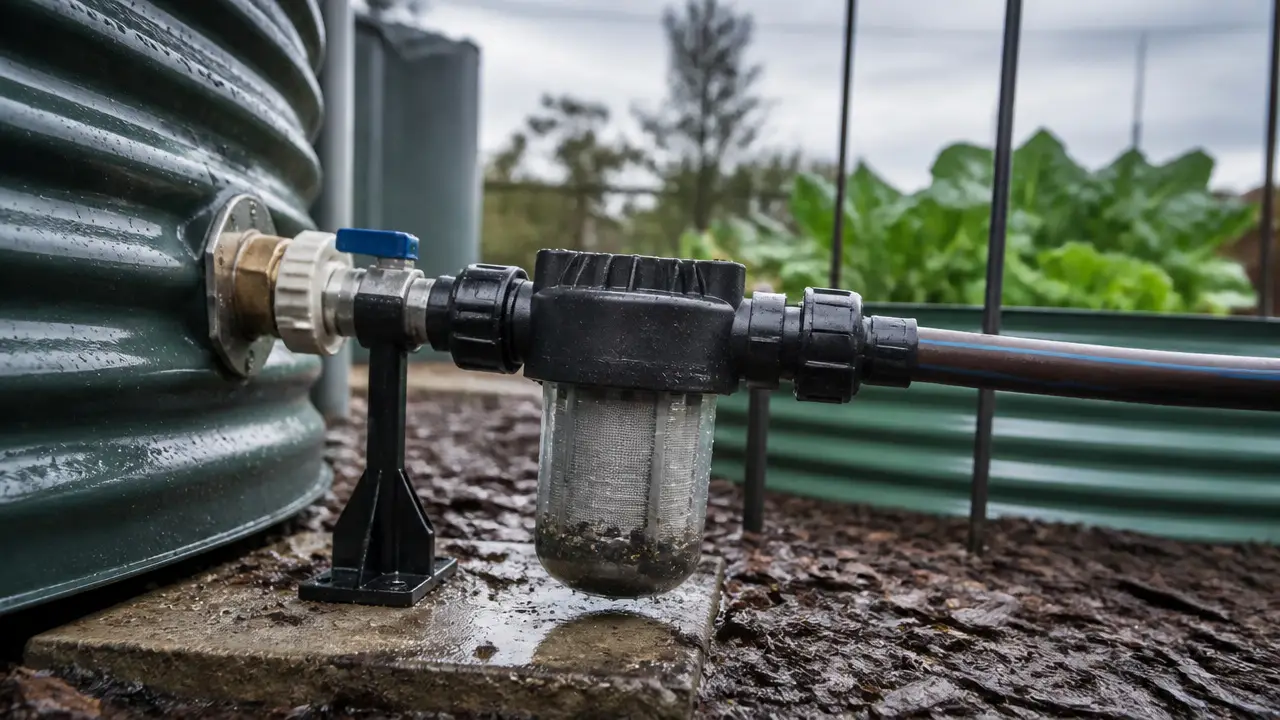
Rainwater Needs Filtration Before Small Drip Emitters
Small drip openings can clog.
Collected rainwater may contain:
- roof particles
- leaves
- organic debris
- sediment
- algae
- insects or insect material
A filter before the irrigation lines helps protect the emitters. The exact filtration requirement depends on the irrigation equipment.
Many drip systems require fine filtration. Extension guidance commonly describes filters in approximately the 120- to 200-mesh range for drip equipment, but you should follow the emitter manufacturer's requirement rather than selecting a filter from that number alone.
A finer filter also needs regular cleaning. If it becomes clogged, pressure and flow downstream can fall enough that parts of the garden stop receiving water.
Rainwater used for garden irrigation is non-potable, meaning it has not been established as safe drinking water. If roof-collected rainwater will be used on edible crops, check current guidance from your local health department, extension service, or other responsible authority. Roof materials, contaminants, collection practices, crop type, and local rules can affect what uses are appropriate.
A Practical Raised-Bed Drip Setup
For a household water supply, a typical system may follow this path:
Water source → backflow protection if required → filter → pressure regulator → main tubing → bed lines → flushable ends
A timer can also be added if you want automatic watering.
Backflow protection matters when an irrigation system is connected to household drinking-water plumbing. It prevents irrigation water from moving backward into the potable water supply. Requirements vary by location, so follow local plumbing or water-provider rules.
With an independent rainwater tank, the layout is different because pressure, filtration, and pumping depend on the storage system.
Divide Different Plants Into Watering Zones
A zone is a part of the irrigation system that operates separately.
Zoning is helpful because not every bed needs the same amount of water.
For example, a bed of large tomatoes may have different water needs than:
- newly planted lettuce
- established herbs
- root crops
- seedlings
If all of them share one valve and one watering schedule, some plants may receive too much water while others receive too little.
You do not necessarily need an elaborate automatic controller. Even separate manual valves for each bed can make watering much easier to adjust.
Do Not Set the Timer and Forget It
There is no single correct number of minutes to run raised-bed irrigation.
The amount of water delivered depends on the emitters and system pressure. The amount the plants need changes with:
- temperature
- wind
- rainfall
- plant size
- growth stage
- soil mix
- mulch
- season
Raised beds can dry faster than surrounding ground, particularly during hot weather.
Check moisture below the surface instead of judging the bed by whether the top looks dry.
After irrigation, inspect several locations between the drip lines. The goal is to wet the active root zone without leaving large dry areas or continuously waterlogged soil.
Adjust the run time or watering frequency based on what you find.
Mulch Makes Drip Irrigation Work Better
Once the irrigation lines are working correctly, covering the soil with suitable mulch can reduce evaporation.
Drip tubing is commonly placed on the soil surface underneath mulch.
Mulch also helps limit large swings between very wet and very dry soil.
Keep an eye on the irrigation system after adding mulch. A hidden line can become disconnected or clogged without being immediately obvious.
Maintenance Is Part of the System
Drip irrigation is low-maintenance, but it is not maintenance-free.
During the growing season:
- inspect emitters for clogged or uneven flow
- look for leaking fittings
- clean the filter
- check the ends of long lines
- flush tubing when necessary
- make sure mulch has not hidden a leak
- adjust lines as plants grow
A partly blocked emitter may leave one plant dry while everything around it looks normal.
If your system uses stored rainwater, inspect it more often because sediment and organic material can increase clogging risk.
Colorado State University recommends checking filters and emitters and flushing drip systems as part of routine operation.
Plan for Freezing Weather
Water trapped inside valves, filters, regulators, pumps, or rigid fittings can freeze and cause damage.
In freezing climates, follow the irrigation equipment manufacturer's winterizing instructions. Drain components that are designed to be drained and store removable parts indoors when recommended.
Rain barrels and above-ground storage also need their own freeze plan. Do not assume that flexible irrigation tubing makes the entire system freeze-safe.
Which Irrigation Method Should You Choose?
For most raised beds, the choice is straightforward:
Use inline drip tubing for a densely planted vegetable bed.
Use individual drip emitters where plants are widely spaced.
Use a soaker hose when simplicity matters more than precise control.
Keep a watering wand for seedlings and occasional spot watering.
Use overhead sprinklers only when there is a clear reason to wet the whole bed.
If you are supplying the garden from a rain barrel or cistern, choose the irrigation equipment only after checking the available pressure, required flow, filtration needs, and connection sizes. A good irrigation method still performs poorly when the water source and irrigation hardware do not match.
Frequently Asked Questions
Is drip irrigation or a soaker hose better for raised beds?
Drip irrigation is usually better when you want precise control, separate watering zones, or an expandable system. A soaker hose is simpler and can work very well for a small raised-bed garden, but its water output may be less uniform.
How many drip lines should I put in a 4-foot-wide raised bed?
Four lines spaced roughly 12 inches apart are a useful starting point for many densely planted vegetable beds. Larger plants may need fewer runs. Check how water spreads through your actual soil and adjust the spacing if dry areas remain.
Should drip irrigation go above or below mulch?
Drip tubing is commonly placed on the soil surface and covered with mulch. This allows the water to enter the soil while the mulch helps reduce evaporation. Make sure you can still inspect or access fittings and flush points.
How often should raised beds be watered?
There is no fixed schedule that works everywhere. Raised beds often dry faster than in-ground gardens, but watering frequency depends on weather, plants, soil, mulch, and irrigation output. Check moisture in the root zone and adjust the schedule rather than watering by the calendar alone.
Can I run raised-bed drip irrigation directly from a rain barrel?
Sometimes, but only when the irrigation system is designed to operate at very low gravity pressure. A barrel elevated only a few feet produces much less pressure than a household faucet. Standard drip equipment may require a pump or a different low-pressure design.
Do I need a filter for drip irrigation?
Yes, filtration is important because small emitters can clog. It becomes especially important with rainwater, pond water, or other sources that may contain sediment and organic debris. Match the filter to the irrigation equipment manufacturer's requirements.
Are sprinklers bad for raised garden beds?
Not necessarily, but they are usually less efficient for a small raised bed because they wet foliage, pathways, and areas outside the root zone. Drip irrigation or soaker hoses normally provide better control.