As an affiliate, we may earn a commission from qualifying purchases. We get commissions for purchases made through links on this website from Amazon and other third parties.
For low water pressure, the best pop-up sprinkler is usually a standard pop-up spray body fitted with a low-pressure fixed-pattern spray nozzle. Look for a nozzle that has a published operating range that matches the pressure you actually have while the irrigation zone is running.
Some fixed spray nozzles are designed to operate from about 15 to 30 psi, although they may give their best coverage closer to 30 psi. By comparison, many rotary nozzles need at least 30 psi and are designed to work best around 40 to 45 psi.
That means a rotary nozzle is not automatically the best choice just because it uses less flow. When pressure is genuinely low, a simple fixed spray nozzle often works better.
What Makes a Pop-Up Sprinkler Good for Low Pressure?
A pop-up sprinkler has two main parts:
- The sprinkler body, which rises out of the ground when the zone turns on.
- The nozzle, which controls the pattern, distance, and flow of the water.
When water pressure is limited, the nozzle is especially important.
You want a nozzle that can form a usable spray without needing high pressure. You also want a zone that does not demand more water than the supply or pump can provide.
A good low-pressure setup usually has:
- A standard pop-up spray body
- A fixed-pattern spray nozzle
- A relatively short spray radius
- Only as many sprinkler heads as the available flow can support
- Pipe large enough to avoid excessive pressure loss
- Clean nozzle screens and filters
For example, Rain Bird's MPR fixed spray nozzles list a pressure range of 15 to 30 psi, with 30 psi listed as the optimum pressure.
That does not mean every fixed spray nozzle will perform properly at 15 psi. Always check the performance chart for the exact nozzle you plan to use.
Fixed Spray Nozzles Are Usually the Better Choice
Fixed spray nozzles send water through stationary openings rather than rotating streams.
For a low-pressure lawn zone, this simplicity can be useful.
Manufacturers offer fixed spray nozzles for different patterns, including:
- Quarter circles
- Half circles
- Full circles
- Narrow strips
- Short-radius areas
Some fixed spray designs have published operating ranges starting around 15 psi.
The tradeoff is water demand.
Traditional spray nozzles can use considerably more water per minute than rotary nozzles. If your problem is low flow rather than low pressure, putting many fixed spray heads on one zone may make the problem worse.
This is why you need to measure both pressure and available flow before choosing sprinklers.
Low Pressure and Low Flow Are Not the Same Thing
These two problems are often confused.
Water pressure is the force pushing water through the irrigation system. It is usually measured in pounds per square inch, or psi.
Flow rate is the amount of water available over time. In a residential irrigation system, it is commonly measured in gallons per minute, or GPM.
You can have:
- Good pressure but very little available flow
- Plenty of flow but poor pressure
- Both low pressure and low flow
The sprinkler layout needs to work with both.
For example, installing six sprinklers that each need more water than your source can supply will cause the pressure to fall once the zone starts running.
The sprinklers may rise only halfway, spray unevenly, or fail to reach the next sprinkler.
Measure Pressure While the Water Is Running
Static pressure alone does not tell you whether a sprinkler system will work.
Static pressure is the pressure measured when little or no water is flowing. The pressure may look acceptable under those conditions and then fall sharply when several sprinklers turn on.
What matters more is dynamic pressure, meaning the pressure available while the irrigation zone is actually using water.
Measure as close as practical to the irrigation system under realistic operating conditions.
If you are using a rainwater pump, check its pump performance information as well. A pump may produce a high pressure when almost no water is moving but much less pressure when several gallons per minute are flowing.
Do Not Choose a Pressure-Regulated Body to Fix Low Pressure
Pressure-regulated sprinkler bodies are useful products, but their purpose is often misunderstood.
A pressure regulator reduces excessive pressure to a controlled level. It cannot create pressure that is not available in the supply.
EPA WaterSense-labeled spray sprinkler bodies are designed to regulate excessive incoming pressure so that compatible nozzles receive a more consistent operating pressure.
So if your supply reaches only 20 psi while the zone is running, installing a sprinkler body designed to regulate the outlet to 30 psi will not magically produce 30 psi.
For a genuinely low-pressure system, adding an unnecessary regulator can also introduce another pressure loss.
Use a pressure-regulated body when you have too much or fluctuating pressure, not as a cure for insufficient pressure.
Why Rotary Nozzles May Not Work Well at Very Low Pressure
Rotary nozzles are popular because they use several rotating streams and usually apply water more slowly than conventional spray nozzles.
Their lower flow requirement can be valuable when the water supply has limited GPM.
But they still need enough pressure to operate correctly.
For example:
- Hunter lists a 30 to 55 psi operating range for MP Rotator nozzles, with 40 psi recommended.
- Rain Bird lists a 30 to 55 psi range for its R-VAN rotary nozzles, with 45 psi recommended.
If you have only 18 or 20 psi at the sprinkler, switching to one of these rotary nozzles may reduce flow demand, but the nozzle would still be operating below its stated pressure range.
Coverage and radius can suffer.
When rotary nozzles can still help
Suppose your water source can provide adequate pressure but not enough flow to operate a large number of conventional sprays.
Dividing the lawn into more zones is one solution.
Using lower-flow rotary nozzles may be another, provided the system can maintain the nozzle's required operating pressure.
In other words:
Low flow with adequate pressure: rotary nozzles may help.
Very low pressure: fixed spray nozzles designed for lower pressure are usually the safer starting point.
Choose a Shorter Spray Radius
As pressure falls, sprinkler throw distance normally decreases.
Trying to make one low-pressure sprinkler cover a very large area usually produces poor results.
A better design is often to use shorter-radius nozzles and space sprinklers so their patterns overlap correctly.
EPA recommends what irrigation designers call head-to-head coverage. Each sprinkler should normally be able to reach the neighboring sprinkler so the lawn receives more even coverage.
This is important because the outer edge of a sprinkler's spray pattern usually does not receive as much water as the area closer to the nozzle.
Do not space sprinklers according to their maximum advertised radius if your system cannot maintain the pressure used to produce that radius.
Use the manufacturer's performance chart at your actual operating pressure.
Put Fewer Sprinklers on Each Zone
Reducing the number of heads operating at the same time is one of the most useful fixes for a weak irrigation system.
Every additional nozzle adds another demand on the available flow.
Suppose a supply can comfortably deliver 5 GPM at the pressure you need. A zone whose sprinklers require 8 GPM will not operate correctly simply because the static pressure appears high enough.
Dividing that zone into two smaller zones may allow both groups of sprinklers to operate properly.
Details about practical what sprinkler works best with low water pressure help evaluate component ratings under sustained system demand.
This can be especially important for:
- Small rainwater pumps
- Well systems
- Long irrigation lines
- Elevated storage tanks
- Homes with restricted water service
- Irrigation systems sharing water with the house
Calculate the flow requirements from the manufacturer's nozzle performance tables rather than guessing how many heads a zone can support.
Pipe Size Can Be Part of the Problem
Water loses pressure as it moves through pipe, fittings, valves, filters, and other components.
This is called friction loss.
Long runs and undersized pipe increase that loss.
A sprinkler system might start with reasonable pressure at the pump or house connection but have much less left by the time water reaches the last sprinkler.
Before replacing every sprinkler head, inspect the rest of the system.
Look for:
- Very small irrigation pipe
- Long pipe runs
- Many elbows or restrictive fittings
- Partly closed valves
- Clogged filters
- Damaged pipes
- Leaks
- Crushed or kinked tubing
Increasing pipe size can reduce friction losses in some installations, but changing underground irrigation plumbing can become a substantial project.
Elevation Also Reduces Available Pressure
Water going uphill loses pressure.
This matters when sprinklers are above the pump, rainwater tank, or supply connection.
The vertical difference is sometimes called head height. Head height is simply the vertical distance the water must be lifted.
A pump therefore has to overcome both:
- The vertical lift.
- The pressure needed by the sprinklers while providing their required flow.
A sprinkler system on a steep property may work well near the pump but poorly at the highest part of the lawn.
If elevation differences are large, separate irrigation zones or a properly sized pressure system may be needed.
Using Pop-Up Sprinklers With Rainwater
Pop-up sprinklers can work with harvested rainwater, but a gravity-fed rain barrel usually does not provide enough pressure for a conventional pop-up lawn system.
A rainwater irrigation pump may be needed.
Do not select the pump based only on its maximum pressure or maximum flow number. Those maximum values usually occur under different operating conditions.
Instead, determine:
- Required sprinkler pressure
- Total sprinkler flow for one zone
- Vertical lift
- Pipe friction losses
- Filter losses
Then compare that requirement with the pump's performance curve.
A pump curve shows how much water the pump can deliver at different amounts of pressure or head.
Also protect the pump from running dry if the rainwater tank can empty. The exact protection method depends on the pump and control system.
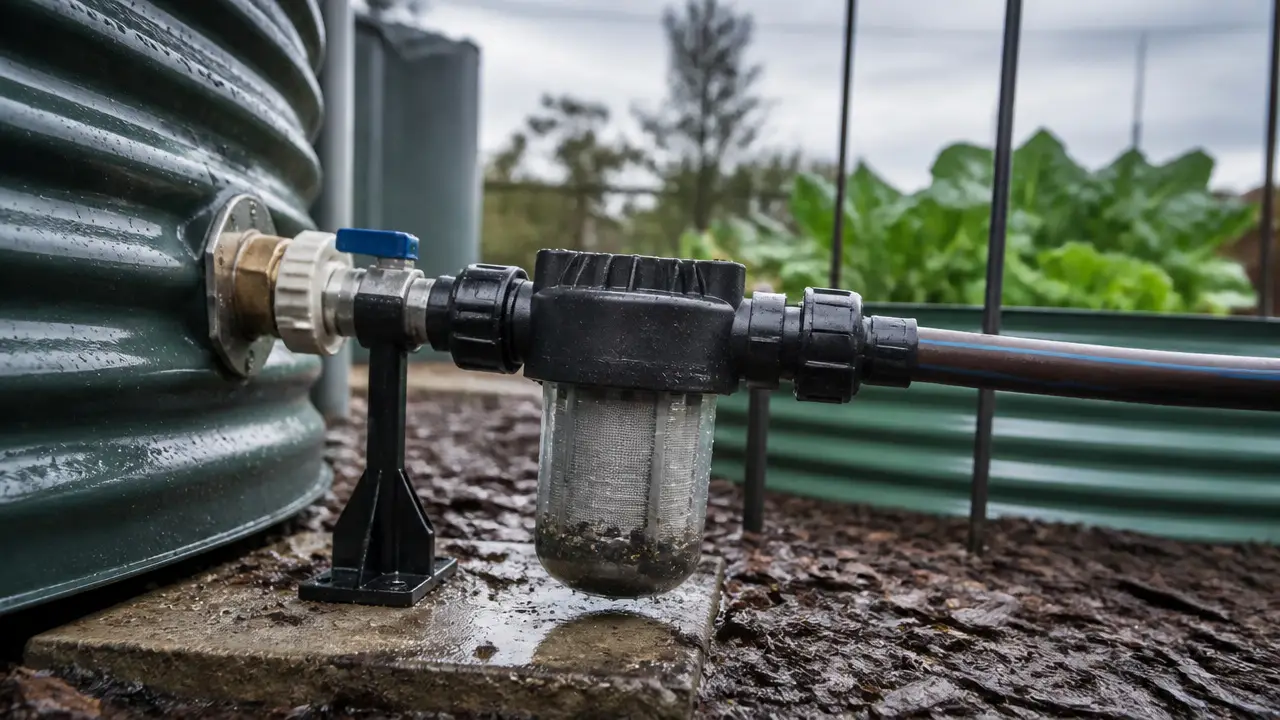
Rainwater Needs Filtration Before Small Sprinkler Nozzles
Small sprinkler openings can clog with debris.
Rainwater systems can contain:
- Roof grit
- Leaves
- Insects
- Sediment
- Organic material
- Tank debris
Use suitable screening and filtration before the irrigation system.
The filter must also be sized for the required flow. A clogged or undersized filter can create enough pressure loss to make an already weak sprinkler system perform badly.
Clean filters according to their condition and the manufacturer's instructions rather than waiting until sprinkler performance becomes noticeably poor.
Rainwater used for lawn irrigation is non-potable, meaning it is not being supplied as drinking water. Keep rainwater irrigation plumbing separated and identified as required by applicable local plumbing and cross-connection rules.
Check the Pop-Up Height
Pressure is only part of choosing the sprinkler body.
The riser also has to clear the surrounding grass.
A pop-up that rises only slightly above dense turf can have much of its spray blocked by grass blades.
Four-inch pop-ups are commonly suited to maintained turf, while taller bodies may be useful where plants or taller groundcover would obstruct the spray. The proper height depends on the landscape and sprinkler design.
Do not install the sprinkler so high that it becomes an easy target for mower blades or foot traffic.
Look for a Check Valve on Slopes
A check valve can be helpful when the irrigation system is installed on a slope.
Without one, water remaining in the pipe may drain through the lowest sprinkler after the system shuts off.
Some sprinkler bodies have built-in check valves. These valves are designed to reduce low-head drainage.
They do not increase low operating pressure.
In fact, every valve creates some resistance, so check the manufacturer's requirements before adding one to a system that already has marginal pressure.
A Practical Low-Pressure Selection Guide
| Your situation | Better starting choice |
|---|---|
| About 15-30 psi available at the nozzle | Fixed-pattern spray nozzle rated for that range |
| Less than the sprinkler manufacturer's minimum pressure | Fix the supply, redesign the zone, or consider another irrigation method |
| 30+ psi but very limited GPM | Consider lower-flow rotary nozzles |
| Long pipe run with weak sprinklers at the end | Check pipe size and friction losses |
| Sprinklers work individually but not together | Reduce the number of heads per zone |
| Rain barrel with gravity pressure only | Pop-ups are usually a poor match |
| Pumped rainwater system | Size the pump using required pressure and zone flow |
| Garden beds rather than lawn | Consider drip or microirrigation instead |
EPA also notes that spray irrigation is best suited to fairly uniform turf areas. For trees, shrubs, and planted beds, microirrigation can often apply water more directly to the root area.
When Low Pressure Means You Should Skip Pop-Ups
Sometimes the best low-pressure sprinkler is no pop-up sprinkler at all.
If your available dynamic pressure remains below the minimum required by suitable spray nozzles, forcing a conventional pop-up system to operate will usually lead to poor coverage.
For garden beds, shrubs, and individual plants, drip irrigation or another form of microirrigation may be a better fit.
For a lawn, you may instead need to:
- Reduce zone size
- Correct plumbing restrictions
- Repair leaks
- Increase pipe capacity
- Correct a pump problem
- Select a properly sized irrigation pump
A booster pump can solve some pressure problems, but it should be selected based on the required pressure and flow rather than simply installing the largest pump available. Pump controls, electrical requirements, dry-run protection, and pressure limits also need to match the system.
Frequently Asked Questions
What is the best pop-up sprinkler for 20 psi water pressure?
A fixed-pattern spray nozzle with a manufacturer-listed operating range that includes 20 psi is usually a better choice than a rotary nozzle. Some fixed spray nozzles are rated from about 15 to 30 psi. Check their performance chart to see how much radius and flow they provide at 20 psi.
Will a pressure-regulated sprinkler increase low pressure?
No. A pressure regulator reduces or controls excessive upstream pressure. It cannot increase a 20 psi supply to 30 or 40 psi. Pressure-regulated sprinkler bodies are mainly useful where incoming pressure is higher than the nozzle needs.
Are rotary sprinklers better for low pressure?
Not necessarily. Rotary nozzles often require less flow than conventional spray nozzles, but many require at least about 30 psi. They can help a low-flow system that still has adequate pressure, but they are usually a poor choice when pressure itself is below their operating range.
Why do my pop-up sprinklers barely rise?
Possible causes include insufficient operating pressure, too many sprinklers on one zone, a partially closed valve, clogged filter, leak, undersized pipe, or excessive elevation. Measure pressure while the zone is running and check for restrictions before replacing the sprinkler heads.
Can I run pop-up sprinklers from a rain barrel?
A normal gravity-fed rain barrel usually provides much less pressure than conventional pop-up sprinklers require. A pump may be needed. Size it for the pressure and flow required by the entire irrigation zone, including pipe and filter losses.
Does using fewer sprinkler heads increase pressure?
It can improve operating pressure when the existing zone is demanding more flow than the water source can supply. Splitting one large zone into two smaller zones is often more effective than changing sprinkler nozzles alone.
What happens if sprinkler pressure is below the recommended pressure?
The sprinkler may have a shorter radius, poor pattern, incomplete pop-up action, and uneven coverage. Use the manufacturer's performance data at your actual operating pressure rather than assuming the sprinkler will achieve its advertised maximum distance.