
As an affiliate, we may earn a commission from qualifying purchases. We get commissions for purchases made through links on this website from Amazon and other third parties.
Best Overall
Best Premium Kit
Best Wide-Range Kit
A hole saw is usually the cleanest way to make a fixed-size opening for a rain-barrel spigot, bulkhead fitting, overflow hose, or tank connection. The important part is not buying the biggest kit. It is having the exact cutter size your fitting needs and a saw that can pass through plastic without grabbing, melting the edge, or leaving an opening too large for the gasket.
The five kits here cover different jobs. Some are bi-metal sets meant for repeated use across wood, metal, and plastic. One is a broad carbon-steel set aimed more at wood, PVC, and plastic. The practical choice comes down to hole-size coverage, arbor setup, how often you will use the kit, and whether you need clean holes in more than one material.
Before drilling a tank, use the fitting's required wall-hole diameter rather than its nominal plumbing size. A fitting labeled 3/4 inch can require a much larger hole through the tank wall.
Hole Saw Kits at a Glance
| Product | Best For | Key Strength | Tradeoff |
|---|---|---|---|
| DEWALT Bi-Metal Hole Saw Kit | Most rain-barrel and general shop work | Useful 3/4 to 2-1/4 inch set with two mandrels | Smaller range than large multi-piece sets |
| Lenox 13-Piece Bi-Metal Kit | Frequent plumbing and fabrication work | Nine saw sizes, two arbors, and easy plug-removal slots | More kit than a one-barrel project needs |
| HYCHIKA 17-Piece Bi-Metal Kit | Broad DIY size coverage | Eleven saw blades with plastic and PVC use | Cutting durability is inconsistent in harder material |
| KATA 25-Piece Hole Saw Kit | Large openings in plastic and PVC | Broad 3/4 to 6 inch range | Better suited to softer materials than demanding metal work |
| Bosch 9-Piece Bi-Metal Kit | Compact general-purpose setup | Six common sizes and a universal arbor | Stops at 2 inches, so some larger bulkheads need another cutter |
Match the Hole Saw to the Fitting, Not the Pipe Label
A common rainwater-installation mistake is treating pipe size and hole size as the same number. They are not. The body of a bulkhead fitting has to pass through the tank wall, so its required opening is often much larger than the pipe or hose that connects to it.
Measure the fitting instructions before choosing a saw. If a bulkhead calls for a 1-1/4-inch opening, a kit that jumps from 1-1/8 to 1-1/2 inches does not have the right cutter even though both sizes sound close. An oversized hole can leave too little wall under the gasket and create a leak that sealant will not reliably fix.
The same rule applies to overflow fittings and tank adapters. Choose the hole first, then the kit.
A Practical Bi-Metal Kit for Common Tank Holes
1 / 5
DEWALT Bi-Metal Hole Saw Kit

Hole Saws
3/4, 7/8, 1-1/8, 1-1/2, 1-3/4, 2-1/4 in
Mandrels
2
Use
Wood, metal and plastic
The DEWALT kit covers a useful set of diameters for rain barrels and smaller water-tank fittings. Its six hole saws run from 3/4 inch through 2-1/4 inches, and the kit includes two mandrels. That gives you several sizes commonly encountered when adding spigots, overflows, vents, and through-wall fittings.
The bi-metal saws are intended for wood, metal, and plastic, so the kit is useful beyond one rainwater project. Large side slots also make it easier to push out the plastic or wood plug after a cut. That matters more than it sounds when you are making several holes and do not want to fight a stuck disc after each one.
The main limit is size coverage. If your tank fitting requires something between the supplied diameters or larger than 2-1/4 inches, this kit does not solve that job. For the sizes it does include, it is a balanced choice for someone who wants a durable general-purpose set rather than a large box of lightly used cutters.
Why It Works
- Six useful saw sizes cover many rain-barrel and small-tank fittings.
- Bi-metal construction supports plastic plus other common shop materials.
- Two mandrels make it easier to work across the included sizes.
- Side slots help remove the cut plug after drilling.
What To Keep In Mind
- The size range stops at 2-1/4 inches.
- A saw can bind if you force it through flexible plastic too quickly.
- Some users find the saw difficult to remove from the arbor after a cut, so avoid overtightening during setup.
A Larger Professional-Style Set for Repeated Work
2 / 5
Lenox 13-Piece Bi-Metal Hole Saw Kit

Pieces
13
Hole Saws
9
Arbors
2
The Lenox kit makes more sense when rainwater plumbing is only one of several jobs you expect to do. It includes nine bi-metal hole saws, two arbors, and two pilot bits. That broader tool set reduces the chance that the next tank, pipe chase, wall opening, or plumbing project needs a size you do not own.
Its Speed Slot design gives you several places to push against a stuck plug with a screwdriver. For plastic tanks, plug removal is usually easy, but the feature becomes useful when you move into thicker wood or other materials. The saws are intended for wood and metal, which makes the kit less specialized than a plastic-only set.
This is still a powerful cutting tool. A large drill can twist hard if a saw catches. When drilling a curved or flexible tank wall, keep the drill square, use controlled speed, and let the teeth cut rather than leaning into the tool.
Why It Works
- Nine hole-saw sizes give broader coverage than compact kits.
- Two arbors and two pilot bits support repeated use.
- Plug-removal slots make cleanup faster between cuts.
- The kit remains useful for plumbing and fabrication beyond rainwater systems.
What To Keep In Mind
- It is unnecessary if you only need one opening in one barrel.
- Large hole saws can grab when the pilot breaks through a flexible wall.
- Exact hole size still matters more than the number of pieces in the case.
A Broad DIY Kit for PVC and Plastic
3 / 5
HYCHIKA 17-Piece Bi-Metal Hole Saw Kit

Pieces
17
Hole Saws
11
Range
3/4 to 2-1/2 in
The HYCHIKA kit gives you eleven hole saw blades plus mandrels, drill bits, a hex key, and a storage box. Its range runs from 3/4 inch to 2-1/2 inches, giving it a little more top-end coverage than the DEWALT and Bosch sets here. PVC board and plastic plate are among the intended materials.
For a homeowner building several barrels or tanks with different fittings, that wider size choice is useful. The saws can cover a mix of inlet, outlet, vent, and overflow openings without buying a single cutter for every job. The case also keeps the arbors and pilot bits together, which matters when a project sits unfinished between rain events.
Durability is the compromise. The saws can make clean cuts, but broken pilot bits and damaged teeth are recurring risks. It is better treated as a versatile DIY set than a heavy fabrication kit. In plastic, moderate speed and light pressure reduce both heat and tooth shock.
Why It Works
- Eleven saw blades cover many common tank-opening sizes.
- The 3/4 to 2-1/2 inch range suits a wide mix of fittings.
- The saws are designed for plastic and PVC as well as other common materials.
- The case includes the mandrels and pilot hardware needed for the set.
What To Keep In Mind
- Tooth and pilot-bit durability is inconsistent under harder use.
- Some size markings may not behave exactly like precision-machined shop tooling.
- Do not force the saw when cutting thicker material.
A Large-Diameter Kit for Plastic and PVC Projects
4 / 5
KATA 25-Piece Hole Saw Kit

Pieces
25
Hole-Saw Range
3/4 to 6 in
Use
Wood, drywall, PVC and plastic
The KATA set stands out for its much larger diameter range. The kit covers 3/4 inch through 6 inches and is intended for wood, drywall, PVC, and plastic. That makes it the most useful option here when a rainwater project needs a wide tank opening rather than only small spigot and bulkhead holes.
Large openings can come up with inspection ports, oversized inlet fittings, or custom DIY tank work. Having the correct fixed-size saw is safer than trying to enlarge a big hole freehand. The kit includes mandrels, drill bits, and other setup pieces in a storage case.
Its carbon-steel construction and intended material range make it a softer-material tool first. If your rainwater installation also involves repeated holes through tougher metal, one of the bi-metal sets above is a better fit. For plastic, the broad diameter coverage is the reason to choose it.
Why It Works
- Hole saws extend to 6 inches for much larger openings.
- PVC and plastic are intended cutting materials.
- The kit includes a broad selection of saws and setup hardware.
- Large fixed sizes reduce the need to improvise an oversized opening.
What To Keep In Mind
- It is not the first choice for demanding metal work.
- Large cutters need careful drill control because they can grab hard.
- A 6-inch opening removes a lot of tank wall, so placement matters as much as cutting technique.
A Compact Bosch Set With a Universal Arbor
5 / 5
Bosch 9-Piece General-Purpose Bi-Metal Hole Saw Kit

Hole Saws
6
Sizes
3/4 to 2 in
Arbor
Universal
The Bosch kit includes six common sizes: 3/4, 7/8, 1-1/8, 1-1/2, 1-3/4, and 2 inches. That range covers many small tank and barrel openings without carrying a large case of specialty diameters.
Its most useful feature is the universal arbor system. It is designed to simplify switching between saw diameters and removing plugs without a separate tool-heavy setup. That can make a multi-hole project less frustrating when you move from a vent opening to a spigot or overflow fitting.
The tradeoff is straightforward: the largest included saw is 2 inches. Many rain-barrel jobs fit within that range, but larger bulkheads and inspection openings do not. Buy this one when its actual sizes match your project, not simply because the arbor is convenient.
Why It Works
- Six common sizes cover many smaller plumbing openings.
- The universal arbor simplifies saw changes.
- The compact kit is easier to store than large multi-size sets.
- Bi-metal construction keeps it useful beyond plastic tanks.
What To Keep In Mind
- The range ends at 2 inches.
- A fitting that needs an in-between diameter still requires another cutter.
- Keep the pilot centered so the saw does not wander across a curved tank wall.
How to Make a Clean Hole in a Plastic Water Tank
Start With an Empty, Stable Tank
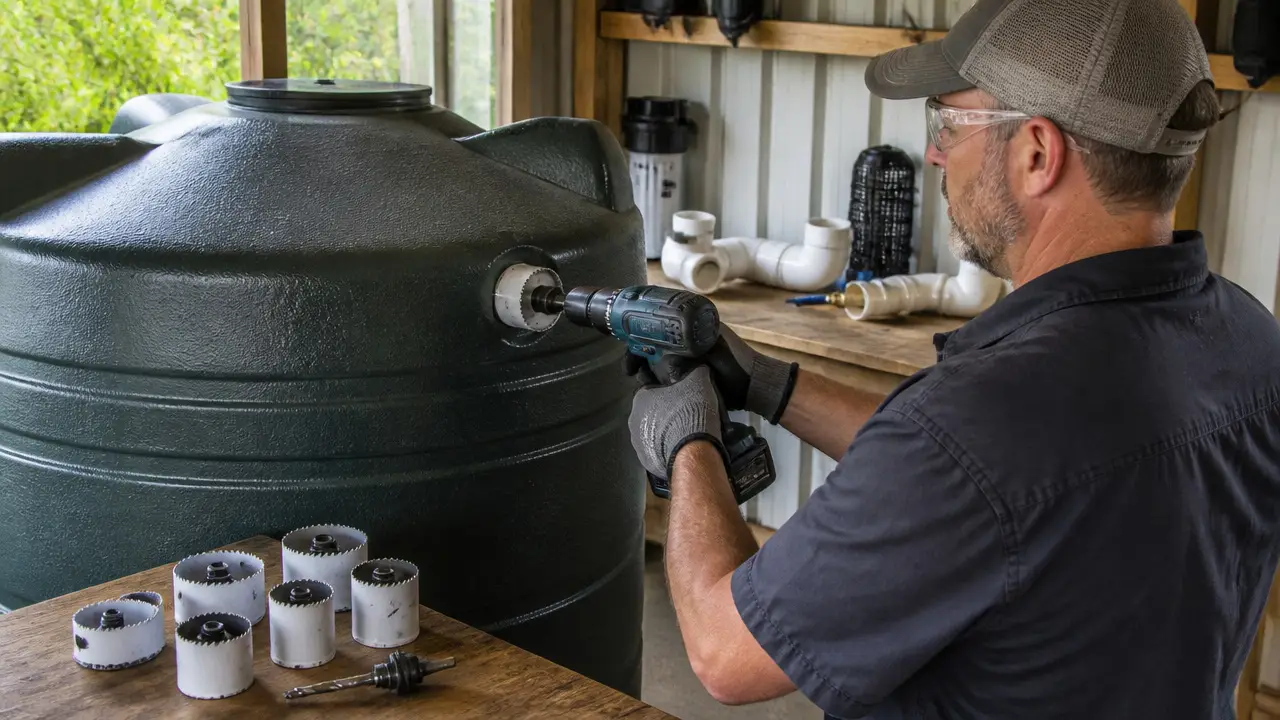
Drain the tank before cutting. Set it where it cannot rock, roll, or collapse under drill pressure. A curved barrel wall needs more control than a flat board because the saw initially contacts only part of the surface.
Mark the Hole From the Fitting Requirement
Use the fitting's wall-opening diameter. Mark the center where there is enough flat or gently curved surface for the gasket and nut to seat. Stay clear of molded ribs, seams, sharp corners, and places where the inside nut cannot be reached when access is required.
Use the Pilot Bit to Establish the Center
Let the pilot bit enter first. Once the hole saw touches the wall, hold the drill square. Starting at a strong angle makes the teeth bite on one side and can pull the saw sideways.
Cut at Controlled Speed
Plastic does not need high RPM. Too much speed builds heat and can melt the rim. Too much pressure can make the saw grab as the plug breaks free. Keep the teeth moving steadily and back off if the wall starts smearing instead of producing chips.
Deburr Without Enlarging
Remove loose curls and rough edges after the plug comes out. Do not sand the hole larger unless the fitting instructions specifically require final adjustment. The gasket needs the planned diameter and a smooth contact surface.
Hole Saw vs. Step Drill Bit
A hole saw is best when you already know the exact final opening and that diameter is available in the kit. It cuts a straight-sided circle in one operation and is especially useful for larger bulkheads.
A step drill bit is useful when you want to approach the size gradually or when one bit includes the exact step you need. It works well on thin plastic for smaller openings. The risk is accidentally moving one step too far and making the hole oversized.
For a fixed 1-1/2-inch hole, use a 1-1/2-inch hole saw. For several small openings where the required diameters appear on a step bit, the step bit may be faster.
Common Hole Saw Mistakes on Rainwater Tanks
Buying by Nominal Pipe Size
A 1-inch fitting does not automatically need a 1-inch hole. Use the required wall opening for the fitting body.
Drilling Too Close to a Rib
A gasket needs a reasonably even surface. A molded rib or steep curve can prevent the seal from sitting flat.
Running the Drill Too Fast
High speed heats plastic. The edge can soften, smear, or become uneven before the cut finishes.
Leaning Hard on the Drill
Heavy pressure increases the chance of the saw catching. Let the teeth cut and keep both hands positioned to control the drill.
Enlarging a Slightly Small Hole by Wobbling the Saw
Do not use the hole saw as a side-cutting reamer. Wobbling can make an oval opening that a round gasket cannot seal well.
Care and Storage
Remove plastic plugs and chips from the saw before putting it away. Check the pilot bit and arbor threads for damage, especially after a cutter binds. Keep all adapters and mandrels in the case so the correct hardware is available for the next size.
If a tooth is bent or missing, replace that saw before making an important tank opening. A damaged cutter can pull off-center and ruin a container that costs far more than the tool.
Frequently Asked Questions
What size hole saw do I need for a rain barrel spigot?
Use the installation hole size for the exact spigot or bulkhead fitting. The nominal hose or thread size is not the same as the hole through the barrel wall.
Can a hole saw cut a plastic water tank?
Yes. Hole saws intended for plastic or general-purpose cutting can make clean tank openings when used at controlled speed with the tank empty and stable.
Is bi-metal better than carbon steel for a rain barrel?
Both can cut plastic. Bi-metal is more versatile if you also expect to cut metal or tougher materials, while a carbon-steel kit can be enough for PVC, wood, and plastic work.
How do I stop a hole saw from melting plastic?
Use moderate drill speed, light pressure, and clear chips as you cut. If the edge starts smearing instead of cutting cleanly, stop and let the plastic and saw cool.
Should I use a step bit or a hole saw for a bulkhead fitting?
Use whichever tool provides the exact required diameter cleanly. Hole saws are often better for larger fixed openings, while step bits are convenient for smaller sizes included on the bit.
Can I drill a rain barrel while it is full?
No. Drain and stabilize the barrel first. Water weight, wall flex, and uncontrolled runoff make accurate drilling much harder.
If you need to approach smaller openings gradually, step drill bits for rain barrels are the better companion tool. Once the hole is cut, bulkhead fittings for water tanks help match the pass-through connection to the tank wall. For barrel-size installations, bulkhead fittings for rain barrels focus on smaller containers and common DIY connections. After the fitting is installed, PVC pipe cutters for rainwater systems can make the downstream plumbing easier to assemble cleanly.