
As an affiliate, we may earn a commission from qualifying purchases. We get commissions for purchases made through links on this website from Amazon and other third parties.
Best Overall
Best for Larger Hoses
Best for Small Tubing
A hose clamp only works when its working range matches the outside diameter of the hose after it is pushed onto the fitting. That measurement matters more than the nominal hose size. A clamp that is too large runs out of adjustment before it grips, while an undersized clamp may never slide over the connection at all.
The four kits here cover very different size ranges. TICONN offers focused sets for small tubing, medium hose, and larger hose. Qibaok offers a 120-piece assortment spanning roughly 1/4 to 1-1/2 inches, which is convenient for a mixed parts bin but has more concerns about thin bands and stripped drives.
For a rainwater system, use worm-gear clamps on compatible flexible-hose-to-barb connections. They are not a repair for mismatched threads, cracked fittings, or a hose that is the wrong inside diameter. The clamp should support a connection that already fits mechanically.
Quick Comparison
| Clamp Kit | Best For | Working Range | Pieces | Main Tradeoff |
|---|---|---|---|---|
| TICONN 3/4- to 1-1/4-Inch | Common medium hose connections | 18-32 mm | 20 | One-size set is less useful if your system uses several diameters |
| TICONN 1-1/8- to 2-Inch | Larger pump or transfer hoses | 27-51 mm | 12 | Oversized for small garden and sensor tubing |
| TICONN 1/4- to 7/16-Inch | Small tubing | 6-12 mm | 20 | Too small for typical garden-hose-size connections |
| Qibaok 120-Piece Assortment | A broad spare-parts box | 6-38 mm | 120 | Thin bands can strip or buckle when tightened hard |
Measure Before You Pick a Clamp
Measure the hose on the fitting, not loose on the bench. A hose expands when it slides over a barb, so the finished outside diameter can be larger than the hose's printed size.
Choose a clamp whose working range puts that finished diameter somewhere in the middle, not at the absolute end. That gives you room to tighten without running out of screw travel.
Also look at where the connection sits. A clamp inside a dry shed sees a different environment from one mounted beside a tank in sun, rain, and fertilizer splash. Corrosion-resistant construction matters outdoors, but the band and screw still need enough strength to tighten without deforming.
A Useful Range for Common Hose Connections
1 / 4
TICONN 20-Piece 3/4- to 1-1/4-Inch Hose Clamp Set

Working Range
3/4 to 1-1/4 in
Metric Range
18-32 mm
Pieces
20
This TICONN set covers 3/4 to 1-1/4-inch outside diameters, a practical range for many flexible hose connections around rain barrels, small pumps, garden lines, and transfer fittings. All 20 clamps are the same size range, so the box makes sense when your system repeats similar hose connections rather than mixing tiny tubing with large suction hose.
The worm-gear layout lets you tighten the band gradually with a screwdriver. The clamps use 0.023-inch stainless-steel bands with smooth edges, which helps protect soft hose during normal tightening. Each clamp is marked for easier size identification.
Long-term leak performance is uncertain, as are material and dimension details outside the core working range. Use the 18-32 mm range as the deciding specification.
Why It Works
- 18-32 mm range suits many medium flexible-hose connections found around barrels and garden systems.
- Twenty matching clamps are useful when several identical fittings need the same size.
- Smooth band edges reduce the chance of cutting into softer hose surfaces during normal tightening.
What To Keep In Mind
- Measure the hose on the barb before buying.
- A clamp cannot compensate for a loose hose-to-fitting mismatch.
- Treat long-term performance and construction details beyond the working range as uncertain.
A Larger Set for Transfer and Pump Hoses
2 / 4
TICONN 12-Piece 1-1/8- to 2-Inch Hose Clamp Set

Working Range
1-1/8 to 2 in
Metric Range
27-51 mm
Pieces
12
The larger TICONN set covers 27-51 mm, or 1-1/8 to 2 inches. That makes it the better choice for larger flexible transfer hose, pump connections, and plumbing where a medium garden-hose-size clamp cannot open far enough.
Each clamp uses a 1/2-inch-wide band and a worm-gear screw. The working range is engraved on the clamp, which is helpful when several plumbing sizes are stored in the same toolbox. The set includes 12 pieces rather than 20 because the larger clamps take more space and serve a narrower group of connections.
Long-term performance is uncertain, so straightforward size fit is the best reason to choose this box. Do not buy larger clamps “just in case”; an oversized clamp can bottom out before it puts enough pressure on a smaller hose.
Why It Works
- 27-51 mm range covers larger hose connections that standard garden-size clamps cannot reach.
- Wide bands spread clamping force over more hose surface.
- Size markings make replacement and maintenance easier.
What To Keep In Mind
- Too large for most small tubing and many ordinary hose-barb connections.
- Measure the assembled hose outside diameter before choosing the clamp.
- A suction-side pump hose also needs a hose and fitting designed not to collapse under suction.
A Small Clamp Set for Narrow Tubing
3 / 4
TICONN 20-Piece 1/4- to 7/16-Inch Hose Clamp Set

Working Range
1/4 to 7/16 in
Metric Range
6-12 mm
Pieces
20
The micro TICONN set covers 6-12 mm outside diameters. That is useful for narrow drain lines, small control tubing, or other low-flow connections where a regular hose clamp would be too large to tighten properly.
The 20 clamps use the same adjustable worm-gear approach as the larger TICONN sets. A storage case keeps the small parts together, which matters because tiny clamps are easy to lose around a pump shed or workbench.
Construction and dimension details beyond the core size range are uncertain. Keep the selection simple: use these only when the measured assembled connection falls within 6-12 mm.
Why It Works
- 6-12 mm range gives small tubing a properly scaled clamp.
- Twenty-piece box is useful for repeated small connections.
- Worm-gear adjustment gives more control than a fixed spring clip when the hose wall thickness varies.
What To Keep In Mind
- Not suitable for ordinary 3/4-inch garden hose connections.
- Small tubing can be damaged by overtightening.
- Use a fitting designed for the tubing rather than trying to crush an oversized hose onto a small barb.
A Broad Assortment for the Spare-Parts Box
4 / 4
Qibaok 120-Piece Stainless Steel Hose Clamp Assortment

Working Range
1/4 to 1-1/2 in
Metric Range
6-38 mm
Pieces
120
Qibaok's 120-piece assortment covers a much wider span than the focused TICONN boxes. The range runs from 1/4 to 1-1/2 inches, or 6-38 mm. That makes it attractive when you maintain several barrels, pumps, irrigation lines, and miscellaneous hoses and want many clamp sizes on hand.
The quantity is the advantage, not clamping strength. Thin bands, sharp edges, stripped screws, and buckling under hard tightening are recurring problems. That is a serious limitation when the connection needs substantial compression to stop leaking.
Use this assortment for correctly fitted low-stress hose connections where the clamp only needs to secure the hose. If a joint is already loose enough to leak before the clamp is tightened heavily, fix the hose or barb fit rather than relying on two or three weak clamps stacked together.
Why It Works
- 120 pieces cover a broad 6-38 mm range.
- Useful as a general maintenance assortment for systems with many hose diameters.
- Reusable worm-gear layout makes size changes possible when the band and screw remain in good condition.
What To Keep In Mind
- Bands and drive screws can strip or buckle under high tightening force.
- Sharp edges can damage soft hose, so inspect each clamp before use.
- Do not use multiple weak clamps as a substitute for a properly matched hose and fitting.
Where Hose Clamps Belong in a Rainwater System
Hose clamps are most useful where flexible hose slides over a barb or smooth hose-tail fitting. The hose should already be sized to grip the barb closely. The clamp then provides compression so the hose cannot pull off or seep around the fitting.
They do not belong on threaded joints. NPT, GHT, IBC buttress threads, bulkheads, and camlocks use their own sealing methods. Adding a worm clamp around the outside of a threaded fitting does not fix the wrong thread or a damaged gasket.
For pump suction lines, the connection also needs to remain airtight. A tiny air leak may not drip water outward but can still make a pump lose prime. Use hose and fittings intended for suction service and inspect the clamp position carefully.
Tightening Without Damaging the Hose
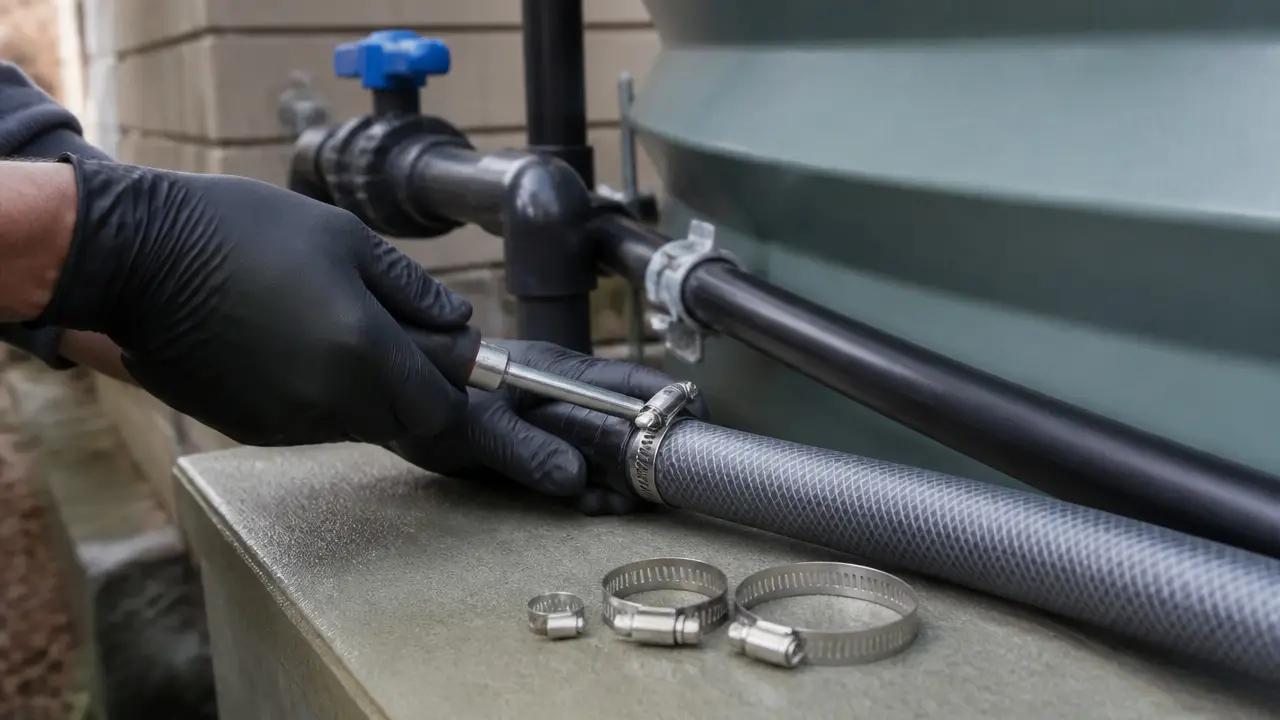
Place the clamp over the barb area, not beyond the end of the fitting. Tighten until the hose is secure and the joint stays dry. Stop before the band cuts deeply into the hose or the screw housing begins to deform.
Thin-wall vinyl and soft tubing need less force than heavy reinforced hose. If you have to tighten until the clamp visibly crushes the tube, the connection size is probably wrong.
After the first few wet-and-dry cycles, inspect the connection again. Flexible hose can relax slightly after installation, especially in warm sun.
Frequently Asked Questions
What size hose clamp do I need?
Measure the outside diameter of the hose after it is installed on the fitting. Choose a clamp whose working range includes that finished diameter with adjustment room on both sides.
Are stainless steel hose clamps good for rainwater systems?
Stainless steel can be a practical choice for damp outdoor installations because of its corrosion resistance, but steel grade alone does not guarantee clamp strength. Band thickness, screw quality, and correct sizing still matter.
Can a hose clamp stop a leaking threaded fitting?
No. Threaded fittings use thread geometry, gaskets, washers, or suitable thread sealant. A hose clamp is meant for compatible flexible hose connections, not for repairing threaded joints.
Should I use two hose clamps on one connection?
A correctly sized hose, barb, and good clamp usually should not need several weak clamps stacked together. For critical large-hose connections, follow the fitting and hose manufacturer's requirements rather than assuming more clamps are always better.
Why does my worm-gear clamp keep stripping?
The screw or band may be too thin, damaged, or overtightened. Stop when the drive starts slipping. Replacing the clamp is safer than forcing a stripped mechanism tighter.
Can I reuse a hose clamp?
Many worm-gear clamps can be reused if the band, screw, and housing are not bent, rusted, or stripped. Inspect the clamp before reinstalling it.
Do I need special clamps for pump suction hose?
Use clamps and hose recommended for the pump and suction connection. Suction lines need an airtight seal and hose that will not collapse, so the full connection matters more than the clamp alone.
If your flexible line first needs a compatible outlet, hose adapter kits for rain barrels cover hose-ready and barrel-linking connections. Larger removable transfer lines may be better served by camlock fittings for water tanks rather than worm clamps alone. A dedicated shutoff can use ball valves for rainwater tanks where the thread size matches. If rigid pipe must be cut before adding a hose transition, PVC pipe cutters for rainwater systems compare tools for that installation step.