
As an affiliate, we may earn a commission from qualifying purchases. We get commissions for purchases made through links on this website from Amazon and other third parties.
Best Overall
Best 30-Foot Automatic Cable
Best Short High-Output Cable
Pipe heat cable can protect a vulnerable rainwater line when draining the system is not practical, but it has to be treated as electrical freeze-protection equipment rather than generic “warm tape.” Cable type, length, watts per foot, pipe material, thermostat location, insulation limits, and the manufacturer’s installation pattern all matter.
That is especially important around rainwater systems because exposed plumbing often includes a mix of PVC, PEX, metal pipe, pump fittings, valves, and short outdoor runs. A cable approved for one pipe material or installation method should not be assumed safe for every component nearby.
Heat cable is also not a replacement for winterization. If a seasonal rainwater line can be drained and isolated, that is usually the simpler failure-resistant strategy. Heat cable makes the most sense on water-filled sections that must remain operational through freezing weather.
Pipe Heat Cables at a Glance
| Product | Best For | Key Strength | Main Tradeoff |
|---|---|---|---|
| HEATIT 40ft Self-Regulating | Best overall long exposed run | 40-foot self-regulating cable at 3 W/ft with thermostat control | Needs a nearby power source and careful cable routing |
| Frost King HC30A | 30-foot automatic protection | Built-in thermostat and stated compatibility with metal and plastic water pipe | Fixed-length kit gives less layout flexibility |
| HEATIT HISD 3ft 7W/ft | Short vulnerable pipe section | Higher 7 W/ft output with automatic 37°F/50°F thermostat | Short reach and insulation limit must be respected |
| HEATIT 2ft Self-Regulating | Tiny exposed section | Compact self-regulating 3 W/ft cable for a very short run | Limited coverage and one long-term heating failure |
Best Overall: HEATIT 40ft Self-Regulating Heat Cable
1 / 4
HEATIT 40ft Self-Regulating Heat Cable

Length
40 ft
Output
3 W/ft
Thermostat
On about 38°F / off about 50°F
The 40-foot HEATIT cable is the best overall choice when a rainwater system has a longer exposed pipe run through a crawlspace, garage, exterior wall area, or other freeze-prone zone. Its self-regulating design is paired with an integrated thermostat that activates around 38°F and switches off around 50°F.
The 3-watt-per-foot output is lower than the short 7-watt HEATIT cable in this roundup, but that is not automatically a disadvantage. Longer pipe runs benefit from controlled heat distributed along the line rather than concentrating high output at one point.
It has protected outdoor and unheated plumbing with even heat and low power draw. The main ownership complaint is thermostat timing: some users would prefer the cable to switch off at a lower temperature rather than staying energized until about 50°F.
Use the cable only on pipe types and installation arrangements allowed by the current instructions. Self-regulating behavior does not give permission to improvise overlaps, bury the cable in unsupported insulation, or place it on valves, tanks, pumps, or fittings that are not listed for use.
Why It Works
- Forty feet covers a meaningful exposed rainwater pipe run without chaining several short kits.
- Self-regulating output is designed to adjust heat as conditions change.
- The integrated thermostat automates cold-weather operation.
- A 3 W/ft rating balances long-run protection with power use.
What To Keep In Mind
- The cable needs continuous access to a suitable electrical supply during freezing weather.
- Follow the approved attachment pattern and pipe-material list exactly.
- Insulation can improve freeze protection only when the cable maker permits the insulation type and thickness.
- Install and test before the pipe freezes rather than treating heat cable as an emergency thawing tool.
Best 30-Foot Automatic Cable: Frost King HC30A
2 / 4
Frost King HC30A Automatic Electric Heat Cable

Length
30 ft
Voltage
120 V
Pipe Claim
Metal and plastic water pipe up to 2 in
The Frost King HC30A is a straightforward automatic kit for a medium-length exposed water line. It is a 30-foot, 120-volt cable with a built-in thermostat and manufacturer-stated compatibility with metal and plastic water pipes up to two inches.
Frost King also claims freeze protection that keeps water flowing down to -40°F when the cable is installed under the conditions required by the product. Treat that as a product claim, not a universal guarantee for every rainwater installation. Wind exposure, insulation, pipe diameter, incoming water temperature, cable contact, and power continuity all change the real heat loss.
The cable can operate for multiple seasons and has kept a travel-trailer water line flowing in subzero weather. Its long-term failure history is limited, so the recommendation rests on cable format and compatibility rather than a claim of superior durability.
A fixed-length kit should be chosen from the actual pipe run. Do not buy excess cable and assume it can be doubled over or coiled unless the manufacturer explicitly permits that installation.
Why It Works
- Thirty feet fits many outdoor or crawlspace rainwater runs.
- Built-in thermostat reduces the need for manual switching.
- The product specifically lists both metal and plastic water-pipe use.
- Common 120V operation simplifies residential installation.
What To Keep In Mind
- Match the pipe material, diameter, and insulation arrangement to the current instructions.
- Do not use the -40°F claim without the required installation conditions.
- Fixed cable length means careful measurement is important.
- A power outage during a freeze removes active protection.
Best Short High-Output Cable: HEATIT HISD 3ft 7W/ft
3 / 4
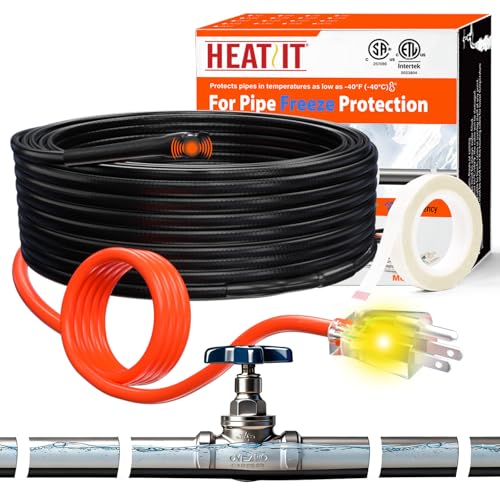
HEATIT HISD 3ft Heat Trace Cable
Length
3 ft
Output
7 W/ft
Thermostat
On about 37°F / off about 50°F
The three-foot HEATIT HISD cable is the strongest fit for a short, clearly defined freeze-prone pipe section rather than a long run. It operates at 120 volts and 7 watts per foot, with an automatic thermostat that switches on around 37°F and off around 50°F.
That higher output can be useful around a short section entering an unheated room or passing through an exposed area, provided the exact pipe and installation are approved by the manufacturer. It should not be used as a reason to concentrate heat on a plastic fitting, valve body, or other component that is not listed for cable contact.
This product gives one unusually specific insulation boundary: no more than 1/2 inch of fiberglass insulation over the heating cable for lower-temperature protection. Do not generalize that limit to foam, rubber, or other insulation types. Follow the current cable instructions for approved insulation material and thickness.
The cable can work through winter, but one three-foot installation protected its covered area while a nearby section still froze. That is the core sizing lesson: heat cable only protects the pipe it is correctly installed on.
Why It Works
- Seven watts per foot provides higher output on a short run.
- Automatic thermostat control reduces manual operation.
- Three-foot length fits a localized vulnerable section without a long unused tail.
- The product line carries CSA and ETL positioning.
What To Keep In Mind
- Three feet is easy to undersize; measure the entire vulnerable section.
- Observe the stated insulation limit and approved insulation material.
- Do not assume adjacent unheated pipe is protected by heat spreading from the cable.
- Use the cable only on compatible pipe materials.
Best for a Tiny Exposed Section: HEATIT 2ft Self-Regulating Cable
4 / 4
HEATIT 2ft Self-Regulating Pipe Heating Cable
Length
2 ft
Output
3 W/ft
Type
Self-regulating
The two-foot HEATIT cable is a niche option for a very short exposed water-pipe section. It uses the same general 3-watt-per-foot self-regulating approach as the longer HEATIT model but avoids installing a much longer cable where only a small run needs protection.
That small size is also its limitation. A two-foot cable cannot protect an exposed faucet supply, wall penetration, and several feet of pipe unless all of those vulnerable points fit within the approved heated length. Freeze damage often occurs just outside the area an owner expected to be at risk.
One cable worked through its first winter but no longer heated properly in the next. That does not establish a general failure rate, but it supports testing the cable before every cold season rather than assuming last year’s operation proves this year’s readiness.
Why It Works
- Very short length fits small localized pipe sections.
- Self-regulating output is designed for automatic heat adjustment.
- Three watts per foot keeps power demand modest for a tiny run.
- A short cable avoids managing excess unused length.
What To Keep In Mind
- Test the cable and thermostat before freezing weather each year.
- Two feet may be too short once elbows and vertical runs are included.
- Follow current installation instructions for attachment and insulation.
- Keep a winterization fallback plan if this short section is critical to system operation.
Where Heat Cable Fits in a Rainwater System
Pipe heat cable is usually most useful after the storage tank, on water-filled delivery plumbing that cannot be drained during normal winter operation. Examples can include an exposed suction or discharge line, a short pipe through an unheated space, or plumbing feeding a winter-use fixture—when the cable is approved for that pipe material and location.
It is not a general solution for freezing tanks. A large rainwater tank, pump, filter housing, valve, and faucet each have different freeze risks. Protect those components with their own approved winterization method.
If the rainwater system is seasonal, draining the tank outlet, pump, filters, hoses, and exposed plumbing may be simpler than keeping an electric heat cable energized all winter.
How to Size a Pipe Heat Cable
Measure the Entire Vulnerable Pipe Run
Measure the actual pipe path, including vertical sections and bends, rather than straight-line distance between two points. Follow the manufacturer’s sizing method if it requires extra length for specific pipe diameters or valve arrangements.
Do Not Invent a Way to Use Excess Cable
Fixed-length resistance cables and self-regulating cables can have different rules about crossing, spiraling, or overlap. Never coil excess cable tightly or cross sections unless the exact product instructions say that layout is permitted.
Match Pipe Material
Metal transfers heat differently from PEX, PVC, or other plastics. Use only products explicitly approved for the pipe material and follow any required aluminum tape, contact, or attachment method in the current instructions.
Heat Cable and Insulation Work Together Differently
Heat cable adds energy. Pipe insulation slows heat loss. They solve different parts of the freeze problem.
Adding insulation over an approved heat cable can improve performance, but too much or the wrong type can violate the cable’s temperature limits. One product here specifically references no more than 1/2 inch of fiberglass insulation. Other cables may have different requirements.
Never assume a foam sleeve is automatically safe over every heat cable. Check the exact cable manual first.
Electrical Safety and Reliability
Use the Required Electrical Protection
Install the cable using the outlet type, grounding, weather protection, and circuit protection required by the current manufacturer instructions and local electrical code. Do not use damaged extension cords or improvised outdoor connections.
Keep Connections Dry
The heated cable may be rated for damp environments, but plugs, thermostats, splices, and outlets have their own exposure limits. Position them exactly as directed.
Test Before Cold Weather
Test the cable's thermostat operation before the first hard freeze. A dead cable discovered after the pipe freezes has already failed its purpose.
Plan for Power Failure
Electric freeze protection stops during an outage. If the rainwater line is critical, have a drain-down or backup-power plan appropriate to the installation.
Common Heat-Cable Mistakes
Heating Only the Most Obvious Foot of Pipe
Freeze points can occur at wall penetrations, elbows, valves, and adjacent unheated sections. Protect the full vulnerable run.
Covering the Thermostat Incorrectly
An automatic thermostat has to sense the condition it was designed to monitor. Mount it exactly where the manufacturer specifies.
Using Heat Cable Instead of Repairing Air Leaks
A pipe in a crawlspace may freeze because cold air blows directly over it. Sealing building-envelope gaps and adding appropriate insulation can reduce the heat load the cable must overcome.
Leaving a Failed Cable in Place
A cable can look normal after its heating element or thermostat has failed. Functional testing matters more than visual inspection alone.
Final Recommendations
The HEATIT 40ft self-regulating cable is the best overall option for a longer exposed rainwater line because it combines long coverage, 3 W/ft output, and thermostat-controlled self-regulating operation. The Frost King HC30A is a simpler 30-foot automatic kit with explicit metal-and-plastic pipe positioning.
For localized freeze points, the HEATIT HISD 3ft 7W/ft cable provides higher output on a short run, while the HEATIT 2ft self-regulating cable fits a very small section but needs careful annual testing and exact coverage planning.
Choose the cable from the pipe, exposure, length, electrical supply, and approved insulation method—not from wattage alone. Where the system can be drained safely for winter, drain-down remains the most failure-resistant freeze-protection strategy.
Frequently Asked Questions
Is heat cable enough to keep rainwater pipes from freezing?
It can protect compatible pipe when correctly sized, installed, powered, and insulated within the manufacturer’s limits. Severe exposure or power loss can still overwhelm active protection.
Can I put heat cable on PVC or PEX?
Only when the specific cable is approved for that pipe material and installed using the required method. Do not transfer metal-pipe instructions to plastic pipe.
Can I put foam insulation over heat cable?
Only if the cable manufacturer allows that insulation material and thickness. One product in this roundup specifically references fiberglass, so do not assume foam is equivalent.
Should heat cable be left plugged in all winter?
Automatic products are designed to control operation through a thermostat or self-regulating output, but follow the current instructions for the exact cable. Test the control before cold weather.
Can heat cable thaw a pipe that is already frozen?
Water may begin flowing after cable installation, but freeze-protection cable should be selected and installed as prevention. Follow approved thawing procedures for an already frozen pipe rather than improvising with electrical equipment.
What happens if the power goes out?
The cable stops heating. Drain vulnerable plumbing or use an appropriate backup plan if prolonged outage and freezing conditions coincide.
Do I still need pipe insulation?
Often yes. Insulation reduces heat loss, while cable supplies heat. Use only an insulation type and thickness approved for the cable installation.