As an affiliate, we may earn a commission from qualifying purchases. We get commissions for purchases made through links on this website from Amazon and other third parties.
A gravity water filter uses the weight of water to push rainwater through a screen or filter media. It does not need a pump if the tank sits high enough and the filter does not create too much resistance.
Gravity filtration works well for many rain barrels, garden systems, cabins, and simple non-potable water lines. The main limit is pressure. Fine filters can slow gravity-fed water to a trickle.
A gravity filter also does not make collected rainwater automatically safe to drink. Roof runoff can contain germs, dirt, metals, and other contaminants. The CDC advises choosing treatment based on the contaminants present and regularly testing rainwater used for drinking, cooking, or bathing.
How Gravity Water Filtration Works
Water stored above a filter has pressure because of its height. This height is often called head height.
As a useful rule:
- 1 foot of water height creates about 0.43 psi.
- 5 feet creates about 2.2 psi.
- 10 feet creates about 4.3 psi.
- 20 feet creates about 8.7 psi.
Psi means pounds per square inch. It is a measure of water pressure.
These numbers are the pressure available before losses from pipes, fittings, valves, and filters.
For example, suppose the water surface in a tank is 10 feet above a garden filter. The system starts with about 4.3 psi of static pressure. Once water begins moving, the actual pressure downstream will be lower.
The pressure also falls as the tank empties.
This is why a filter that works well with a full elevated tank may produce much less flow when the tank is nearly empty.
Gravity Filters Can Serve Different Jobs
"Gravity water filter" can describe several different parts of a rainwater system. They do not all do the same job.
Screens Before the Storage Tank
A screen at the gutter, downspout, rain head, or tank inlet can stop leaves, insects, and larger debris.
This is usually the easiest type of filtration for a gravity rainwater system because the screen creates little resistance.
A first flush diverter may also be installed before the tank. A first flush diverter sends away some of the first roof runoff from a storm. That early runoff often carries more dust, bird droppings, and other material from the roof.
These devices improve incoming water quality, but they are not drinking-water treatment.
Sediment Filters After the Tank
A sediment filter removes suspended particles as water leaves the tank.
Possible filter styles include:
- Washable mesh screens
- Disc filters
- Spin-down sediment filters
- Cartridge sediment filters
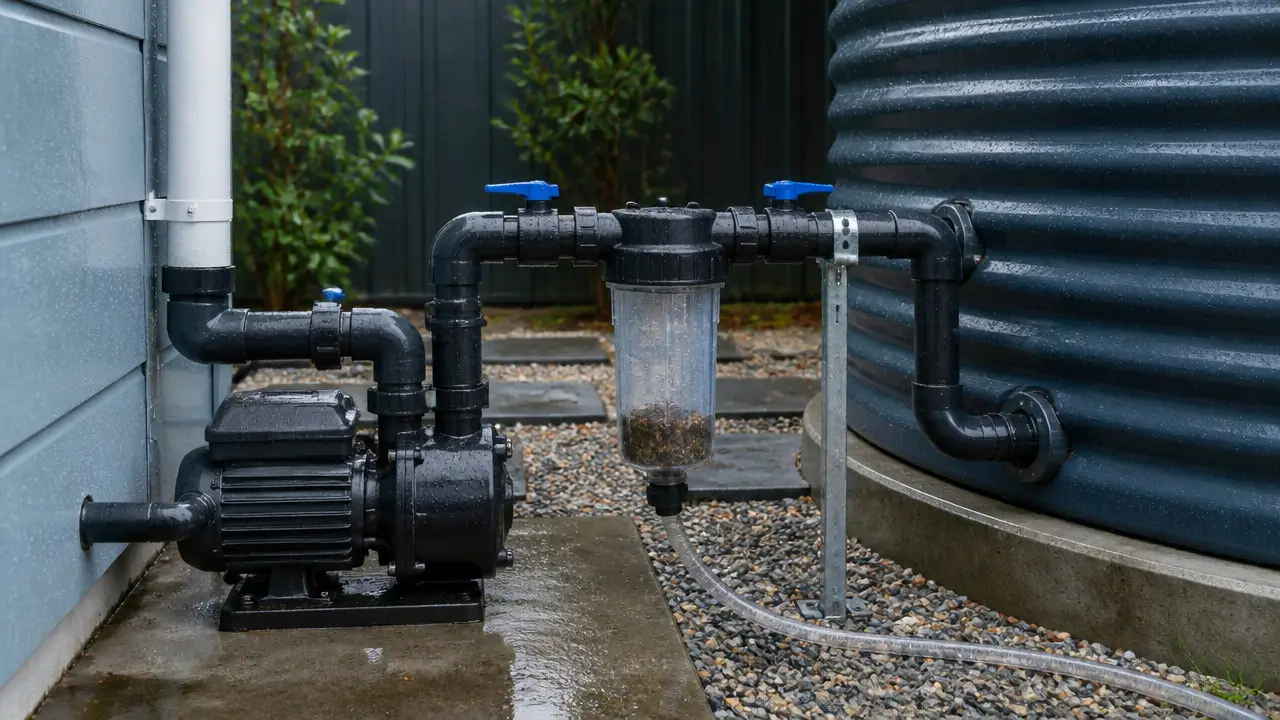
These can help protect irrigation valves, emitters, hoses, pumps, and later treatment equipment.
The finer the filter becomes, however, the harder it usually is for gravity alone to move water through it.
Activated Carbon Filters
Activated carbon can reduce certain tastes, odors, and chemicals when the particular filter is designed for them.
Carbon is not a general disinfectant. Many common carbon filters are not designed to remove disease-causing germs. The CDC notes that different filters remove different contaminants and that many household filters do not remove germs.
Carbon cartridges can also cause a noticeable pressure drop. That matters in a low-pressure gravity system.
Fine Membrane or Ceramic Filters
Some point-of-use gravity systems use very fine ceramic or membrane filters.
A micron is one-millionth of a meter. A lower micron number means smaller openings.
Fine filters can remove some types of microorganisms when they have suitable pore sizes and verified performance claims. However, filter performance varies by technology. For example, the CDC notes that microfiltration, ultrafiltration, nanofiltration, and reverse osmosis do not all remove the same germs or chemicals.
Fine filtration also creates more resistance. A small gravity system may therefore produce only a limited amount of filtered water at a time.
The Best Filter Depends on How You Use the Rainwater
There is no single correct filter setup for every rainwater tank.
| Rainwater use | Typical filtration goal |
|---|---|
| Watering trees or landscape plants | Keep leaves, insects, and large debris out |
| Garden hose use | Reduce sediment that could clog the hose or nozzle |
| Drip irrigation | Protect emitters using filtration that meets the irrigation equipment requirements |
| Pumps and valves | Keep sediment from damaging or blocking equipment |
| Toilet or laundry reuse | Provide water quality suitable for the equipment and local plumbing requirements |
| Drinking or cooking | Use a complete treatment approach based on testing and applicable health requirements |
A simple garden system may need little more than good inlet screening and an irrigation filter.
A drinking-water system is very different. Adding an extra cartridge to a rain barrel does not turn it into a potable system.
Potable means suitable for drinking. Non-potable means water that is not intended for drinking.
Why Some Filters Barely Flow Without a Pump
One of the most common problems with gravity filtration is choosing equipment designed for pressurized plumbing.
A filter housing may physically connect to your rainwater tank while still being a poor match for gravity flow.
Several things can restrict the water.
The Filter Is Too Fine
Water passes through a coarse screen much more easily than a very fine cartridge.
A filter that provides good flow at normal household water pressure may perform very differently with only 2 or 3 psi from a tank.
The Cartridge Is Dirty
Sediment slowly fills the filter media.
As the filter loads with dirt, its resistance increases. In a pumped system you may notice a small pressure loss. In a gravity system, the flow can fall dramatically.
The Plumbing Is Too Small
Small pipes, narrow valves, elbows, and restrictive fittings all reduce flow.
Keeping the line from the tank reasonably short and avoiding unnecessary restrictions can make a large difference when pressure is already low.
The Tank Is Not High Enough
A rain barrel sitting on a short stand may provide enough pressure for a hose near the barrel but not enough for a restrictive filter followed by a long irrigation line.
Raising a tank increases pressure, but water is extremely heavy. Do not place a full barrel, tote, or cistern on a platform that has not been designed for the load.
The Tank Is Almost Empty
Gravity pressure comes from the vertical distance between the water surface and the point where the water is being used.
As the water level drops, so does the available pressure.
A Practical Gravity-Fed Rainwater Layout
A basic non-potable system might follow this path:
Roof → gutter screening → first flush or debris control → screened tank inlet → storage tank → outlet filter → hose or irrigation
Alongside the performance of gravity water filters actually, understand the appropriate follow-up check for likely contaminants.
This approach removes larger debris before it enters the tank, then catches smaller material before the water reaches equipment.
Filtering everything only after storage can cause unnecessary problems. Leaves, roof grit, and organic debris are better kept out of the tank whenever practical.
The CDC recommends keeping rainwater collection systems clean, repairing damaged parts, using inlet screening, and considering first-flush diversion as ways to improve collected water quality.
Choose a Gravity Filter by Flow, Not Just Micron Rating
It is easy to focus only on micron size.
That can be a mistake.
A filter must also provide enough flow rate, which is the amount of water that can pass through it during a given time.
When choosing a filter for a gravity line, check:
- What contaminants or particles the filter is intended to remove
- The pressure range required by the filter
- Flow performance at very low pressure, if the manufacturer provides it
- Inlet and outlet connection sizes
- Whether the element can be cleaned or must be replaced
- How much pressure loss occurs as the filter becomes dirty
- Whether the housing can remain outdoors
- Whether freezing conditions require draining or protection
Do not assume a high advertised flow rate will apply to a gravity system. Flow ratings may be measured at much higher pressures than an elevated rainwater tank can provide.
Larger Connections Help Low-Pressure Systems
A gravity system has little pressure to waste.
Keeping the plumbing reasonably open can help preserve flow. A narrow valve or fitting can become a major restriction.
Rain tanks often use a bulkhead fitting, which is a sealed fitting that passes through the tank wall. The outlet pipe attaches to this fitting.
Check the outlet size before buying filters, valves, and adapters. Reducing a large tank outlet immediately to a very small pipe can limit the whole system.
The smallest restriction in the flow path can have an outsized effect when the system is running only on gravity.
Where Should the Filter Go?
For most systems, use more than one level of debris control rather than expecting one filter to do everything.
Before the Tank
Remove larger material early.
This can include gutter debris control, inlet screens, and a first flush device where appropriate.
Keeping debris out helps reduce sludge buildup inside the tank.
After the Tank
Install finer filtration when the water use needs it.
For example, drip irrigation may need a filter near the tank outlet to stop small particles that could block emitters.
If the filter needs frequent cleaning, install it where you can easily reach and service it.
A shutoff valve upstream of the filter can also make maintenance easier.
When a Pump Makes More Sense
Gravity is useful because it is simple and does not require electricity. But there is a practical point where adding a pump is better than trying to force everything through gravity.
Consider a properly selected pump when:
- The tank cannot provide enough height.
- Long pipes cause too much pressure loss.
- Irrigation equipment requires more pressure.
- A fine filter produces unacceptable flow.
- Water must travel uphill.
- Several outlets may operate at once.
- Treatment equipment requires a minimum operating pressure.
- Household fixtures or appliances require steady pressure.
A pump should be selected using both required flow and pressure.
Do not assume adding a larger pump will solve every filtration problem. Filters, piping, pressure controls, power supply, dry-run protection, and treatment equipment all need to work together.
Can Gravity-Filtered Rainwater Be Used for Drinking?
Gravity can be part of a drinking-water treatment system, but gravity alone does not make the water safe.
Roof runoff can collect contamination from the air, roofing materials, gutters, storage materials, animals, and debris. Water that looks clear can still contain harmful germs or chemicals.
For drinking-water use, think about the whole system:
- Use suitable collection and storage materials.
- Keep debris and animals out of the system.
- Manage dirty initial roof runoff where appropriate.
- Remove sediment before finer treatment.
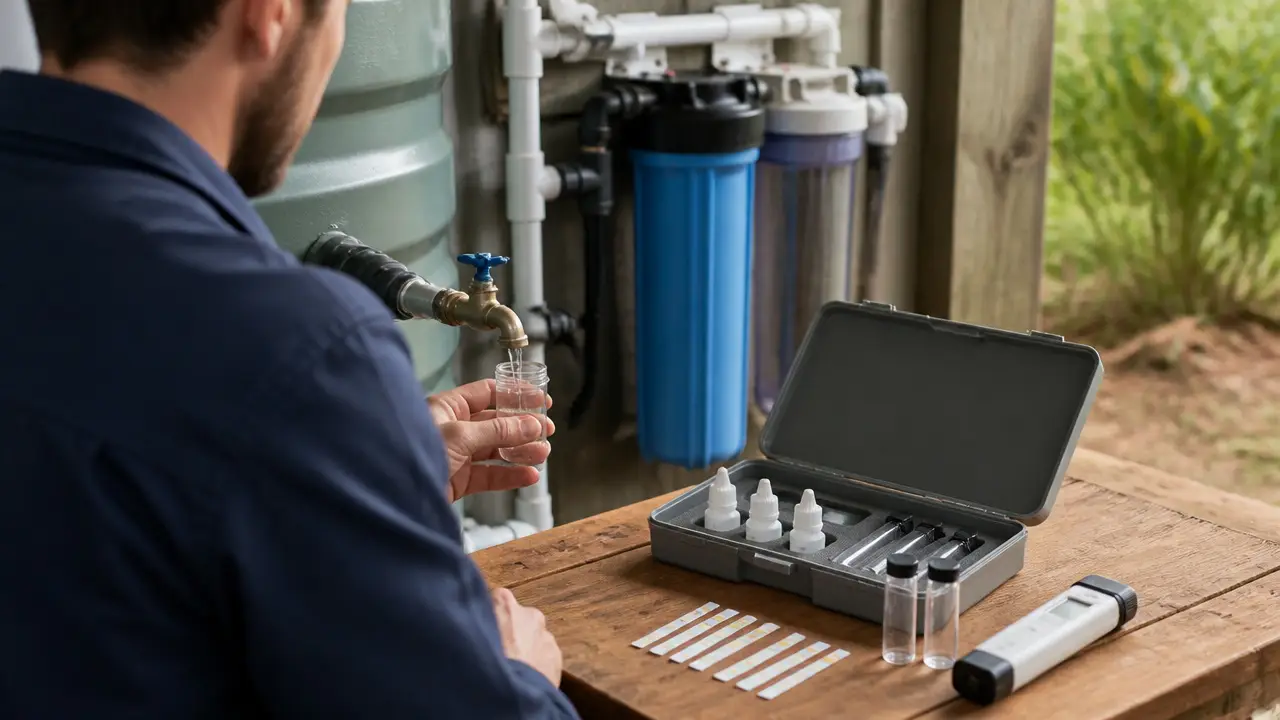
- Test the water for relevant germs and chemicals.
- Choose treatment stages that address what testing and the water source require.
- Include appropriate disinfection when required.
- Maintain every treatment stage according to its instructions.
- Follow current local health and plumbing requirements.
The CDC advises people using rainwater systems to test their water for harmful germs and chemicals, and its general filter guidance recommends testing private well or rainwater sources at least once each year.
A single sediment cartridge, carbon filter, ceramic element, UV unit, or home test strip does not provide a complete drinking-water safety assessment.
Maintaining a Gravity Filter
Maintenance matters even more in a gravity system because small amounts of clogging can cause large drops in flow.
Check the system regularly for:
- Reduced water flow
- Sediment buildup
- Damaged screens
- Algae or organic growth
- Leaking filter housings
- Loose fittings
- Insect access
- Cracked or damaged filter elements
Wash reusable screens according to their instructions. Replace disposable media as required by the manufacturer or when its condition or performance calls for replacement.
Do not keep using a clogged cartridge simply because water still passes through it.
For systems used for higher-quality household water, cleaning and treatment maintenance need to be part of the normal operating routine. Poorly maintained filters can support microbial growth.
In freezing climates, outdoor housings, valves, and filter bowls may also need to be drained or otherwise protected. Trapped water can freeze, expand, and damage equipment.
Frequently Asked Questions
Do gravity water filters work with rain barrels?
Yes. Gravity filters can work well with rain barrels when the filter has low enough resistance and the barrel has enough height above the outlet. Coarse screens and irrigation filters are usually easier to run by gravity than fine cartridges.
How high should a rainwater tank be for gravity filtration?
There is no single required height. Each foot of vertical water height provides about 0.43 psi before plumbing and filter losses. The required height depends on the filter, pipe length, desired flow, and equipment downstream.
Can I use a whole-house filter without a pump?
Sometimes, but many whole-house cartridges are designed for pressurized plumbing. They may greatly reduce flow when connected directly to a low rain barrel or tank. Check the filter's operating requirements and low-pressure performance.
What micron filter should I use for rainwater?
Choose a micron rating based on the job the filter needs to perform. Coarser filtration is useful for protecting irrigation and removing visible sediment. Finer filtration may be part of higher-level treatment but usually causes more flow resistance. Drinking-water treatment should be chosen from testing and verified contaminant-reduction requirements, not micron size alone.
Does a carbon gravity filter make rainwater safe to drink?
No. Activated carbon may reduce certain tastes, odors, or chemicals, depending on the filter, but it does not provide complete protection from all germs and chemical contaminants. Rainwater intended for drinking needs a whole-system treatment and testing plan.
Should I filter rainwater before or after the storage tank?
Usually both stages have a role. Use screens and debris control before storage to keep larger material out of the tank. Add finer filtration after storage when needed to protect irrigation equipment, pumps, fixtures, or later treatment stages.
Why does my gravity filter get slower as the tank empties?
The pressure comes from the height of water above the filter and outlet. When the tank level falls, the head height falls too. A dirty filter can make the drop in flow even more noticeable.