As an affiliate, we may earn a commission from qualifying purchases. We get commissions for purchases made through links on this website from Amazon and other third parties.
A turbidity meter can be quite accurate when it is calibrated, kept clean, and used with a consistent sampling method. But the number on the screen is not an absolute measurement of every particle in the water.
Turbidity is an optical measurement. The meter shines light through a water sample and measures how that light is scattered by suspended particles. Different particles, water colors, instruments, and sample conditions can change the result. Even two properly calibrated meters can give somewhat different readings on the same natural water sample if their optical designs differ.
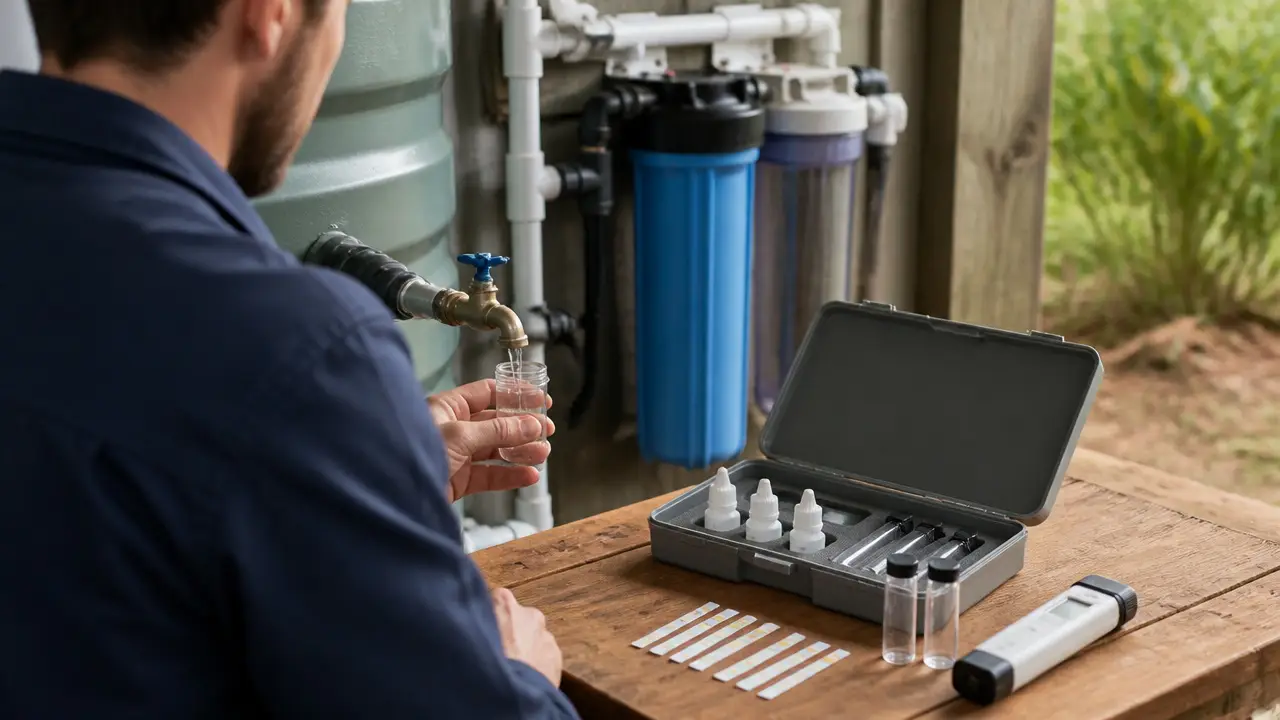
For a rainwater system, a turbidity meter is most useful for watching changes over time, checking whether sediment treatment is working, and spotting unusual cloudiness. It cannot tell you whether the water is safe to drink.
What Does a Turbidity Meter Measure?
Turbidity means how cloudy water is because of suspended material.
That material can include:
- Fine soil or dust
- Silt and clay
- Organic debris
- Tiny plant material
- Rust or mineral particles
- Microorganisms attached to particles
- Other suspended matter
Most handheld turbidity meters report results in NTU, or nephelometric turbidity units. Some instruments use FNU, or formazin nephelometric units.
A nephelometric meter usually measures light scattered at about a 90-degree angle from the incoming light. EPA Method 180.1 uses this basic approach and compares the sample's scattered light with calibrated turbidity standards.
A turbidity meter does not directly count particles. It also does not measure how much sediment weighs.
How Accurate Are Turbidity Meters?
There is no single accuracy number that applies to every turbidity meter.
Accuracy depends on:
- The meter's design.
- Its stated measurement range.
- Its calibration.
- The turbidity standards used.
- The condition of the sample vial or optical sensor.
- How the sample is collected and handled.
- The type of particles in the water.
- Water color and other optical interference.
A suitable meter that is correctly calibrated can produce useful, repeatable measurements within its stated operating limits. However, you should use the manufacturer's accuracy specification for the exact meter rather than assuming that every meter is accurate to the same percentage.
EPA Method 180.1, for example, includes calibration verification requirements and calls for checking instrument performance against known standards. That does not mean every consumer turbidity meter automatically meets EPA Method 180.1 or has the same accuracy.
For most homeowners, consistency matters almost as much as laboratory-level absolute accuracy.
If your rainwater normally measures around the same turbidity and suddenly becomes much cloudier, that change may be useful even if the meter is not a laboratory instrument.
Accuracy, Resolution, and Repeatability Are Different
Turbidity meter specifications can be confusing because several numbers may be listed.
Accuracy
Accuracy describes how close the meter's reading is to the accepted value of a known turbidity standard.
For example, if you test a certified standard, an accurate meter should give a result close to that standard's assigned value.
Resolution
Resolution is the smallest change the display can show.
A display that reads to 0.01 NTU does not necessarily mean the measurement is accurate to 0.01 NTU.
A meter could display:
0.47 NTU
while its actual measurement uncertainty is much larger than 0.01 NTU.
More decimal places do not automatically mean better accuracy.
Repeatability
Repeatability describes how closely repeated measurements agree.
If you test the same well-mixed sample several times and obtain:
- 2.1 NTU
- 2.1 NTU
- 2.2 NTU
the meter is giving fairly repeatable readings.
If you get:
- 2.1 NTU
- 4.5 NTU
- 1.7 NTU
something may be wrong with the meter, calibration, sample preparation, vial, bubbles, or measurement technique.
Why Turbidity Measurements Can Vary
Turbidity is more sensitive to measurement conditions than many people expect.
USGS notes that turbidity is not an inherent physical property like temperature. The reading depends partly on the instrument's light source and detector arrangement. Particle size, shape, color, and other characteristics also affect how light is scattered.
Several common problems are especially important when testing rainwater.
Air bubbles can make readings too high
Tiny bubbles scatter light.
A freshly shaken sample may therefore appear more turbid than it really is. EPA guidance specifically identifies finely divided air bubbles as a cause of high readings.
Mix a sample enough to distribute settled particles, but avoid vigorous shaking. Let obvious bubbles disappear before taking the reading.
Heavy particles can settle
Larger sediment can fall to the bottom while you are preparing the sample.
EPA Method 180.1 notes that rapidly settling sediment can cause low turbidity readings.
This is one reason two samples collected from the same rain barrel can produce different results if one sits longer before testing.
Fingerprints and scratched vials interfere with light
The sample vial is part of the optical measurement.
Fingerprints, water droplets, scratches, dirt, and residue on the outside can scatter or block light. Keep the optical surface clean and handle the vial where fingerprints will not affect the meter's light path.
Using the same vial orientation each time can also improve consistency, especially if the vial has minor optical differences.
Water color can affect some measurements
Turbidity and color are not the same thing.
Tannins from leaves, for example, may color rainwater without producing the same optical response as suspended sediment. Depending on the instrument design, strongly colored water can influence measurements.
EPA Method 180.1 notes that dissolved substances that absorb light can cause low turbidity readings under some conditions.
Calibration can drift
A turbidity meter should be checked with the correct calibration standards for that instrument.
USGS warns that turbidity standards are not always interchangeable. Using an inappropriate standard can introduce significant calibration errors.
Follow the meter manufacturer's instructions for:
- Standard type
- Standard values
- Calibration frequency
- Storage
- Temperature requirements
- Standard replacement
Do not assume plain distilled water is an adequate substitute for the required calibration standard.
NTU and FNU Readings May Not Be Directly Comparable
Two meters can both be working correctly and still give somewhat different results.
One reason is that turbidity instruments use different wavelengths of light and different detector arrangements.
Traditional NTU instruments commonly use white or broadband light. Many FNU instruments use near-infrared light. USGS cautions that instruments with different optical configurations can produce different results when measuring real environmental water, even though both respond properly to calibration standards.
This matters if you are comparing:
- A new meter with an old meter
- A home meter with laboratory results
- A sensor installed in a tank with a portable meter
- Readings reported as NTU with readings reported as FNU
Factor in home water-turbidity measurements to understand the service interval indicated by reliable monitoring data.
For long-term rainwater monitoring, it is usually better to use the same instrument and measurement method whenever possible.
That makes changes in your own readings easier to interpret.
How to Get More Reliable Turbidity Readings From Rainwater
A consistent procedure often improves your results more than chasing extra decimal places.
1. Sample from the same place
Water near the bottom of a tank may contain more settled material than water near the surface.
If you are tracking turbidity over time, collect samples from roughly the same location.
2. Use a clean container
Residue from an earlier sample can affect the next measurement.
Rinse and clean sampling equipment according to the meter manufacturer's instructions.
3. Mix settled material consistently
If your goal is to measure the general turbidity of stored water, gently mix the sample so suspended material is reasonably distributed.
Do not shake it so hard that you create large numbers of air bubbles.
4. Let bubbles disappear
Check the vial before placing it in the meter.
Bubbles stuck to the inside wall can interfere with the optical reading.
5. Keep the vial clean
Wipe the outside as instructed by the meter manufacturer.
Avoid fingerprints in the optical path.
6. Measure promptly
Sediment can settle while the sample sits.
Using roughly the same delay between sampling and measurement makes comparisons more meaningful.
7. Take repeated readings when something looks wrong
If one result seems unusual, repeat the measurement using the same sample or a fresh sample collected the same way.
Large differences between repeated readings are a reason to check the vial, calibration, bubbles, sample handling, and meter condition.
Are Turbidity Meters Useful for Rainwater Harvesting?
Yes. They can be very useful when you treat turbidity as one piece of information rather than a complete water-quality test.
Checking roof runoff
Turbidity may rise when runoff carries more dust, pollen, roof debris, or other suspended material.
A first-flush diverter sends away some of the first runoff from a rain event before water enters storage. Its purpose is to reduce the initial load of debris and contaminants washed from the collection surface.
Turbidity readings taken consistently may help you see how water clarity changes through a storm, although turbidity alone cannot tell you what contaminants are present.
Watching filtration performance
You can compare readings before and after a sediment filtration stage.
A clear downward trend may indicate that the treatment stage is reducing material that scatters light.
However, turbidity does not identify what the removed particles are, and it does not prove that the filter is removing microorganisms or dissolved contaminants.
Finding changes in a storage tank
A sudden increase in turbidity might be associated with:
- Sediment being disturbed
- A recent dirty runoff event
- Tank cleaning
- Organic material entering storage
- A filter problem
- Pumping from closer to settled sediment
The meter tells you that the optical condition changed. You still need to investigate why.
Can a Turbidity Meter Tell You Whether Rainwater Is Safe to Drink?
No.
Clear water can still contain bacteria, viruses, protozoa, dissolved chemicals, metals, or other contaminants that a turbidity meter cannot detect.
Turbidity does matter in drinking-water treatment because particles can interfere with disinfection. WHO guidance notes that high turbidity can reduce the effectiveness of processes such as chlorination and UV treatment.
But a low turbidity reading does not mean the water is potable.
Potable means suitable for drinking.
Using collected rainwater as drinking water requires a whole-system approach that considers the collection surface, contamination risks, prefiltration, treatment, disinfection where appropriate, maintenance, current laboratory testing, and applicable local requirements. WHO's current drinking-water guidance uses a broader risk-management approach rather than relying on one water-quality measurement.
A turbidity meter is therefore better viewed as a monitoring tool, not a drinking-water safety test.
When Is a Turbidity Meter Accurate Enough?
For a typical homeowner, the meter is likely accurate enough for the job when:
- It covers the turbidity range you need.
- It is calibrated using the correct standards.
- Repeated readings are reasonably consistent.
- The sample vial and optics are clean.
- You use the same sampling method each time.
- You stay within the manufacturer's operating limits.
- You use it mainly to track turbidity rather than identify contaminants.
More formal water-quality work may require a specified analytical method, documented calibration, quality-control checks, and laboratory equipment.
If the result will determine whether water is suitable for drinking, regulatory compliance, or another health-sensitive use, do not rely on a household turbidity meter alone.
Frequently Asked Questions
How accurate is a cheap turbidity meter?
It depends on the individual meter. A lower-cost meter may still be useful for watching trends if it is properly calibrated and gives repeatable readings. Check its stated accuracy, measurement range, calibration requirements, and measurement method rather than judging it by display resolution alone.
Is 0.01 NTU resolution the same as 0.01 NTU accuracy?
No. Resolution only tells you the smallest change the display can show. A meter displaying two decimal places can still have measurement uncertainty much greater than 0.01 NTU.
Why do I get different turbidity readings from the same water?
Particles may be settling, air bubbles may be present, or the sample vial may have fingerprints or scratches. Differences in mixing, sampling location, temperature, calibration, and meter positioning can also affect results.
Can two turbidity meters give different readings?
Yes. Different light sources and detector designs can respond differently to natural particles. This is why readings from different turbidity methods should not automatically be treated as identical, even when both instruments have been calibrated correctly.
Does low turbidity mean rainwater is clean?
It means the water contains relatively little material that scatters light according to that measurement method. It does not establish that the water is free from microbes, chemicals, metals, or other contaminants.
Can I use a turbidity meter to check my rainwater filter?
Yes. Comparing consistent upstream and downstream measurements can help you see changes in suspended-particle removal. Turbidity does not establish removal of contaminants that the meter cannot detect.
Can a turbidity meter prove that rainwater is safe to drink?
No. Turbidity is only one water-quality measurement. Drinking-water decisions require suitable collection and treatment, maintenance, laboratory testing, and attention to applicable local requirements.