As an affiliate, we may earn a commission from qualifying purchases. We get commissions for purchases made through links on this website from Amazon and other third parties.
Water testers can be accurate, but only for the specific thing they are designed to measure. A pH meter can measure pH. A test strip may screen for nitrate or hardness. A TDS meter can estimate dissolved material in the water. None of these tools can tell you that water is safe to drink.
Accuracy also depends on the tester, its measuring range, calibration, sample handling, and how closely you follow the instructions. For health-related decisions, especially with rainwater used for drinking, a state-certified drinking-water laboratory is the better choice. EPA and CDC recommend certified laboratories for drinking-water testing.
What Does “Accurate” Mean for a Water Tester?
A water tester is accurate when its reading is close enough to the true level of the substance being measured.
That sounds simple, but there are several parts to it.
A tester may be good at measuring:
- pH
- hardness
- chlorine
- nitrate
- conductivity
- total dissolved solids
- certain metals
- certain bacteria
But a tester that measures one of these cannot tell you what else is in the water.
For example, a normal pH reading does not rule out bacteria. A low TDS reading does not rule out lead. A negative bacteria test does not rule out pesticides or other chemicals.
This is why there is no single home “water quality tester” that gives a complete answer about drinking-water safety.
How Accurate Are Different Types of Water Testers?
The answer depends heavily on the type.
| Tester | Best use | Main limitation |
|---|---|---|
| Digital pH meter | Checking acidity or alkalinity | Needs calibration and proper care |
| TDS meter | Tracking changes in dissolved material | Does not identify contaminants |
| Conductivity meter | Comparing dissolved-ion levels | Does not show which substances are present |
| Test strips | Quick screening | Color matching and test range limit precision |
| Drop test kit | Hardness, chlorine, and similar checks | Technique affects the result |
| Home bacteria test | Basic screening | Sampling and incubation can affect results |
| Certified laboratory | Health-related contaminant testing | Tests only for contaminants you request |
A simple tester may still be very useful. The key is using it for the right job.
Digital Water Meters Can Be Quite Consistent
Digital meters work well for measurements such as pH and conductivity when they are properly maintained.
They are especially useful for watching trends.
Suppose the conductivity of stored rainwater normally stays within a certain range. A sudden large change can tell you that something in the system has changed.
It does not tell you exactly what changed.
Meters also need care. Depending on the instrument, that may include:
- calibration
- clean probes
- correct storage
- fresh batteries
- suitable water temperature
- enough time for the reading to stabilize
A meter that has not been calibrated for a long time can produce a precise-looking number that is still wrong.
TDS Meters Do Not Test Water Safety
A TDS meter is one of the most misunderstood water testers.
TDS means total dissolved solids. These are dissolved substances in water.
Most handheld TDS meters do not directly identify or measure every dissolved substance. They measure electrical conductivity and use it to estimate TDS.
That makes a TDS meter useful for comparing water before and after some treatment stages or watching for changes over time.
It does not tell you whether the dissolved material is harmless minerals or an unwanted contaminant.
It also does not reliably detect germs.
A low TDS reading should therefore never be treated as proof that rainwater is potable. Potable means suitable for drinking.
Are Water Test Strips Accurate?
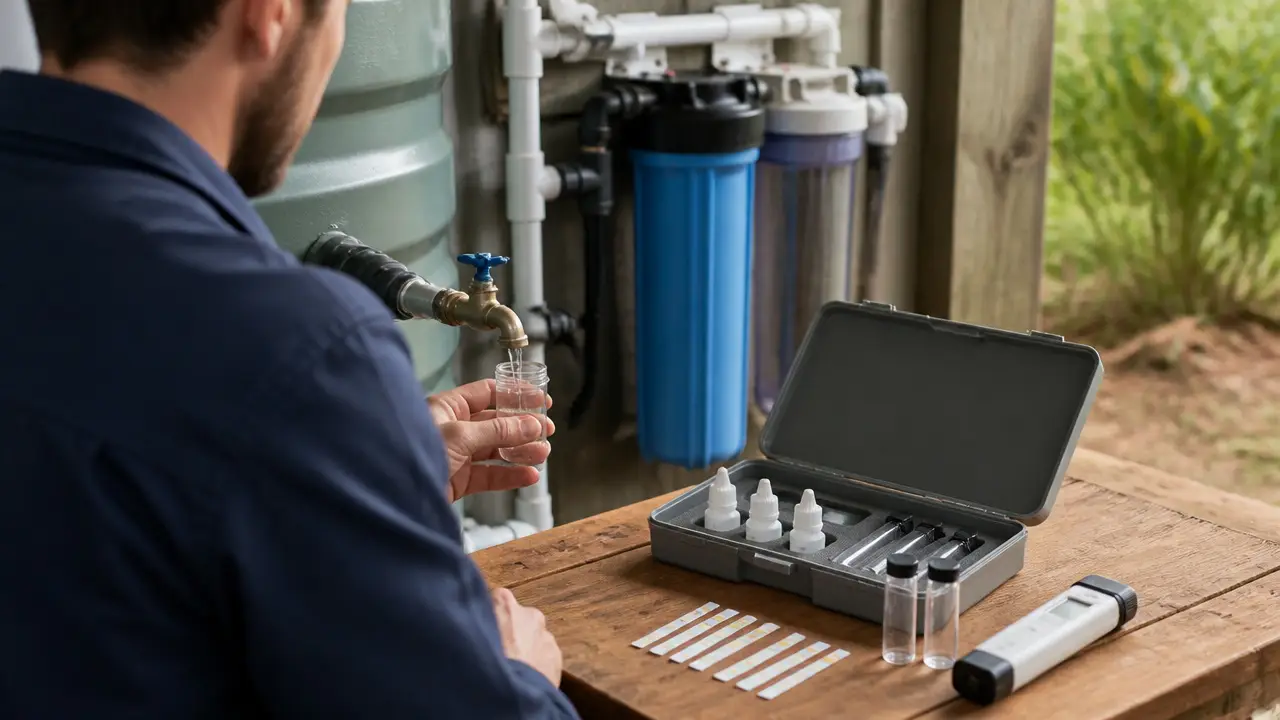
Water test strips can provide useful screening results, but they are usually less precise than proper laboratory analysis.
Many strips use small pads that change color when exposed to a substance. You compare the color with a printed chart.
Several things can affect the result:
- how long the strip stays in the water
- when you read the color
- lighting
- how you judge similar colors
- strip age
- improper storage
- the concentration range covered by the strip
- other chemicals in the sample
This does not make strips useless.
They can be handy for routine checks where an approximate answer is enough. For example, a strip may help you monitor water hardness or a treatment chemical.
But if a strip suggests a possible health-related problem, confirm it with an appropriate laboratory test rather than relying on the strip alone.
What About Home Bacteria Tests?
Bacteria testing requires more care.
Some home kits are designed to indicate whether certain bacteria may be present after the sample has been incubated for a set period.
These tests can be useful as a warning or screening tool. They should not be treated as a complete microbiological assessment of rainwater intended for drinking.
Small mistakes can matter. The sample container, sampling technique, temperature, storage, incubation conditions, and timing can all affect microbiological results.
CDC recommends using a state-certified laboratory when testing private drinking water supplies. It specifically recommends annual testing of private wells for total coliform bacteria along with nitrate, TDS, and pH, plus other contaminants that may be important locally.
Rainwater systems are different from groundwater wells, but the same basic lesson applies: health-related microbiological testing deserves more care than a general-purpose home test.
Laboratory Testing Is More Reliable for Drinking-Water Decisions
Certified drinking-water laboratories provide a much stronger basis for decisions involving drinking water.
Certified labs use approved analytical methods and must meet quality-control requirements. EPA notes that certified laboratories must successfully analyze proficiency-testing samples and undergo periodic audits.
A laboratory test is still not automatically a complete water-safety test.
You have to request the right analyses.
A laboratory cannot tell you that water contains no contaminants simply because you tested it for nitrate and bacteria. Those results apply only to the things included in the test.
This is especially important with collected rainwater because possible contaminants depend on the whole system.
Rainwater Testing Should Match How You Use the Water
You usually do not need the same testing plan for garden irrigation as you would for drinking water.
For non-potable uses, simple meters and test kits may be enough to help diagnose problems.
For example, you might use testing to investigate:
- unusual pH
- mineral buildup
- staining
- irrigation problems
- changes after filtration
- treatment-system performance
Non-potable means water that is not intended for drinking.
For drinking-water use, the standard should be much higher.
Roof runoff can pick up material from roofing, gutters, animals, dust, leaves, air pollution, storage tanks, fittings, and plumbing. A rainwater system also changes over time, so one good test result does not guarantee future water quality.
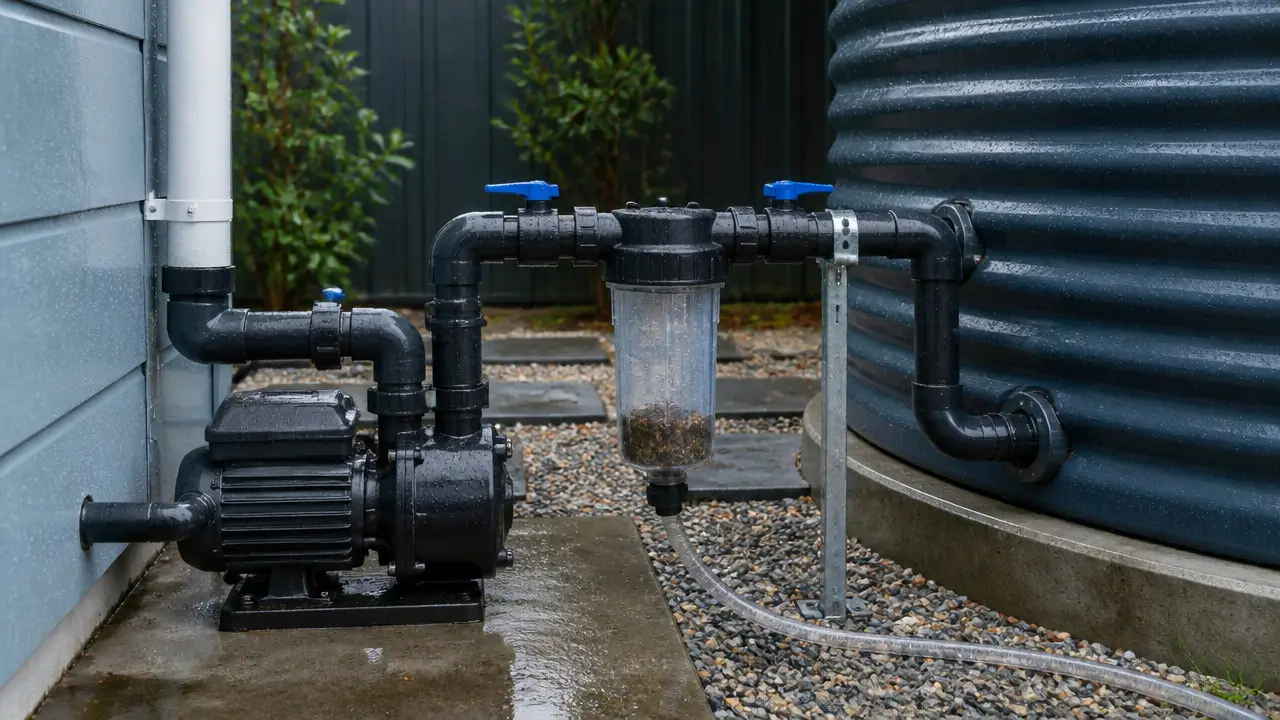
Drinking-water use should be treated as a whole system involving suitable collection surfaces, debris control, first-flush management where appropriate, storage, treatment, maintenance, and current testing.
Examine home drinking-water test equipment to compare maintenance priorities supported by meaningful test results.
A first flush system diverts some of the earliest roof runoff from a rain event because that runoff may carry accumulated roof debris and contamination.
Sampling Errors Can Make a Good Test Look Bad
Sometimes the tester is not the main problem. The sample is.
Where and how you collect the water matters.
For laboratory testing, use the containers and sampling instructions provided by the laboratory. EPA guidance notes that samples for coliform testing require sterile containers and careful collection and handling.
The correct sampling location also depends on what you want to know.
For example:
- Testing water directly from a tank tells you about stored water.
- Testing after filters tells you about water after those filters.
- Testing at the kitchen tap evaluates water after it has also passed through household plumbing.
- Testing before and after treatment can help identify whether a treatment stage is changing the target measurement.
For drinking-water assessment, ask the laboratory where the sample should be taken. Lead testing is a good example because plumbing can be part of the contamination source. EPA recommends certified laboratory analysis for drinking water when checking for lead.
Calibration Matters
A digital tester should be checked and calibrated according to its instructions.
Calibration compares the instrument with a solution that has a known value. The meter can then be adjusted so its readings stay close to that reference.
Calibration is particularly important for pH meters.
Other problems can also cause poor readings:
- a dirty sensor
- a dry or damaged probe
- old calibration solution
- contamination between samples
- extreme temperatures
- improper storage
Rinsing and storing the probe correctly can be just as important as buying a meter with good specifications.
Pay Attention to the Tester's Measuring Range
A test may be accurate within its intended range but still be unsuitable for the question you are asking.
Suppose a strip divides results into broad color bands. It may easily tell you that a level is low, medium, or high. It may not be capable of showing small differences between nearby concentrations.
The same issue applies to detection limits.
A tester must be able to detect the contaminant at a level useful for the decision you are making. A test that cannot measure sufficiently low concentrations may provide false reassurance even if the tester itself works correctly.
For health-related contaminants, choose a laboratory method appropriate for drinking water rather than assuming any consumer test with the contaminant's name on the package is suitable.
Do Not Use One Tester to Judge an Entire Treatment System
Rainwater treatment often involves several stages because different equipment performs different jobs.
For example, sediment filtration may remove particles while another treatment stage addresses microorganisms.
A tester designed to check one part of that process cannot confirm that every other part is working.
The same applies to UV systems. A meter showing normal TDS does not prove that UV disinfection is effective. A clear-looking water sample does not prove that harmful microorganisms are absent.
Testing should match the risk that each treatment stage is intended to control.
When a Home Water Tester Makes Sense
Home testers are most useful for routine monitoring and troubleshooting.
They work especially well when you already know what normal looks like for your system.
You can record readings over time and investigate unexpected changes.
For example, a rainwater system owner might record pH or conductivity periodically. A sudden change could prompt inspection of the roof, gutters, tank, treatment equipment, or plumbing.
That is a much better use of a simple meter than asking it to answer, “Is this water safe to drink?”
When to Use a Certified Laboratory
Use a certified drinking-water laboratory when the answer could affect someone's health.
That includes situations where rainwater is being considered for drinking, cooking, or other uses that could lead to ingestion.
Laboratory testing is also appropriate when:
- a home test gives an unexpected result
- water suddenly changes in smell, taste, or appearance
- contamination is suspected
- treatment equipment has failed
- flooding or other contamination has affected the system
- you need to test for lead, arsenic, nitrate, specific microorganisms, or other health-related contaminants
- you need results for a regulatory or official purpose
EPA recommends state-certified laboratories for independent drinking-water analysis.
If collected rainwater will be used as drinking water, work with your local health authority, a qualified water-treatment professional, or an appropriate certified laboratory to decide what should be tested. Local requirements and likely contaminants vary by location and system design.
The Bottom Line
Water testers can be accurate when they are used for the measurement they were designed to make.
Digital pH and conductivity meters can be useful monitoring tools. TDS meters are good for watching changes in dissolved material. Test strips and home kits can provide useful screening information.
The mistake is treating those results as a complete water-safety assessment.
For rainwater used in gardens, toilets, cleaning, and other non-potable uses, basic testing may be enough for many system checks. For rainwater intended for drinking, rely on an appropriate treatment plan and current laboratory testing rather than a single meter, strip, or home test kit.
Frequently Asked Questions
Can a home water tester tell me if water is safe to drink?
No. Most home testers measure only one substance or a small group of water characteristics. They cannot rule out all harmful germs, metals, chemicals, or other contaminants.
Are digital water testers more accurate than test strips?
Digital meters can provide more precise readings for parameters such as pH and conductivity, but only when the meter is suitable for the measurement and properly calibrated. Test strips are often better suited to quick screening.
Can a TDS meter detect contaminated water?
Not reliably. A TDS meter estimates the amount of dissolved material in water. It does not identify those substances and does not provide a complete test for bacteria, lead, pesticides, or other health-related contaminants.
Can I use a water test kit on collected rainwater?
Yes, for suitable screening and routine monitoring. A home kit can help check specific water characteristics. It should not be used by itself to decide whether collected rainwater is safe to drink.
Why do two water testers give different readings?
The testers may have different calibration, accuracy, measuring ranges, sensors, temperature compensation, or testing methods. Dirty probes, old strips, poor storage, and sampling differences can also cause different results.
How often should rainwater be tested?
There is no single schedule that fits every rainwater system. Testing should depend on the intended use, collection system, treatment process, local contamination risks, and local requirements. Water intended for drinking requires a more careful testing plan than water used only for irrigation.
Is laboratory water testing completely accurate?
Laboratory testing is much more reliable for health-related decisions when appropriate methods and proper sample handling are used. However, a laboratory only reports the contaminants included in the requested tests. A limited test panel cannot prove that no other contaminants are present.