As an affiliate, we may earn a commission from qualifying purchases. We get commissions for purchases made through links on this website from Amazon and other third parties.
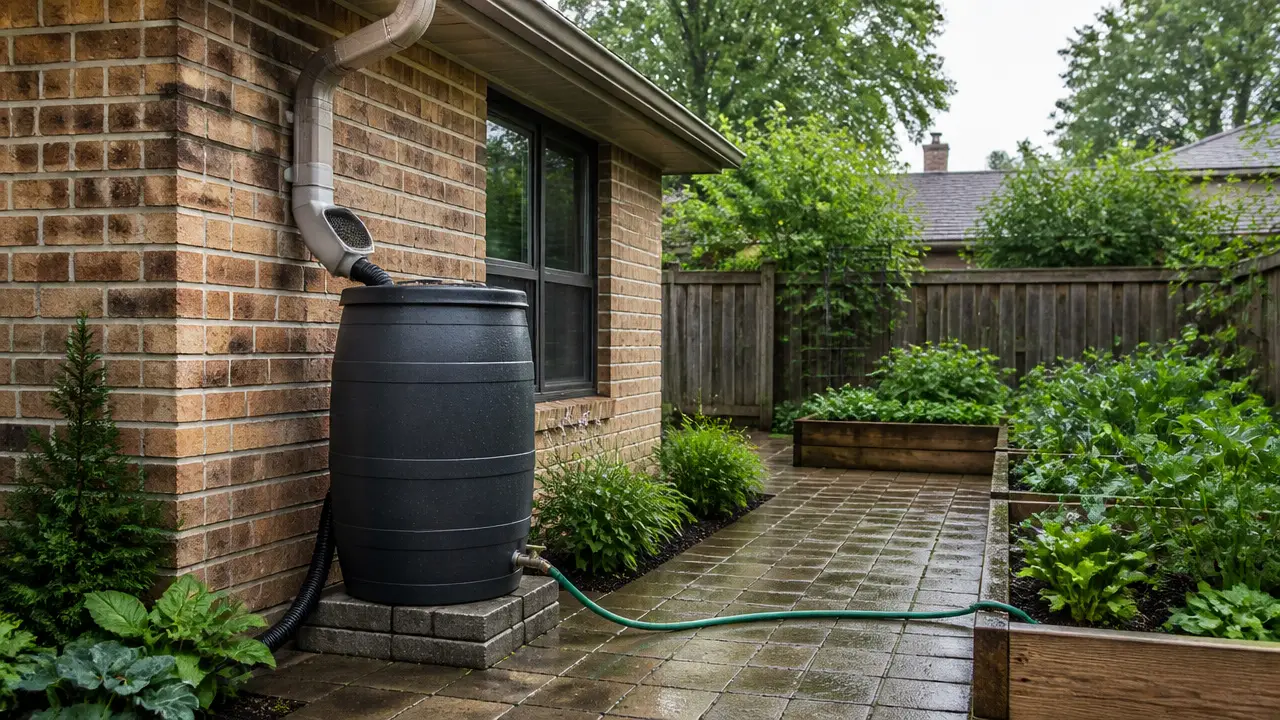
Rain barrels work by catching rainwater from a roof and storing it for later use. A downspout carries roof runoff into the barrel. The barrel holds the water until you release it through a spigot, hose, or small irrigation line.
Most rain barrel systems are simple and use gravity instead of a pump. The main parts are the roof, gutters, downspout, inlet, storage barrel, screened opening, outlet, and overflow.
How a Rain Barrel Collects Water
When rain falls on your roof, it flows toward the gutters.
The gutters direct the water into a downspout. Instead of sending all that water to the ground or a storm drain, the downspout can direct some or all of it into a rain barrel.
The basic path looks like this:
Roof → gutter → downspout → rain barrel → spigot or overflow
The barrel fills from the top or through a downspout diverter.
A screen usually covers the inlet. It helps keep out leaves, insects, and larger debris. It does not make the water clean enough to drink.
The Main Parts of a Rain Barrel System
A basic rain barrel usually has a few important parts.
Storage Barrel
The barrel is the container that holds the collected rainwater.
It should be made from material suitable for water storage and should be able to handle outdoor conditions. The lid or top should be secure so children, animals, mosquitoes, and debris cannot easily get inside.
Remember that stored water is heavy. Water weighs about 8.3 pounds per U.S. gallon. A full 55-gallon barrel can therefore hold more than 450 pounds of water, not counting the barrel itself.
The base must be firm, level, and strong enough for the load.
Inlet
The inlet is where water enters the barrel.
Some barrels have a screened opening on top. Others connect directly to a downspout diverter.
A screen helps catch larger debris and can help keep mosquitoes from entering the barrel.
Downspout Diverter
A diverter is a fitting installed in the downspout.
It sends some rainwater into the barrel while allowing extra water to continue through the downspout once the barrel is full.
This can make overflow easier to manage than simply cutting the downspout and placing it over the barrel.
Spigot
The spigot is usually installed near the bottom of the barrel.
Opening it lets water flow out under gravity. You can fill a watering can or connect a hose if the system provides enough pressure and the fittings are compatible.
Overflow
Every rain barrel needs a safe way to handle excess water.
Once the barrel is full, additional rain must go somewhere. An overflow hose or fitting directs that water away from the barrel.
The overflow should discharge somewhere that will not cause foundation problems, erosion, muddy areas, or unwanted flooding.
How Water Comes Out of a Rain Barrel
Most rain barrels rely on gravity.
Water pushes downward because of its weight. When you open the spigot, that pressure moves water through the outlet.
The higher the water level is above the outlet, the more pressure you generally have.
This height difference is sometimes called head height.
A barrel raised on a sturdy stand can provide more head height than one sitting directly on the ground. Raising the barrel can also make it easier to fit a watering can underneath the spigot.
However, rain barrel pressure is still much lower than normal household water pressure.
A long hose, narrow tubing, uphill run, clogged screen, or restrictive fitting can reduce the flow rate, which means how much water moves through the system in a given amount of time.
How Quickly Does a Rain Barrel Fill?
Often much faster than people expect.
A useful U.S. estimate for rainwater collection is:
Gallons collected = roof area in square feet × rainfall in inches × 0.623
For example, suppose 500 square feet of roof drains toward one barrel during a 1-inch rain:
500 × 1 × 0.623 = about 312 gallons
That is far more than a typical rain barrel can hold.
Real collection will be somewhat lower because of splash, gutter losses, roof wetting, leaks, and other losses. Even so, a modest roof area can fill a small barrel during one storm.
This is why overflow planning matters.
Also use only the roof area that actually drains toward the downspout connected to the barrel. Do not automatically use the size of the entire roof.
What Happens When the Barrel Is Full?
Once the barrel reaches capacity, incoming water must bypass or leave the barrel.
Depending on the design, excess water may:
- Flow through an overflow fitting.
- Return to the downspout through a diverter.
- Move into a second connected barrel.
- Drain through an overflow hose to a suitable location.
Do not rely on water simply spilling over the top.
Uncontrolled overflow can wash out the barrel base, soak soil next to a foundation, damage siding, or create standing water.
The overflow outlet should also be large enough to handle incoming water during heavy rain. A very small overflow connection can become a bottleneck.
Can You Connect More Than One Rain Barrel?
Yes.
Two or more barrels can be linked to increase storage capacity.
One common arrangement connects barrels near their upper sections so water fills one barrel and then moves into the next.
Another design connects barrels near the bottom so their water levels tend to equalize.
The fittings, hoses, and barrel openings need to be compatible. A leak around a connection can waste a surprising amount of collected water.
If a fitting passes through the barrel wall, it may use a bulkhead fitting. This is a fitting designed to create a sealed connection through the wall of a tank or barrel.
All connected barrels also need stable support. Adding another barrel adds hundreds of pounds when the system is full.
What Can Rain Barrel Water Be Used For?
Rain barrel water is commonly used for non-potable jobs.
Guidance on key facts about a rain barrel helps evaluate service access for sediment removal and odor prevention.
Non-potable means water that is not intended for drinking.
Common uses may include:
- Watering ornamental gardens
- Watering trees and shrubs
- Filling watering cans
- Washing some outdoor tools
- Supplying compatible drip irrigation systems
Roof runoff can contain bird droppings, dust, pollen, roofing particles, insects, microbes, and other contaminants.
Because of that, collected roof water should not be assumed safe for drinking, cooking, brushing teeth, or other potable uses.
Potable means safe for drinking.
Using rainwater as household drinking water requires a much more complete system. Collection surfaces, prefiltration, storage, treatment, laboratory testing, maintenance, plumbing design, and local requirements all matter. A simple rain barrel and screen are not a drinking-water treatment system.
Does a Rain Barrel Filter the Water?
A normal rain barrel does very little filtration by itself.
An inlet screen may stop leaves and larger material. Some sediment may also settle to the bottom of the barrel.
That does not mean contaminants have been removed.
If cleaner stored water is important for your intended use, the collection system may include additional stages.
For example, some systems use a first-flush diverter. A first-flush device sends away the first portion of roof runoff before allowing later water into storage. That first runoff may carry a larger amount of loose dirt and debris from the roof.
First flush can improve collection quality, but it does not make rainwater automatically safe to drink.
Why Rain Barrels Should Be Covered
An open rain barrel creates several problems.
Leaves and debris can fall inside. Animals may reach the water. Sunlight can encourage biological growth. Mosquitoes may also use standing water for breeding.
A properly fitted lid and screened openings help reduce these problems.
Check the screen regularly. Small tears or gaps can defeat its purpose.
Keeping the barrel shaded when practical can also reduce heat and light exposure, although shade does not replace regular cleaning.
How Rain Barrels Work With Garden Hoses
A hose can often connect to a rain barrel spigot, but the results may be different from connecting a hose to a house faucet.
Gravity provides much lower pressure.
Short hoses and watering at a lower elevation usually work better than long hoses running uphill.
Some drip irrigation equipment can work with low-pressure gravity systems, while other irrigation parts require more pressure. Check the operating requirements before connecting timers, valves, filters, emitters, or sprinklers.
A conventional lawn sprinkler often needs more pressure than one rain barrel can provide by gravity alone.
Do Rain Barrels Need Pumps?
Not always.
For filling a watering can or slowly feeding a nearby garden line, gravity may be enough.
A pump becomes useful when you need to:
- Move water uphill.
- Move water a longer distance.
- Produce more pressure.
- Supply equipment that requires a specific pressure or flow rate.
A pump must match the storage setup, desired flow, lift, outlet size, power supply, and intended irrigation equipment.
It should also be protected from running dry. Operating some pumps without water can damage them.
Electrical pumps used around water should be installed and powered safely according to the manufacturer's instructions and applicable electrical requirements.
What Maintenance Does a Rain Barrel Need?
Rain barrels are simple, but they are not maintenance-free.
Check the system throughout the collection season.
Look for:
- Leaves blocking the inlet screen
- Sediment collecting inside
- Leaking fittings
- Loose hoses
- Cracks in the barrel
- Clogged spigots
- Damaged mosquito screens
- Overflow problems
- Unstable supports
Clean the barrel as needed based on the amount of sediment and debris entering the system.
Gutters should also be kept reasonably clean. A clogged gutter cannot deliver water properly to the barrel.
What Happens in Freezing Weather?
Freezing water expands.
That expansion can damage barrels, hoses, valves, filters, and fittings.
In climates with hard freezes, the system may need to be drained and disconnected before freezing conditions arrive. Some downspout diverters can be switched back to normal drainage for winter.
Do not assume a barrel is freeze-proof unless its manufacturer specifically says how it should be handled in freezing conditions.
Also remember that trapped water can remain inside low spots, valves, and hoses even after most of the barrel has been drained.
Is a Rain Barrel Worth Using?
A rain barrel can be a simple way to store roof runoff for later outdoor use.
It works especially well when the goal is nearby garden watering and the system has a suitable roof area, stable barrel location, good overflow route, and easy access for cleaning.
The barrel itself is only one part of the system.
A reliable setup also depends on how water gets into the barrel, how debris and mosquitoes are controlled, where overflow goes, how the water will be used, and how the system will be maintained.
Frequently Asked Questions
Does a rain barrel work without electricity?
Yes. A basic rain barrel uses gravity to collect and release water, so electricity is not needed. Electricity is only necessary if you add equipment such as an electric pump.
How does a rain barrel stop filling when it is full?
It needs an overflow or downspout-diverter system. Extra water should be safely routed away once the barrel reaches capacity.
Can I attach a garden hose to a rain barrel?
Usually, if the spigot and hose connections are compatible. However, gravity-fed pressure is much lower than normal household water pressure, so some hose tools and sprinklers may not work well.
Can rain barrel water be used on a garden?
Rainwater is commonly stored for garden irrigation. The suitability of roof runoff can depend on the collection surface, contaminants, the plants being watered, and how the water is applied. Do not assume roof runoff is drinking-quality water.
Why should a rain barrel be raised off the ground?
A raised barrel can provide room under the spigot and increase the height difference that creates gravity pressure. Any stand must be level and strong enough to support the full weight of the barrel.
Do rain barrels attract mosquitoes?
They can if mosquitoes can reach standing water. A secure lid and fine, intact screens over openings help prevent access. Inspect screens and openings regularly.
Can one downspout fill several rain barrels?
Yes. Barrels can be connected to increase capacity, provided the connections and overflow system are designed to move water between the containers safely.
How often should a rain barrel be cleaned?
There is no single schedule that works for every system. Inspect it regularly and clean it when sediment, organic material, odors, clogged fittings, or other buildup becomes noticeable. Keeping gutters and inlet screens clean can reduce how much debris reaches the barrel.