As an affiliate, we may earn a commission from qualifying purchases. We get commissions for purchases made through links on this website from Amazon and other third parties.
The best portable water filtration system is one that matches the water source and the way you plan to use the water. There is no single portable filter that is best for every situation.
For untreated freshwater, stored rainwater, or water from an uncertain source, look beyond a basic filter. A portable purifier, or a filter followed by a suitable disinfection step, provides broader protection from germs. Many common portable filters can remove parasites and some bacteria but do not reliably remove viruses.
If the goal is only to improve the taste of already-treated tap water, a simple activated-carbon system may be enough. If you plan to drink collected rainwater, however, a portable filter should be treated as only one part of a larger water-safety system.
Filter vs. Purifier: What Is the Difference?
The words filter and purifier are sometimes used as if they mean the same thing. They do not.
A filter normally passes water through tiny pores or treatment media. Depending on its design, it may remove:
- Dirt and sediment
- Protozoan parasites such as Giardia and Cryptosporidium
- Some or most bacteria
- Certain chemicals, if special treatment media are included
A purifier is intended to provide broader protection against disease-causing germs, including viruses.
The CDC notes that many portable filters do not remove viruses. A filter with an absolute pore size of 1 micron or smaller can remove parasites, while an absolute pore size of 0.3 micron or smaller can remove bacteria and parasites. Viruses are much smaller and normally require a different treatment method.
An absolute micron rating means the filter's largest pores are no bigger than the stated size. That gives you more useful information than a nominal or average micron rating, which may include some larger pores.
The Best Type Depends on Your Water Source
A good portable system starts with one question: What might be in the water?
| Water source or use | Practical treatment choice | Main concern |
|---|---|---|
| Treated tap water | Carbon filter, if needed | Taste, odor, or a specific chemical |
| Clear backcountry freshwater | Fine filter, with added virus treatment where needed | Parasites, bacteria, viruses |
| Stored rainwater for non-potable use | Sediment filtration as needed | Dirt, roof debris, tank sediment |
| Rainwater intended for drinking | Multi-stage treatment rather than one portable filter | Germs and possible chemical contamination |
| Water with possible sewage contamination | Purification or filter plus suitable disinfection | Viruses, bacteria, parasites |
| Brackish or salty water | Suitable reverse osmosis system | Dissolved salts |
| Water with suspected fuel, pesticide, or chemical contamination | Find another water source unless appropriate treatment has been verified | Dissolved chemicals |
Non-potable means water that is not intended for drinking, cooking, or other uses where drinking-water quality is required.
A filter that works well on clear mountain water may be the wrong choice for roof runoff. A carbon bottle designed for treated city water may do very little against disease-causing microorganisms.
Portable Filter Types
Squeeze Filters
A squeeze filter is connected to a soft water pouch or compatible bottle. Water is pushed through the filter by squeezing the container.
These systems are useful when:
- One or two people need drinking water
- Weight and size matter
- The source water is reasonably clear
- You do not need large amounts of water quickly
Check the filter's actual germ-reduction claims rather than assuming that a small micron number covers every hazard.
Squeeze filters also need regular cleaning or backflushing. Sediment can reduce the flow quickly.
Gravity Filters
A gravity system holds untreated water in an upper bag or container and lets gravity move it through the filter.
This is often the most useful portable design when several people need water at camp, at a cabin, or beside a rainwater storage tank.
Gravity filters have several advantages:
- Little physical effort
- No electrical power
- Larger batch sizes
- Easy connection to bags or containers
They depend on head height, which simply means the vertical distance between the water level and the outlet or filter. More height can provide more pressure, within the limits of the system.
Do not assume that hanging a gravity bag higher than recommended is harmless. Excess pressure can damage some filters or connections.
Pump Filters
A hand-pump filter draws water through a hose and pushes it through the treatment element.
Pump systems can be useful when:
- Filling bottles directly from a stream or tank
- The water level is difficult to reach
- You do not want to wait for gravity flow
- You need more control over the intake point
They have more moving parts than a basic gravity or squeeze system. Seals, valves, hoses, and pump parts need cleaning and inspection.
Bottle Filters
Bottle filters combine a drinking bottle and filter.
They are convenient for travel or individual use, but capacity and flow are limited. They are best when you understand the source water and know what the filter is designed to remove.
Do not assume that every "filter bottle" is designed for untreated water. Some are mainly activated-carbon filters for improving the taste of tap water.
Portable UV Treatment
Ultraviolet, or UV, systems use light to inactivate microorganisms rather than physically trapping them.
UV can add protection against viruses, bacteria, and other germs, but the water normally needs to be clear. Suspended particles can block UV light and prevent proper treatment.
Portable UV systems also depend on batteries or another power source. That makes battery condition, charging, lamp condition, and correct treatment time part of the water-treatment system.
UV does not remove dirt, salts, metals, or most chemical contamination.
Portable Reverse Osmosis
Reverse osmosis, or RO, pushes water through a very fine membrane. CDC guidance notes that RO can remove parasites, bacteria, viruses, and salt, although the exact chemicals removed depend on the system and its verified claims.
RO is useful for some special situations, but it is usually more complicated than a simple portable filter.
RO may require:
- Higher pressure
- More pumping or electrical power
- Prefiltration
- Wastewater discharge
- Membrane maintenance
- More time to produce water
For ordinary rainwater collection, RO should not automatically be considered necessary. Treatment should be chosen according to actual water quality and intended use.
What Should a Good Portable Water Filter Remove?
Start with the contaminants you are concerned about, not with the filter's marketing description.
Sediment
Sediment includes small pieces of dirt, dust, rust, organic matter, or roof debris.
Removing sediment can improve clarity and protect later treatment stages. It does not make contaminated water safe to drink by itself.
For a rainwater system, larger debris should ideally be controlled before the water reaches the portable treatment system.
Gutter screens, tank inlet screening, settling, and suitable prefilters can reduce the amount of material reaching the finer filter.
Parasites
Protozoan parasites such as Giardia and Cryptosporidium are relatively large compared with bacteria and viruses.
CDC guidance says an absolute 1-micron-or-smaller filter can remove these parasites. NSF/ANSI 53 or 58 certification with an appropriate cyst-reduction claim can also provide useful verification.
Bacteria
Bacteria are smaller than protozoan parasites.
CDC guidance says an absolute pore size of 0.3 micron or smaller can remove bacteria and parasites. Other filter technologies, including ultrafiltration, nanofiltration, and RO, may also provide bacterial reduction depending on their design.
Viruses
Viruses are the major limitation of many portable filters.
A typical microfilter should not be assumed to remove them. Where virus contamination is possible, use a treatment system specifically designed for virus protection or combine filtration with an appropriate disinfection method.
This is especially important where human or sewage contamination could enter the water.
Chemicals
Microbial filtration and chemical treatment are different jobs.
Activated carbon may reduce certain chemicals, tastes, and odors, while other contaminants require specialized media or RO. The exact performance depends on the particular filter.
NSF/ANSI 42 mainly covers aesthetic effects such as taste and odor. NSF/ANSI 53 covers specific contaminants that affect health. NSF/ANSI 58 applies to reverse osmosis systems. A standard number alone does not mean that every contaminant covered by that standard is removed. Check the product's specific certified reduction claims.
Boiling or disinfecting water also does not remove most chemical contamination, salts, or heavy metals.
What Is Best for Portable Rainwater Filtration?
For non-potable rainwater use, the best portable setup is often fairly simple.
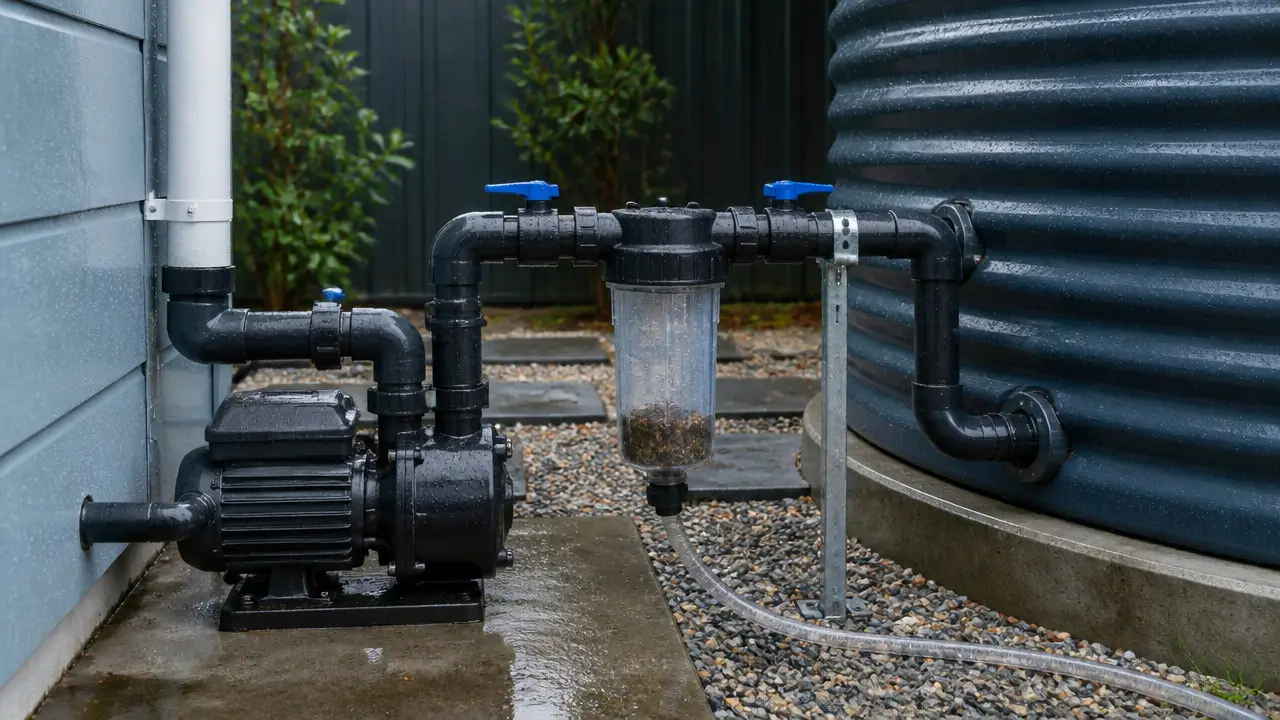
For example, if you are moving water from an IBC tote to a garden or campsite, you may only need:
- A screened tank outlet
- A sediment filter
- A hose or gravity line
- A finer filter if the equipment downstream requires it
The requirements change greatly if the water will be consumed.
A portable drinking-water filter connected to a rain barrel or cistern does not automatically make the water potable.
Potable means suitable for drinking.
Roof runoff can pick up material from roofing, gutters, bird and animal waste, dust, insects, air pollution, and storage tanks. Water quality can also change between rain events.
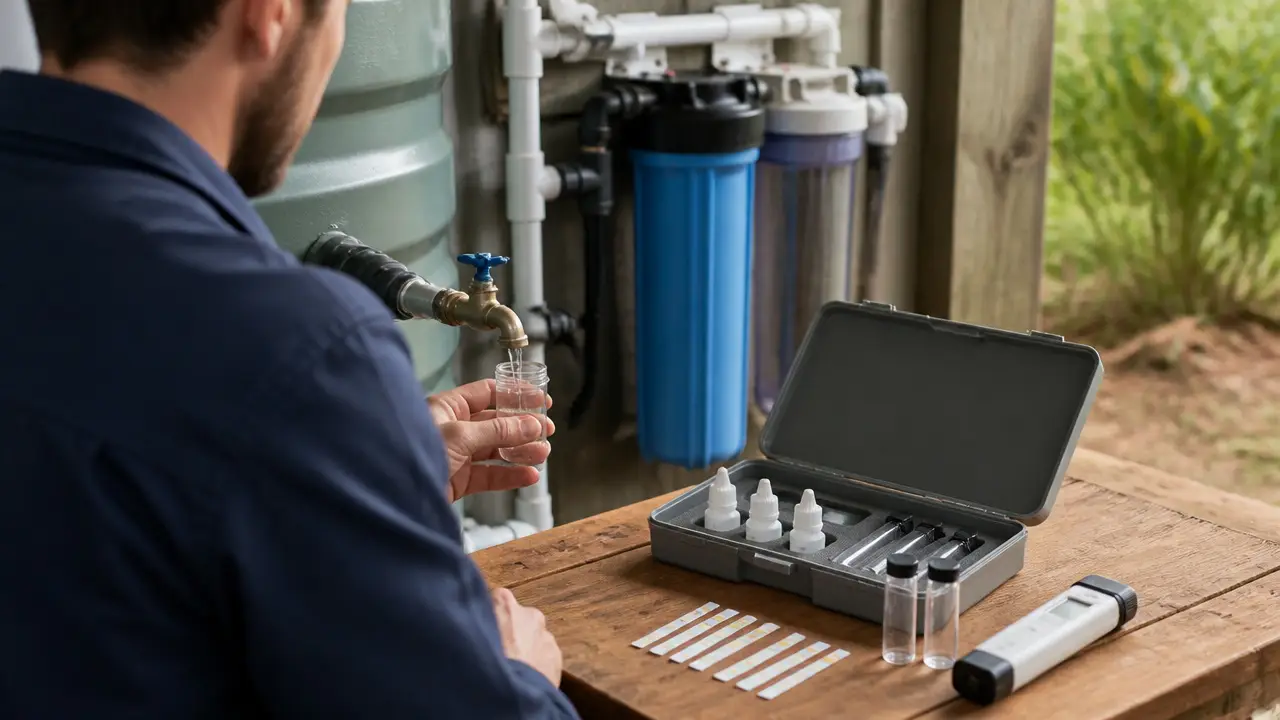
CDC guidance recommends testing rainwater used as a private water source at least annually for harmful germs and chemicals and considering additional testing when its color, taste, or smell changes. Testing needs should be based on the system and local health guidance.
For drinking-water use, think about the complete path:
Roof → gutters → debris control → first flush or diversion → storage → prefiltration → treatment → protected drinking-water outlet
A first flush device diverts some of the first runoff from a rain event so that part of the dirt and debris washed from the roof does not enter storage.
Study selecting filters from rainwater test results to compare testing methods and treatment stages matched to the final use.
Even with good collection practices, drinking-water use should involve suitable treatment, laboratory testing, regular maintenance, and applicable local requirements. A portable filter can be one treatment stage, but it should not be treated as proof that stored rainwater is safe to drink.
Features That Matter More Than Brand Name
Verified Contaminant Claims
Look for clear information stating exactly what the system has been tested or certified to reduce.
Avoid relying only on words such as:
- Pure
- Clean
- Advanced
- Medical grade
- Survival filter
- Removes 99%
- Purification technology
A percentage means little if it does not say what is being reduced and under what test conditions.
Absolute Pore Size
For mechanical filters, check whether the micron rating is absolute rather than nominal.
Smaller pores can block smaller organisms, but small pore size alone does not tell you whether the system removes viruses or dissolved chemicals.
Flow Rate
Flow rate is how much water the system can produce in a given amount of time.
A small bottle filter may be fine for one person but frustrating when several people need drinking and cooking water.
Flow also falls as filters become clogged.
For group use, gravity systems can be easier because they process a batch while you do something else.
Capacity
Capacity should describe how much water the treatment element can process before cleaning or replacement under stated conditions.
Actual service life can change with water quality.
Muddy or algae-filled water may clog a filter much faster than clear water.
Cleaning Method
Portable filters may require:
- Backflushing
- Scrubbing
- Cartridge replacement
- Chemical sanitizing
- Drying before storage
Choose a system you can realistically maintain.
A filter that is technically excellent but difficult to clean may perform poorly if maintenance is skipped.
Connection Compatibility
For rain barrels, IBC totes, and small cisterns, check how the portable filter will connect.
You may need to match:
- Hose size
- Bottle threads
- Tubing diameter
- Tank outlet
- Shutoff valve
- Pump connection
A tank may use a bulkhead fitting, which is a fitting installed through a hole in the tank wall to create a sealed connection.
Do not assume that two fittings with similar-looking diameters have matching threads.
Power Requirements
Manual squeeze, pump, and gravity filters usually require no electricity.
UV and some RO systems may require batteries, charging, or an electrical supply.
If the system will be used at a cabin or away from power, include that requirement in the decision before buying treatment equipment.
Watch Out for Freeze Damage
Many portable hollow-fiber filters can be damaged if water freezes inside them.
Ice expands. That expansion can damage tiny filter fibers in ways that may not be visible from the outside.
Once a filter has frozen, you may not be able to confirm that its microbial barrier is still intact.
Follow the manufacturer's storage instructions and protect the filter from freezing when temperatures drop.
For a seasonal rainwater system, bring sensitive treatment parts into a suitable location before freezing weather if the equipment instructions require it.
Keep the Clean Side Clean
A good filter can still produce contaminated water if the clean outlet is handled poorly.
Keep untreated-water equipment separate from treated-water equipment where possible.
Pay particular attention to:
- Bottle mouths
- Clean-water hoses
- Filter outlets
- Storage container caps
- Hands used to handle dirty hoses or intake equipment
Do not let the clean outlet fall into untreated water.
After long storage, clean and sanitize the system according to the manufacturer's directions before returning it to service.
Do Not Use a TDS Meter as a Safety Test
Some portable treatment systems are sold or used with a TDS meter.
Total dissolved solids, or TDS, is a measure related to dissolved minerals and salts in water.
A TDS reading does not tell you whether drinking water contains harmful bacteria, viruses, parasites, pesticides, or many other contaminants.
A low TDS number therefore does not prove that water is safe.
For rainwater intended for drinking, use appropriate laboratory testing based on the source and local health guidance rather than relying on a TDS meter, test strip, taste, smell, or appearance alone. The CDC notes that harmful germs and chemicals may be present without changing how water looks, tastes, or smells.
When to Use More Than One Treatment Stage
Portable treatment often works best as a sequence rather than as one filter trying to do everything.
For example:
Cloudy water → sediment removal → fine microbial filtration → suitable disinfection
Removing sediment first can help protect a finer filter and improve water clarity. Clear water is particularly important when UV treatment is used.
Activated carbon may then be used where there is a specific need for taste, odor, or verified chemical reduction.
Do not keep adding treatment stages simply because more sounds safer. Every cartridge, housing, hose, and fitting adds maintenance and another possible source of leaks or contamination.
Choose each stage for a reason.
When a Portable Filter Is Not the Right Solution
A portable filtration system is not a good answer for every water problem.
Find a safer source or get qualified advice when:
- Fuel or solvents may have entered the water
- Floodwater has contaminated a rainwater tank
- Agricultural or industrial chemicals are suspected
- A drinking-water system repeatedly fails laboratory tests
- A household rainwater system needs permanent potable plumbing
- Treatment requires complicated chemical dosing
- A pressure system needs electrical or plumbing changes beyond a simple connection
Permanent household rainwater treatment can involve pumps, pressure tanks, prefilters, UV equipment, backflow protection, electrical work, and plumbing separation. That is beyond the job of a simple portable filter.
Frequently Asked Questions
Can a portable water filter make rainwater safe to drink?
Not by itself. Roof runoff can contain germs, sediment, and chemicals. Drinking-water use should consider the complete collection and treatment system, suitable laboratory testing, maintenance, and local requirements. A portable filter may be one treatment stage.
Do portable water filters remove viruses?
Many do not. Standard portable microfilters are generally much better at removing parasites and bacteria than viruses. If viruses are a concern, use treatment specifically designed for virus protection or add an appropriate disinfection stage.
Is a 0.1-micron filter better than a 0.2-micron filter?
A smaller absolute pore size can physically block smaller particles, but micron size is only part of the decision. Neither number alone proves that a filter removes viruses, chemicals, or every type of contamination. Check verified performance claims.
Is activated carbon enough for untreated water?
No. Activated carbon is commonly used to improve taste and odor and can reduce certain chemicals, but it should not be assumed to provide complete protection from disease-causing microorganisms.
Is a gravity filter better than a pump filter?
Neither is always better. Gravity filters are convenient for treating larger batches with little effort. Pump filters can be better when drawing directly from a source or filling containers quickly. Treatment performance matters more than the way water is moved through the system.
Can a TDS meter tell me whether filtered water is safe to drink?
No. A TDS meter measures dissolved material in water. It does not provide a complete test for harmful germs or chemicals and cannot prove that rainwater or other untreated water is potable.
Can I connect a portable filter directly to a rain barrel or IBC tote?
Sometimes. Check the filter's allowed pressure, flow direction, hose or thread size, and water-quality requirements. A sediment prefilter may be useful to prevent rapid clogging. For drinking use, connecting a filter to the tank does not replace proper treatment and water testing.