As an affiliate, we may earn a commission from qualifying purchases. We get commissions for purchases made through links on this website from Amazon and other third parties.
What Is the Best Sealant to Use for a Water Leak?
The best sealant for a water leak depends on what is leaking, what the surface is made from, whether the area stays wet, and whether the water is used for drinking.
For many small household and rainwater-system leaks, the right choice is usually one of these:
- Potable-water-rated silicone sealant for small gaps around fittings and joints
- Polyurethane sealant for durable joints on masonry, metal, or some tanks
- Epoxy repair compounds for cracks, holes, and rigid surfaces
- Thread seal tape or thread sealant for leaking threaded pipe connections
- Butyl sealant or gasket material for some tank penetrations and flange connections
There is no single sealant that works well on every water leak. A product that seals concrete may bond poorly to polyethylene. A sealant that works around a gutter may not be suitable inside a drinking-water tank.
The first step is to find out where the water is escaping and why.
Match the Sealant to the Type of Leak
Small Gaps Around Fittings
A flexible silicone sealant is often useful around:
- Tank fittings
- Downspout connections
- Gutter joints
- Pipe penetrations
- Access covers
Silicone stays flexible as materials move slightly with temperature changes.
For any surface that contacts water intended for drinking, use only a sealant specifically approved or certified for that use. Ordinary bathroom or construction silicone should not automatically be assumed suitable for potable water.
Silicone is also not a good fix for every leaking tank fitting. If a bulkhead fitting is loose, crooked, cracked, or installed through an uneven surface, replacing or reinstalling the gasket may solve the real problem better than adding sealant.
A bulkhead fitting is a fitting that passes through the wall of a tank and creates a sealed pipe connection.
Cracks in Rigid Tanks or Concrete
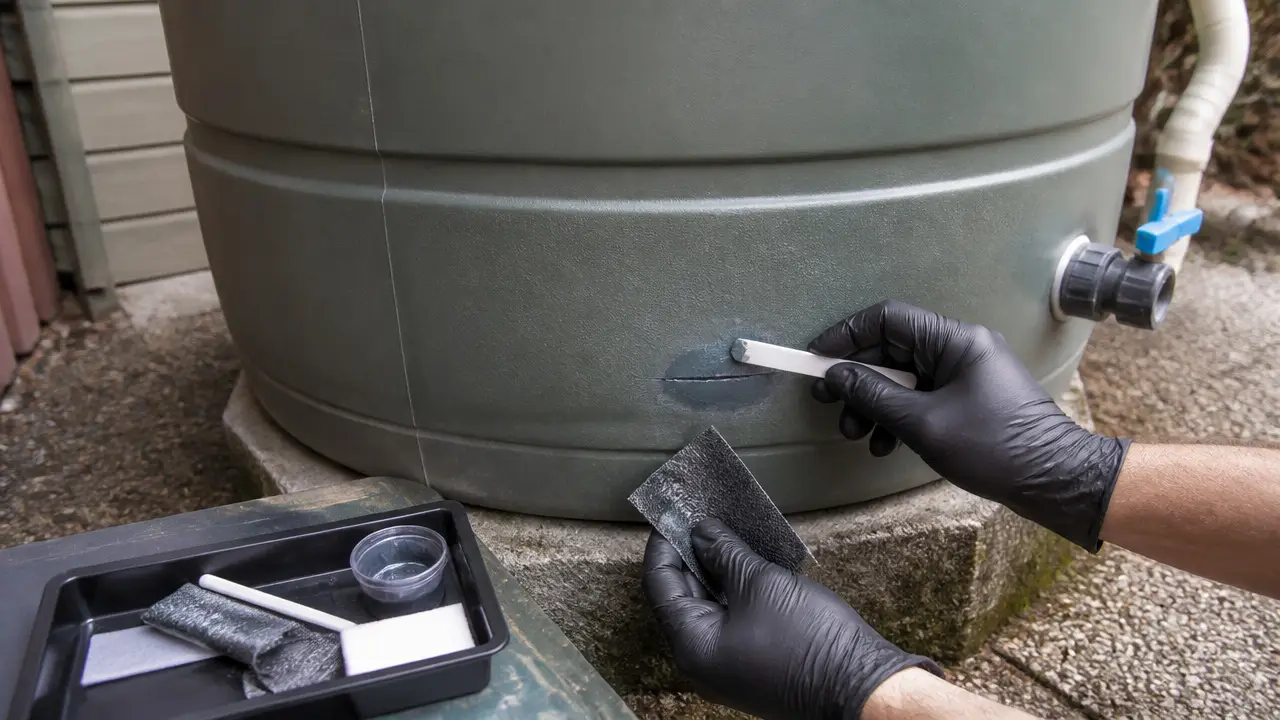
Epoxy repair compounds can work well on rigid materials such as:
- Concrete
- Fiberglass
- Some rigid plastics
- Metal
Epoxy usually cures harder than silicone and can fill larger cracks or damaged areas.
The downside is that epoxy does not flex much. If the tank wall keeps moving, expanding, or bending, a rigid epoxy patch may crack again.
Epoxy should only be used on plastics that the manufacturer says it can bond to.
Threaded Pipe Connections
A leaking threaded connection usually needs a thread-sealing product rather than surface caulk.
Common options include:
- PTFE thread seal tape
- Pipe thread sealant
- Thread-sealing compounds made for water service
Do not spread silicone over the outside of a leaking threaded fitting and expect it to provide a dependable repair. The better approach is usually to depressurize the line, remove the fitting, inspect the threads, and reseal the threaded connection correctly.
Flanges and Tank Penetrations
Leaks around tank outlets are often caused by the gasket rather than the tank itself.
A typical tank outlet may use:
- An inner flange
- An outer nut
- A rubber gasket
- A bulkhead fitting
If the gasket is damaged, folded, dirty, or compressed unevenly, adding more sealant may only hide the problem for a short time.
Inspect the fitting before deciding that sealant is necessary.
The Tank Material Matters
Sealants do not bond equally well to every surface.
Polyethylene Tanks
Many rainwater tanks, barrels, and IBC totes are made from polyethylene.
Polyethylene is difficult to glue because many adhesives and sealants do not bond strongly to its surface. A product may appear to stick at first and then peel away as the tank flexes.
For a polyethylene tank, a mechanical repair is often more dependable. That may include:
- Replacing a gasket
- Reinstalling a bulkhead fitting
- Using a compatible plastic repair method
- Plastic welding by someone experienced with the material
Check the tank manufacturer's repair recommendations before applying adhesive.
Fiberglass Tanks
Fiberglass is usually easier to repair with compatible resin or epoxy systems.
Surface preparation is especially important. Dirt, algae, old coatings, and moisture can prevent a repair from bonding properly.
Large cracks may indicate structural damage rather than a simple sealing problem.
Metal Tanks
Metal tanks may be repaired with compatible polyurethane sealants or epoxy compounds, depending on the location and size of the leak.
Rust must also be addressed. Sealing over corrosion without dealing with the damaged metal may only delay another leak.
Concrete Cisterns
Concrete leaks can come from:
- Cracks
- Pipe penetrations
- Construction joints
- Deteriorated coatings
Hydraulic cement, compatible polyurethane sealants, epoxy systems, and waterproof coatings may all have a place depending on the problem.
A moving structural crack needs more attention than a simple surface patch.
Flexible Sealant or Hard Repair Compound?
A useful way to choose is to ask whether the leaking area moves.
Use a flexible sealant when:
- The joint expands and contracts
- Two different materials meet
- The fitting may move slightly
- The leak is along a seam or penetration
Silicone and polyurethane products are common examples.
Use a rigid repair material when:
- The surface itself is cracked
- You need to rebuild missing material
- The damaged area should not normally move
- The repair needs to bridge a small hole
Epoxy repair compounds are often better for this type of work.
Do Not Seal Over a Pressurized Leak
Sealant works best when it can cure without water pushing through it.
Before repairing a pressurized pipe or tank outlet:
- Turn off the pump or water supply.
- Release pressure from the line.
- Lower the water level below the repair area when practical.
- Dry and clean the surface as required by the sealant manufacturer.
- Make the repair.
- Allow the full curing time before exposing it to water or pressure.
Trying to smear sealant over water that is actively spraying or seeping usually produces a weak repair.
Account for selecting among silicone sealant is the most water-resistant to evaluate practical alternatives for the next planning step.
Some products are designed for wet application, but their limitations still matter.
Surface Preparation Is Often More Important Than the Sealant
Even a good sealant can fail on a dirty surface.
Before applying it, remove materials such as:
- Dirt
- Algae
- Grease
- Loose paint
- Rust
- Old sealant
- Mineral deposits
Follow the product instructions for drying, sanding, priming, and cleaning.
Do not assume that a surface must always be completely dry. Some specialized products are designed for damp surfaces. Use the conditions specified by the manufacturer.
Be Careful With Drinking-Water Systems
If the repaired surface will contact water intended for drinking, the sealant must be suitable for that use.
Do not assume that a product is safe simply because it is:
- Waterproof
- Aquarium-safe
- Mold-resistant
- Food-safe
- Used outdoors
Those descriptions are not automatically the same as approval for potable-water contact.
Potable means water intended to be safe for drinking.
For drinking-water systems, also remember that fixing a leak does not establish that the stored water is safe to drink. Water safety depends on the full system, including collection surfaces, contamination control, treatment, maintenance, and appropriate water testing.
When Silicone Is a Good Choice
Water-compatible silicone is useful for many small sealing jobs because it:
- Remains flexible
- Handles moisture well after curing
- Works on many smooth surfaces
- Is easy to apply around small gaps
It is commonly useful around rainwater-system fittings, lids, gutters, and pipe penetrations when the materials are compatible.
Silicone is less suitable when:
- The gap is large
- The surface is oily or dirty
- The tank material is difficult to bond
- The repair must carry structural loads
- Water pressure is forcing the joint apart
When Polyurethane Is Better
Polyurethane sealants can provide stronger adhesion and durability on materials such as:
- Concrete
- Metal
- Masonry
- Some plastics
They are often useful where the joint needs both adhesion and flexibility.
However, cure times can be longer, and not every polyurethane formulation is suitable for continuous water immersion or potable-water contact.
Check the manufacturer's application limits.
When Epoxy Is Better
Epoxy is useful when you need something stronger than a flexible bead of sealant.
It can be a good choice for:
- Filling a rigid crack
- Repairing a small hole
- Rebuilding damaged material around a fitting
- Patching fiberglass or metal
Epoxy is less useful on flexible plastic tanks unless the specific product is designed for that material.
A Leak May Need a Mechanical Repair Instead
Sealant should not be used to compensate for damaged hardware.
Check for:
- Cracked fittings
- Loose nuts
- Damaged O-rings
- Flattened gaskets
- Cross-threaded connections
- Split pipes
- Warped tank walls
Replacing a damaged gasket or fitting is often more reliable than covering it with sealant.
For example, if an IBC tote outlet leaks between the valve and tank, the correct repair may be a replacement gasket rather than epoxy around the outside.
Avoid Using Sealant as a Structural Repair
A sealant is not a substitute for fixing serious tank damage.
Stop using the tank and assess the damage if you see:
- A long crack that keeps growing
- Bulging tank walls
- A cracked tank base
- Separation around a major outlet
- Severe corrosion
- Concrete movement
- Repeated failure of the same repair
Water is heavy. A large storage tank can place substantial force on its walls, base, and fittings.
A small leak can sometimes be repaired. A failing tank structure is a different problem.
Best Choice by Leak Type
| Leak location | Common repair approach |
|---|---|
| Threaded pipe joint | PTFE tape or suitable pipe thread sealant |
| Small gap around fitting | Compatible flexible silicone or polyurethane |
| Damaged gasket | Replace the gasket |
| Small rigid crack | Compatible epoxy repair compound |
| Concrete joint | Compatible polyurethane, epoxy, or masonry repair system |
| Polyethylene tank crack | Manufacturer-approved plastic repair or plastic welding |
| Fiberglass tank crack | Compatible fiberglass resin or epoxy system |
| Rusted metal | Repair corrosion first, then use a compatible sealing system |
The exact product still needs to match the surface, water exposure, temperature range, pressure, and intended water use.
How to Choose the Right Sealant
Before buying or applying anything, check five things:
- Surface material: Plastic, concrete, fiberglass, metal, or another material.
- Leak type: Crack, gap, threaded joint, gasket, or damaged fitting.
- Water exposure: Occasional splashing or continuous immersion.
- Pressure: Gravity-fed water behaves differently from a pressurized pump line.
- Water use: Garden water and drinking-water systems may have different material requirements.
A sealant that matches all five conditions is much more likely to provide a useful repair.
Frequently Asked Questions
Can I use silicone to stop a water leak?
Yes, silicone can seal some small gaps and joints. It works best where the surface is compatible and the joint needs flexibility. It is not usually the best repair for damaged threads, broken fittings, or structural cracks.
What sealant works underwater?
Some epoxy, polyurethane, and specialty repair products are designed for wet surfaces or immersion. Check the manufacturer's instructions carefully. A product described as waterproof is not automatically designed to cure underwater.
Can I use silicone inside a water tank?
Only use silicone that is specifically suitable for the tank material, continuous water contact, and the intended water use. For drinking-water tanks, confirm that the product is approved or certified for potable-water contact.
What is the best sealant for a plastic water tank?
There is no universal plastic-tank sealant. Polyethylene tanks are especially difficult to bond. Replacing a gasket, installing a proper mechanical fitting, or using a manufacturer-approved plastic repair method is often more dependable.
Should I use epoxy or silicone for a tank leak?
Use silicone when the joint needs to remain flexible. Epoxy is generally better for filling rigid cracks or rebuilding damaged material. The tank material must be compatible with whichever product you choose.
Can I seal a leaking pipe without turning off the water?
A dependable repair normally requires stopping the water and relieving pressure. Water pushing through the repair area can prevent proper bonding and curing.
Why does my water tank fitting still leak after adding sealant?
The gasket may be damaged, the fitting may be crooked, the tank wall may be uneven, or the connection may be overtightened. Remove and inspect the fitting rather than continuing to add layers of sealant.