As an affiliate, we may earn a commission from qualifying purchases. We get commissions for purchases made through links on this website from Amazon and other third parties.
Yes, Drip Irrigation Can Work With Gravity Feed
Drip irrigation can work with a gravity-fed water supply, but the system must be designed for low pressure.
A rain barrel, IBC tote, or small tank can feed drip lines without a pump when the water level is high enough above the garden. The main limits are pressure, flow, hose length, elevation changes, and the type of emitters you use.
Standard drip parts are often made for pressurized household water. Some may not work well from a low tank.
For a simple gravity-fed setup, keep the system short, use parts made for low pressure, and place the tank as high as practical and safe.
How Gravity Creates Water Pressure
A gravity-fed system uses the weight of water above the outlet to create pressure.
The vertical distance between the water surface in the tank and the drip emitters is called head height.
More head height means more pressure.
As a rough rule, about 2.3 feet of vertical water height creates 1 psi of pressure.
For example:
| Water height above emitters | Approximate pressure |
|---|---|
| 2.3 feet | 1 psi |
| 4.6 feet | 2 psi |
| 9.2 feet | 4 psi |
| 11.5 feet | 5 psi |
These numbers assume the system is not losing much pressure through pipes, fittings, filters, or elevation changes.
A rain barrel sitting directly on the ground may provide very little pressure to nearby drip lines. Raising it a few feet can improve flow, but only if the support is strong enough for the full weight of the barrel.
Water is heavy. Do not place a large tank on a weak platform just to gain pressure.
Low Pressure Is the Main Challenge
Most gravity-fed drip problems come from low pressure.
A normal outdoor faucet may provide far more pressure than a rain barrel or tote. Because of this, parts designed for a pressurized faucet may behave differently when connected to gravity feed.
Possible problems include:
- Emitters near the tank release more water than emitters farther away.
- Some emitters barely drip at all.
- Long tubing causes large pressure losses.
- Small filters reduce flow when they become dirty.
- Valves, timers, or backflow devices may need more pressure than gravity can provide.
- Water stops reaching higher parts of the garden.
The easiest way to avoid these problems is to build the system around low-pressure operation from the start.
Choose Emitters That Can Work at Low Pressure
Emitter choice matters more in a gravity-fed system than in many pressurized systems.
Simple Drip Emitters
Basic non-pressure-compensating emitters are often better suited to very low pressure.
Their flow will change as the tank empties, but they may still work where more complex emitters do not.
Check the manufacturer's minimum operating pressure before buying them.
Pressure-Compensating Emitters
Pressure-compensating emitters are designed to give a more even flow across a range of pressures.
However, they usually need a certain minimum pressure before they begin working correctly.
A low rain barrel may not reach that pressure.
Do not assume that a pressure-compensating emitter will improve a gravity-fed setup. Its pressure requirement may actually make it a poor match.
Drip Tape
Some drip tape can work at relatively low pressure, which can make it useful for vegetable rows.
The exact pressure requirement depends on the tape.
Very long runs can still produce uneven watering when the tank pressure is low.
Soaker Hose
A soaker hose may work from an elevated tank, but results vary.
Many soaker hoses are designed for normal hose pressure. Under gravity feed, water may seep strongly near the tank and very slowly farther away.
If you want predictable watering, purpose-made low-pressure drip tubing is usually easier to control.
Tank Height Makes a Big Difference
If your drip system is not flowing well, tank height is one of the first things to check.
A barrel raised 6 inches above the garden creates much less pressure than one raised several feet.
But increasing height has practical limits.
A full 55-gallon barrel can weigh well over 400 pounds when the weight of the water and container are included. Larger totes and cisterns can weigh several thousand pounds.
Any raised platform must safely support the full load and resist tipping.
For large storage tanks, it is usually better to keep them on a properly prepared base and use a pump if more pressure is needed rather than building a tall platform.
Keep the Main Water Line Large
Small tubing creates more resistance to flow.
For gravity feed, it often helps to move water from the tank through a larger main line before branching into smaller drip tubing.
For example, a system might use:
tank → shutoff valve → filter → larger supply line → drip laterals
The exact tubing size depends on system length and water demand.
Avoid reducing the pipe diameter immediately at the tank outlet if you need to supply several rows.
Also look for unnecessary restrictions such as:
- Very small hose adapters
- Partly closed valves
- Narrow connectors
- Dirty filters
- Sharp bends
- Long runs of small tubing
Every restriction matters more when you only have a few pounds of pressure available.
Keep Drip Zones Small
A gravity-fed system usually works better when it waters a small section at a time.
Instead of connecting an entire garden to one tank outlet, divide the garden into zones.
You might have separate lines for:
- Raised beds
- Tomato rows
- Berry plants
- Container gardens
- Greenhouse beds
Open only one or two zones at a time if the tank cannot provide enough flow for everything.
This reduces demand and helps keep watering more even.
Watch for Changes in Elevation
Gravity systems are very sensitive to elevation.
Water naturally moves downhill.
If one drip row is lower than another, the lower row may receive more pressure and more water.
A row that climbs uphill may receive little or no water.
Try to keep emitters within each zone at a similar elevation.
If your garden sits well below the tank, the extra height can help. If the garden is above the tank outlet or close to the tank's water level, gravity may not provide enough pressure.
Review whether a pump for irrigation is necessary to assess delivery-pressure changes that indicate lost prime.
Remember that the important measurement is not just the outlet height.
It is the difference between the water surface inside the tank and the emitters.
As the tank empties, that difference becomes smaller. Pressure drops with it.
Use a Filter Before the Drip Lines
Drip emitters have small openings that can clog easily.
Rainwater can contain:
- Roof grit
- Dust
- Plant material
- Insects
- Sediment
- Algae
- Small pieces of organic debris
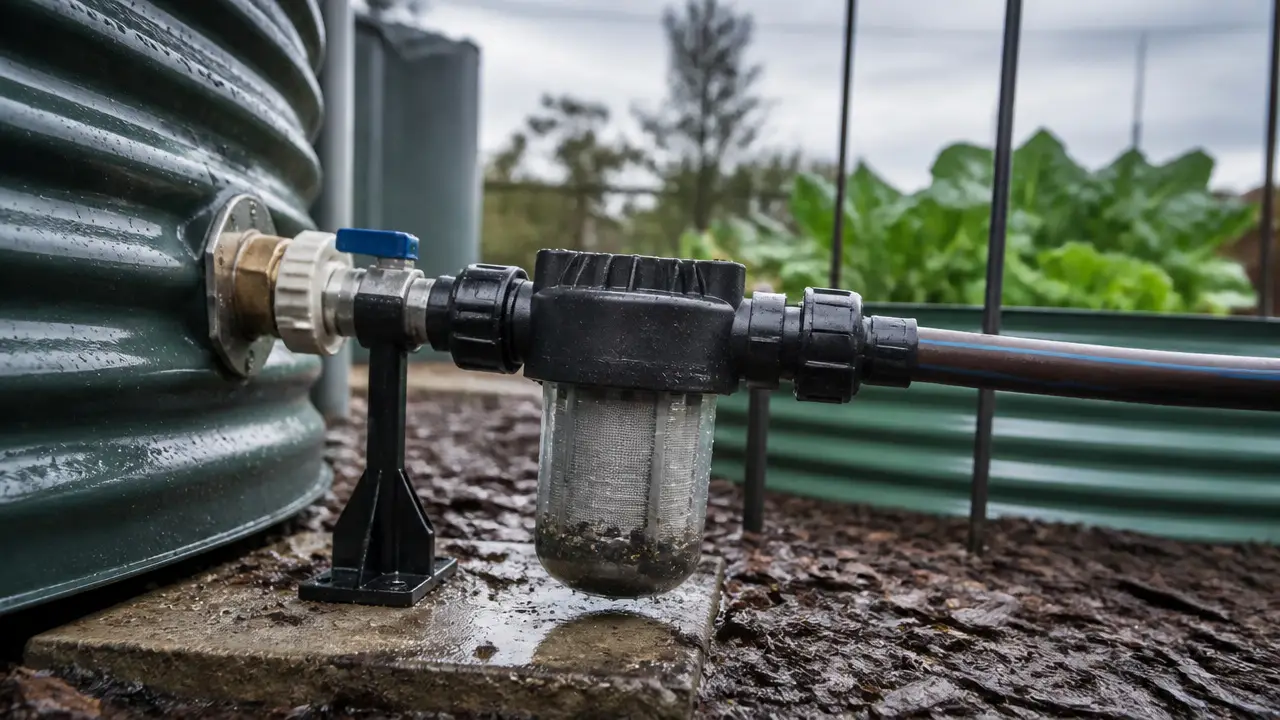
A filter installed before the drip tubing helps protect the emitters.
The required micron rating depends on the drip equipment. Micron rating describes the size of particles a filter is designed to capture. A smaller micron number means finer filtration.
Use the filter size recommended by the drip equipment manufacturer.
Do not choose an extremely fine filter just because it sounds better. A fine filter can restrict a low-pressure gravity system, especially when it becomes dirty.
Keeping leaves and debris out of the storage tank in the first place also makes the drip system easier to maintain.
Do You Need a Pressure Regulator?
Usually, a gravity-fed rain barrel does not need a normal drip pressure regulator.
A pressure regulator reduces high incoming pressure to a lower level.
Gravity-fed systems often have the opposite problem: they do not have enough pressure.
Installing a regulator that requires minimum inlet pressure may reduce flow or stop the system from working.
If your tank sits far above the garden and creates more pressure than the drip equipment allows, regulation may be useful. Follow the pressure limits for the tubing and emitters you are using.
Will a Hose Timer Work?
Maybe.
Many hose timers are designed for pressurized water. Some need a minimum pressure difference to open or close properly.
That can be a problem with a rain barrel.
Before adding an automatic timer, check whether it is specifically rated for gravity-fed or zero-pressure use.
A timer that works perfectly on a faucet may allow only a trickle from a low tank.
The same issue can apply to some automatic valves.
A Simple Gravity-Fed Drip Layout
A basic garden system might look like this:
- Rain barrel or storage tank
- Full-flow shutoff valve
- Washable filter
- Large main supply tube
- Branch valves for individual beds
- Low-pressure drip tubing or emitters
- Flushable ends on each drip line
Place the storage tank above the garden when possible.
Keep the main line reasonably short and avoid unnecessary fittings.
At the beginning, test only one watering zone. Make sure the last emitters in the line are flowing before expanding the system.
Flush the Lines Regularly
Sediment can settle inside drip tubing even when you use a filter.
Add a removable cap or flush valve at the end of each line.
Periodically open the end and allow water to flush through until it runs clear.
Also clean the filter as needed.
Gravity systems have little extra pressure available to push debris through narrow emitters, so keeping the system clean is especially important.
What Happens as the Rain Barrel Empties?
Flow normally decreases.
A full barrel has a higher water surface, which creates more head height.
As the water level falls, pressure falls too.
This means a gravity-fed system may water more strongly at the beginning than near the end of the tank.
You can reduce this problem by:
- Using short drip runs
- Keeping emitters at similar elevations
- Watering small zones
- Using larger supply tubing
- Choosing low-pressure emitters
- Refilling the tank before it becomes nearly empty
If you need very even water delivery from a nearly full tank all the way to almost empty, a small pump may be a better solution.
When a Pump Makes More Sense
Gravity feed is useful for small, simple gardens. It becomes less practical as the system grows.
Consider a pump when you need to:
- Water a large garden
- Run many emitters at once
- Send water a long distance
- Push water uphill
- Use equipment with a minimum pressure requirement
- Operate certain irrigation timers or valves
- Use sprinklers instead of drip emitters
- Maintain more consistent flow as the tank level changes
When choosing a pump, both flow rate and pressure matter.
Flow rate is how much water the pump can move over time. Pressure determines how strongly it can move that water through the irrigation system.
Also account for head height, which includes how high the pump must lift the water.
A pump should be matched to the irrigation system rather than chosen only by its maximum advertised flow.
A Gravity System Works Best When It Is Simple
For a few garden beds, gravity-fed drip irrigation can work very well.
The most reliable setup usually has:
- An elevated water source
- Short irrigation runs
- A large main supply line
- Few restrictive fittings
- Low-pressure drip components
- Small watering zones
- Good filtration
- Similar elevation across each zone
Start with a small section and observe how evenly it waters.
Check the emitters closest to the tank and those farthest away. If there is a large difference, shorten the line, reduce the number of emitters operating at once, increase safe head height, or consider adding a pump.
Frequently Asked Questions
How high should a rain barrel be for drip irrigation?
There is no single required height. More height creates more pressure, with roughly 2.3 feet of water height producing about 1 psi. The correct height depends on the minimum pressure required by your emitters, tubing length, elevation changes, and other restrictions in the system.
Can I run drip irrigation directly from a rain barrel?
Yes. A rain barrel can feed drip irrigation directly if the system uses low-pressure-compatible parts and the barrel has enough height above the emitters. A filter should normally be installed before the drip lines to reduce clogging.
Do I need a pump for rain barrel drip irrigation?
Not always. Small gardens can often use gravity alone. A pump becomes more useful when the garden is large, uphill, far from the tank, or uses equipment that requires more pressure.
Can I use regular drip emitters with gravity feed?
Some will work and some will not. Check the manufacturer's minimum operating pressure. Emitters designed for pressurized systems may perform poorly when connected to a low rain barrel.
Will drip irrigation work if the rain barrel is on the ground?
It may work poorly if the emitters are nearly level with the water inside the barrel. Gravity pressure depends on the vertical difference between the water surface and the emitters. Raising the tank safely or placing the garden downhill can improve flow.
Should I use a pressure regulator with a gravity-fed system?
Usually not. Gravity systems often already have very low pressure. A regulator can create another restriction. Use one only if the available pressure is higher than the drip equipment allows and the regulator is suitable for the system.
Why does the end of my drip line get less water?
The system may be losing pressure through long tubing, small fittings, elevation changes, too many emitters, or a clogged filter. Shortening the line or dividing the garden into smaller zones often helps.