As an affiliate, we may earn a commission from qualifying purchases. We get commissions for purchases made through links on this website from Amazon and other third parties.
Rainwater storage works best when the tank is sized for the water you actually plan to use, placed on a solid base, protected from sunlight and pests, and connected to a collection system that keeps leaves and roof debris out.
A simple garden barrel may need little more than a screened inlet, hose outlet, and safe overflow. A large cistern supplying irrigation or household fixtures needs more planning around tank size, plumbing, pumps, treatment, freezing, and maintenance.
The most important point is that storing rainwater does not make it clean or safe to drink. Roof runoff can carry dirt, bird droppings, microbes, metals, and other contaminants. Drinking-water use requires a complete collection and treatment plan, ongoing maintenance, current water testing, and compliance with local requirements. The CDC recommends keeping rainwater separate from safe piped drinking water unless the system is properly designed to prevent contamination.
Start With How You Will Use the Water
Tank choice becomes much easier once you know what the stored water needs to do.
Common uses include:
- Watering gardens and landscaping
- Supplying drip irrigation
- Washing tools or outdoor equipment
- Supplying livestock water where appropriate
- Flushing toilets in a properly designed system
- Supplying a cabin or household system after suitable treatment
Water used for drinking, cooking, or brushing teeth needs much more protection and treatment than water used on ornamental plants.
Potable means suitable for drinking.
Non-potable means water that is not intended for drinking. Most simple residential rainwater systems are designed around non-potable uses.
Even non-potable systems may be subject to plumbing, backflow, labeling, or other local requirements, especially when rainwater enters a building. EPA guidance notes that rainwater harvesting requirements can differ by location, so check with the local building, plumbing, health, or water authority before connecting a storage system to household plumbing.
How Much Rainwater Can You Collect?
Tank size should reflect both how much rain falls and how much water you use.
A useful starting point is:
Gallons collected = roof area in square feet × rainfall in inches × 0.623
The 0.623 figure converts one inch of rain falling on one square foot into gallons.
For example, a 1,000-square-foot roof receiving 1 inch of rain has a theoretical yield of:
1,000 × 1 × 0.623 = 623 gallons
You should not assume all 623 gallons will reach your tank.
Some water is lost through:
- Roof wetting
- Gutter losses
- Splashing
- First-flush diversion
- Screens and filters
- Leaks
- Tank overflow
EPA rainwater calculations likewise account for collection losses rather than treating theoretical roof yield as fully recoverable water.
Use the roof area that actually drains to the tank
Do not automatically use the entire roof area.
If only one section of roof drains through the connected downspout, use that portion of the roof in your calculation.
Rainfall timing matters too
Annual rainfall alone can be misleading.
Two places might receive the same total rain during a year but have very different storage needs. One may receive regular rain every month, while another has a long dry season.
A larger tank becomes more useful when you need to carry water through longer gaps between storms.
How to Choose a Rainwater Storage Tank Size
There is no single ideal tank size.
Think about four main factors:
- How much roof area feeds the system
- How much and how often it rains
- How much water you use between storms
- How much room you have for safe storage
A small rain barrel can work well for occasional hand watering.
Several linked barrels can provide more garden capacity, although they create additional connections that need to stay watertight and free-flowing.
An IBC tote can provide more storage in a relatively compact footprint, but the tote's previous contents and material suitability matter.
Large above-ground or underground cisterns are better suited to systems with higher demand. They also require more planning for foundations, overflow, pumps, access, cleaning, and plumbing.
More capacity is not always more useful
A very large tank does not help much if your roof cannot refill it.
The opposite problem also occurs. A small tank connected to a large roof may fill quickly and send most of the remaining rainfall through the overflow.
Good sizing balances collection with actual demand.
Common Rainwater Storage Options
Rain barrels
Rain barrels are one of the simplest choices for garden use.
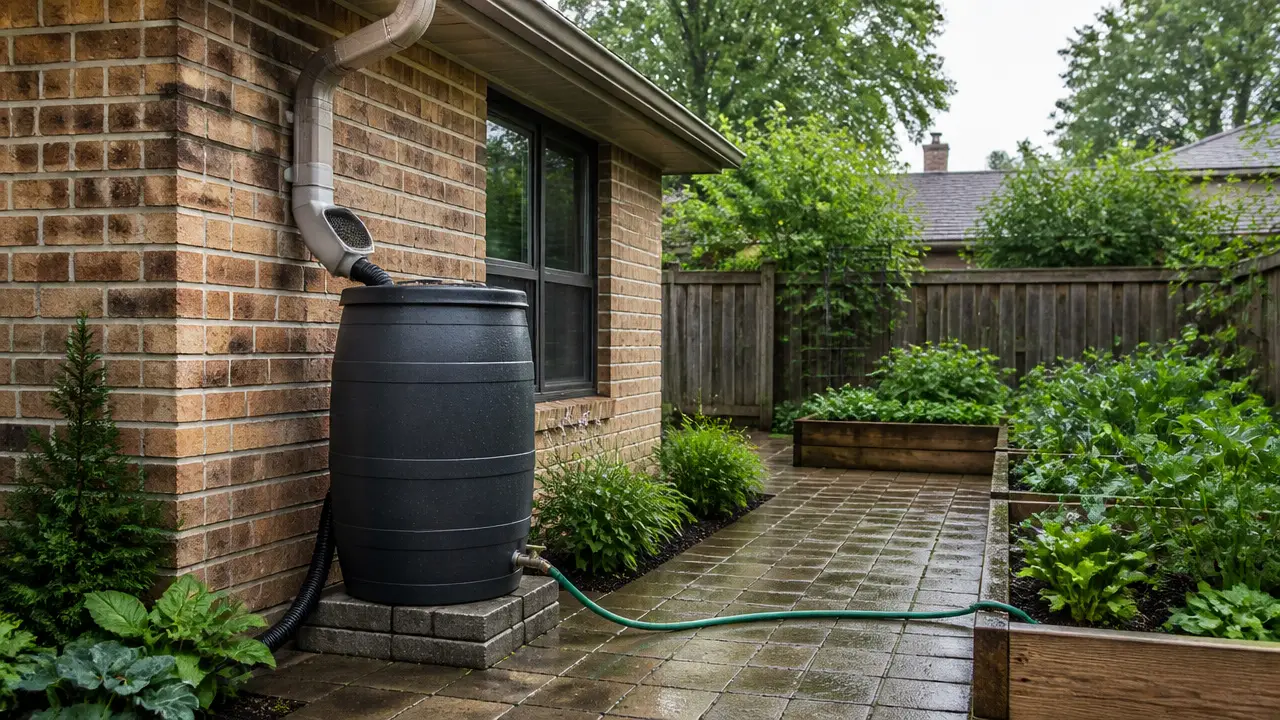
They normally sit beside a building and collect water from a downspout.
A practical barrel needs:
- A screened inlet
- A secure lid
- An outlet
- An overflow
- A stable base
- A way to drain or clean it
The overflow matters more than many first-time users expect. Once the barrel fills, every additional gallon has to go somewhere.
Route overflow somewhere that will not damage the foundation, wash away soil, flood a walkway, or immediately flow back toward the building.
IBC totes
Intermediate bulk containers, commonly called IBC totes, can store much more water than a typical barrel.
However, do not assume that any used tote is suitable for rainwater storage.
Avoid containers that previously held pesticides, petroleum products, toxic chemicals, or other unknown materials. CDC guidance specifically warns against storing water in containers that previously held toxic substances.
For water that may eventually be treated for drinking, use a container specifically suitable for that intended use rather than relying on an unknown secondhand tote.
IBC totes are also vulnerable to sunlight. Light entering a translucent tank can encourage biological growth. An appropriate opaque enclosure or other suitable light-blocking approach can help, but it must not interfere with inspection, drainage, or tank safety.
Above-ground cisterns
Above-ground cisterns can hold hundreds or thousands of gallons.
They are relatively easy to inspect compared with buried tanks, but their weight and dimensions become major considerations.
A large tank may require:
- A properly prepared base
- Larger inlet and overflow plumbing
- A pump
- Tank-level monitoring
- Freeze protection
- Safe cleaning access
Underground cisterns
Buried tanks save surface space and are protected from direct sunlight.
They are not simply above-ground tanks placed in a hole.
A buried tank must be designed for underground installation and the loads it will experience. Soil pressure, groundwater, buoyancy, vehicle loads, excavation safety, plumbing access, and maintenance all matter.
Large excavation and buried-tank work may require contractors, permits, or engineered installation. Never enter a tank or cistern unless you are qualified and equipped for confined-space work.
Tank Weight and the Importance of a Strong Base
Water is heavy.
In U.S. units, one gallon of water weighs about 8.34 pounds.
That means approximately:
| Stored water | Water weight alone |
|---|---|
| 50 gallons | 417 lb |
| 100 gallons | 834 lb |
| 275 gallons | 2,294 lb |
| 500 gallons | 4,170 lb |
| 1,000 gallons | 8,340 lb |
The tank itself adds more weight.
A full rainwater tank therefore needs a level, stable base capable of carrying the load without settling or shifting.
Do not place a large tank on a deck, elevated platform, roof, balcony, or questionable slab without confirming that the structure can safely support the load.
Keep Sunlight Out of the Tank
Sunlight can encourage algae and other biological growth.
For most permanent rainwater storage, an opaque tank is preferable to a clear or translucent one.
Also keep access openings closed.
A tank lid is not just for blocking light. It also helps keep out:
- Leaves
- Animals
- Insects
- Dirt
- Windblown debris
Tank openings should be designed so they remain serviceable without leaving the stored water exposed.
Screen Inlets and Overflows
Mosquito control should be part of the original design rather than something added after mosquitoes appear.
The CDC recommends screening openings where mosquitoes might enter a rainwater collection system.
Check both the inlet and overflow.
A screened inlet will not help if mosquitoes can enter through an unscreened overflow pipe.
Screens need occasional cleaning because fine debris can restrict flow. A blocked inlet or overflow can cause water to back up during heavy rain.
Keep Roof Debris Out Before It Reaches the Tank
Storage tanks are easier to maintain when debris is removed upstream.
Depending on the system, this may include:
- Gutter guards
- Leaf screens
- Downspout screens
- Debris filters
- First-flush devices
A first-flush diverter sends the first portion of runoff from a storm away from the storage tank.
That early runoff can carry material that accumulated on the roof between storms. CDC guidance recommends considering first-flush diversion as one way to improve the quality of collected rainwater.
A first flush is not a drinking-water treatment system. It simply reduces some of the material entering storage.
Plan the Overflow Before Filling the Tank
Every closed rainwater tank eventually needs an overflow unless water use always exceeds collection.
The overflow should be able to handle incoming water when the tank is full.
It should discharge safely away from:
- Building foundations
- Septic components
- Erodible soil
- Neighboring property
- Electrical equipment
- Areas where standing water creates a problem
Large roof areas can produce surprisingly high runoff during intense rain. An undersized or blocked overflow can cause water to escape from tank openings or back up through the collection plumbing.
Choose Tank Connections Carefully
Most tanks need several connections.
These may include:
- Inlet
- Outlet
- Overflow
- Drain
- Pump suction connection
- Level sensor connection
Details about sanitary quality of collected rainwater help verify compatibility among components before final selection.
A bulkhead fitting is a fitting that passes through the wall of a tank and seals around the opening. It creates a connection point for a pipe, valve, or hose.
Tank fittings need to match the tank material, wall shape, fitting size, and intended pressure.
Do not drill a tank simply because there appears to be room for another fitting. Some tanks have specific reinforced areas intended for connections.
Decide Whether Gravity Is Enough
A raised storage tank creates some water pressure through gravity.
But modest elevation creates modest pressure.
That may be enough to fill a watering can or supply certain low-pressure garden setups. It may not be enough for sprinklers, long hoses, household fixtures, or irrigation equipment designed for higher pressure.
A pump may be needed when the system requires more pressure or flow.
Pump selection depends on factors such as:
- Required flow
- Required pressure
- Vertical lift
- Pipe length
- Pipe diameter
- Power availability
- Pump location
- Dry-run protection
A large storage tank does not automatically mean the system will have strong water pressure.
Protect Pumps From Sediment
Sediment that enters a storage tank can eventually reach pumps, valves, emitters, and appliances.
Good debris control before the tank reduces that problem.
For systems using pumps, the outlet arrangement may also help avoid drawing directly from the heaviest sediment at the bottom of the tank.
Do not simply add a very fine filter without checking the system's flow requirements. Fine filtration can create significant pressure loss as the filter loads with debris.
Think About Water Quality Before Choosing the Tank
The intended use affects what tank and system design makes sense.
Garden irrigation
A garden system usually focuses on debris control, mosquito protection, usable flow, and keeping emitters from clogging.
Water quality may still matter for edible crops, spray irrigation, and situations where runoff could contain unwanted contaminants.
Household non-potable use
Toilet flushing and other indoor uses usually require more controls than outdoor watering.
Local rules may require separate plumbing, identification of non-potable lines, backflow protection, filtration, disinfection, or other safeguards.
Rainwater must not be allowed to flow backward into a drinking-water supply. CDC specifically advises keeping rainwater separate from piped safe drinking water.
Drinking water
Roof-collected rainwater should not be assumed safe to drink.
Storage is only one part of a potable rainwater system.
Drinking-water use can require suitable collection surfaces, debris removal, protected storage, treatment matched to the contaminants of concern, regular maintenance, and current laboratory testing. CDC advises people who collect rainwater for drinking or household use to maintain the system and test for harmful germs and chemicals.
A single sediment filter, carbon filter, UV unit, purifier, test strip, or handheld meter cannot by itself establish that stored rainwater is safe to drink.
If rainwater will supply drinking water, work with the appropriate local health authority and qualified water-treatment professionals.
Do Not Ignore Tank Maintenance
Rainwater storage systems are not maintenance-free.
At least periodically, inspect:
- Roof collection surfaces
- Gutters
- Leaf screens
- First-flush components
- Tank inlet
- Tank lid
- Mosquito screens
- Overflow
- Tank fittings
- Valves
- Pump
- Filters
- Visible sediment
The exact maintenance schedule depends on your climate, roof, nearby trees, system design, and how frequently the tank fills and empties.
A wooded property may need frequent screen and gutter cleaning. A large protected cistern receiving relatively clean runoff may need attention on a different schedule.
CDC recommends keeping rainwater collection systems clean and repairing damaged components as part of routine maintenance.
Plan for Sediment Removal
Even a well-screened system can accumulate some sediment.
Designing for maintenance from the start makes that easier.
A useful storage setup should allow you to:
- Shut off incoming water if needed
- Drain the tank
- Reach serviceable fittings
- Inspect important components
- Remove accumulated debris safely
Large cistern cleaning can involve hazards that do not exist with a small barrel. Do not enter tanks or other confined spaces to clean them.
Floodwater is another concern. If a cistern is contaminated by flooding, do not assume the stored water remains usable for drinking. CDC advises treating a drinking-water cistern exposed to floodwater as contaminated until it has been appropriately cleaned and disinfected.
Prepare Rainwater Storage for Freezing Weather
Water expands as it freezes.
That can damage:
- Tanks
- Valves
- Filters
- Pumps
- Pipes
- Hose connections
- First-flush devices
Freeze protection depends on the system and local winter conditions.
Some seasonal rain barrels are disconnected, drained, and stored or left empty for winter. Larger systems may use buried piping, protected equipment spaces, insulation, or other climate-appropriate designs.
Do not assume that insulating a pipe or tank guarantees freeze protection.
Pay special attention to small pipes, exposed valves, filters, pump housings, and other places where water can become trapped.
A Simple Storage Layout for Garden Use
A basic garden system might follow this path:
Roof → gutter → leaf screen → first-flush or debris control → storage tank → outlet → garden line
The tank should also have its own screened overflow.
That simple layout keeps most debris-control work ahead of the storage tank, where it is easier to reach.
For larger systems, additional components may include pumps, filters, controls, level sensors, treatment equipment, and dedicated plumbing.
Common Rainwater Storage Mistakes
Buying a tank before calculating collection
A tank can be too small for the available roof runoff or much larger than the roof can reasonably refill.
Calculate first.
Ignoring overflow
Overflow is part of the system, not an optional accessory.
Plan where excess water goes before the first storm.
Using an unknown secondhand container
A bargain container is not worthwhile if you cannot establish what it previously held.
Never use a container that held toxic chemicals for water storage.
Letting light enter the tank
Translucent storage can encourage unwanted biological growth.
Leaving openings unscreened
A covered inlet does little good if insects can enter through an overflow, vent, or damaged screen.
Expecting gravity to provide household pressure
Tank capacity and water pressure are different issues.
A large tank sitting close to ground level can still provide very little gravity pressure.
Treating stored rainwater as automatically drinkable
A clean-looking tank does not establish water safety.
Drinking water requires a suitable whole system and appropriate testing.
A Practical Rainwater Storage Checklist
Before installing a storage tank, confirm:
- The intended use of the water
- Roof area connected to the tank
- Typical rainfall pattern
- Expected water demand
- Available space
- Full tank dimensions
- Full tank weight
- Base or foundation requirements
- Inlet size and location
- Outlet size and location
- Overflow route
- Mosquito screening
- Sunlight protection
- Maintenance access
- Sediment management
- Pump requirements
- Freeze exposure
- Plumbing separation
- Local rules for the intended use
Getting these decisions right before buying or placing the tank prevents many compatibility problems later.
Frequently Asked Questions
What size rainwater tank should I get?
Size the tank from your connected roof area, local rainfall pattern, intended water use, and demand between storms. About 0.623 gallon of water falls on each square foot of roof during one inch of rain, but actual stored volume will be lower because of collection losses, first flush, and overflow.
Can I use an IBC tote for rainwater storage?
An IBC tote can work for some non-potable rainwater systems if the container is suitable for the intended use and its history is known. Do not use a tote that previously contained toxic chemicals, pesticides, petroleum products, or unknown materials. Protect translucent tanks from sunlight where appropriate.
Does a rainwater tank need an overflow?
Yes. Once the tank fills, incoming rain needs a safe path out of the system. Route overflow away from foundations and other areas where concentrated runoff could cause flooding, erosion, or damage.
Should a rainwater tank be opaque?
An opaque tank is generally helpful because blocking sunlight reduces conditions that encourage algae and other biological growth. Keep lids, inspection ports, and other openings closed when they are not being serviced.
Can stored rainwater be used for drinking?
Do not assume stored roof runoff is safe to drink. Drinking-water use requires an appropriately designed collection, storage, treatment, maintenance, and testing program that addresses both microbes and chemicals. Follow current local health and plumbing requirements.
Do I need a pump for a rainwater tank?
Not always. Gravity may be enough for filling watering cans or some low-pressure uses. A pump is usually needed when sprinklers, long irrigation lines, household fixtures, or other equipment require more pressure or flow than gravity can provide.
How often should I clean a rainwater storage tank?
There is no single schedule that fits every system. Inspect the tank and collection system regularly and clean them when sediment, debris, fouling, or contamination requires it. Systems under trees or exposed to frequent debris may need attention more often.
Can I leave a rainwater tank full during winter?
That depends on the tank, plumbing, installation, and local freezing conditions. Water trapped in valves, pumps, filters, and pipes can expand and cause damage when it freezes. Seasonal systems are often drained, while permanent systems need climate-appropriate freeze protection.