As an affiliate, we may earn a commission from qualifying purchases. We get commissions for purchases made through links on this website from Amazon and other third parties.
Rain barrels can save money, but the savings are usually modest. Their biggest value is often having a convenient supply of rainwater for gardens, containers, and other outdoor jobs that do not need drinking-quality water.
How much you save depends on how much rain you can collect, how much water you normally buy from your utility, how often you use the stored water, and what the barrel system costs to install and maintain.
A rain barrel that gets regular use can slowly pay for itself. A barrel that stays full because you rarely use the water will save very little.
How Rain Barrels Reduce Water Bills
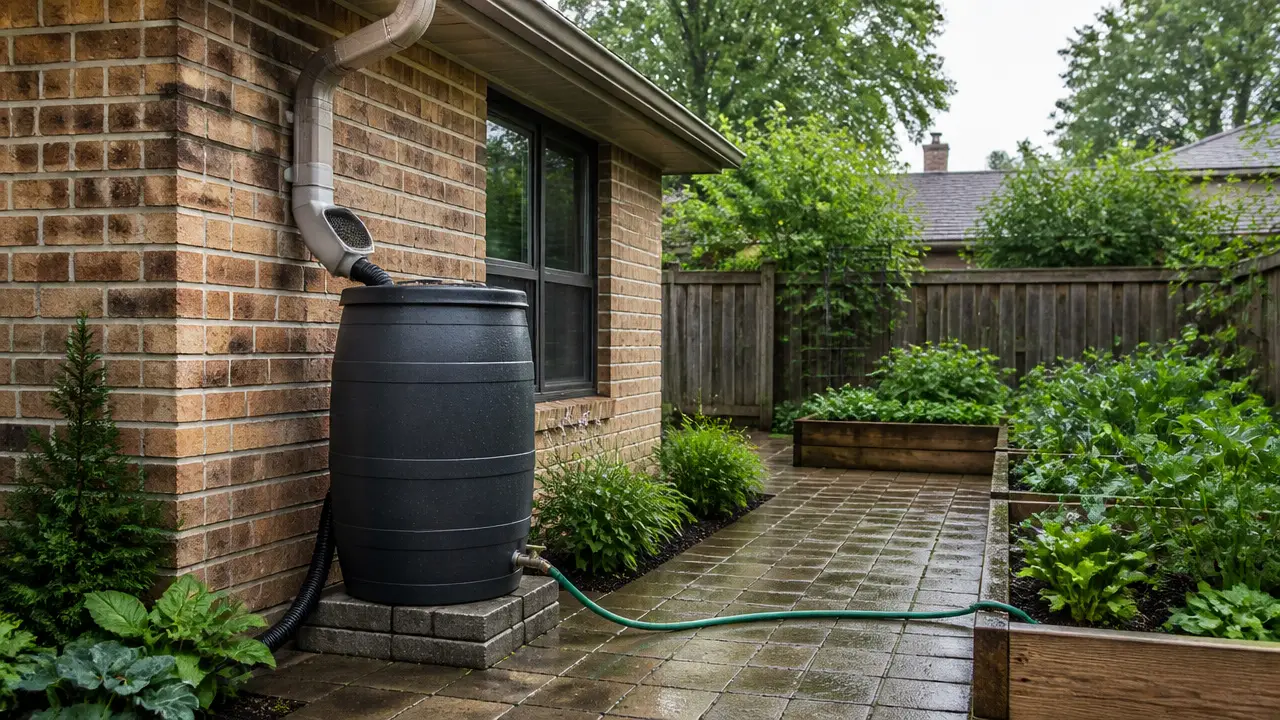
A rain barrel captures runoff from a roof through a downspout. Instead of sending that water into a drain or onto the ground, you store some of it for later use.
You might use the collected water for:
- Watering garden beds
- Watering trees and shrubs
- Filling watering cans
- Drip irrigation designed for low-pressure water
- Some outdoor cleaning jobs
Each gallon of rainwater you use can replace a gallon that might otherwise come from your household water supply.
However, the dollar value of that gallon depends on your local water rates. Some utility bills also include fixed charges that do not decrease when you use less water. That means cutting outdoor water use does not necessarily reduce the entire bill by the same percentage.
How Much Water Can a Rain Barrel Collect?
A roof can produce much more runoff than many people expect.
A useful estimate is:
Collected gallons = roof area in square feet × rainfall in inches × 0.623 × collection efficiency
The 0.623 figure converts one inch of rain falling on one square foot into gallons.
For example, suppose 500 square feet of roof drains toward one downspout.
With one inch of rain:
500 × 1 × 0.623 = about 312 gallons
That is the theoretical amount falling on that roof section.
You will normally collect less. Some water is lost because of roof wetting, gutter losses, splash, leaks, first-flush diversion, overflow, and other factors.
A standard rain barrel may hold only a fraction of the runoff from one storm. Once the barrel fills, additional water needs a safe overflow path.
This capacity limit matters when estimating savings.
A Full Barrel Does Not Mean Maximum Savings
Suppose you have a 55-gallon barrel.
If one storm fills it and you use all 55 gallons before the next storm, the barrel can fill again. That repeated cycle is what makes the system useful.
But suppose the barrel fills in spring and stays nearly full for three weeks. Several storms may pass while there is no available storage capacity. Almost all of that additional runoff bypasses or overflows the barrel.
The amount of water you use and replace matters more financially than the number of gallons that fall on your roof.
A small barrel used frequently may therefore save more water during a season than a larger barrel that rarely gets emptied.
How to Estimate Your Own Rain Barrel Savings
You can make a reasonable estimate without complicated calculations.
1. Estimate how much rainwater you will actually use
Do not start with total annual rainfall. Start with your outdoor water needs.
For example, estimate how much water you normally use each week for plants that could reasonably be supplied by a rain barrel.
Then consider whether rainfall and barrel capacity are likely to supply that amount.
2. Find your water rate
Check your utility bill or utility website for the amount you pay for metered water.
Rates may be listed per:
- Gallon
- 1,000 gallons
- Hundred cubic feet
- Another billing unit
Some utilities use tiered rates, meaning the price changes as water consumption increases.
3. Calculate the value of the water you replace
If your utility charges per 1,000 gallons, you can use:
Annual savings = rainwater used ÷ 1,000 × water rate per 1,000 gallons
For example, if you actually use 2,000 gallons of collected rainwater during a year, calculate the cost of 2,000 gallons using your own current utility rate.
Do not count water that simply overflows the barrel.
4. Compare savings with your total system cost
Include more than the barrel itself.
A basic setup might require:
- A barrel or storage tank
- Downspout diverter or inlet
- Screen
- Overflow hose or pipe
- Spigot or bulkhead fitting
- Stable base
- Connecting hose if barrels are linked
A bulkhead fitting is a fitting that passes through the wall of a barrel or tank while making a sealed connection.
Maintenance may occasionally require replacement screens, seals, hoses, or other small parts.
Divide the total cost by your estimated annual savings for a rough idea of the financial payback period.
Why Some Rain Barrels Save More Money Than Others
Several factors have a much larger effect on savings than the barrel itself.
Frequent water use
Gardens and landscaping can create steady demand during warm weather. If you regularly empty the barrel, there is room to catch the next rainfall.
Enough roof area
A barrel connected to a tiny roof section may refill slowly.
A barrel connected to a larger roof section may fill quickly, sometimes during a fairly small storm.
More roof area is useful only if you also have enough storage and enough demand for the water.
Suitable rainfall patterns
Two locations with the same annual rainfall can have very different rainwater harvesting results.
Frequent small storms may keep a garden barrel supplied.
A climate where most rain falls during a few large storms may cause a small barrel to overflow repeatedly while providing little water during long dry periods.
Adequate storage
Increasing storage can capture more runoff between uses.
For example, two connected barrels can store more than one barrel. Larger tanks or cisterns can store much more.
But additional capacity is not automatically economical. Larger systems cost more and may require stronger foundations, larger overflow arrangements, pumps, filtration, or other equipment.
High outdoor water use
Account for key facts about a rain barrel to verify tank dimensions and fittings suited to the available space.
Someone watering a large garden may have far more opportunity to replace purchased water than someone with only a few container plants.
When Rain Barrels May Not Save Much Money
A rain barrel is not guaranteed to pay for itself.
Savings may be small when:
- Municipal water is inexpensive.
- Outdoor water use is already very low.
- Rain is uncommon during the growing season.
- The barrel frequently overflows because it stays full.
- The barrel is too small for the available roof runoff.
- The system costs a lot relative to the water it replaces.
- Plants need irrigation during periods when no stored rainwater remains.
People sometimes calculate potential savings using every gallon of rain that falls on the roof. That can greatly overstate the result.
Your actual savings are based on the rainwater you capture and use, not the roof's theoretical annual runoff.
Do Rain Barrels Save Money on Sewer Charges?
Sometimes, but not necessarily.
Water and sewer billing systems vary. Some utilities base some sewer charges on measured household water use, while others use separate calculations or fixed charges.
Using rainwater outdoors may therefore reduce only the water portion of a bill in some places.
Check your utility's current billing method before including sewer savings in your calculations.
Can a Bigger Tank Save More Money?
Potentially.
A larger storage tank gives you more room to capture water during storms. This can reduce the amount lost through overflow.
But there is a point where extra storage provides little financial benefit.
Imagine that your garden typically uses 100 gallons between storms. Increasing storage from 50 gallons to 100 gallons could help you replace more tap water.
Increasing storage from 100 gallons to 1,000 gallons may not help much if you rarely use more than 100 gallons before the next rainfall.
Size storage around both your rainfall pattern and your actual water demand.
Can Connecting Several Rain Barrels Improve Savings?
It can.
Linked barrels increase storage without requiring one large tank. They can make sense when a single barrel frequently fills and overflows while you still need irrigation water between storms.
Make sure the connections are sized and installed so water moves properly between barrels.
Every barrel also needs stable support. Water is heavy. One gallon weighs roughly 8.3 pounds, so a full barrel creates a substantial load.
Do not place large storage containers on weak decks, unstable blocks, soft ground, or other surfaces that may not safely carry the filled weight.
Gravity Systems Can Keep Costs Low
One reason a basic rain barrel can be economical is that it may not require electricity.
If the barrel is raised safely above the watering point, gravity creates some pressure at the outlet.
The vertical distance between the water surface and the outlet or irrigation point is called head height. More head height generally means more available pressure.
But a rain barrel produces much less pressure than a typical household water line.
A watering can or short hose may work well. Some drip systems can work if they are designed for very low pressure.
Sprinklers and other devices that require substantial pressure may perform poorly.
Adding a pump can improve water movement, but it also adds equipment cost, electricity use, maintenance, and freeze-protection concerns. Those costs should be included when deciding whether a larger rainwater system will actually save money.
Does Garden Rainwater Need Filtration?
Basic screening is useful even when the water is only intended for irrigation.
Keeping leaves, insects, and larger debris out of the barrel can reduce maintenance and help protect outlets and irrigation equipment from clogging.
Fine drip emitters may require additional filtration.
The needed filter depends on the equipment downstream. A filter's micron rating describes the approximate size of particles it is designed to capture. Smaller micron numbers indicate finer filtration.
Do not assume that filtered roof runoff is drinking water. Rain barrel water can contain contaminants from roofing materials, bird and animal waste, airborne material, gutters, and storage equipment.
Using rainwater as drinking water is a separate whole-system decision involving suitable collection materials, prefiltration, appropriate treatment, current laboratory testing, ongoing maintenance, and applicable local requirements.
Maintenance Affects the Real Cost
A neglected barrel may eventually become inconvenient enough that you stop using it. That eliminates most of the potential savings.
Routine care can include:
- Cleaning inlet screens
- Removing accumulated sediment
- Checking the lid
- Keeping mosquito entry points screened
- Checking fittings for leaks
- Making sure overflow water drains somewhere safe
- Cleaning clogged hoses or irrigation filters
In freezing climates, the barrel, valves, hoses, and connected plumbing may also need seasonal protection. Follow the equipment manufacturer's instructions for draining and winter storage.
Maintenance does not have to be complicated, but it should be part of your cost calculation.
Are Rain Barrels Worth It Just for the Savings?
Sometimes. But financial savings are only one reason people install them.
A simple barrel may also give you:
- Convenient water near a garden
- Less dependence on a hose for small watering jobs
- Temporary storage after rainfall
- A way to make useful use of some roof runoff
For a homeowner whose only goal is reducing a water bill, the payback may be slow.
For someone who already waters a garden regularly, has useful roof runoff, and can install a simple system without expensive equipment, the economics can be much better.
The best test is simple: estimate how many gallons you will realistically use each year, multiply that amount by your local water cost, and compare the result with the total cost of the system.
Frequently Asked Questions
How much money can one rain barrel save per year?
There is no single amount. Savings depend on barrel capacity, rainfall, roof area, how often you empty the barrel, and your local water rate. Calculate savings using the amount of collected rainwater you actually use rather than the amount that falls on your roof.
How quickly does a rain barrel pay for itself?
The payback period can range widely. Divide the total installed cost of the barrel system by your estimated annual water-bill savings. A low-cost system used frequently will generally pay back sooner than an expensive system that receives little use.
Does a larger rain barrel always save more money?
No. Larger storage helps only when you can use the additional water. Oversized storage that remains full for long periods may provide little extra savings.
Is rain barrel water free?
The rain itself does not have a water-utility charge, but collecting it is not completely free. The barrel, fittings, screens, base, maintenance, and any pumps or filters are system costs.
Can I use rain barrel water instead of tap water for my garden?
Rainwater is commonly collected for non-potable outdoor uses such as landscape irrigation, where locally allowed and appropriate for the plants and collection surfaces involved. Non-potable means water that is not intended for drinking. Avoid assuming roof runoff is suitable for every crop or use without considering possible contaminants.
Do rain barrels lower sewer bills too?
Not always. Sewer billing methods vary by utility. Check how your local provider calculates water and sewer charges before assuming a rain barrel will reduce both.
Is connecting two rain barrels better than buying one larger barrel?
Either approach can increase storage. The better choice depends on available space, connection layout, structural support, overflow management, and how much water you actually use between storms.