As an affiliate, we may earn a commission from qualifying purchases. We get commissions for purchases made through links on this website from Amazon and other third parties.
Gutter guards can reduce the amount of leaves and large debris entering your gutters, but they do not make gutters maintenance-free. They can also slow water flow, clog with fine debris, make cleaning harder, and add another part that must fit your roof and rainwater system correctly.
For rainwater harvesting, gutter guards can be useful. But they should be treated as one part of debris control, not as a replacement for gutter cleaning, downspout screens, first-flush devices, or other treatment steps.
The Main Downsides of Gutter Guards
They Can Still Clog
Most gutter guards are designed to stop leaves, twigs, and other large debris. Smaller material can still collect on or inside them.
Common examples include:
- Pine needles
- Seeds
- Roof grit
- Pollen
- Moss
- Small leaves
- Dust and dirt
- Insect debris
Fine material may form a layer across the guard. Water can then run over the clogged surface instead of entering the gutter.
Some debris can also pass through openings and collect inside the gutter, where it may be harder to reach.
Heavy Rain Can Overwhelm Some Designs
A gutter guard changes how rain reaches the gutter. Water must pass through holes, mesh, slots, or around a curved surface before it can enter.
During light rain, this may not matter much. During a strong storm, a clogged or restrictive guard may not pass water fast enough.
Water can then:
- Spill over the gutter edge
- Run behind the gutter
- Miss the downspout
- Reduce the amount of rainwater reaching your storage tank
This matters for rainwater harvesting because the roof may be producing plenty of runoff while the collection system is capturing only part of it.
A guard should not become the narrowest flow point in the system.
Gutter Guards Do Not Eliminate Cleaning
"Maintenance-free gutters" is an unrealistic expectation.
Even with guards installed, the system still needs inspection and cleaning. Debris can collect:
- On top of the guard
- Along roof valleys
- At guard joints
- Near downspout openings
- Under the guard
- Inside the gutter
Trees close to the roof usually increase the cleaning load.
How often cleaning is needed depends on the roof, surrounding vegetation, weather, guard design, and gutter slope.
Cleaning Can Become More Difficult
An open gutter is easy to inspect. You can usually see where debris has collected.
A covered gutter is different.
Some guards must be lifted, unclipped, unscrewed, or partly removed before you can reach the gutter underneath. That can turn a simple cleaning job into a longer one.
If the guard is difficult to remove, homeowners may also postpone cleaning until a blockage becomes obvious.
Roof and ladder work can be hazardous. If the gutters cannot be inspected safely from a stable position, use a qualified gutter professional.
Fine Mesh Can Restrict Flow
Very fine mesh can keep more debris out of the gutter, but smaller openings are also easier to block.
Pollen, dust, roof particles, or organic material can coat the mesh. Water may bead across the surface rather than pass through freely.
This creates a tradeoff:
Smaller openings may stop more debris, but they can require more surface cleaning.
For a rainwater system, good debris control is useful only if enough water can still enter the gutter during the storms you want to collect.
Large Openings Let More Debris Through
Guards with larger holes or slots usually allow water through more easily. However, they may also allow smaller leaves, seeds, pine needles, insects, and roofing debris into the gutter.
That material can eventually reach:
- Downspout strainers
- First-flush devices
- Tank inlet screens
- Pumps
- Filters
This is why gutter guards should not be your only debris-control stage.
They Can Hide Problems Inside the Gutter
Because the gutter is covered, you may not notice sediment buildup or standing water.
Problems can include:
- Poor gutter slope
- Clogged downspouts
- Loose fasteners
- Rust or corrosion
- Leaking seams
- Organic sludge
- Insect activity
Periodic inspection is still important, especially when the gutter feeds a rain barrel, IBC tote, or cistern.
Some Guards Can Create Water-Shedding Problems
Certain guard designs rely on water following a curved surface into the gutter. Leaves and debris are supposed to fall away.
These systems can work under suitable conditions, but their performance can depend on roof pitch, rainfall intensity, gutter position, and installation.
If water moves too quickly across the roof or the surface is dirty, some runoff may shoot past the gutter.
That lost runoff can be especially noticeable on a rainwater harvesting system because every gallon that bypasses the gutter is water that never reaches storage.
Installation Can Affect the Roof
Some gutter guards slide under or interact with roofing materials.
Poor installation can disturb shingles, flashing, drip edges, or gutter alignment. The exact risk depends on the roof and guard design.
Avoid forcing materials under shingles or changing roof components without understanding how the roof is meant to drain.
If installation requires altering roofing, flashing, or difficult roof-edge areas, it is better handled by someone familiar with the roofing system.
Snow and Ice Can Cause Problems
In freezing climates, gutter guards do not prevent ice buildup.
Snow can sit on top of the guard, melt, and refreeze. Ice may form around the gutter edge or across the guard surface.
A gutter guard also does not fix the underlying causes of ice dams.
Before choosing a guard for a freezing climate, consider:
- Roof insulation and ventilation
- Gutter drainage
- Snow accumulation
- Safe winter maintenance
- Whether the guard can handle local snow and ice conditions
Do not assume a guard provides freeze protection.
They Can Make Small Repairs Harder
Downspout clogs, leaking seams, and loose gutter hangers are easier to reach when the gutter is open.
A guard may have to be removed before repairs can begin. That can add work whenever you need to:
- Replace a downspout outlet
- Reseal a seam
- Adjust gutter slope
- Tighten hangers
- Remove sediment
- Install a rainwater diverter
Evaluate roofing professionals’ views on gutter guards to assess collection capacity with suitable debris exclusion.
This is worth considering if you frequently modify or maintain a DIY rainwater system.
Gutter Guards Do Not Make Rainwater Safe to Drink
A gutter guard can reduce some debris, but it does not remove many contaminants that may be present in roof runoff.
Rainwater may still contain material from:
- Bird and animal droppings
- Dust
- Smoke
- Roofing surfaces
- Air pollution
- Microorganisms
- Decomposing organic matter
A gutter guard should therefore be viewed as a coarse debris-control step.
For potable use, meaning water intended for drinking, the entire collection and treatment system must be considered. Suitable collection surfaces, prefiltration, appropriate treatment, maintenance, current laboratory testing, and applicable local requirements may all matter.
A gutter guard alone cannot establish that collected rainwater is safe to drink.
Gutter Guards Can Complicate First-Flush Systems
A first-flush device diverts some of the first roof runoff at the start of a rain event. That initial runoff often carries more loose dust and debris from the roof.
Gutter guards can reduce larger material entering the downspout, but fine contamination may still pass through.
This means installing gutter guards does not automatically remove the need for a first-flush strategy where one is appropriate.
It may actually make the gutter look cleaner while fine material continues toward the tank.
They Can Shift Maintenance Downstream
A guard may reduce the amount of debris inside the gutter without eliminating it from the rainwater system.
Fine material that passes through may collect elsewhere, including:
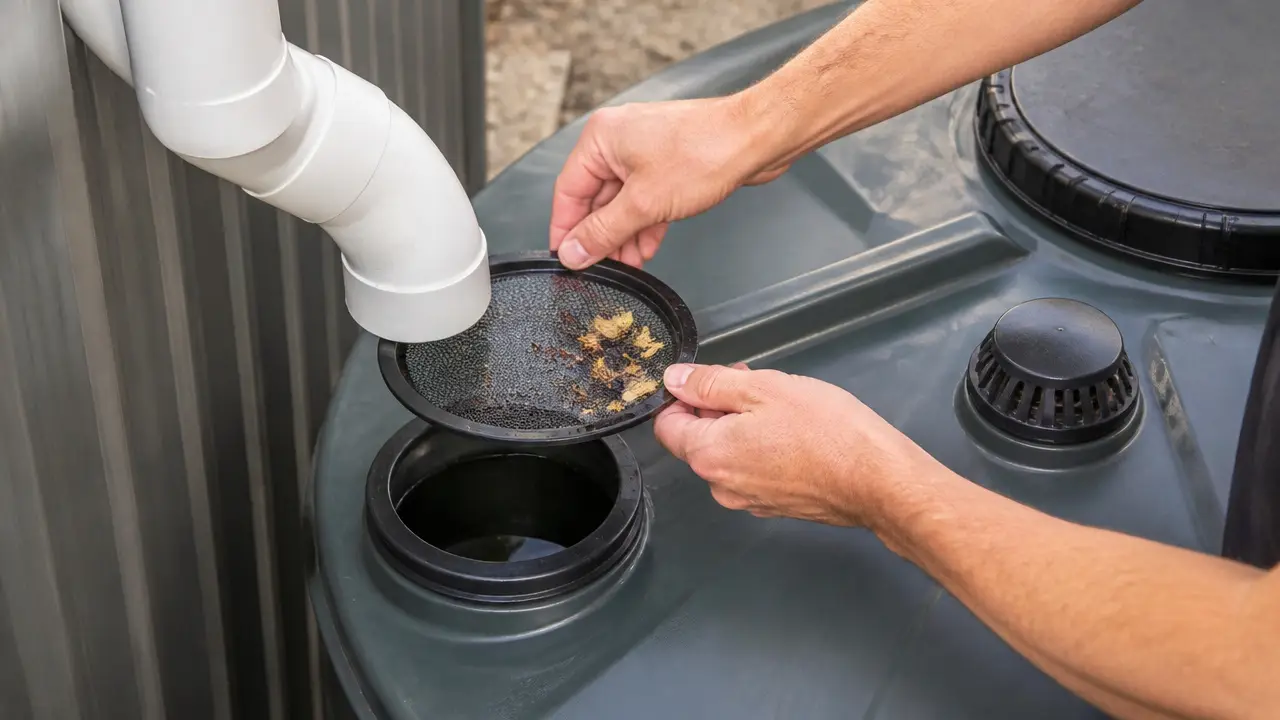
- Downspout screens
- Tank inlet strainers
- First-flush chambers
- Sediment traps
- Filters
The system still needs a maintenance plan from the roof all the way to storage.
Gutter Guard Types Have Different Weaknesses
| Guard type | Common downside |
|---|---|
| Fine mesh | Can become coated with pollen, dirt, and roof grit |
| Perforated screen | Smaller debris can pass through |
| Brush style | Debris can become trapped in the bristles |
| Foam insert | Organic material can collect on or within the material |
| Curved surface design | Fast-moving water may overshoot under some conditions |
| Large-hole screen | Pine needles, seeds, and small debris may enter |
There is no design that completely eliminates both debris and maintenance.
Are Gutter Guards Bad for Rainwater Harvesting?
Not necessarily.
They can be helpful when they reduce leaves and large debris before runoff enters the downspout. This can make downstream screens and tank inlets easier to maintain.
The key is choosing a guard that does not interfere with water collection.
For a rainwater harvesting system, look at the whole path:
Roof → gutter guard → gutter → downspout → debris screen or first flush → tank inlet → storage
Water should be able to move through every stage without a major restriction.
When Gutter Guards Make the Most Sense
Gutter guards may be useful when:
- Large leaves frequently fill the gutters
- Trees overhang the roof
- Downspout screens clog often
- A rainwater tank receives too much coarse debris
- Gutters can still be inspected and cleaned after installation
They may be less useful where most of the debris consists of very fine particles or pine needles that the chosen guard does not handle well.
What to Check Before Installing Gutter Guards
Before adding guards to a rainwater collection system, check a few practical details.
Gutter condition
Repair leaks, poor slope, loose sections, and existing blockages first. A guard will not correct those problems.
Water-flow capacity
The guard needs to accept runoff quickly enough for the roof and local rainfall conditions. Water overflowing the guard means less water reaches storage.
Downspout access
Make sure you can still reach the downspout opening if it becomes blocked.
Debris type
Choose based on what actually falls on your roof. Large leaves, pine needles, pollen, and roof grit create different problems.
Cleaning access
Know how the guard will be opened or removed before installing it.
Rainwater-system connections
Check that the guard does not interfere with downspout diverters, first-flush devices, leaf screens, or other collection equipment.
The Bottom Line
The biggest downside of gutter guards is that they can create the impression that gutters no longer need attention.
They still require inspection and cleaning. Some designs can clog, restrict heavy rainfall, hide sediment, or make repairs more difficult.
For rainwater harvesting, a well-matched gutter guard can reduce large debris entering the system. But it should remain only the first part of a larger debris-management and maintenance plan.
Frequently Asked Questions
Do gutter guards completely stop gutters from clogging?
No. They can reduce large debris, but smaller material can collect on top of the guard or pass through and settle inside the gutter.
Can gutter guards reduce rainwater collection?
Yes. If the guard is clogged or cannot pass runoff quickly enough, water may flow over the gutter instead of reaching the downspout and storage tank.
Do gutters with guards still need cleaning?
Yes. The guard surface, gutter interior, downspout, and rainwater-system screens should still be inspected and cleaned when needed.
Are mesh gutter guards good for rainwater harvesting?
They can be useful because they block larger debris, but fine mesh may become coated with pollen, dirt, or roof grit. It needs enough open area to handle runoff without causing overflow.
Do gutter guards replace a first-flush diverter?
No. Gutter guards mainly control physical debris. A first-flush system serves a different purpose by diverting some of the initial roof runoff.
Can I drink rainwater collected through gutter guards?
Gutter guards do not make roof runoff potable. Drinking-water use requires a whole-system approach that may include appropriate collection, treatment, maintenance, current laboratory testing, and compliance with applicable local requirements.
Are gutter guards worth using on a rain barrel?
They can be helpful if leaves frequently clog the gutter or barrel inlet. You should still use appropriate inlet screening and keep the gutter, downspout, and barrel clean.