As an affiliate, we may earn a commission from qualifying purchases. We get commissions for purchases made through links on this website from Amazon and other third parties.
A 2-inch overflow is a good default for most rain barrels. If the barrel receives the full flow from a downspout, the overflow should have enough capacity to pass that incoming water without the barrel spilling over the top. In higher-flow setups, a 2- to 3-inch overflow may be more appropriate.
A smaller 1-1/2-inch overflow can work when a downspout diverter limits how much water enters the barrel. The Southwest Florida Water Management District recommends at least a 1-1/2-inch overflow and notes that the overflow should be about the size of the inflow pipe. Some rain barrel installation guides specify a minimum 2-inch overflow.
A Simple Rain Barrel Overflow Size Guide
| Rain barrel setup | Practical overflow size |
|---|---|
| Small diverter-controlled inlet | 1-1/2 inches may be enough |
| Typical 50- to 60-gallon barrel | 2 inches is a good default |
| Full downspout directed into barrel | 2 to 3 inches, sized for incoming flow |
| Large roof area or heavy storm flow | Consider 3 inches or another high-capacity overflow |
| Multiple barrels | Size the final overflow for all water entering the system |
The barrel size itself is not the main factor. A 55-gallon barrel and a 100-gallon barrel connected to the same downspout can receive water at nearly the same rate.
What matters most is how fast water can enter compared with how fast it can leave through the overflow.
Why a 2-Inch Overflow Is a Good Starting Point
Rain barrels fill much faster than many people expect.
Once the barrel is full, every additional gallon coming from the roof has to leave through the overflow. A small overflow can become a bottleneck.
A 3/4-inch garden-hose fitting may look large enough when the barrel is filling slowly. During a hard rain, though, it can have much less flow capacity than the incoming downspout.
Guidance from American Water calls for a minimum 2-inch overflow opening in its rain barrel design. Oakland County, Michigan, describes residential rain barrel overflow pipes in the roughly 1- to 3-inch range, depending on the system.
For a basic DIY barrel receiving a useful portion of a downspout's flow, 2 inches gives you considerably more drainage capacity than a small hose fitting without making the installation unusually large or complicated.
Match the Overflow to the Inlet
The safest sizing rule is:
The overflow should be able to carry at least as much water as the barrel can receive.
This matters more than choosing an overflow based only on barrel capacity.
There are two common rain barrel inlet arrangements.
Downspout Diverter
A diverter takes part of the water from the downspout and sends it into the barrel. Many designs also send excess water back through the downspout after the barrel fills.
Because the diverter controls the incoming flow, the barrel may not need a very large separate overflow.
A 1-1/2- or 2-inch overflow may be adequate in many of these systems, but follow the diverter manufacturer's installation requirements.
Some diverter systems use the inlet connection itself as part of the overflow return path. In that case, adding a large separate outlet may not be necessary.
Full-Flow Downspout
A full-flow setup sends most or all of the downspout water directly into the barrel.
This is different.
During a hard storm, the barrel may receive a large amount of water very quickly. Once it fills, the overflow has to handle that flow.
For this type of installation, do not rely on a small 3/4- or 1-inch overflow hose. A 2- to 3-inch overflow is a more practical range, with the final size based on the inlet and expected flow.
The Southwest Florida Water Management District specifically recommends making the overflow approximately the diameter of the inflow pipe when designing for large storms.
When a 1-1/2-Inch Overflow Can Work
A 1-1/2-inch overflow is common on rain barrels.
It can work well when:
- A diverter limits incoming water.
- The barrel receives only part of the downspout flow.
- The overflow hose is short.
- The hose has few bends.
- The outlet stays clear.
- The barrel also has another safe way for excess water to return to the drainage system.
A government rain barrel guide from Southwest Florida recommends an overflow of at least 1-1/2 inches while using a 2-inch pipe in its example.
The important point is that 1-1/2 inches should not automatically be treated as adequate for every downspout.
When to Use a 3-Inch Overflow
Consider a larger overflow when the barrel gets unrestricted flow from a downspout.
A 3-inch overflow may make sense when:
- The entire downspout empties into the barrel.
- A large roof section drains to that downspout.
- Heavy rainfall is common.
- The overflow line must be fairly long.
- Several barrels eventually drain through one final overflow.
- Previous storms have caused water to spill over the barrel rim.
Going larger can also provide some extra capacity when screens, fittings, elbows, or corrugated hose reduce flow.
Do not assume that a larger pipe alone solves every overflow problem. The outlet position, fittings, hose slope, and discharge location all matter.
Pipe Diameter Is Not the Only Thing That Affects Flow
Two overflow systems using the same pipe size may handle water very differently.
Hose Length
A short overflow usually moves water more easily than a long one.
Long hoses create more resistance to flow.
Bends and Elbows
Every tight bend makes it harder for water to move.
Keep the overflow route simple where practical.
Corrugated Hose
Flexible corrugated hose is convenient, but its rough inside surface can restrict flow more than a smooth pipe of similar diameter.
Do not reduce the hose size immediately after installing a large overflow fitting.
Screens
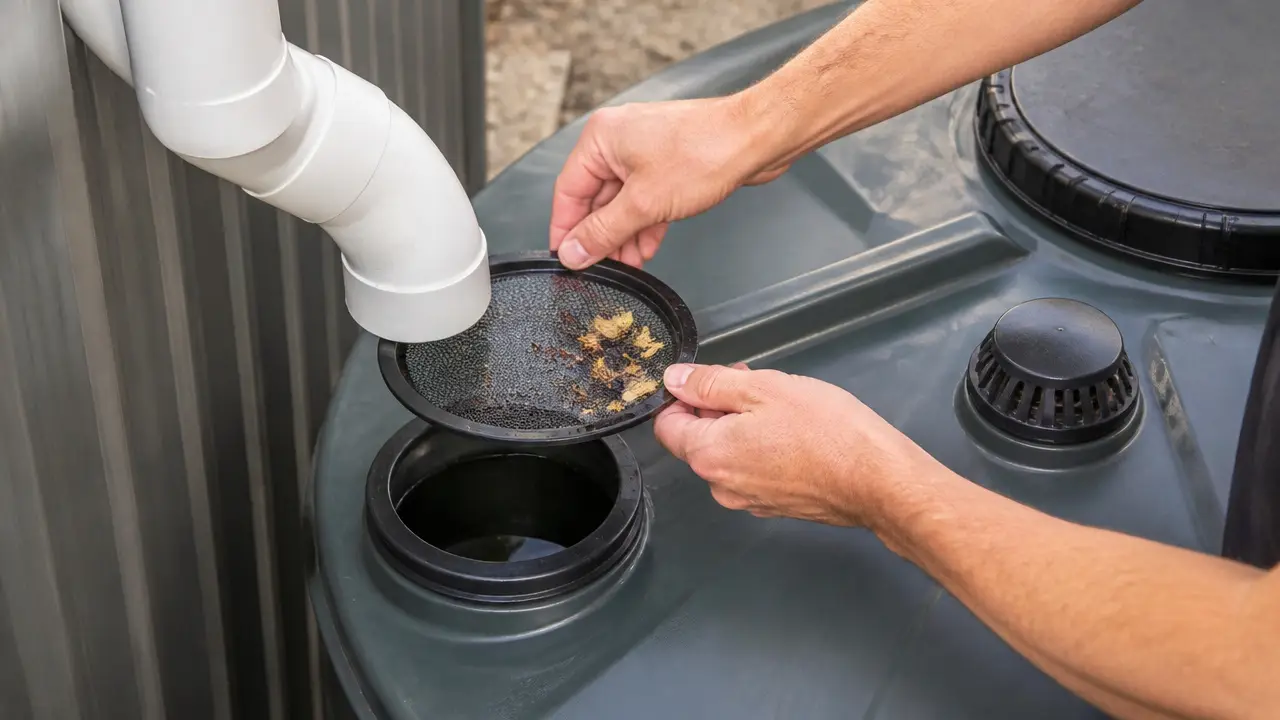
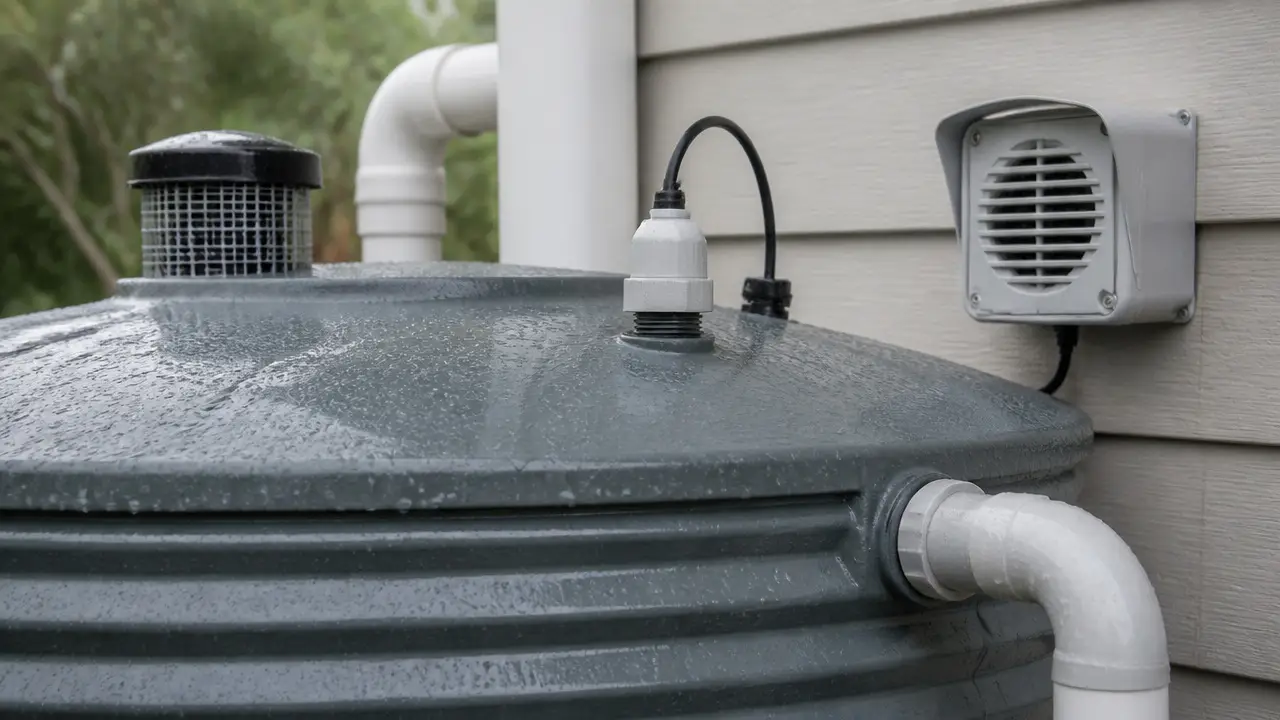
Overflow openings should normally be screened to help keep mosquitoes and small animals from entering the barrel.
The screen must also remain clean. Leaves and debris can reduce the effective opening.
Slope
With routing downspout runoff into a rain barrel, you can understand screening and conveyance for anticipated storm conditions.
An overflow should drain freely toward its discharge point rather than having low spots that hold water.
Make sure the hose is not kinked or crushed.
Where Should the Overflow Fitting Go?
Install the overflow near the top of the barrel, but leave enough material around the opening for the fitting to seal securely.
The exact hole size depends on the fitting, not just the nominal pipe size.
For example, a fitting sold for 2-inch pipe does not necessarily require a 2-inch hole. A bulkhead fitting is a fitting that passes through the barrel wall and seals against it with a gasket. Its required hole may be noticeably larger than the pipe connection.
Use the hole size specified for your fitting rather than guessing from the pipe diameter.
The overflow opening should also be lower than any uncontrolled opening where water could escape toward the house.
Where Should Rain Barrel Overflow Go?
Sizing the pipe correctly only solves half the problem. You also need somewhere safe for the water to go.
Direct overflow toward a suitable drainage or infiltration area, such as:
- A lawn area that can absorb the water
- A rain garden
- Another rain barrel
- An approved stormwater drainage route
Avoid simply dumping the overflow beside the building foundation.
Rain barrel guidance commonly stresses routing excess water away from the foundation because a full barrel may discharge significant water during a storm.
Do not route water where it can wash out soil, cross a walking area, damage neighboring property, or create standing water.
Local drainage rules can also affect where stormwater may be discharged.
What About Connecting Multiple Rain Barrels?
Multiple barrels need a little more planning.
If water enters the first barrel and then passes into additional barrels, the connecting pipes must move water fast enough to keep the barrels reasonably balanced.
More important, the final overflow still needs enough capacity to handle the incoming rainwater once every barrel is full.
Adding barrels increases storage capacity. It does not reduce the rate at which water can arrive from the roof.
For example, three barrels may take longer to fill than one barrel. But once all three are full, the system may still have to discharge the full incoming flow from the downspout.
Do not make the final overflow smaller simply because you added more storage.
A Small Overflow Can Defeat a Large Inlet
One common DIY mistake is making a large opening in the barrel lid for the downspout while using a small garden-hose connection for overflow.
That arrangement can work during light rain.
During heavy rain, water may enter through the large inlet much faster than it can escape through the small outlet. The water level then rises until it finds another way out, often around the lid or inlet.
If the barrel is beside the house, that uncontrolled overflow can put the water exactly where you were trying to avoid sending it.
If you use a large unrestricted inlet, provide a correspondingly high-capacity overflow.
How to Tell If Your Existing Overflow Is Too Small
You may need a larger overflow if:
- Water comes out around the barrel lid during storms.
- Water backs up around the inlet.
- The overflow runs full while the barrel continues rising.
- A fitting or screen frequently becomes clogged.
- Water spills beside the foundation.
- Connected barrels cannot transfer water fast enough.
- The overflow hose has been reduced to a much smaller diameter.
Check for blocked screens, kinked hoses, poor slope, and debris before assuming the pipe itself is too small.
If everything is clear and the barrel still overtops during strong rain, increasing overflow capacity may be necessary.
Bottom Line
For most DIY rain barrels, a 2-inch overflow is a good default.
A 1-1/2-inch overflow may work when a downspout diverter limits incoming flow. If the full downspout empties directly into the barrel, size the overflow to handle that incoming flow. A 2- to 3-inch system is often more appropriate, and larger inflows may require additional capacity.
Whatever size you use, keep the overflow short and clear, avoid unnecessary restrictions, screen openings against pests, and route the discharged water safely away from the building.
Frequently Asked Questions
Is a 1-inch overflow big enough for a rain barrel?
It may work with a very small or controlled inlet, but it is usually small for a barrel receiving substantial downspout flow. A larger 1-1/2- or 2-inch overflow provides more capacity.
Is a 2-inch overflow enough for a 55-gallon rain barrel?
A 2-inch overflow is a good starting size for many 55-gallon rain barrels. The correct size depends more on incoming roof runoff than on whether the barrel holds exactly 55 gallons.
Should the overflow be the same size as the downspout?
The overflow should have enough flow capacity to handle the water entering the barrel. If the full downspout feeds the barrel, matching or exceeding the inlet's effective flow capacity is a conservative approach.
Can I use a garden hose for rain barrel overflow?
A standard garden hose can be too restrictive when a barrel receives substantial rainwater flow. It may be acceptable for a tightly controlled inlet, but larger overflow hose or pipe is generally better for direct downspout collection.
Where should I drill the rain barrel overflow hole?
Place it near the top of the barrel so the barrel can use most of its storage capacity. Leave enough space around the opening for the fitting and gasket to seat correctly.
Can I connect the overflow to another rain barrel?
Yes. Overflow can feed another barrel if the connections are sized and arranged to move the incoming water. The last barrel still needs a safe final overflow for times when the whole system is full.
Why does my rain barrel overflow around the lid?
The overflow may be too small, clogged, kinked, poorly sloped, or restricted by fittings or screens. Water entering faster than it can leave will eventually rise to the lid or inlet opening.