As an affiliate, we may earn a commission from qualifying purchases. We get commissions for purchases made through links on this website from Amazon and other third parties.
Liquid water test kits are often better than test strips when you need a more detailed reading. But they are not automatically more accurate.
Test strips are fast and simple. They work well for quick checks and routine monitoring. Liquid kits usually take more steps, but some give smaller measurement ranges or clearer endpoints. That can make them more useful when you need to track a specific water condition closely.
For rainwater systems, the best choice depends on what you are testing, why you are testing it, and what decision you will make from the result.
Neither type of home kit can prove that rainwater is safe to drink. Drinking-water decisions require suitable collection and treatment, proper maintenance, and appropriate laboratory testing.
How Test Strips Work
Water test strips have small pads containing chemical reagents. You dip the strip into the water, wait for the specified amount of time, and compare the colors with a chart.
A strip may test one condition or several at once.
Common strip tests include:
- pH
- hardness
- alkalinity
- chlorine
- nitrate and nitrite
- iron
- copper
- other selected chemicals
The exact tests depend on the strip.
The main advantage is speed. You can check several conditions without measuring liquids or cleaning test tubes afterward.
The downside is that you are usually choosing the closest color from a limited number of choices. A color chart might show several ranges rather than giving an exact concentration.
That is often enough for routine system checks. It may not be enough when small changes matter.
How Liquid Water Test Kits Work
"Liquid test kit" can describe several types of tests.
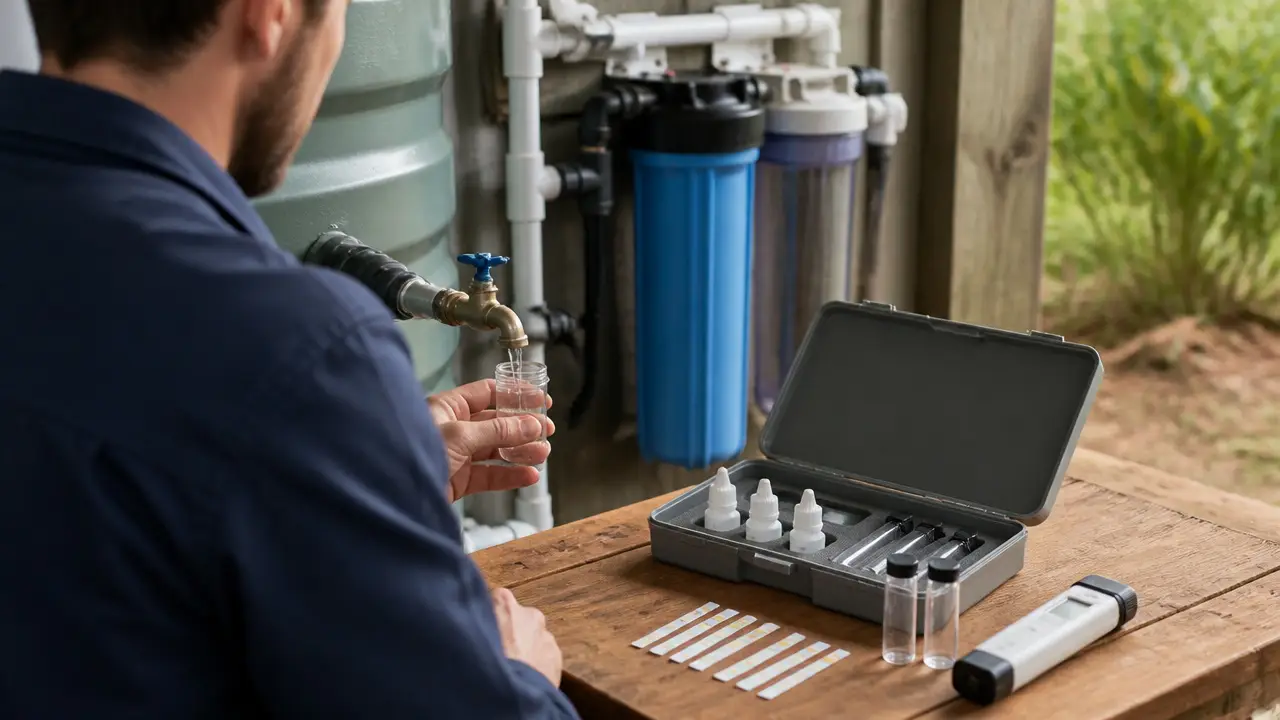
One common type uses drops of reagent. You add a set amount of water to a vial, add the reagent, and compare the resulting color with a chart or comparator.
Another type is a titration test. You add reagent one drop at a time until the water changes color. The number of drops tells you the approximate concentration.
Some kits also use tablets or powders rather than liquids. They work on the same general idea: a controlled chemical reaction produces a measurable change.
Liquid methods are commonly used for conditions such as:
- pH
- chlorine
- hardness
- alkalinity
The available tests and their useful ranges vary widely.
Liquid Tests vs. Strips
Neither format wins in every situation.
| Feature | Test Strips | Liquid Test Kits |
|---|---|---|
| Speed | Very fast | Usually slower |
| Ease of use | Very simple | More steps |
| Cleanup | Little or none | Test tubes or vials may need cleaning |
| Measurement detail | Often broad ranges | Can provide finer ranges |
| User technique | Timing and color matching matter | Measuring, drop size, mixing, and color matching matter |
| Storage | Sensitive to moisture and age | Reagents also have storage and shelf-life limits |
| Routine monitoring | Very convenient | Useful when more detail is needed |
| Drinking-water safety decision | Not enough by itself | Not enough by itself |
The quality of the test matters at least as much as whether it uses a strip or liquid reagent.
A well-designed strip for one specific measurement can be more useful than a poorly designed liquid kit.
When Liquid Test Kits Are Better
Liquid kits make the most sense when you want more measurement detail from a specific test.
Tracking pH More Closely
pH tells you how acidic or basic the water is.
A strip may be good enough to tell whether water is roughly acidic, neutral, or alkaline. A liquid test with narrower increments may make changes easier to see.
This can be useful when monitoring water treatment or investigating corrosion concerns.
Rainwater is often affected by the atmosphere, roof materials, storage conditions, and anything added during treatment. Do not assume its pH will stay constant.
Checking Chlorine After Treatment
If chlorine is intentionally used in a water system, knowing the chlorine level may require more than a simple yes-or-no result.
Some liquid color tests provide useful resolution for routine chlorine monitoring.
That does not mean a chlorine reading alone establishes that the water is microbiologically safe. Disinfection performance also depends on factors such as water quality, chlorine dose, contact time, system design, and maintenance.
Measuring Hardness or Alkalinity
Drop-count titration kits can be useful for hardness and alkalinity.
Instead of deciding which colored square matches a strip, you add drops until a clear color change occurs. Each drop represents a specified amount according to that test's instructions.
These measurements can help with treatment equipment or other parts of a water system where mineral chemistry matters.
Raw rainwater is usually relatively low in dissolved minerals compared with many groundwater sources, but storage materials, dust, roofing, and other parts of the system can change its chemistry.
When Test Strips Are the Better Choice
More detail is not always necessary.
Strips are useful when you need a quick check rather than a detailed measurement.
For example, you may want to see whether:
- pH has changed noticeably
- chlorine is present
- a parameter has moved outside its normal range
- stored water has changed enough to justify further investigation
They can also make regular monitoring easier.
A test that takes one minute is more likely to be used regularly than a complicated test that stays in a cabinet.
For a rain barrel used only to water ornamental plants, that convenience may matter more than getting a highly detailed chemical reading.
Why Liquid Kits Are Not Automatically More Accurate
Liquid tests can look more scientific because they use vials, droppers, and reagents. That does not guarantee a better result.
Several things can affect both liquid tests and strips.
Timing
Many tests must be read within a specific period.
Reading a strip too early or too late can change the apparent color. Liquid reactions may also continue developing after the correct reading time.
Follow the manufacturer's timing instructions exactly.
Lighting
Color-based tests depend on your ability to compare colors.
Strong yellow indoor lighting, shadows, and colored backgrounds can make two shades look more alike or more different than they really are.
Use the lighting conditions recommended for the test.
Reagent Condition
Test strips can be damaged by moisture. Liquid reagents can degrade with age, heat, light, freezing, or contamination.
Check storage instructions and expiration information.
Do not assume an old kit still gives useful results just because the reagents look normal.
Sample Size
Liquid kits commonly require a specific amount of water.
Too much or too little water changes the ratio between the sample and reagent. That can affect the reading.
Use the marked fill line or measuring device supplied for that method.
Contamination
Dirty containers, fingers touching reagent pads, leftover chemicals in a test vial, or mixing reagent droppers can all interfere with results.
Understanding recommended rainwater test kits for home monitoring helps assess thread size and material compatibility before purchase.
Keep test equipment clean and follow the kit instructions for rinsing and handling.
What Matters More Than Strip vs. Liquid
Start by deciding what you actually need to know.
Testing "water quality" is not one test.
Water can contain many different physical, chemical, and biological contaminants. A pH result tells you about pH. It does not tell you whether bacteria, lead, pesticides, or other contaminants are present.
The same limitation applies to chlorine, hardness, nitrate, iron, and most other home measurements.
Choose the test based on the question.
For example:
- Is my treatment system maintaining the expected chlorine level? A suitable chlorine test may help.
- Has the pH changed since the last check? Either strips or a suitable liquid test may work.
- How hard is this water? A hardness titration kit may provide useful information.
- Is this roof-collected rainwater safe to drink? Neither a strip nor a general liquid kit can answer that question.
Testing Rainwater for Drinking Use
Roof runoff can pick up contaminants from the atmosphere, roofing materials, gutters, debris, animal droppings, insects, storage tanks, plumbing, and other parts of the collection system.
A first-flush device can divert some of the dirty runoff from the beginning of a rainfall event. It does not make the remaining water automatically safe to drink.
Likewise, a home water test kit only measures the things it is designed to measure.
If rainwater will be used for drinking, cooking, brushing teeth, or another potable use, testing should be part of a wider water-safety plan.
Potable means suitable for drinking.
That plan may involve:
- suitable roof and collection materials
- debris control and first-flush management
- protected storage
- appropriate prefiltration
- treatment matched to the actual water quality
- routine cleaning and maintenance
- laboratory testing for relevant contaminants
- compliance with applicable local requirements
For drinking-water analysis, the U.S. Environmental Protection Agency recommends using certified drinking-water laboratories. Certified laboratories use approved methods and quality-control procedures that home kits generally cannot reproduce.
A home kit can still be useful for routine checks between laboratory tests. It should not be treated as a complete safety assessment.
What About Bacteria Test Kits?
Microbial contamination deserves extra caution.
Some home kits offer bacteria tests. Their usefulness depends on the organisms they detect, the test method, sample handling, incubation conditions, and how the result is interpreted.
A negative home test does not establish that roof-collected rainwater is safe to drink.
Microbial water testing can be particularly sensitive to sample collection and handling. If drinking safety is the question, use appropriate laboratory testing and follow local public-health guidance.
EPA advises private drinking-water users to work with certified laboratories for drinking-water testing rather than relying only on home testing.
What About Lead, Arsenic, PFAS, and Other Contaminants?
These are another reason not to treat a multi-parameter home kit as a complete water test.
Some contaminants require laboratory equipment and analytical methods capable of detecting very small concentrations.
For example, a kit that tests pH, hardness, chlorine, and nitrate tells you nothing about a contaminant it does not test.
Even when a home kit claims to test a particular contaminant, check its measurement range and limitations before deciding what the result means.
For significant health decisions, EPA encourages the use of state-certified drinking-water laboratories.
A Practical Testing Approach for Rainwater Systems
You do not necessarily have to choose between strips and liquid tests.
They can serve different purposes.
1. Use Simple Tests for Routine Checks
A strip may be convenient for frequent monitoring when an approximate range is enough.
Keep a record if you want to recognize changes over time.
2. Use a More Detailed Test When the Number Matters
If a strip shows an unexpected result, a suitable liquid test may provide more detail.
A liquid titration or color test may also be preferable for parameters you need to monitor closely.
3. Investigate Unexpected Changes
A sudden change in pH, color, odor, treatment readings, or another measurement can indicate that something in the system has changed.
Check the collection surface, gutters, tank, treatment equipment, filters, plumbing, and maintenance history as appropriate.
Do not simply adjust treatment chemicals until the test gives the number you expect.
4. Use Laboratory Testing When Safety Depends on the Answer
When water is intended for drinking, home tests are best treated as monitoring tools rather than final proof of safety.
A certified laboratory can test specified contaminants using validated procedures and report actual concentrations. EPA maintains information for finding state drinking-water laboratory certification programs.
Which Type Should You Choose?
Choose test strips when you want fast, simple, approximate checks.
Choose a liquid kit when a suitable method offers the measurement detail you need and you are willing to follow the extra steps carefully.
Do not choose based only on the format.
Look at:
- what the test actually measures
- its measurement range
- how small the measurement steps are
- how the result is read
- storage requirements
- expiration information
- required sample preparation
- possible test interferences
- whether the result is precise enough for the decision you need to make
For ordinary rainwater-system monitoring, strips can be perfectly useful. For certain chemical measurements, a liquid test may give you a clearer picture.
For drinking-water safety, neither replaces appropriate laboratory analysis.
Frequently Asked Questions
Are liquid water test kits more accurate than strips?
Sometimes. A liquid test may provide smaller measurement increments or a clearer endpoint than a strip. Accuracy still depends on the specific method, reagent condition, sample handling, and user technique. The fact that a kit uses liquid reagents does not automatically make it more accurate.
Are water test strips good enough for rainwater?
They can be useful for routine checks such as pH, chlorine, or other parameters a particular strip is designed to measure. They only provide information about those specific parameters and cannot establish the overall safety of collected rainwater.
Can a liquid test kit tell me whether rainwater is safe to drink?
No single home liquid test can establish that roof-collected rainwater is safe to drink. Potable use requires suitable collection and treatment, maintenance, testing for relevant contaminants, and compliance with applicable local requirements.
Which is better for testing pH?
Either can work. Strips are convenient when an approximate pH range is enough. A suitable liquid color test may provide finer measurement steps when you need to monitor changes more closely.
Which is better for testing chlorine?
Both formats are available. A suitable liquid color test can be useful when you need more detail than a basic strip provides. The correct method depends on the type of chlorine being measured and the needs of the treatment system.
Do water test kits expire?
Yes. Reagents can deteriorate with age or poor storage. Test strips are especially vulnerable to moisture, while liquid reagents can also be damaged by improper temperature or storage conditions. Follow the kit's expiration and storage instructions.
Should I use a laboratory if my home test shows a problem?
For a result that could affect drinking-water safety, laboratory confirmation is the safer approach. In the United States, EPA recommends using a state-certified drinking-water laboratory for drinking-water analysis.