As an affiliate, we may earn a commission from qualifying purchases. We get commissions for purchases made through links on this website from Amazon and other third parties.
You can tell how full a rainwater tank is by checking the water level directly or by using a level gauge. The simplest methods are a clear sight tube, a mechanical float gauge, or a dipstick. Larger or enclosed tanks may use pressure, ultrasonic, or electronic sensors.
The best method depends on the tank shape, whether you can safely reach it, and whether you need a quick visual check or a remote reading.
Simple Ways to Check a Rainwater Tank Level
Use a Clear Sight Tube
A sight tube is a clear hose or tube connected near the bottom of the tank. Water rises inside the tube to about the same height as the water inside the tank.
You can look at the tube and see the tank level without opening the lid.
A sight tube works well on:
- Rain barrels
- Above-ground plastic tanks
- IBC totes
- Small cisterns
The lower connection must be watertight and compatible with the tank. A bulkhead fitting is often used. A bulkhead fitting passes through the tank wall and seals around the opening.
Keep the tube covered or shaded when possible. Sunlight can encourage algae growth inside clear tubing.
A shutoff valve at the bottom can also help. You can keep the tube isolated except when checking the level.
Install a Mechanical Float Gauge
A float gauge uses a floating part inside the tank. As the water rises or falls, the float moves an indicator.
Some gauges have a dial on top of the tank. Others have an external marker.
These gauges do not normally require electricity. They can be a good choice when you want a quick reading without adding electronics.
Make sure the float can move freely. Internal pipes, screens, inlet calming devices, and tank braces can interfere with it.
Use a Dipstick
For a small tank with a safe, easy-to-reach opening, a clean measuring stick can show the water depth.
Lower the stick vertically until it reaches the bottom. Remove it and look for the wet line.
For example, if a straight-sided tank is 40 inches deep and the wet mark reaches 20 inches, the tank is about half full.
This method is inexpensive, but opening the tank repeatedly can allow dirt, insects, or debris inside. Do not lean over, climb onto, or enter a tank to take a reading.
How to Calculate How Much Water Is Left
Knowing the water depth does not always tell you the exact number of gallons remaining.
For a tank with straight vertical sides, the percentage full is approximately:
Water depth ÷ usable tank depth × 100 = percentage full
For example:
- Usable tank depth: 60 inches
- Water depth: 45 inches
- 45 ÷ 60 = 0.75
- Tank is about 75% full
If the tank has a stated usable capacity of 1,000 gallons:
1,000 × 0.75 = about 750 gallons
This simple calculation works reasonably well for rectangular tanks and vertical cylindrical tanks with straight sides.
It may not work well for tanks that have curved bottoms, tapered walls, irregular shapes, or large internal spaces that do not hold water.
Horizontal Tanks Need a Different Calculation
A horizontal cylindrical tank is more difficult.
When the water reaches halfway up the tank, the tank is about half full. But at other heights, water depth does not change in direct proportion to volume.
For example, one-quarter of the tank's height does not mean it contains one-quarter of its full capacity.
For these tanks, use a level-to-volume chart supplied for that tank shape or calculate volume using its exact dimensions.
Adding permanent level marks to the tank or gauge can make future checks easier.
Check the Tank From the Outside
Some light-colored plastic tanks allow you to see the water line through the wall.
Looking from the shaded side may make the line easier to see. A flashlight held against the tank wall can sometimes improve visibility.
Do not rely on this method if the tank is opaque, heavily stained, coated, or difficult to access.
Avoid hitting or repeatedly tapping the tank to judge the level. Sound can change with water level, but wall thickness, tank shape, temperature, and internal supports make this method unreliable.
Electronic Tank Level Sensors
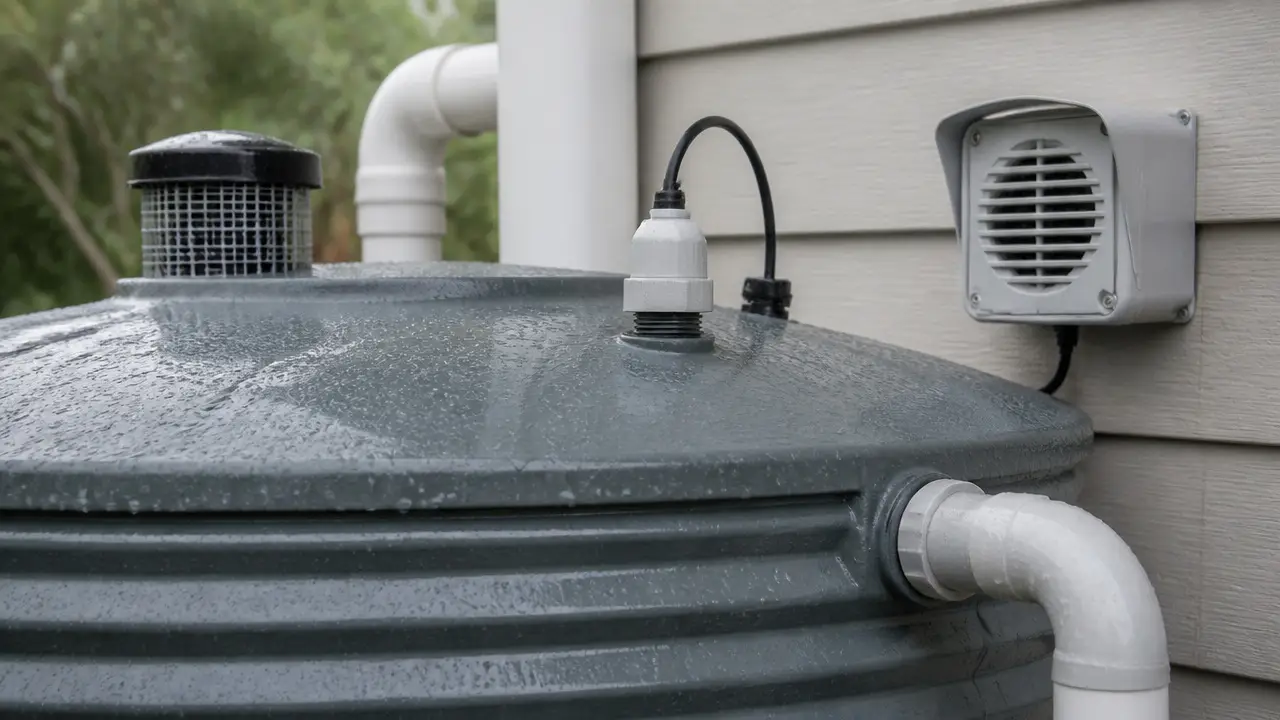
Electronic gauges can be useful when the tank is large, hard to reach, underground, or far from the house.
Several types are available.
Ultrasonic Sensors
An ultrasonic sensor is mounted above the water. It sends a sound pulse toward the surface and measures how long the echo takes to return.
The system converts that distance into a water-level reading.
These sensors can provide a reading without touching the water. However, the sensor must have a clear path toward the water surface.
Foam, condensation, tank shape, internal pipes, and poor sensor placement can affect readings.
Pressure Sensors
A pressure sensor can measure the pressure created by the water above it.
Deeper water creates more pressure, so the system can estimate the water depth.
These sensors may be installed near the bottom of the tank or suspended in the water, depending on the design.
Guidance on key facts about some good devices for measuring water tank level helps evaluate cleaning access for sediment and odor control.
They need to be rated for the intended environment and installed according to the sensor instructions.
Float Switches
A float switch usually tells you whether the water has reached a particular level rather than giving an exact percentage.
For example, switches might indicate:
- Low water
- Half full
- High water
- Nearly full
Float switches are also commonly used with pumps and controls.
A low-level switch can help prevent a pump from running when the tank is empty. This is called dry-run protection.
Mark the Tank at Useful Levels
If you use a sight tube or visible level indicator, adding permanent marks can make readings faster.
Useful marks might include:
- 25%
- 50%
- 75%
- Full
- Minimum pump level
You can calculate each mark from the tank's usable water depth if the tank has straight sides.
Do not assume the very bottom of the tank is usable water. The outlet may sit above the floor, and sediment may collect below it.
Likewise, the tank may stop filling below the roof because of the overflow opening.
Measure or use the manufacturer's usable dimensions when possible.
Watch the Water Level While It Rains
Tank level information becomes more useful when you compare it with rainfall and water use.
If the tank reaches full capacity quickly during normal storms, you may be losing useful water through the overflow.
If it rarely fills, possible reasons include:
- The tank is large compared with the collection area
- Rainfall has been low
- Only part of the roof drains to the tank
- Gutters or downspouts are blocked
- A diverter is sending water elsewhere
- The system has a leak
- Water use is keeping up with collection
Do not assume a low tank level means the tank is too small or too large. Look at both collection and water use.
Make Sure the Gauge Shows Usable Water
A tank can contain water that your system cannot actually reach.
For example, a pump intake may sit several inches above the bottom. Sediment may also make the lowest part of the tank unsuitable for normal withdrawal.
If your gauge says 10% remains but the pump is already drawing air, the gauge needs to be interpreted based on the usable operating range.
You can mark the lowest practical operating level separately from "empty."
Check Level Gauges During Maintenance
Tank gauges can become inaccurate over time.
Check for:
- Algae inside sight tubes
- Kinked or blocked tubing
- Leaking fittings
- Stuck floats
- Tangled float cords
- Dirt on sensors
- Condensation around ultrasonic sensors
- Loose electrical connections
- Incorrect calibration
Compare the gauge with a direct level measurement occasionally when that can be done safely.
A reading that suddenly changes without rain or water use may point to a sensor problem or a leak.
Do Not Enter a Rainwater Tank to Check the Level
Never climb inside a cistern or enclosed water tank just to inspect the water level.
A tank can be a confined space with poor air quality, difficult exits, slippery surfaces, and other hazards.
Also avoid standing on tank lids unless they are specifically designed to support people.
Most level checks can be made from outside the tank using a gauge, tube, sensor, or safe access point.
Which Tank Level Method Is Best?
For many small above-ground systems, a sight tube or mechanical float gauge is enough.
A useful rule is:
| Situation | Practical option |
|---|---|
| Small rain barrel | Sight tube or dipstick |
| Above-ground storage tank | Sight tube or float gauge |
| IBC tote | Visible tank wall or sight tube |
| Large cistern | Mechanical or electronic gauge |
| Underground tank | Electronic or pressure-based sensor |
| Tank far from the house | Remote electronic monitor |
| Pumped system | Level sensor plus low-water protection |
Choose a system that is easy to inspect and maintain. A complicated gauge is not very useful if you cannot tell when it has stopped reading correctly.
Frequently Asked Questions
How can I tell how full my rainwater tank is without opening it?
Use a clear sight tube, mechanical float gauge, or electronic level sensor. These methods allow you to check the water level from outside the tank.
Can I tell the tank level by tapping on the side?
Sometimes the sound changes above and below the water line, but tapping is not a reliable way to measure tank volume. A sight tube or gauge gives a clearer reading.
Does halfway up the tank mean half the water is left?
Yes for most straight-sided vertical or rectangular tanks. It is not generally true for horizontal cylindrical, tapered, or irregular tanks.
Can I use a clear hose as a water-level gauge?
Yes. A clear hose connected near the bottom can act as a sight tube because the water inside the hose rises to approximately the same height as the water inside the tank. The connection must be secure and watertight.
How do I know how many gallons are left?
For a straight-sided tank, multiply the tank's usable capacity by the fraction of its usable depth that contains water. For irregular or horizontal tanks, use a level-to-volume chart based on the tank's dimensions.
Why does my tank gauge say water is left when my pump stops working?
The pump intake may sit above the bottom of the tank. Water below the intake may not be usable by the pump. Mark the minimum operating level separately from the physical bottom of the tank.
What is the best gauge for an underground rainwater tank?
An electronic sensor, such as an ultrasonic or pressure-based level sensor, is often more practical because the water cannot easily be seen from outside. The sensor must be suitable for the tank layout and environment.