As an affiliate, we may earn a commission from qualifying purchases. We get commissions for purchases made through links on this website from Amazon and other third parties.
The best drip irrigation kit is not the one with the most parts. It is the kit that matches your water source, garden layout, and available pressure.
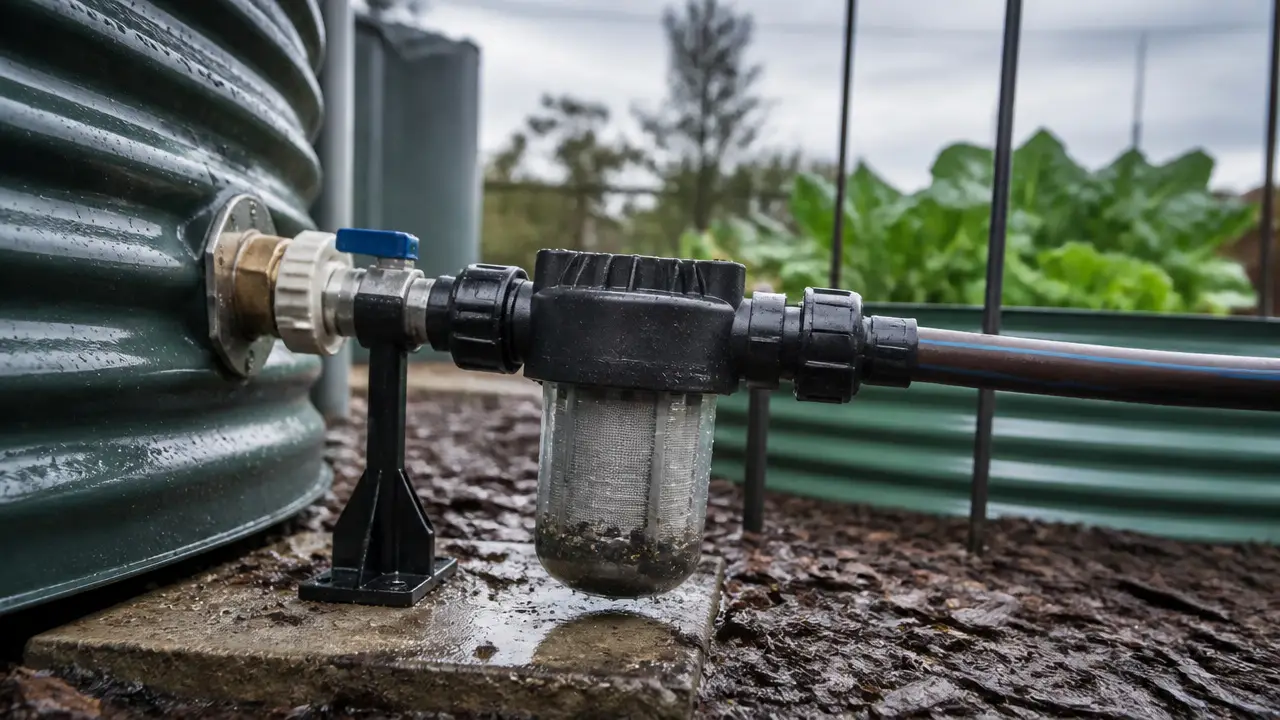
For most home gardens connected to a hose faucet, a good all-purpose kit uses 1/2-inch supply tubing, smaller branch tubing or dripline, a filter, a pressure regulator, suitable emitters, and enough fittings to divide the system into useful watering zones. If you plan to run drip irrigation from a rain barrel or low cistern, choose equipment specifically designed for low-pressure or gravity-fed irrigation instead. A standard faucet kit may not work well with the very low pressure from a barrel.
What Should a Good Drip Irrigation Kit Include?
A basic kit should give you the parts needed to move water from the source to the plants without forcing incompatible pieces together.
Look for these core parts:
- Main supply tubing, often around 1/2 inch
- Dripline, small branch tubing, or both
- Drip emitters suited to the plants
- A water filter
- A pressure regulator when using pressurized water
- Tees, elbows, couplers, and end fittings
- Tubing stakes or hold-downs
- Plugs for closing unused holes
- A faucet or hose connection that fits your water source
- Backflow protection where required for a household water connection
Colorado State University Extension lists filtration and pressure regulation among the important parts of a home drip system and notes that common setup mistakes include leaving out the filter or pressure reducer.
A timer can also be useful, but it is not necessary for the irrigation system itself to work.
The Best Type Depends on What You Are Watering
Different gardens need water distributed in different ways.
Raised Beds and Vegetable Rows
For raised beds, a kit built around dripline with emitters already installed inside the tubing is usually the simplest choice.
Instead of running a small tube to every vegetable, you lay several parallel lines through the bed. Water comes out at regular points along each line.
This works well for:
- Lettuce
- Beans
- Carrots
- Peppers
- Tomatoes
- Herbs
- Mixed vegetable beds
The exact line spacing should match the soil, crop spacing, and emitter pattern rather than following one number for every garden. Colorado State University gives 12-inch line spacing as one example for typical raised vegetable beds, while larger plants may need fewer lines.
Pots and Containers
For pots, look for a kit with 1/4-inch branch tubing and individual emitters.
A larger supply line can run along the patio or garden edge. Small tubes then branch off to individual pots.
This makes it easier to give each container its own emitter rather than soaking the entire area around the pots.
It also allows you to change emitter placement when containers move.
Shrubs and Widely Spaced Plants
Individual emitters are usually more useful than closely spaced dripline when plants are far apart.
The main tube runs through the bed, and individual emitters deliver water near each plant's root area.
As shrubs and trees grow, the watering area usually needs to expand as well. Keeping a single emitter next to the trunk year after year may leave much of the active root area dry.
Dense Flower Beds
Closely spaced emitter tubing can work better in dense beds than running separate small tubes to dozens of plants.
Utah State University Extension describes both approaches: individual micro-tubes and emitters for spaced plants, and grid-style tubing with built-in emitters for densely planted areas.
Choose the Kit Based on Your Water Source
This is especially important because a kit that works from a household faucet may perform poorly from a rain barrel.
Household Faucet
A hose faucet normally provides far more pressure than drip tubing needs.
A pressure regulator reduces that pressure to the operating range required by the drip equipment. Drip components vary, so use the pressure recommended by the tubing and emitter manufacturer rather than assuming every system uses the same pressure.
A filter is also important because the small openings inside emitters can clog.
For a permanent system connected to household plumbing, backflow protection may also be required. Backflow prevention keeps irrigation water from moving backward toward the household drinking-water system. Requirements vary, so check with the local water provider or building authority.
Rain Barrel
A rain barrel creates very little pressure unless it is elevated substantially.
Water pressure from gravity is roughly:
0.43 psi for every foot of vertical water height
This vertical distance is called head height. It is measured from the water surface to the outlet or irrigation point.
For example, 4 feet of head produces only about:
4 × 0.43 = 1.7 psi
Real pressure available at the emitters will be lower once water travels through tubing, fittings, and filters.
That is much less than many faucet-connected drip systems are designed to use.
For a rain barrel, look for a kit specifically described as compatible with gravity-fed or very-low-pressure water sources. Avoid assuming that ordinary pressure-compensating emitters will operate correctly from a barrel.
Pumped Rainwater Tank or Cistern
A pump changes the situation because it can provide useful pressure and flow.
The drip system still has to match:
- Pump pressure
- Available flow
- Pressure regulator requirements
- Tubing size
- Number of emitters running at once
A pump should also have suitable controls and protection against running dry.
Rainwater should be filtered before it reaches small drip emitters. Roof runoff can contain leaves, grit, insects, organic material, and other debris capable of clogging a drip system.
Filtration Matters More Than It Seems
Drip emitters have small water passages. Even relatively small particles can restrict them.
That makes a filter one of the most important parts of a kit.
Colorado State University recommends filtration for drip irrigation and notes that relatively clean municipal water may use a 150- to 200-mesh filter. The correct filter ultimately depends on the emitter manufacturer's requirements and the water source.
Rainwater systems may need more attention because stored rainwater can contain fine sediment and biological material even when a leaf screen or first-flush device is installed.
A first flush device diverts some of the initial roof runoff away from storage. That first runoff often carries concentrated dirt and debris from the roof. It helps reduce contamination entering the tank, but it does not replace irrigation filtration.
Choose a filter that you can easily open, inspect, and clean.
Pressure-Regulated vs. Gravity-Fed Kits
These two types should not be confused.
| Water source | Better kit type | Main concern |
|---|---|---|
| Household hose faucet | Standard regulated drip kit | Reduce excessive pressure |
| Pressurized irrigation line | Pressure-rated drip kit | Match regulator and components |
| Rain barrel without pump | Gravity/low-pressure kit | Not enough pressure |
| Elevated IBC tote | Low-pressure system unless sufficiently pressurized | Head height and flow |
| Pumped cistern | Regulated drip system | Pump pressure and available flow |
Installing a normal pressure regulator on an already low-pressure rain barrel system can make matters worse. Regulators are generally designed to reduce higher incoming pressure, not create pressure that is not there.
Check Flow Before Choosing a Large Kit
Account for an easy-to-use drip irrigation system to verify storage recovery between successive watering periods.
Flow rate tells you how much water can move through the system over a certain period.
Drip emitters are commonly rated in gallons per hour, or GPH.
If you have 20 emitters rated at 1 GPH each, the zone requires about:
20 × 1 GPH = 20 GPH
The source and tubing need to supply that amount while maintaining enough operating pressure for the emitters.
Colorado State University recommends adding the flow requirements of all emitters and other watering devices operating in a zone so the total does not exceed the system's available flow.
Large gardens are often better divided into several zones rather than attaching every emitter to one long line.
Pressure-Compensating Emitters Can Improve Uniformity
A pressure-compensating emitter is designed to maintain a more consistent flow while water pressure changes within its approved operating range.
They can be useful for:
- Longer irrigation lines
- Sloped gardens
- Systems with moderate pressure differences
- Gardens where even application matters
They do not solve every pressure problem.
In particular, they cannot compensate for pressure below the emitter's minimum operating requirement. That is why a pressure-compensating faucet emitter is not automatically a good rain-barrel emitter.
Make Sure the Tubing and Fittings Match
Drip irrigation parts can look interchangeable when they are not.
Nominal tubing labels do not always tell you the exact inside and outside dimensions. Fittings from one tubing system may therefore fit another poorly.
Before buying a kit or expanding one, check:
- Tubing inside diameter
- Tubing outside diameter
- Fitting type
- Mainline connection size
- Faucet or tank connection
- Emitter connection method
- Pressure limits
Keeping the main tubing and fittings within one compatible system makes future repairs much easier.
For rainwater tanks, also check the tank outlet before ordering irrigation parts. An IBC tote, rain barrel, or cistern outlet may require an adapter before standard irrigation tubing can connect to it.
Do You Need Adjustable Emitters?
Adjustable emitters sound convenient because you can change their output by hand.
They can work well for mixed container gardens where individual plants have different needs.
For larger systems, fixed-flow emitters are often easier to manage because their expected output is known. That makes calculating total system flow much simpler.
Built-in dripline emitters are generally the simpler choice for rows and dense planting areas.
A Timer Is Useful, but It Cannot Decide How Much to Water
A faucet timer can automate irrigation, but there is no single correct schedule for every drip system.
Run time depends on:
- Emitter flow
- Number of emitters per plant
- Soil type
- Root depth
- Weather
- Plant size
- Plant type
- Mulch
- Recent rainfall
Colorado State University recommends adjusting operation based on soil moisture, plant requirements, and seasonal conditions rather than relying on a fixed schedule year-round.
Check the soil after irrigation. The goal is to wet the useful root zone without constantly keeping the soil saturated.
What About Rainwater Irrigation?
Drip irrigation and stored rainwater can work well together, but the system needs to be designed as one chain:
collection → storage → outlet → filtration → pressure or gravity supply → tubing → emitters
The best irrigation kit cannot correct problems earlier in that chain.
For example, a good dripline will still clog quickly if dirty tank water reaches it without adequate filtration. A standard faucet kit may barely flow when connected directly to a low rain barrel. And adding hundreds of emitters will not help if the supply line cannot provide enough flow.
When using harvested rainwater, also provide a safe tank overflow and prevent mosquitoes and debris from entering storage.
Rainwater used for garden irrigation is non-potable, meaning it is not being treated and supplied as drinking water. Keep rainwater plumbing separated from potable household plumbing unless the system has been professionally designed to meet applicable local requirements.
Maintenance Should Be Simple
The best kit is one you can maintain without dismantling the whole garden.
During the watering season:
- Inspect emitters for weak or missing flow.
- Clean the filter when debris builds up.
- Check fittings for leaks.
- Look for crushed or kinked tubing.
- Flush lines when sediment accumulates.
- Replace damaged emitters or tubing.
- Adjust emitter locations as plants grow.
Extension guidance also recommends flushing lines and periodically checking filters and emitters for clogging.
In freezing climates, drain parts that can trap water and follow the manufacturer's winterizing instructions. Filters, timers, regulators, valves, and other rigid components are generally more vulnerable to freeze damage than flexible tubing.
So, What Is the Best Drip Irrigation Kit?
For a typical vegetable garden connected to a hose faucet, the best starting point is a kit with a 1/2-inch main supply line, built-in emitter dripline or appropriate individual emitters, a cleanable filter, a matched pressure regulator, compatible fittings, stakes, and end closures.
For containers, choose a system based on a main supply line with 1/4-inch branches and individual emitters.
For shrubs and widely spaced plants, use individual emitters that can be repositioned or expanded as plants grow.
For a rain barrel without a pump, choose a low-pressure or gravity-compatible kit rather than a standard faucet drip kit.
The key is compatibility. Match the kit to your water source first, then the garden layout, required flow, and plant spacing. A smaller kit that works at your available pressure is much more useful than a large kit full of emitters your water source cannot operate.
Frequently Asked Questions
Can I connect a drip irrigation kit directly to a rain barrel?
Yes, but only if the irrigation components can operate at the very low pressure produced by the barrel. Many standard faucet drip kits need more pressure. A gravity-compatible system or a suitable pump may be needed.
Do I need a pressure regulator for drip irrigation?
Usually yes when the system is connected to a pressurized household faucet or irrigation supply. Use a regulator that matches the operating requirements of the drip equipment. A gravity-fed rain barrel may already have too little pressure and normally should not use a conventional regulator unless the system design specifically calls for one.
Do I need a filter if I use rainwater?
Yes. Rainwater can contain sediment and organic debris that clog small emitter passages. Screens and first-flush devices help protect storage but do not eliminate the need for suitable irrigation filtration.
Is dripline better than individual emitters?
Neither is always better. Dripline is convenient for closely spaced vegetables and dense beds. Individual emitters are often easier for pots, shrubs, trees, and plants spaced far apart.
How many emitters can I put on one drip line?
It depends on emitter flow, tubing size, line length, elevation, available pressure, and the manufacturer's limits. Add the flow rates of all emitters in the zone and make sure both the water source and tubing can support the total.
Can I bury drip irrigation tubing?
Some dripline is designed for subsurface use, while other tubing is intended for the soil surface or beneath mulch. Follow the tubing manufacturer's instructions. Surface tubing is easier to inspect for leaks and clogged emitters.
Can I use drip irrigation in freezing weather?
Drip systems should generally be shut down and winterized where freezing occurs. Drain components that hold water and protect vulnerable timers, filters, regulators, valves, and fittings according to manufacturer instructions.