As an affiliate, we may earn a commission from qualifying purchases. We get commissions for purchases made through links on this website from Amazon and other third parties.
For most rain barrels, the best hose is a standard 5/8-inch garden hose that stays flexible and has good-quality threaded fittings. A 1/2-inch hose can work for short runs and light watering, while a 3/4-inch hose is better when you need to move more water over a longer distance.
The hose itself is only part of the decision. Rain barrels usually provide much less pressure than a house faucet. Hose length, diameter, barrel height, fittings, and the watering tool at the end can all affect how well the system works.
What Hose Size Works Best With a Rain Barrel?
A 5/8-inch garden hose is a good starting point for most rain barrel setups.
It offers a useful balance between:
- Water flow
- Weight
- Flexibility
- Ease of handling
- Compatibility with common garden fittings
A smaller or larger hose may make sense in some systems.
| Hose size | Best use | Main limitation |
|---|---|---|
| 1/2 inch | Short hose runs and small watering jobs | More flow loss over longer distances |
| 5/8 inch | Most rain barrel watering | Good general-purpose choice |
| 3/4 inch | Longer runs or higher desired flow | Heavier and harder to handle |
The connection on the barrel matters too. Many rain barrels use a spigot or adapter with standard garden-hose threads, but not all barrels are built the same way. Check the fitting before choosing a hose.
Why Rain Barrel Hoses Behave Differently
A hose connected to an outdoor faucet may receive relatively high water pressure. A hose connected directly to a rain barrel usually does not.
Most simple rain barrels depend on gravity.
Water pressure increases as the water surface gets higher above the hose outlet. This vertical distance is sometimes called head height.
For example, raising a barrel on a stable stand can give the water more head height and improve gravity flow. The improvement is still modest compared with household water pressure.
A full barrel may also flow better than a nearly empty one because the water level is higher.
This is why a very long, narrow hose can perform poorly on a rain barrel even if the same hose works well on a faucet.
A Larger Hose Can Improve Gravity Flow
Water loses pressure as it moves through a hose. Longer hoses and smaller inside diameters create more resistance.
If you are watering a garden 10 feet from the barrel, a normal 5/8-inch hose may work well.
If you are trying to move water 50 feet or more, a larger hose may reduce some of the flow loss.
However, a large hose cannot create pressure that the barrel does not have. If the garden is uphill from the barrel, gravity flow may become very weak or stop completely.
For longer distances, uphill movement, or equipment that requires pressure, a pump may be a better solution than simply installing a larger hose.
Choose a Hose That Will Not Kink Easily
Kinks matter more in a low-pressure rain barrel system than they do with a pressurized faucet.
Even a partially collapsed hose can greatly reduce gravity flow.
Look for a hose that:
- Remains flexible in your normal outdoor temperatures
- Resists flattening when bent
- Does not kink easily
- Has secure fittings at both ends
- Can tolerate regular outdoor exposure
Very lightweight expandable hoses may be less suitable for some gravity-fed systems because their behavior can depend on water pressure. Check the hose manufacturer's operating requirements before using one with a rain barrel.
Check the Rain Barrel Connection First
Before buying or connecting a hose, inspect the barrel outlet.
A typical setup may include:
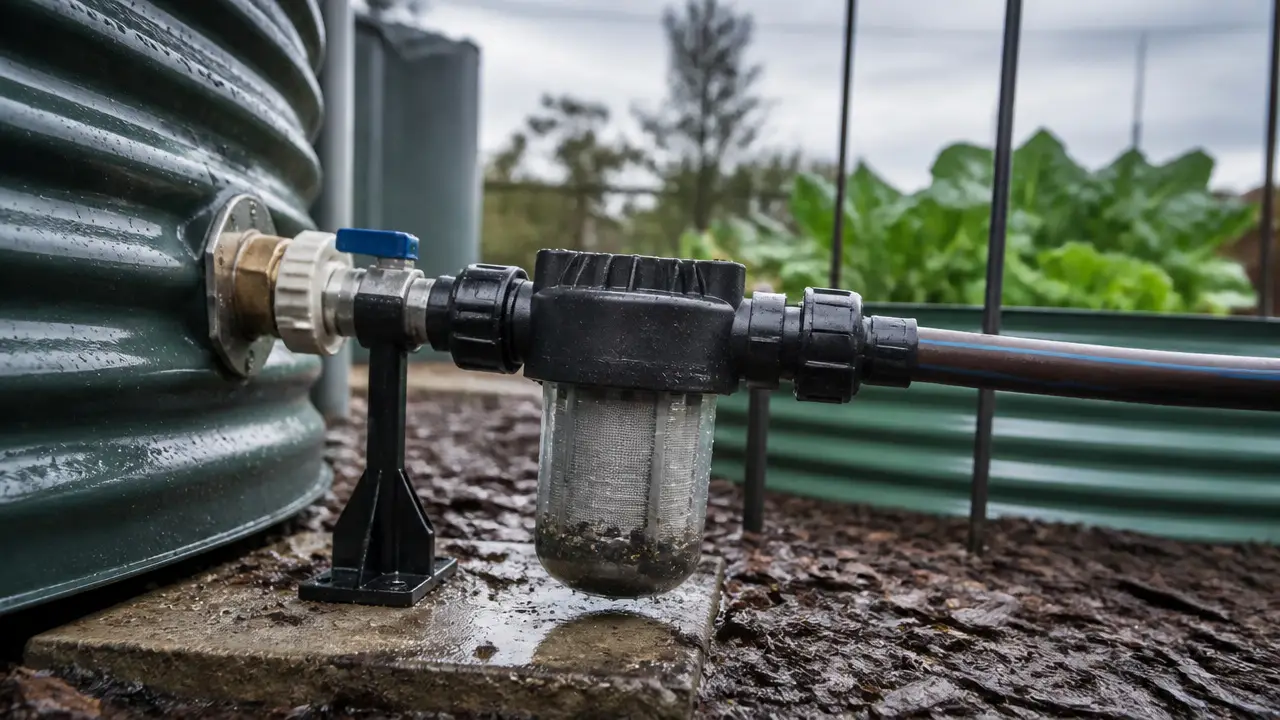
Barrel → outlet fitting → valve or spigot → hose
Some barrels have a garden-hose-compatible spigot. Others may use pipe threads or a different fitting that requires an adapter.
Do not force mismatched threads together. They can leak or permanently damage plastic fittings.
A barrel may also use a bulkhead fitting. This is a fitting that passes through the barrel wall and creates a sealed connection for a valve, pipe, or hose adapter.
If you are adding your own bulkhead fitting, follow the fitting manufacturer's installation requirements. Cutting or modifying a barrel incorrectly can cause permanent leaks.
Keep the Hose Run as Short as Practical
For gravity-fed watering, shorter is usually better.
A short hose:
- Has less friction loss
- Gives better flow
- Is easier to drain
- Is easier to clean
- Has fewer places for water to sit
Do not automatically attach a 100-foot hose just because you already own one. If the plants are only 15 feet away, using a shorter hose can make a noticeable difference.
If you need a long run, consider installing a larger-diameter supply line for most of the distance and using a shorter flexible hose near the watering area.
Can You Use a Soaker Hose With a Rain Barrel?
Sometimes, but performance varies.
Soaker hoses are made to release water slowly along their length. Many are designed around a certain operating pressure. A gravity-fed rain barrel may not supply enough pressure for even watering across a long soaker hose.
A short soaker hose located below an elevated barrel may work better than a long one.
Before installing one, check the manufacturer's pressure requirements. If the hose requires more pressure than gravity can provide, you may need a suitable pump or a different irrigation layout.
Drip irrigation has the same issue. Some drip components work at very low pressure, while others require pressure regulators, emitters, or operating pressures that a basic rain barrel cannot provide.
Avoid Restrictive Hose Accessories
Every small opening adds resistance.
Consider practical considerations for a rain barrel have enough pressure for a hose to verify target pressure at the furthest delivery fixture.
Low-pressure rainwater systems can lose a surprising amount of flow through:
- Small hose adapters
- Partially open valves
- Narrow quick-connect fittings
- Clogged screens
- Spray nozzles
- Long sections of small tubing
A spray nozzle that works well on a house faucet may produce little more than a trickle from a gravity-fed barrel.
For basic watering, an open-ended hose or a simple low-restriction watering attachment often works better.
Keep the Outlet and Hose Screen Clean
Rainwater can carry small pieces of leaves, roof debris, insects, sediment, and organic material into storage.
A screen or prefilter can help keep larger material out of the barrel. Still, sediment may collect over time.
If hose flow becomes weaker than usual, safely check:
- The water level in the barrel.
- Whether the valve is fully open.
- Whether the hose is kinked.
- Whether the outlet screen is clogged.
- Whether sediment is blocking the barrel outlet.
- Whether the end attachment is restricting flow.
Cleaning gutters, inlet screens, and barrel components as needed can reduce these problems.
A first-flush diverter may also be part of some collection systems. It directs the first portion of runoff away from storage, helping reduce some dirt and debris washed from the roof. It does not make stored rainwater automatically safe to drink.
Raising the Barrel Can Help
If gravity flow is weak, increasing the barrel's height may help.
However, water is heavy. A filled barrel can weigh hundreds of pounds. Larger tanks weigh much more.
Only place a barrel on a level, stable base or stand designed to support the expected load. Do not improvise with unstable blocks, loose lumber, or furniture.
Also secure the barrel if tipping is possible.
If substantially more pressure is required, use a properly selected water pump rather than raising a heavy tank to an unsafe height.
What Hose Material Should You Choose?
For ordinary garden irrigation with non-potable rainwater, a durable outdoor garden hose is usually sufficient.
Non-potable means water that is not intended for drinking.
If stored rainwater will be used for a more sensitive purpose, hose material becomes more important. Do not assume that an ordinary garden hose is suitable for drinking-water service.
Water intended for drinking requires a much broader approach. Roof material, collection surfaces, storage, plumbing materials, prefiltration, treatment, ongoing maintenance, current laboratory testing, and applicable local requirements all matter. A special hose by itself cannot make collected rainwater potable.
Consider Freezing Weather
A hose full of water can freeze.
Freezing water expands and may damage:
- Hoses
- Valves
- Spigots
- Pumps
- Filters
- Barrel fittings
In freezing climates, follow the barrel and hose manufacturers' winterizing instructions.
A common part of winter preparation is disconnecting and draining hoses when the system will not be used. The barrel itself may also need seasonal preparation depending on its design and climate.
Do not assume that a flexible hose makes the entire system freeze-proof.
A Simple Hose Setup for Garden Watering
For many homeowners, a practical layout is:
Rain barrel → full-flow valve → 5/8-inch hose → garden
Keep the hose reasonably short and avoid unnecessary adapters.
If flow is too slow, work through the system in this order:
- Remove kinks and restrictions.
- Clean the outlet and screens.
- Shorten the hose if possible.
- Confirm that the hose or watering attachment works with low pressure.
- Consider a larger hose.
- Increase safe head height if practical.
- Consider a suitable pump if real pressure is required.
This approach usually makes more sense than starting with complicated plumbing.
Frequently Asked Questions
Can I use a regular garden hose on a rain barrel?
Yes. A regular garden hose is suitable for many rain barrels used for garden watering, provided the hose fitting matches the barrel outlet. A 5/8-inch hose is a good general-purpose size.
Is a 1/2-inch or 5/8-inch hose better for a rain barrel?
A 5/8-inch hose is generally better when gravity provides the water flow because its larger inside diameter creates less resistance. A 1/2-inch hose may still work well for short distances and low-flow watering.
Will a 3/4-inch hose make my rain barrel flow faster?
It can reduce friction loss, especially on longer runs, but it cannot create additional pressure. Barrel height, water level, valves, fittings, and elevation changes also affect flow.
Why does my rain barrel hose have such low pressure?
Most rain barrels use gravity rather than household water pressure. A low barrel, long hose, small fittings, clogged outlet, uphill hose run, or restrictive nozzle can make the flow even weaker.
Can I attach a spray nozzle to a rain barrel hose?
You can, but many spray nozzles work poorly at the low pressure produced by gravity-fed barrels. A low-restriction attachment or an open hose may provide better flow.
Can I connect a soaker hose directly to a rain barrel?
Possibly. Some soaker hoses can work with low-pressure systems, while others need more pressure than a rain barrel provides. Check the hose manufacturer's operating requirements and keep the run reasonably short.
Should I use a drinking-water-safe hose with a rain barrel?
For ordinary non-potable garden watering, a standard suitable outdoor hose is commonly used. If rainwater is intended for drinking or another sensitive use, hose selection is only one part of a complete water-safety system involving appropriate collection, treatment, maintenance, testing, and local requirements.