As an affiliate, we may earn a commission from qualifying purchases. We get commissions for purchases made through links on this website from Amazon and other third parties.
The right hose size for a rain barrel diverter is the size that matches the diverter outlet and the rain barrel inlet fitting. Do not choose the hose by barrel size alone.
Many rain barrel diverter kits use hose in the general range of 1/2 inch to 1 inch, but there is no single standard size. A replacement hose should match the fittings on your specific system.
How to Find the Correct Hose Size
Check these three parts before buying or cutting hose:
- The outlet on the downspout diverter
- The inlet fitting on the rain barrel
- The hose that must connect them
Ideally, both fittings are designed for the same hose diameter.
If you already have the original hose, replacing it with the same inside diameter is usually the simplest choice.
Measure the Hose, Not Just the Fitting
Flexible hose is normally described by its inside diameter, or ID.
For example, a hose sold as 3/4-inch hose generally has an opening about 3/4 inch across. Its outside diameter will be larger because of the hose wall.
This matters because measuring the outside of an old hose can lead you to buy the wrong size.
If you do not have the original hose, check the diverter instructions or measure the connection carefully.
Common Rain Barrel Diverter Hose Sizes
There is no universal rain barrel hose size. Depending on the design, you may encounter connections such as:
- 1/2 inch
- 5/8 inch
- 3/4 inch
- 1 inch
Some systems use flexible tubing that slips over a barbed fitting. Others use threaded adapters, rubber connectors, or fittings made specifically for that diverter kit.
A 3/4-inch fitting on one system also does not necessarily mean that any hose labeled 3/4 inch will fit. Hose-barb dimensions, tubing type, and wall stiffness can affect the connection.
When possible, match the manufacturer's specified tubing size.
Why Hose Size Matters
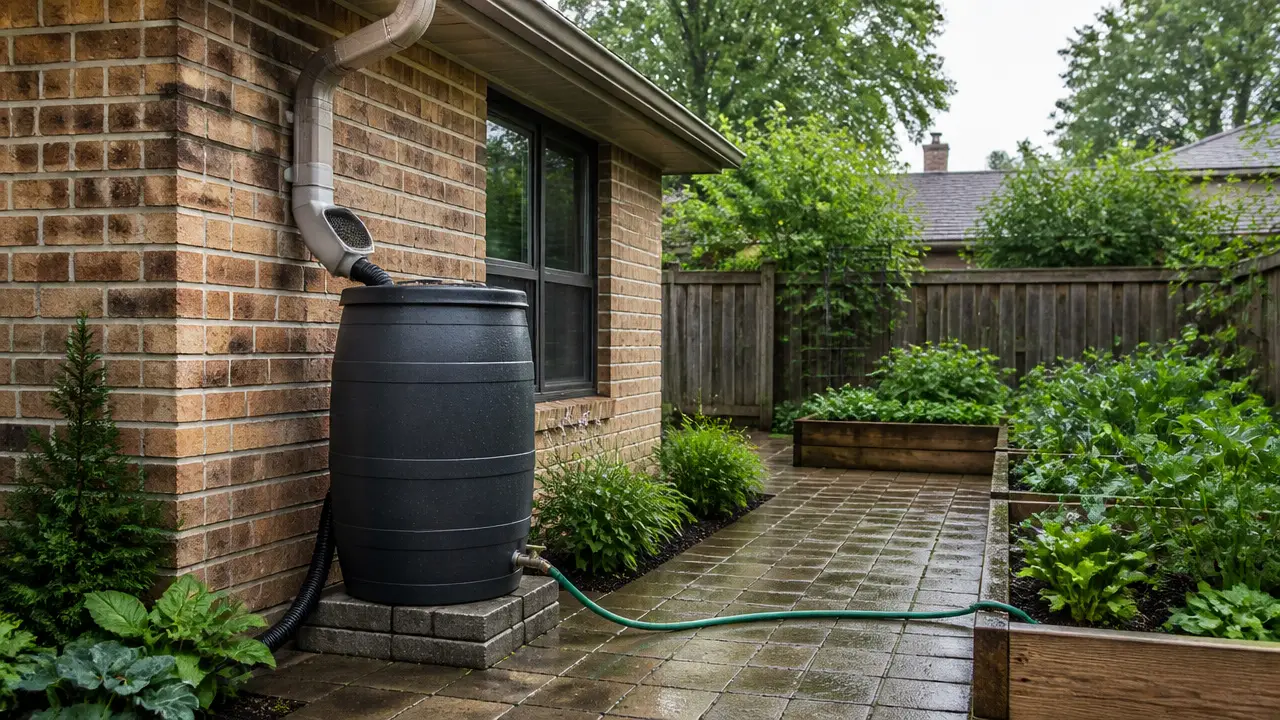
The hose carries water from the downspout diverter into the barrel. If it is too small, too large, kinked, or poorly fitted, the system may not work as intended.
A Hose That Is Too Small
A hose with too little inside diameter can restrict flow.
During heavier rain, water may not move toward the barrel as easily. The diverter should still send excess water down the downspout if it is designed correctly, but unnecessary restriction can reduce how quickly the barrel fills.
Do not automatically install a larger hose to fix this. The diverter opening itself may still be the limiting point.
A Hose That Is Too Large
A larger hose does not help if it does not seal against the fittings.
Trying to clamp an oversized hose tightly around a smaller connector can create:
- Leaks
- Loose connections
- Distorted hose
- Connections that pull off under movement
Use properly sized adapters rather than forcing mismatched parts together.
Check the Diverter Connection Type
The diameter is only part of the answer. You also need to know how the hose attaches.
Barbed Fittings
A hose barb has raised ridges that grip the inside of flexible tubing.
The tubing normally slips over the barb and may be secured with a suitable clamp if the system calls for one.
Match tubing to the barb size specified for the fitting. A hose that is too stiff or too small can split when forced onto the barb.
Threaded Fittings
Some diverter or barrel connections use threaded fittings instead of a simple hose barb.
In that case, you may need an adapter that changes the threaded connection to the correct hose connection.
Do not assume a stated thread size equals the hose's inside diameter. Plumbing thread sizes are nominal sizes and do not always match the diameter you measure with a ruler.
Proprietary Connectors
Some rain barrel diverters use molded connectors designed around the hose supplied with the kit.
Replacement tubing may need to match both its diameter and flexibility. Checking the kit instructions is safer than choosing tubing based only on appearance.
Hose sizing should support the overflow plan for diverting water when a rain barrel is full.
The Hose Should Run Properly Between the Diverter and Barrel
Correct diameter will not help if the hose layout prevents water from flowing.
Follow the diverter manufacturer's installation instructions for the relative height of the diverter and barrel connection.
Many diverter systems depend on the position of the barrel inlet to control filling and overflow behavior. Raising, lowering, or rerouting the connection can change how the system works.
Avoid:
- Sharp bends
- Kinks
- Crushed tubing
- Long unnecessary loops
- Hose that pulls sideways on the fittings
Evaluate whether a diverter for a rain barrel is necessary to understand long-term tank ventilation with dependable overflow handling.
Keep the run as simple as the installation allows.
Do You Need a Large Hose for a Large Rain Barrel?
Not necessarily.
A 100-gallon barrel does not automatically require a larger diverter hose than a 50-gallon barrel.
The hose size is determined mainly by the diverter design and its connections, not just storage capacity.
A larger barrel may take longer to fill through a small diverter, but increasing the hose diameter alone will not increase flow if the diverter opening is smaller.
Diverter Hose and Overflow Hose Are Different
Do not confuse the hose coming from the downspout diverter with a barrel's separate overflow connection.
They do different jobs.
The diverter hose moves collected roof runoff from the downspout toward the barrel.
An overflow hose or pipe carries excess water away when the barrel cannot accept more water.
Some diverters are designed so that excess water remains in the downspout instead of using a separate barrel overflow. Other systems need dedicated overflow plumbing.
Follow the design of your particular system rather than assuming the diverter hose can handle both jobs.
What If the Diverter and Barrel Have Different Connection Sizes?
Use the correct adapter rather than forcing one hose onto both fittings.
For example, the system may need:
diverter → hose barb → hose → adapter → barrel fitting
Before assembling it, check:
- Hose inside diameter
- Barb size
- Thread type
- Male or female threads
- Barrel inlet size
- Whether the fitting is intended for flexible tubing
This is especially important when connecting a diverter kit to a barrel that was purchased separately.
Should You Use Clear Vinyl Tubing?
Clear flexible tubing can physically work with some diverters if its dimensions and material are suitable for the fittings.
However, sunlight passing through clear tubing can encourage biological growth inside wet sections of the line.
Opaque tubing is often easier to manage outdoors for that reason.
Whatever tubing you use should also tolerate the expected outdoor temperature range and sunlight exposure. Tubing that becomes brittle, soft, or badly kinked can eventually leak or restrict flow.
Check the Hose During Routine Maintenance
Inspect the diverter hose when you clean the barrel or downspout system.
Look for:
- Cracks
- Loose fittings
- Kinks
- Sediment buildup
- Insect entry points
- Algae or other growth
- Damage from sunlight
- Freeze damage
- Connections pulling away from the barrel
In freezing climates, follow the diverter manufacturer's winterizing instructions. Water trapped in hoses and fittings can freeze, expand, and damage parts.
The Simple Rule
If you are replacing a rain barrel diverter hose, match the hose's inside diameter to the connection size specified by the diverter system.
Do not guess from the downspout size or barrel capacity.
If the diverter and barrel use different connections, use properly sized adapters. The finished hose should fit securely, stay free of kinks, and follow the height and routing requirements of the diverter.
Frequently Asked Questions
Is 3/4-inch hose good for a rain barrel diverter?
It can be if the diverter and barrel fittings are designed for 3/4-inch hose. Do not switch to 3/4-inch tubing simply because it is a common garden-hose size. Check the actual connection requirements.
Can I use a garden hose with a rain barrel diverter?
Only if the diverter is designed for a garden-hose connection or you use suitable adapters. Standard garden-hose threads are different from many hose-barb and plumbing-thread connections.
Should I measure the inside or outside diameter of the hose?
Use the inside diameter when identifying most flexible tubing. Hose is commonly sized according to the diameter of the opening, not its total outside diameter.
Will a bigger hose fill my rain barrel faster?
Not necessarily. Flow may be limited by the diverter opening itself. Installing a larger hose after a smaller outlet generally does not increase the amount of water the diverter can collect.
Can I reduce a large diverter hose to a smaller barrel fitting?
A proper reducer may make the physical connection possible, but the smaller section can restrict flow. Make sure the arrangement is compatible with the diverter design and does not interfere with its overflow or bypass operation.
How long should the hose between the diverter and barrel be?
Use enough hose to make the connection without stretching it, but avoid unnecessary length, loops, and sharp bends. Follow the diverter instructions because some systems depend on specific inlet positioning.
Does the rain barrel size determine the hose size?
No. Barrel capacity and hose diameter are separate issues. The diverter fittings and barrel inlet normally determine the required hose size.