As an affiliate, we may earn a commission from qualifying purchases. We get commissions for purchases made through links on this website from Amazon and other third parties.
Outdoor faucet covers work best as an extra layer of freeze protection, not as the only protection. For most standard hose bibs, a rigid molded-foam cover that fits tightly against the wall is the best simple choice. For large, unusual, or awkward faucets, a weather-resistant insulated fabric cover can fit better.
The cover matters, but winterizing the faucet matters more. Disconnect the garden hose, shut off the indoor supply valve if your plumbing has one, and drain the outdoor line before freezing weather arrives. Water utilities commonly recommend these steps along with insulating the faucet.
Which Type of Outdoor Faucet Cover Is Best?
There are several common styles. The best choice depends mainly on the shape of your faucet, how exposed it is, and how cold your winters get.
| Cover type | Best use | Main advantage | Main limitation |
|---|---|---|---|
| Molded foam cover | Standard wall-mounted hose bib | Simple, firm insulation | May not fit large or unusual faucets |
| Insulated fabric cover | Large or awkward faucet shapes | Flexible fit | Needs good weather resistance |
| Hard-shell insulated cover | Very exposed locations | Protects insulation from wind and weather | Must fit tightly against the wall |
| DIY insulated wrap | Short-term protection | Uses materials you may already have | Less durable and easier to install poorly |
For a normal outdoor faucet on the side of a house, molded foam is usually the best starting point.
Molded Foam Faucet Covers
These are the familiar dome- or cone-shaped covers sold for standard outdoor faucets. The foam surrounds the faucet while a hook, cord, or internal fastener pulls the cover against the wall.
This design works well because it:
- surrounds the faucet with insulating material
- reduces direct exposure to cold wind
- is quick to install and remove
- keeps its shape instead of sagging around the faucet
Portland Water Bureau specifically recommends molded-foam hose bib covers as one option for insulating exterior faucets.
The main issue is fit. A cover that sits crooked or leaves a large gap against the wall will not protect the faucet as well as one that closes around it.
Insulated Fabric Faucet Covers
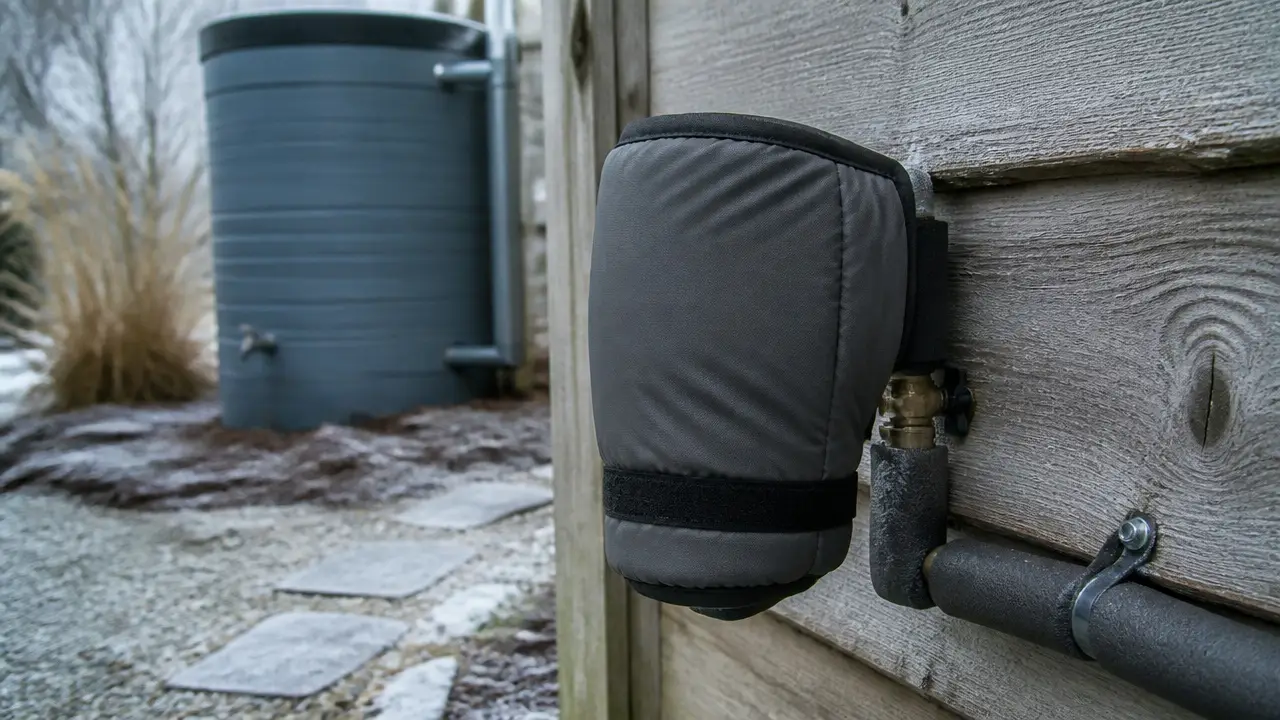
A fabric-style cover looks more like a small insulated pouch. It slips over the faucet and usually closes with a strap or drawstring.
This type can be useful when a rigid foam shell will not fit around:
- long faucets
- unusual handles
- anti-siphon devices
- pipes that extend farther from the wall
- irregular installations
Look for a design that keeps the insulation protected from rain, melting snow, and wind. Wet insulation can become much less useful.
Flexible covers also need to close snugly near the wall or pipe. Simply hanging an insulated bag loosely over a faucet leaves more room for cold air to enter.
Hard-Shell Insulated Covers
Some faucet covers place insulation inside a harder outer shell.
The rigid outside can be useful on faucets exposed to wind, precipitation, or accidental bumps. However, the shell itself is not what provides most of the freeze protection. The insulating layer and the fit against the building are more important.
A large hard cover with poor contact around the wall is not necessarily better than a smaller foam cover that fits properly.
What to Look for in a Good Faucet Cover
You do not need a complicated faucet cover. Focus on a few practical details.
A Snug Fit Against the Wall
A cover should surround the entire faucet and sit close to the wall.
The goal is not to make the faucet airtight. Instead, you want to reduce its exposure to freezing outside air while allowing some warmth from the building side of the wall to remain around the faucet.
Check the shape of the siding before choosing a cover. Uneven stone, brick, deeply textured siding, and pipes coming through oversized openings can make a tight fit harder.
Sealing large air gaps around plumbing penetrations can also help reduce cold-air exposure. Portland Water Bureau recommends caulking around pipes where they enter a building as part of freeze preparation.
Enough Room for the Whole Faucet
Measure before buying.
Check:
- how far the faucet extends from the wall
- the faucet's overall height and width
- the size of its handle
- whether an anti-siphon or vacuum-breaker device sticks upward
- whether nearby pipes interfere with the cover
Do not force a small foam cover over a large faucet. Crushing the cover or leaving one side open defeats much of its purpose.
Insulation That Stays Dry
Outdoor insulation has to deal with rain, snow, condensation, and melting ice.
Rigid closed-cell foam naturally handles moisture fairly well. Soft covers need an outer layer designed to keep most weather away from the insulation.
If you make a temporary cover from cloth or newspaper, protect that insulation from moisture. Portland Water Bureau and Cincinnati's Greater Cincinnati Water Works both recommend covering temporary newspaper or rag insulation with plastic.
A Secure Attachment
Wind can loosen or remove a poorly secured cover.
The attachment should pull the cover firmly toward the wall without putting heavy pressure on the faucet itself. After installation, give the cover a gentle check to make sure it cannot easily slide off.
A Faucet Cover Cannot Replace Winterizing
This is the most important point.
A faucet cover slows heat loss. It does not produce heat, and it cannot guarantee that standing water inside the faucet or pipe will remain above freezing.
When possible, prepare the plumbing itself.
1. Disconnect the Garden Hose
Never leave a hose attached simply because the faucet has a cover.
An attached hose can hold water at the outlet and may prevent some frost-free faucets from draining correctly. Water utilities regularly recommend removing and draining hoses before freezing weather.
Drain the hose and store it where trapped water will not freeze inside it.
2. Shut Off the Outdoor Water Supply If Possible
Some houses have an indoor shutoff valve that controls the outdoor faucet.
If yours does, close that valve before winter.
Then open the outdoor faucet so water remaining between the shutoff and the exterior faucet can drain. Portland and Seattle both recommend this approach when a separate outdoor shutoff is available.
3. Drain the Faucet
After shutting off the indoor valve, open the outdoor faucet.
Let trapped water leave the line. Some plumbing systems also have a small drain or bleeder near the shutoff valve.
Do not force valves that are stuck or heavily corroded. A plumber can repair or replace a valve that no longer operates properly.
4. Install the Cover
Once the hose is removed and the faucet has been winterized as your plumbing allows, install the insulating cover.
Center it over the faucet and tighten its attachment until the edge sits firmly against the building.
What About Frost-Free Outdoor Faucets?
Details about the performance of outside faucet covers help understand temperature controls and clearances for winter hardware.
A frost-free faucet, sometimes called a frost-free sillcock, is designed differently from a standard hose bib.
Its actual shutoff point sits farther inside the building, where temperatures are normally warmer. When installed correctly, the exposed section can drain after the valve is closed.
That does not mean it is impossible to freeze.
A frost-free faucet may still have problems if:
- a garden hose remains attached
- the faucet cannot drain properly
- the pipe slopes the wrong way
- the interior portion passes through an unusually cold space
- temperatures inside the wall or crawl space fall below freezing
Removing the hose is particularly important because the faucet needs somewhere for water to drain.
Adding a foam cover can provide another layer of protection, but it should not be treated as a repair for a frost-free faucet that does not drain correctly.
Are Faucet Covers Enough for Very Cold Weather?
Not always.
A basic insulated cover can be useful during ordinary freezing weather, especially where the plumbing behind the faucet remains within the heated part of the building.
Risk rises when you have:
- prolonged freezing temperatures
- strong cold winds
- plumbing in an unheated crawl space
- exposed supply pipes
- a vacant or poorly heated building
- pipes located close to exterior openings
- a faucet with no way to shut off and drain the line
In those situations, protect the plumbing as a system rather than relying on the cover.
That may mean insulating exposed pipes, sealing drafts, maintaining safe indoor heat, and shutting down vulnerable water lines. Government and utility freeze-prevention guidance commonly includes these measures in addition to faucet covers.
If pipes routinely freeze despite normal winterizing, the problem may involve pipe placement or inadequate protection inside the wall. A qualified plumber can inspect the installation.
Can You Make a DIY Outdoor Faucet Cover?
Yes, particularly for temporary protection.
You can wrap a faucet with dry insulating material such as rags or newspaper and protect the outside with plastic to help keep the insulation dry. This approach appears in guidance from several water utilities.
However, a DIY wrap should not interfere with valves, vents, drains, or other plumbing devices.
For an ordinary hose bib, a properly fitted reusable foam cover is usually simpler.
Also, do not treat exposed backflow-prevention assemblies exactly like ordinary faucets. Some devices have vents or drainage openings that must remain functional. Guidance for above-ground backflow devices specifically warns against blocking required vents and drain outlets while insulating them.
Common Faucet-Cover Mistakes
Even a good cover may provide little protection if the rest of the setup is wrong.
Leaving the Hose Attached
Remove the hose first. This is one of the simplest and most important winterizing steps.
Buying a Cover That Is Too Small
The cover should surround the faucet without being stretched, crushed, or tilted away from the wall.
Ignoring Exposed Supply Pipe
Covering the faucet does little good if several feet of water-filled pipe beside it remain exposed to freezing air.
Insulate vulnerable piping as well.
Using Wet Towels as Insulation
Dry fabric can provide temporary insulation. Wet fabric is much less useful and can freeze around the plumbing.
Protect temporary insulation from precipitation.
Assuming the Cover Guarantees Freeze Protection
No passive faucet cover can guarantee that plumbing will not freeze.
The cover only reduces heat loss. Temperature, wind, duration of the freeze, building heat, plumbing layout, and whether water is trapped inside the line all matter.
Choosing the Best Cover for Your Situation
For most homes, the choice can stay simple.
Choose a molded foam faucet cover when you have a normal wall-mounted hose bib and the cover can sit flat against the building.
Choose an insulated flexible cover when the faucet is too large or oddly shaped for a rigid cover.
Choose a more weather-resistant rigid design when the faucet is highly exposed to wind and precipitation, provided it still fits correctly.
Use dry wrapped insulation protected from moisture as a temporary option when a proper cover is not available.
Most importantly, remove hoses and drain vulnerable plumbing whenever your system allows it. The best faucet cover is an added layer of protection over a properly winterized outdoor water connection, not a substitute for winterizing.
Frequently Asked Questions
Do outdoor faucet covers really work?
Yes. An insulating cover can reduce heat loss around an outdoor faucet and lower its exposure to freezing air. Water utilities including Portland and Seattle recommend insulating exterior faucets as part of winter preparation. A cover cannot guarantee that a water-filled pipe will not freeze, however.
Is foam or fabric better for an outdoor faucet cover?
Molded foam is usually the better simple choice for a standard hose bib because it holds its shape and is easy to fit against a wall. Insulated fabric covers work well for larger or unusually shaped faucets that will not fit inside a rigid cover.
Should I leave my hose connected under the faucet cover?
No. Disconnect, drain, and store the hose before freezing weather. Removing hoses is routinely recommended as part of outdoor faucet winterization.
Do frost-free faucets need covers?
A correctly installed frost-free faucet may not require the same level of protection as a conventional hose bib, but an insulated cover can add protection. The garden hose still needs to be disconnected so the faucet can drain properly.
Should I turn off the water before covering an outdoor faucet?
If your house has a separate shutoff valve for that outdoor line, shutting it off and draining the exterior section gives better protection than relying on insulation alone. Follow the layout of your particular plumbing system.
Can I use towels instead of a faucet cover?
Dry towels or rags can serve as temporary insulation, but they should be protected from rain and snow. Several water utilities recommend adding a plastic outer layer when using rags or newspaper.
Can an outdoor faucet still freeze with a cover on it?
Yes. A cover slows heat loss but does not create heat. Prolonged severe cold, trapped water, exposed pipes, drafts, or an unheated building can still allow plumbing to freeze.