As an affiliate, we may earn a commission from qualifying purchases. We get commissions for purchases made through links on this website from Amazon and other third parties.
Choosing between an above-ground and underground rainwater tank mostly comes down to space, cost, installation work, climate, and how easy you want the system to inspect and maintain.
For most simple home and garden systems, an above-ground tank is easier and cheaper to install. An underground tank makes sense when yard space, appearance, or large storage capacity matters enough to justify excavation and a more complex installation.
Neither type is automatically better. The right tank is the one that fits your site, water use, plumbing layout, and maintenance needs.
Above-Ground vs Underground Rainwater Tanks at a Glance
| Factor | Above-Ground Tank | Underground Tank |
|---|---|---|
| Installation | Usually simpler | Requires excavation and careful site work |
| Access | Easy to inspect and clean | More difficult to access |
| Yard space | Uses visible surface space | Keeps most storage below ground |
| Appearance | Visible | Mostly hidden |
| Plumbing | Often simpler | Usually needs a pump |
| Leak detection | Easier | Harder |
| Freeze exposure | Greater | Often lower below frost-prone surface areas |
| Structural concerns | Needs a firm, level base | Must handle soil and groundwater forces |
| Expansion | Often easier to add tanks | Usually harder after installation |
| Maintenance | Generally easier | More involved |
| Best fit | Gardens, homes, cabins, simple reuse | Large systems or limited surface space |
What Is an Above-Ground Rainwater Tank?
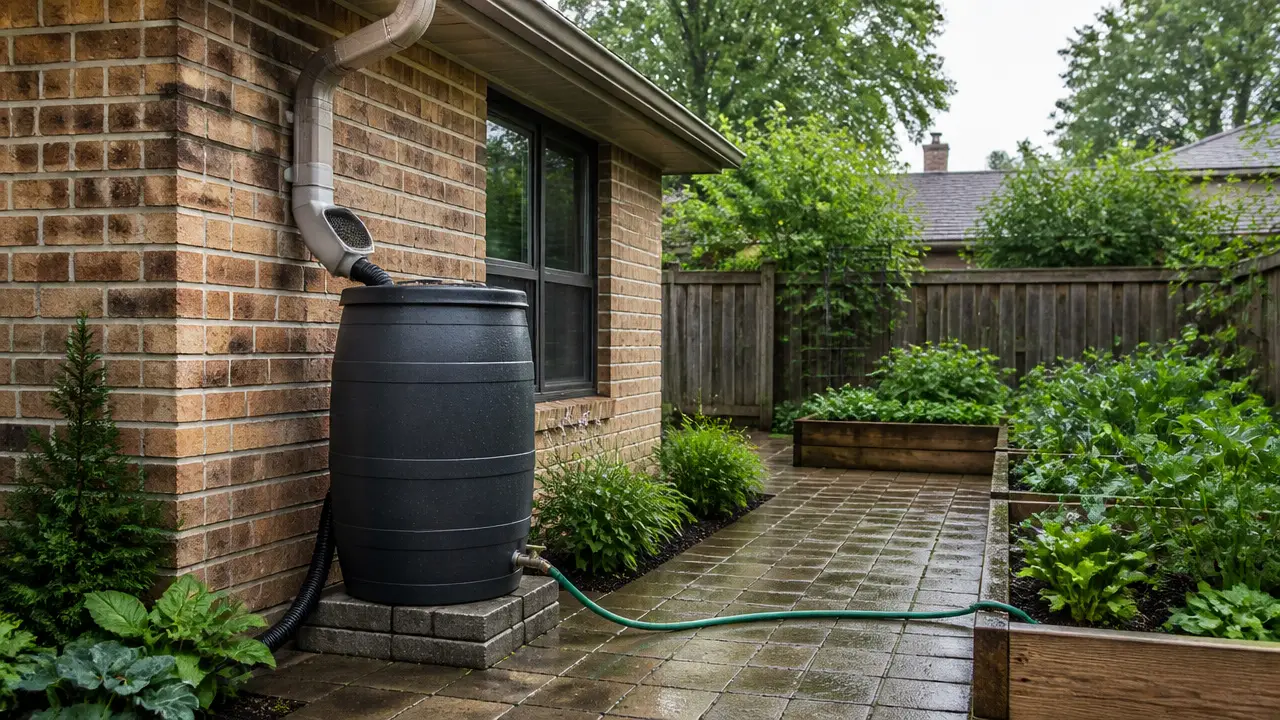
An above-ground tank sits on a prepared pad, stand, slab, or other suitable foundation near the collection area.
Common examples include:
- Rain barrels
- Vertical polyethylene tanks
- Slimline tanks
- IBC totes used where appropriate
- Larger outdoor cisterns
Water usually enters the tank from roof gutters and downspouts after passing through screens or other debris-control parts.
An outlet near the bottom may feed a garden hose, irrigation line, or pump.
Because the tank remains visible, most fittings are easy to reach.
What Is an Underground Rainwater Tank?
An underground rainwater tank is installed below the ground surface.
These systems may store several thousand gallons or more, depending on the site and tank design. The tank usually connects to underground inlet, overflow, vent, and pump plumbing.
An underground tank must be specifically designed for burial.
A normal above-ground plastic tank should not simply be buried. Soil pressure can deform or collapse a tank that was not built to handle those loads.
Underground systems also need careful planning around groundwater, drainage, access openings, excavation, soil conditions, and vehicle loads.
Advantages of Above-Ground Rainwater Tanks
Easier Installation
Above-ground tanks normally require much less site work.
A small system may only need:
- A stable, level base
- A gutter connection
- An inlet screen
- An overflow line
- An outlet or pump connection
Larger tanks still need careful foundation planning because stored water is very heavy.
One U.S. gallon of water weighs about 8.34 pounds. A 1,000-gallon tank therefore holds more than 8,000 pounds of water before adding the weight of the tank itself.
The base must safely support that load.
Easier Maintenance
Being able to see the tank makes routine checks much easier.
You can usually inspect:
- Inlet screens
- Tank walls
- Fittings
- Valves
- Overflow plumbing
- Pump connections
- Leaks
- Sediment buildup
Easy access matters because rainwater systems require ongoing maintenance.
Leaves, roof debris, sediment, insects, algae, damaged screens, loose fittings, and blocked overflow lines can all cause problems over time.
Easier Leak Detection
A leak from an above-ground tank or fitting is usually noticeable.
Wet ground, dripping fittings, or falling tank levels can point you toward the problem.
Leaks from underground systems may be much harder to identify.
Simpler Expansion
Above-ground storage is often easier to expand.
For example, two compatible tanks can sometimes be connected together instead of replacing one tank with a much larger one.
The connection arrangement matters. Tanks connected at the bottom usually need compatible outlet heights and plumbing that allows them to fill and drain as intended.
Gravity Can Sometimes Move the Water
An elevated tank can provide limited gravity flow.
The vertical distance between the water surface and the outlet creates head height. Greater head height creates more available pressure.
However, a tank sitting only slightly above a garden usually produces low pressure.
Gravity may work for:
- Filling watering cans
- Slow hose use
- Drip irrigation designed for low pressure
It may not provide enough pressure for ordinary sprinklers or household fixtures.
Disadvantages of Above-Ground Tanks
They Take Up Yard Space
Large tanks need a surprisingly large footprint.
That can become a problem in:
- Small yards
- Narrow side passages
- Urban lots
- Areas with setbacks or access requirements
Before buying a tank, check its actual diameter, height, and clearance requirements rather than relying only on storage capacity.
They Are Visible
Some homeowners do not want a large tank beside the house.
Slimline tanks can reduce the footprint, but shape affects capacity and sometimes installation options.
Fencing or landscaping can help hide a tank, but do not block maintenance access, ventilation, overflow paths, or inspection openings.
Greater Temperature Exposure
An above-ground tank is exposed to outdoor temperatures.
In hot climates, direct sunlight can warm stored water. Opaque tanks and shaded locations can help reduce light exposure.
In freezing climates, exposed plumbing, valves, pumps, and tank contents may freeze.
Freeze protection depends on local temperatures, tank design, water level, pipe placement, and intended winter use. Simply wrapping a pipe is not a guarantee against freezing.
Systems used through severe winters need climate-specific planning.
Damage Is More Exposed
Above-ground tanks can be more vulnerable to accidental impacts, falling branches, landscaping equipment, and weather exposure.
They should also be secured and installed according to the tank manufacturer's requirements.
Advantages of Underground Rainwater Tanks
They Save Surface Space
The biggest benefit of underground storage is that much of the tank does not occupy usable yard space.
That can be valuable when a property needs substantial storage but has limited room around the house.
Access covers, inspection points, pumps, and other service components still need to remain reachable.
They Are Less Visible
An underground tank can keep the yard looking relatively unchanged.
This is useful where homeowners want rainwater storage without a large visible tank.
However, buried does not mean maintenance-free. The system still needs accessible inspection and cleaning points.
Large Capacity Can Fit More Easily
Large above-ground tanks can dominate a small property.
Placing storage underground may make a larger cistern practical where surface space would otherwise prevent it.
Tank size should still be based on expected collection and water use rather than choosing the largest tank that will physically fit.
Stored Water Has Less Direct Weather Exposure
Soil can reduce rapid temperature swings compared with a fully exposed tank.
That may be useful in hot or cold conditions.
However, buried tanks are not automatically protected from freezing. Pipes, access risers, pumps, and shallow sections of the system can still be vulnerable.
Local frost depth and winter operating plans matter.
Disadvantages of Underground Tanks
Installation Is Much More Complex
Installing an underground tank involves more than digging a hole.
The installer may need to consider:
- Soil stability
- Excavation safety
- Tank bedding
- Backfill material
- Groundwater
- Drainage
- Tank buoyancy
- Burial depth
- Access risers
- Underground piping
- Vehicle or surface loads
Excavation can also damage utilities if the site is not properly checked beforehand.
Deep excavations and unstable soil can collapse without warning. Larger underground tank projects should be handled by people familiar with excavation and buried tank installation.
Groundwater Can Create Buoyancy Problems
An empty or partly empty underground tank can act somewhat like a buried boat.
If groundwater rises around it, upward forces may try to lift the tank.
The correct installation depends on the tank design, site conditions, groundwater level, and manufacturer's requirements.
Do not improvise anchoring or backfill methods.
Leaks Are Harder to Find
A buried pipe or fitting can leak without being immediately visible.
That can make troubleshooting difficult.
Unexpected water loss might come from:
- A leaking tank
- A damaged underground pipe
- A bad fitting
- Pump plumbing
- An overflow problem
- Normal water use that was underestimated
Finding the cause may require excavation.
Cleaning Is Less Convenient
Sediment can accumulate in any rainwater tank.
Underground systems require safe access arrangements for inspection and cleaning.
Do not enter a rainwater tank or cistern. Tanks can present confined-space hazards, including unsafe air and difficult rescue conditions.
Cleaning should be done from outside the tank or by qualified professionals using suitable equipment and procedures.
Pumping Is Usually Required
A buried tank normally sits below the fixtures or irrigation system it supplies.
That means gravity cannot usually deliver the water where it needs to go.
A pump must be selected for both the required flow rate and head height.
Flow rate tells you how much water the pump can move over time. Head height represents the vertical lift and resistance the pump must overcome.
Do not choose a pump based only on its advertised maximum flow. Pump output falls as required head increases.
Which Tank Is Better for Garden Watering?
Regarding rainwater-tank installation costs, understand airflow and overflow provisions around the storage vessel.
For a basic garden system, an above-ground tank is usually the easier choice.
It offers:
- Simple installation
- Easy hose connections
- Easy cleaning
- Visible water level options
- Straightforward pump access
Gravity may be enough for low-pressure drip irrigation if the tank is raised sufficiently and the irrigation equipment is designed for low pressure.
Sprinklers usually need more pressure, which often means adding a pump.
An underground tank may make sense for a large garden where substantial storage is needed but surface space is limited.
Which Is Better for Household Rainwater Use?
Either tank type can be part of a household reuse system.
The deciding factor is usually the plumbing layout rather than the tank alone.
Possible non-potable uses may include:
- Toilet flushing
- Irrigation
- Laundry where permitted and appropriately designed
- Outdoor washing
Non-potable means water that is not intended for drinking.
Household reuse systems often require pumps, controls, backflow protection, suitable plumbing, and separation from the potable water system.
Potable means suitable for drinking.
Do not assume water becomes potable because it is stored underground, looks clear, passes through a filter, or has been treated with one device.
Drinking-water use should be treated as a complete system involving suitable collection surfaces, debris control, prefiltration, treatment appropriate to the hazards, current laboratory testing, regular maintenance, and applicable local requirements.
Which Tank Is Easier to Connect?
Above-ground tanks generally win.
Most fittings remain visible, which makes it easier to plan:
- Inlets
- Outlets
- Overflows
- Tank-to-tank connections
- Pumps
- Drain valves
A bulkhead fitting is a fitting that passes through a tank wall and creates a sealed connection for pipe or hose.
Fitting size matters because small outlets and narrow pipes can restrict flow.
Underground systems may use similar basic connections, but they involve buried piping and more difficult access.
Planning connection locations before excavation is especially important.
Which Tank Is Better in Freezing Climates?
Neither option is automatically freeze-proof.
An underground tank may have an advantage because much of the stored water can be below the coldest surface zone.
But vulnerable parts may still include:
- Inlet pipes
- Overflow pipes
- Pump lines
- Valves
- Filters
- Access risers
- Above-ground equipment
An above-ground tank is more exposed and may need to be drained or taken out of service during winter.
The right approach depends on local winter temperatures, frost depth, plumbing depth, and whether the system needs to operate year-round.
What About Algae and Water Quality?
Light encourages algae growth.
Opaque above-ground tanks help reduce sunlight entering stored water. Underground tanks naturally receive very little light when properly sealed.
But darkness does not make stored rainwater clean.
Contamination can enter from:
- Bird droppings
- Dust
- Leaves
- Roof materials
- Insects
- Animal activity
- Dirty gutters
- Sediment
Both tank types should use appropriate debris control.
Some systems also use a first-flush diverter, which directs an initial portion of roof runoff away from storage so some accumulated roof debris does not enter the tank.
A first-flush device can reduce contamination entering storage, but it does not make rainwater safe to drink.
Tank Size Matters More Than Tank Location
Do not choose between above-ground and underground storage before estimating how much water you actually need.
Rainwater collection depends mainly on:
- Roof catchment area
- Rainfall
- Collection efficiency
- Storage capacity
- Water demand
For U.S. units, one inch of rain falling on one square foot of roof equals about 0.623 gallons before losses.
A basic theoretical estimate is:
Gallons collected = roof area in square feet × rainfall in inches × 0.623
Real systems collect less because of losses from splash, evaporation, first-flush diversion, gutter overflow, roof wetting, and other factors.
A huge underground tank provides little benefit if rainfall and roof area rarely provide enough water to fill it.
Likewise, a small above-ground tank may overflow frequently if the roof produces much more water than the tank can hold.
Consider Overflow Before Choosing Either Tank
Every rainwater tank needs somewhere for excess water to go.
Overflow becomes especially important during heavy rain when the tank is already full.
The overflow should direct water somewhere that will not cause:
- Foundation problems
- Erosion
- Mud
- Neighboring property problems
- Tank-base damage
An above-ground tank makes the overflow path easier to see.
Underground systems require more careful drainage planning because the overflow piping may also be buried.
Above-Ground Tanks Need a Strong Base
A tank should not be placed directly on soft, uneven ground unless the manufacturer specifically allows the installation method.
Water is heavy, and uneven support can stress the tank.
A proper base should generally be:
- Level
- Stable
- Able to carry the full loaded weight
- Large enough to support the tank correctly
- Protected from erosion
Exact foundation requirements depend on tank size, material, and manufacturer instructions.
Do not assume paving stones, loose soil, or an old deck can support a large tank.
Underground Tanks Need the Right Tank Design
A tank intended for above-ground use should not be buried just because it fits in the hole.
Buried tanks experience forces from surrounding soil.
They may also encounter:
- Groundwater pressure
- Saturated soil
- Uneven backfill
- Loads from vehicles or structures above
Use a tank specifically rated for the intended underground installation and follow its burial requirements.
Think About Maintenance Before Hiding the Tank
A rainwater system is easier to live with when routine maintenance was considered during installation.
You should be able to reach important components without dismantling half the system.
Plan access for:
- Inlet screens
- First-flush devices
- Filters
- Pumps
- Valves
- Tank openings
- Overflow lines
- Level sensors
Above-ground systems naturally make this easier.
Underground systems require deliberate access planning.
When an Above-Ground Tank Makes More Sense
Choose above-ground storage when you want:
- A simpler installation
- Easy access for maintenance
- Lower installation complexity
- Garden or outdoor water storage
- The option to add another tank later
- Easy inspection of fittings and leaks
- Minimal excavation
For many homeowners starting with rainwater harvesting, this is the more practical option.
When an Underground Tank Makes More Sense
Consider underground storage when:
- Surface space is limited
- A visible tank would be difficult to accommodate
- You need substantial storage capacity
- The property layout suits excavation
- You already expect to use a pump
- Professional installation is practical
- Soil and groundwater conditions are suitable
Underground tanks can work very well, but installation mistakes are much harder to correct later.
A Simple Way to Choose
Start with five questions.
1. How much water do you need?
Estimate demand first.
A few garden beds may need far less storage than whole-property irrigation or household reuse.
2. How much rain can you collect?
Use your roof area and actual local rainfall records to estimate collection.
3. Where can the tank physically fit?
Check tank dimensions, access, plumbing routes, overflow location, and maintenance clearance.
4. Will you need a pump?
An underground system almost always will.
An above-ground system may also need one if the required pressure is higher than gravity can provide.
5. How difficult do you want maintenance to be?
If easy inspection and repair matter, above-ground storage has a clear advantage.
If preserving yard space matters more, underground storage may be worth the extra complexity.
Frequently Asked Questions
Are underground rainwater tanks better than above-ground tanks?
Not necessarily. Underground tanks save surface space and hide large storage volumes, but they require more excavation, plumbing, pumping, and installation planning. Above-ground tanks are usually easier to install, inspect, clean, and repair.
Can I bury a normal plastic water tank?
Not unless the tank is specifically designed and approved by its manufacturer for burial. Soil pressure can deform or collapse an above-ground tank.
Do underground rainwater tanks need a pump?
Usually. Because the stored water is below the point where it will be used, a pump is normally needed to provide lift, flow, and pressure.
Can an above-ground rainwater tank work without a pump?
Sometimes. Gravity can provide limited flow when the tank water level is above the outlet. Low-pressure drip irrigation or filling containers may work, but sprinklers and household fixtures often need a pump.
Do underground tanks freeze?
They can. Burial may reduce exposure to surface temperatures, but pipes, access risers, pumps, filters, and shallow sections can still freeze. Freeze protection should be designed for local conditions.
Which tank is easier to maintain?
Above-ground tanks are generally easier to maintain because fittings, valves, screens, pumps, and tank walls are more accessible. Underground systems need carefully planned access points.
Is underground rainwater cleaner than water stored above ground?
Not automatically. Underground storage reduces light exposure, but contamination can still come from the roof, gutters, animals, sediment, and poor maintenance. Tank location alone does not determine water safety.
Which type should I choose for a basic home rainwater system?
For simple garden watering and outdoor use, an above-ground tank is often the most practical starting point. Underground storage becomes more attractive when you need large capacity but cannot give up surface space.