As an affiliate, we may earn a commission from qualifying purchases. We get commissions for purchases made through links on this website from Amazon and other third parties.
Best Overall
Best for Multiple Beds
Best Long-Probe Option
A soil moisture meter can make stored rainwater last longer by answering a simple question before you open a valve or start a pump: is the root zone actually dry enough to need water? The soil surface can look dry while deeper soil remains moist, especially after slow irrigation or a soaking rain.
For rainwater irrigation, that matters because storage is finite. Watering by habit can empty a tank faster than necessary, while waiting too long can stress plants. A basic probe meter gives you another data point alongside weather, plant appearance, and soil feel.
The meters here are simple, battery-free tools. They do not measure tank level, rainfall, or water quality. Their job is limited to checking soil conditions at the probe location so you can make a better irrigation decision.
Quick Fit Checklist
- Match the probe to the root zone. Shallow pots and deep garden beds do not need the same reach.
- Use multiple readings. One point does not represent an entire raised bed or lawn area.
- Do not force the probe into hard soil. Rocks and compacted ground can bend a thin shaft.
- Remove the meter after testing. These are spot-check tools, not permanent buried sensors.
- Clean the probe after each use. Soil and oxidation can interfere with future readings.
- Do not test water directly. The products here are designed for soil, not tanks or rainwater samples.
Soil Moisture Meters at a Glance
| Product | Best For | Key Strength | Tradeoff |
|---|---|---|---|
| XLUX Plant Soil Moisture Meter | Straightforward routine checks | Simple 1-10 dry/moist/wet dial with slim battery-free probe | Must be removed and cleaned after each test |
| XLUX 2-Pack Soil Moisture Meter | Multiple beds or zones | Two identical battery-free meters for separate areas | Same single-purpose design as the standard XLUX |
| Dr.meter Soil Moisture Meter | Lightweight alternative | Battery-free single-probe design and simple dial | Probe can bend if pushed into hard soil |
| Dr.meter Long Probe Soil Moisture Meter | Deeper containers and root zones | Long-probe format for deeper spot checks | Customer evidence includes bent probes and occasional faulty readings |
Best Overall: XLUX Plant Soil Moisture Meter
1 / 4
XLUX Plant Soil Moisture Meter
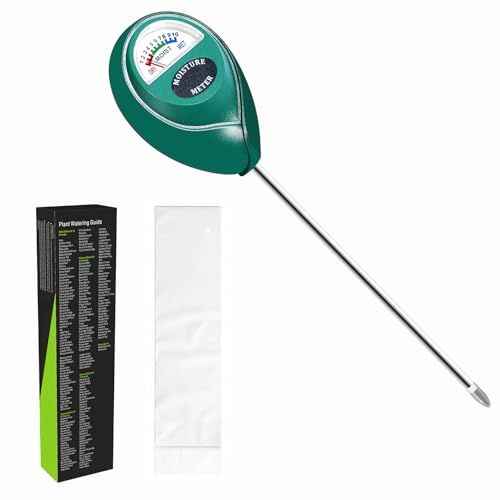
Scale
1-10 dry / moist / wet
Power
No batteries required
Use
Temporary soil test
The standard XLUX meter is the clearest fit for someone who wants a simple yes-or-no irrigation aid rather than another electronic device. The large color-coded dial uses a ten-point dry-to-wet scale, and the probe works without batteries or charging.
For rainwater irrigation, the simplicity is a strength. Insert the probe into the root zone, wait for the reading to stabilize, decide whether watering is justified, then remove and clean it. There is no app, calibration menu, or stored history to manage.
The manufacturer specifically treats this as a temporary test tool and recommends removing it within five minutes. That matters because leaving a metal probe in damp soil can accelerate corrosion and eventually reduce reliability.
The slim single-probe design also causes less soil disturbance than a multi-probe tool. It still should not be forced through hard, rocky, or compacted soil.
Why It Works
- Battery-free operation makes it ready whenever irrigation is being considered.
- A simple dry/moist/wet scale is easy to interpret for routine watering decisions.
- The slim single probe is suitable for spot-checking root-zone moisture.
What To Keep In Mind
- Remove it after each reading rather than leaving it buried.
- Wipe the probe clean before storage.
- Take several readings across large beds instead of trusting one location.
Best for Multiple Beds: XLUX 2-Pack Soil Moisture Meter
2 / 4
XLUX 2-Pack Soil Moisture Meter

Quantity
2 meters
Power
No batteries needed
Probe Depth Guidance
About 2-5 in insertion
The XLUX two-pack makes sense when the garden has clearly different irrigation zones. A raised vegetable bed, container group, greenhouse bench, or ornamental planting area can dry at different rates even when all are supplied from the same rainwater tank.
Keeping two meters in separate locations reduces the temptation to treat the whole garden as one moisture condition. The product evidence recommends inserting the probe around two to five inches into soil, then removing and wiping it after the test.
Like the single XLUX meter, this is not meant to stay in the ground. The manufacturer warns that prolonged soil contact can gradually corrode the metal tip. That makes storage and cleaning part of normal use rather than optional care.
Why It Works
- Two meters are convenient when the property has more than one watering zone.
- Battery-free operation keeps both tools low-maintenance.
- Single probes reduce soil disturbance during spot checks.
What To Keep In Mind
- Do not leave either meter in the soil between readings.
- Avoid very hard soil that could damage the probe.
- Separate meters do not replace taking several readings within a large bed.
Best Lightweight Alternative: Dr.meter Soil Moisture Meter
3 / 4
Dr.meter Soil Moisture Meter
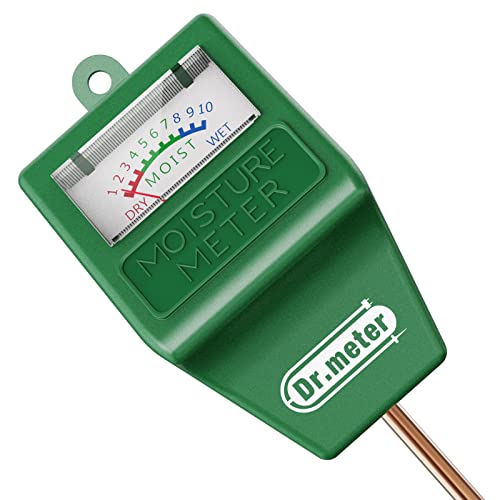
Weight
2.72 oz
Power
No batteries required
Probe
Single
The standard Dr.meter is another straightforward battery-free probe, with a documented weight of 2.72 ounces. It is designed for quick soil checks without digging up the root zone or installing a permanent sensor.
Customer evidence is mixed but useful. Some users report that the meter helped reveal moist soil below a dry-looking surface and reduced unnecessary watering. Others describe bent probes or readings they did not trust. Those reports reinforce the need to treat any inexpensive analog meter as a comparative tool rather than an unquestionable laboratory instrument.
If a reading conflicts with obvious soil conditions, test another location and feel the soil by hand before changing irrigation dramatically.
Why It Works
- Very light and easy to carry between pots or beds.
- No batteries or setup process are required.
- Single-probe format keeps testing simple.
What To Keep In Mind
- The probe can bend if pushed into compacted or rocky soil.
- Clean the probe after each use.
- Compare surprising readings with a second location or another method.
Best Long-Probe Option: Dr.meter Long Probe Soil Moisture Meter
4 / 4
Dr.meter Long Probe Soil Moisture Meter

Format
Long probe
Power
No batteries required
Use
Deeper soil spot checks
This Dr.meter version is the better match when the moisture question is deeper in a large pot, planter, or garden root zone. Its product identity specifically emphasizes the longer probe, allowing a reading below the upper layer that often dries first.
That deeper reach is useful with rainwater-fed drip or slow watering. Surface soil may look dry soon after irrigation even when moisture remains lower in the profile. A longer probe can help avoid topping up a bed simply because the first inch appears dry.
The limitation is mechanical. Customer evidence includes a probe bending during use, and another report describes a unit that continued to read dry despite added water. Do not force the probe, and compare implausible readings with another method before relying on them.
Why It Works
- Long-probe format better suits deeper containers and root zones.
- Battery-free operation keeps the tool simple.
- Single-probe testing can be repeated at several depths and locations.
What To Keep In Mind
- The longer probe still needs gentle insertion to avoid bending.
- Remove and clean it after each test.
- A meter that repeatedly shows the same result in clearly different soil conditions should not be trusted.
Why We Did Not Prioritize 3-in-1 Soil Testers
Multi-function meters that combine moisture, light, and pH can sound more useful, but the supplied evidence for the SONKIR 3-in-1 raises repeated concerns about pH accuracy. For rainwater irrigation, the most relevant function in this roundup is soil moisture.
A moisture meter should not be treated as a water pH meter, and a soil pH function should not be used to infer the chemistry or safety of stored rainwater. Different questions require different tools.
How to Use a Soil Moisture Meter With Stored Rainwater
Check the soil before the irrigation event, not immediately after. Take readings near the active root zone in several representative places. If most readings are still moist, delay watering and preserve the tank supply.
After irrigation, you can take another set of readings once water has had time to move into the soil. This helps show whether the watering duration is reaching the intended depth or only wetting the surface.
Over several weeks, combine moisture checks with rainfall and weather records. You may find that certain beds stay moist for days after rain while containers dry quickly, allowing stored water to be directed where it has the highest value.
Common Soil-Moisture Meter Mistakes
Leaving the Probe in the Ground
These handheld analog meters are intended for temporary testing. Extended exposure can corrode the probe and shorten useful life.
Forcing the Probe Through Hard Soil
A thin metal shaft can bend. If the soil is compacted or rocky, choose another insertion point rather than pushing harder.
Testing Only One Spot
Drip emitters, shade, soil texture, and plant roots create large moisture differences across a bed. Use several readings.
Treating the Number as a Universal Watering Rule
Different plants and soils tolerate different moisture ranges. Use the meter to compare conditions, then combine that reading with plant needs and local experience.
Using It in a Rainwater Tank
These products are soil probes. Do not immerse them in stored rainwater to test water quality or tank conditions.
Frequently Asked Questions
Do soil moisture meters save rainwater?
They can reduce unnecessary irrigation by showing when deeper soil is still moist. Actual savings depend on how consistently you use the reading to adjust watering.
How deep should I insert a soil moisture probe?
Insert it into the active root zone without forcing it. Product guidance varies, and deeper-rooted plants may need readings at more than one depth.
Can I leave a soil moisture meter in the garden?
The handheld meters in this roundup should be removed after testing. Prolonged soil contact can corrode the probe.
Do soil moisture meters need batteries?
The selected models here are battery-free analog meters.
Irrigation decisions improve when you understand whether soil moisture meters work reliably in the soil type and root zone.
Can a soil moisture meter test rainwater pH?
No. Use a water-specific pH meter for rainwater testing. Soil moisture meters answer a different question.
What if the meter says dry right after watering?
Test another point and depth, allow time for water to infiltrate, and inspect the probe. If readings remain implausible across clearly wet and dry soil, the meter may be faulty.
To decide how recent weather should affect garden watering, best weather stations for rainwater harvesting compares local rainfall and weather-monitoring systems. For a simpler record of how much rain actually fell at the property, best rain gauges covers manual options.