As an affiliate, we may earn a commission from qualifying purchases. We get commissions for purchases made through links on this website from Amazon and other third parties.
A hole in a water tank can often be covered or repaired, but the right method depends on the tank material, hole size, water use, and whether the repair must hold water pressure.
For a small hole in a plastic rainwater tank, a properly fitted bulkhead fitting, tank fitting, plastic-compatible patch, or suitable repair system may work. Larger cracks, damaged seams, and holes near the bottom of a large tank need more caution because the weight of the stored water can put a lot of force on the repair.
If the tank stores drinking water, do not use a random glue, sealant, or patch. Any material that touches the water should be suitable for that use, and the repair should not be treated as proof that the water is safe to drink.
Start by Identifying the Tank and the Damage
Before choosing a repair, check four things:
- What is the tank made from?
- How large is the hole?
- Where is the hole?
- What will the stored water be used for?
Common tank materials include polyethylene plastic, fiberglass, steel, and concrete. A repair that works on one may fail on another.
Location also matters. A hole near the top of a tank sees little water pressure. A hole near the bottom has to resist the pressure created by the water above it.
A small, clean round hole is usually easier to repair than a long crack, split seam, or badly distorted area.
Empty the Tank Below the Hole
Do not try to make a permanent repair while water is pushing through the damaged area.
Drain the tank until the water level is safely below the hole. For many repairs, completely emptying the tank makes the job easier because the surface can be cleaned and dried.
Remember that water is heavy. A large tank may contain thousands of pounds of water. Do not move, lift, tilt, or crawl under a partly filled tank.
Do not enter a large cistern or enclosed tank. Tanks can be confined spaces with serious air-quality and access hazards. Repairs that require entering a tank should be handled by someone trained for that work.
Clean and Dry the Area
A patch needs a sound surface.
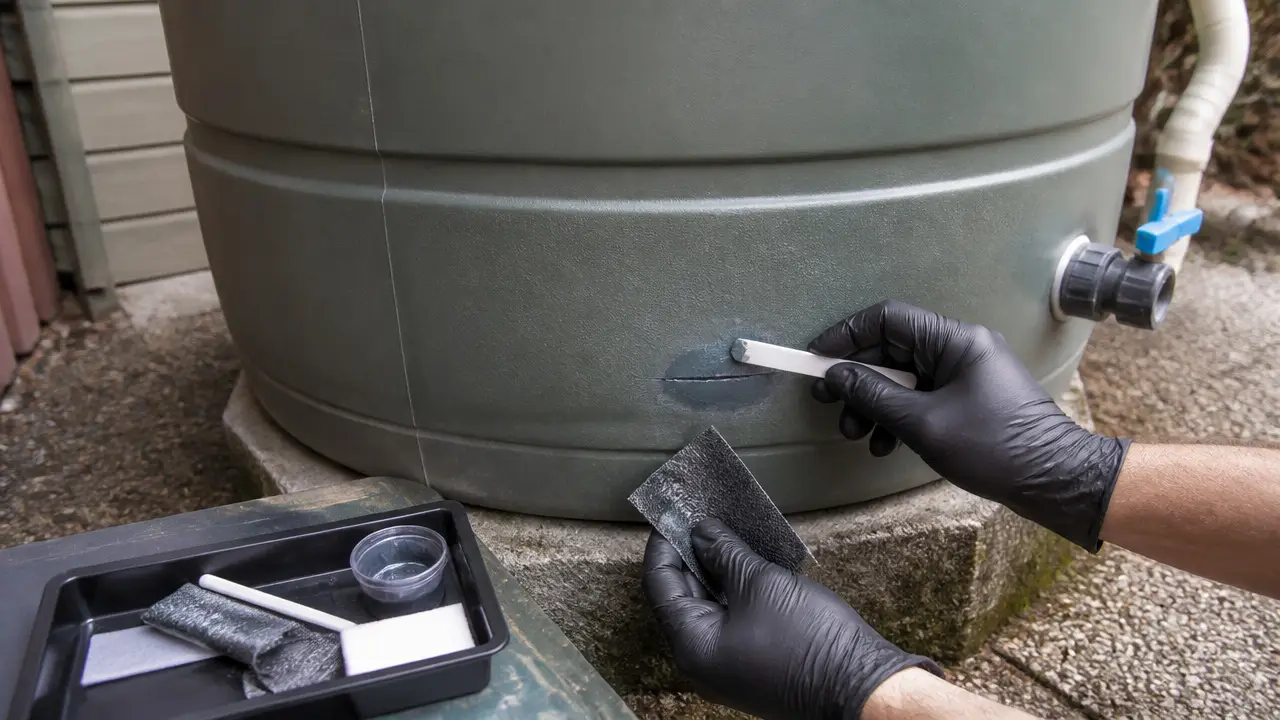
Remove dirt, algae, loose material, and old sealant from around the hole. Follow the preparation instructions for the repair material you plan to use.
The area generally needs to be clean and dry unless the repair product specifically says otherwise.
Do not assume that household silicone, construction adhesive, or general-purpose glue will bond properly to a water tank. Polyethylene tanks are especially difficult for many common adhesives to stick to.
Best Ways to Cover a Small Round Hole
A small round hole is sometimes best repaired mechanically instead of simply being covered with adhesive.
Use a Bulkhead or Tank Fitting
If the hole is round and in a flat, accessible part of the wall, a bulkhead fitting may be a practical solution.
A bulkhead fitting is a fitting that passes through the tank wall and seals against it with a gasket. It is commonly used to create tank outlets and connections.
The hole must match the fitting's required opening size. Do not force an undersized or oversized fitting into an existing hole.
A typical installation involves:
- Draining the water below the opening.
- Cleaning the tank wall.
- Checking that the surrounding plastic is flat and undamaged.
- Installing the fitting and gasket in the orientation specified by the manufacturer.
- Tightening it enough to compress the gasket without crushing or distorting the tank wall.
- Refilling slowly and checking for leaks.
You can cap or plug the fitting if you do not need it as an outlet.
This approach can be more reliable than gluing a flat patch over a clean round opening because the seal is mechanically clamped to the tank.
Use a Compatible Plug
Some small holes may accept a purpose-made threaded or mechanical plug.
The plug must be compatible with the tank, opening, and water use. A plug that simply wedges into the hole may loosen as the tank expands, contracts, or fills.
Repairing a Hole in a Polyethylene Tank
Many rainwater tanks and IBC tote inner containers are made from polyethylene.
Polyethylene is durable, but it can be difficult to repair with ordinary adhesives. Many glues do not form a lasting bond to it.
For an unwanted hole, possible repair methods include:
- a correctly sized bulkhead fitting and cap
- a manufacturer-approved repair fitting
- a polyethylene repair system
- professional plastic welding
Plastic welding uses compatible plastic and heat to join the damaged area. It can be useful for some polyethylene tanks, but technique matters. Too much heat can weaken or deform the tank.
Large cracks or damaged structural areas are not good beginner repair jobs.
Be Careful With IBC Totes
The plastic bottle inside an IBC tote is supported by its outer cage. Damage to the bottle, cage, base, or valve area can affect the whole container.
A small unused opening may sometimes be fitted with a suitable tank fitting, but a split, major puncture, or damaged lower wall can be much harder to repair reliably.
Also consider what the tote previously contained. A repaired tote is not made suitable for drinking water simply because it no longer leaks.
Repairing a Fiberglass Tank
Fiberglass tanks require a repair system intended for fiberglass.
A typical repair may involve preparing the damaged surface and applying compatible resin with reinforcing fiberglass material. The exact preparation and curing process depends on the system being used.
Do not cover a fiberglass crack without checking how far the damage extends. A visible crack may be part of a larger weakened area.
For a large tank, extensive cracking, or damage near a fitting, professional repair is often the safer choice.
Repairing a Metal Water Tank
Metal tanks can develop holes because of corrosion or physical damage.
A small hole may sometimes be repaired with a mechanical fitting or a tank repair method designed for that specific metal. Corroded metal requires more caution.
If the metal around the hole is thin, flaky, or deeply rusted, patching only the visible hole may not solve the problem. More holes may soon appear nearby.
Welding may be appropriate for some tanks, but it creates fire, heat, coating, and contamination concerns. It is not a good general DIY solution for an unknown tank.
A tank that previously contained fuel, chemicals, or other hazardous materials should never be welded or cut without appropriate professional assessment.
Repairing a Concrete Tank
Small surface defects in concrete are different from active cracks or structural damage.
A repair material used on a concrete water tank needs to be compatible with the concrete, the expected water exposure, and the intended use of the stored water.
A widening crack, movement at a joint, major leak, or damaged structural section should be evaluated before being covered. Simply applying more coating over moving concrete often leads to another leak.
Can You Put a Patch Over the Hole?
Explore a suitable glue for plastic water tanks to evaluate storage-surface compatibility with the planned application.
Sometimes, but a patch only works when it is suited to the tank material and the damaged area is strong enough to support it.
A good patch should extend beyond the damaged section onto sound material. It also needs to remain attached as the tank fills, empties, heats up, cools down, and flexes.
Avoid relying on improvised materials such as:
- duct tape
- ordinary packing tape
- random household glue
- unknown construction adhesive
- an unidentified piece of plastic glued over the hole
These may slow a leak temporarily, but they should not be treated as durable tank repairs.
How Water Pressure Affects the Repair
Water pressure increases with water depth.
That means a repair near the bottom of a tall tank has a harder job than the same repair near the top.
For example, covering an overflow opening near the top of a rain barrel is quite different from repairing a puncture close to the outlet of a large cistern.
The lower the damage and the larger the tank, the more important a mechanically secure or professionally made repair becomes.
Do Not Block an Overflow by Accident
Before covering a hole, make sure you know why it is there.
Some tank openings are intentional. They may be used for:
- overflow
- ventilation
- inlet connections
- pump lines
- level sensors
- drain fittings
An overflow is especially important. It gives excess water somewhere to go when the tank becomes full.
Sealing an intended overflow without providing another properly sized overflow path can cause water to back up into gutters, escape around the lid, or flood the area around the tank.
Test the Repair Slowly
Once the repair has cured or been installed according to its instructions, refill the tank gradually.
Watch the repair as the water level rises.
Check for:
- dripping
- dampness around the repair
- movement of the fitting
- distortion of the tank wall
- a crack continuing beyond the patch
- water appearing somewhere else nearby
If possible, inspect it again after the tank has remained filled for a while.
A leak that appears only when the tank is full may indicate that the wall is flexing or that the damaged area cannot handle the load.
What If the Hole Is Too Large?
A large hole can be much more difficult to repair than a small drilled opening.
Consider professional repair or tank replacement when there is:
- a long or spreading crack
- a split seam
- major deformation
- several nearby cracks
- serious corrosion
- damage around the tank base
- damage around a major outlet
- a large missing section
- repeated failure of earlier repairs
The important question is not only whether you can stop the leak today. The repair needs to remain secure when the tank is full.
Temporary Ways to Slow a Leak
If you cannot make the permanent repair immediately, reduce the water level below the damaged area whenever practical.
That usually removes the pressure from the hole and is safer than relying on an improvised patch.
A temporary exterior patch may reduce leakage in some situations, but its performance depends heavily on the tank material and damage. Do not rely on a temporary patch where failure could flood a building, damage equipment, undermine the tank foundation, or release a large volume of water.
Repairs for Drinking-Water Tanks Need Extra Care
Repairing the leak and making the water safe to drink are separate issues.
For a tank used for potable water, meaning water intended for drinking, cooking, or similar uses, every repair material that contacts the water should be suitable for that purpose.
The complete rainwater system also matters. Drinking-water safety can depend on the collection surface, gutters, first-flush or debris controls, storage conditions, treatment stages, maintenance, and current water testing.
A repaired tank should not be assumed safe for drinking simply because the patch is watertight.
For household drinking-water systems, follow current local requirements and use qualified water-treatment or tank professionals when appropriate.
How to Choose the Right Repair Method
For a clean, small, round hole in sound tank material, a properly sized mechanical tank fitting is often worth considering first.
For a small crack or irregular puncture, use a repair method specifically designed for the tank material.
For large cracks, structural damage, damaged seams, severe corrosion, or leaks near the bottom of a large tank, professional repair or replacement may be the better option.
The goal is not just to cover the opening. The repair must match the tank material, withstand the water load, and remain suitable for the way you use the stored water.
Frequently Asked Questions
Can I use silicone to cover a hole in a plastic water tank?
Do not assume ordinary silicone will make a lasting repair. Some tank plastics, especially polyethylene, are difficult for common sealants to bond to. Use a repair method specifically compatible with the tank material.
Can I use a bolt to plug a hole in a water tank?
A properly designed mechanical plug or fitting may work for some small round holes. A random bolt alone is less reliable because it may not seal correctly and can concentrate force on the tank wall. A fitting with suitable gaskets is generally a better approach.
Will epoxy stick to a polyethylene water tank?
Many ordinary epoxies do not bond reliably to polyethylene. If the tank is polyethylene, use a repair system that specifically lists compatibility with that material or consider a mechanical fitting or professional plastic welding.
Can I repair a water tank without emptying it?
For a lasting repair, you normally need to lower the water below the damaged area. Many repair materials also require a clean and dry surface. Repairing a hole while water is actively pushing through it can prevent the repair from bonding or sealing properly.
Can a large crack in a plastic tank be repaired?
Some cracks can be professionally plastic-welded, but large or spreading cracks may indicate that the tank wall has been weakened. Damage near the base, seams, or major fittings deserves extra caution because those areas can carry significant loads.
Is it safe to repair a drinking-water tank with glue?
Only use repair materials that are specifically suitable for contact with the type of water being stored and for the tank material. A watertight repair alone does not establish that collected rainwater is safe to drink.
Should I replace the tank instead of repairing it?
Replacement may make more sense when the tank has extensive cracking, severe corrosion, major deformation, repeated leaks, structural damage, or a failed repair area. A small isolated hole in otherwise sound material is more likely to be a practical repair.