As an affiliate, we may earn a commission from qualifying purchases. We get commissions for purchases made through links on this website from Amazon and other third parties.
For most home drip irrigation systems, 120-mesh filtration is a good starting point. It is fine enough to protect many common drip emitters without creating unnecessary flow restriction.
However, some drip systems require 150- or 200-mesh filtration, especially when they use very small emitters. Utah State University Extension notes that most drip systems need filtration in the 120- to 200-mesh range.
The safest rule is simple: use at least the filtration level required by your dripline or emitter manufacturer. Do not choose the filter only by pipe or hose size.
What Does Mesh Size Mean?
Mesh describes how fine the openings in a screen filter are.
A higher mesh number means smaller openings:
| Filter size | Approximate opening | Typical use |
|---|---|---|
| 80 mesh | Coarser | Larger emitters and relatively clean water |
| 120 mesh | About 125 microns | Common dripline filtration |
| 150 mesh | About 100 microns | Finer drip and micro-irrigation |
| 200 mesh | About 75 microns | Small emitters or systems requiring fine filtration |
A micron is one-thousandth of a millimeter.
These conversions should be treated as approximate unless the filter manufacturer provides its own specification. For example, Rain Bird identifies its 120-, 150-, and 200-mesh screens as 125, 100, and 75 microns respectively.
This can seem backward at first. A 200-mesh filter is finer than a 120-mesh filter.
Is 120 Mesh Enough for Drip Irrigation?
For many systems, yes.
Several common commercial and landscape driplines specify 120-mesh filtration. Netafim, for example, recommends 120 mesh for several of its dripline products, while Rain Bird specifies 120 mesh for several XF dripline configurations.
That makes 120 mesh a useful general choice when you are building a basic garden drip system and do not yet have a more specific requirement.
But it is not a universal number.
Some emitters need finer filtration. Other larger-flow emitters can operate with coarser filtration. One Netafim dripline, for example, specifies 80 mesh for some higher-flow emitters and 120 mesh for its lower-flow versions.
Always give the emitter specification priority over a general rule.
When Should You Use a 150- or 200-Mesh Filter?
Use finer filtration when the drip equipment calls for it or when protecting components with very small water passages.
A 150- or 200-mesh screen can catch particles that would pass through a 120-mesh screen.
Some low-volume irrigation filters are supplied with 150-mesh screens, while others intended for drip and micro-irrigation use 200-mesh screens. Rain Bird, for example, offers drip filtration using both sizes depending on the system.
Finer is not automatically better, though.
A finer filter:
- catches smaller particles;
- can clog faster;
- may require more cleaning;
- can cause more pressure loss if it is undersized or dirty.
Installing a 200-mesh filter where the equipment only needs 120 mesh may simply increase maintenance without improving irrigation performance.
The Water Source Matters
The right filter also depends on what is entering the irrigation system.
Municipal water
Clean municipal water usually contains relatively little visible debris. Filtration may still be required to protect small emitters, especially if the dripline manufacturer specifies it.
A simple screen filter may be enough for many household systems.
Well water
Well water may contain sand, mineral particles, or other sediment.
A screen or disc filter can catch solid particles, but heavy sand loads may require additional separation or filtration before the drip filter.
Stored rainwater
Rainwater from a barrel, IBC tote, or cistern can contain:
- roof grit;
- leaf fragments;
- pollen;
- insect material;
- sediment;
- organic debris that settles in the tank.
This makes filtration particularly important for drip irrigation.
A useful system may include coarse screening before storage followed by a finer irrigation filter before the drip tubing.
For example:
Roof → gutter screen → storage tank → pump or outlet → 120- to 200-mesh irrigation filter → pressure regulator if needed → drip lines
The exact order can change with the pump and equipment. A pump may need its own inlet protection, and some filters have pressure and flow limits that must be followed.
Pond or surface water
Pond water can contain algae and large amounts of organic material.
A small screen filter may clog very quickly in this situation. More substantial filtration may be needed before the final drip filter.
Rainwater Often Needs More Than One Screen
Putting a very fine filter directly on dirty rain-barrel water can create constant maintenance.
It is usually better to remove large material earlier.
For a rainwater-fed drip system, that might mean:
- Keep leaves and large debris out of the tank.
- Allow heavier sediment to settle where practical.
- Avoid drawing water from the dirtiest sediment layer at the tank bottom.
- Install the irrigation filter before the emitters.
- Clean both the filter and drip lines as needed.
A first-flush diverter may also reduce some of the dirt entering storage. A first flush diverts an initial portion of roof runoff that can carry accumulated roof debris.
It does not eliminate the need for irrigation filtration.
Screen Filter or Disc Filter?
Both can work well for home drip irrigation.
Screen filters
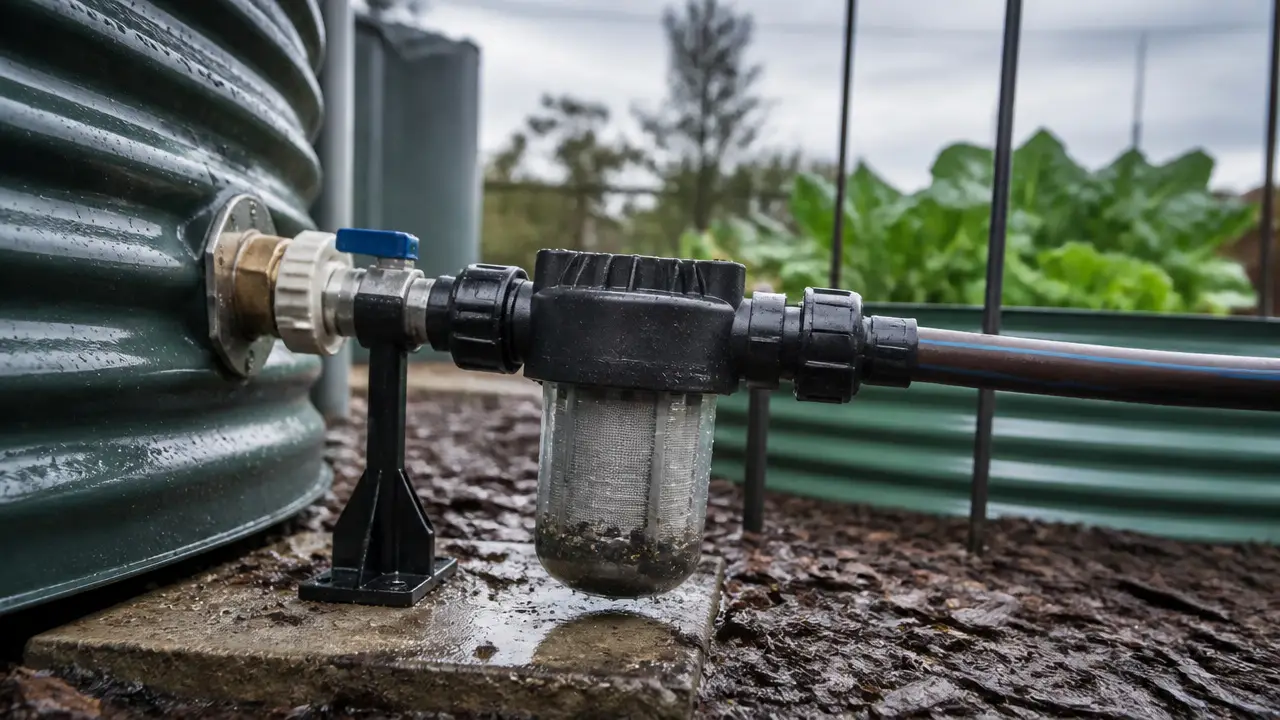
Understanding choosing water-filter mesh size helps interpret a treatment standard based on the final water application.
A screen filter passes water through a fine mesh.
They are simple and work well for catching:
- sand;
- grit;
- small pieces of debris.
They are easy to inspect because you can often remove and rinse the screen.
Disc filters
Disc filters use a stack of grooved discs rather than one flat screen.
Water passes through small passages between those discs. Their larger filtering surface can be useful when water contains more debris. Utah State University Extension notes that both screen and disc filters are common for household drip systems and that disc filters often provide more filtering area than similarly sized screen filters.
For stored rainwater containing fine organic debris, a disc filter can sometimes be easier to live with than a very small screen filter.
Neither type makes rainwater potable. These filters are being used here to protect irrigation equipment, not to make roof runoff safe to drink.
Make Sure the Filter Can Handle Your Flow
Mesh size is only part of filter selection.
The filter must also be large enough for the water flowing through it.
For example, suppose six drip lines together require 5 gallons per minute. A filter rated for only 3 gallons per minute would be a poor match even if its mesh size were correct.
An undersized filter can create excessive pressure loss.
Check:
- required mesh or micron rating;
- maximum and recommended flow;
- operating pressure;
- inlet and outlet connection size;
- direction of water flow;
- cleaning requirements.
Utah State University Extension specifically warns that drip filters need enough flow capacity because an undersized or clogged filter can restrict the system.
Do Not Forget Pressure
A clean filter cannot correct excessive irrigation pressure.
Many drip systems operate at lower pressure than normal household plumbing. Depending on the equipment, you may need a pressure regulator as well as a filter.
A basic setup often looks like:
Water source → shutoff valve → filter → pressure regulator → main drip tubing → emitters
Some equipment combines the filter and pressure regulator in one assembly.
Follow the component manufacturer's required installation order. Some filter-regulator assemblies have specific requirements about where they can be placed.
For a gravity-fed rain barrel, pressure can be much lower than a normal pressurized irrigation system. Adding an overly restrictive or dirty filter can reduce the available flow even further.
How Often Should a Drip Filter Be Cleaned?
There is no single cleaning schedule that fits every system.
Check the filter more often when you first start using it. This shows how quickly your particular water source loads the screen or discs.
Rainwater systems may need frequent checks after:
- heavy storms;
- high pollen periods;
- leaves enter the gutter;
- sediment is disturbed inside the tank;
- the tank has been cleaned or refilled.
Signs of a dirty filter include:
- lower emitter flow;
- uneven watering;
- reduced pressure downstream;
- visibly dirty filter material.
Clean the filter according to its manufacturer's instructions. Regular cleaning is important for keeping a drip system working properly.
It is also useful to flush the ends of drip lines periodically so accumulated particles can leave the tubing rather than settling near emitters.
A Practical Mesh Guide
For a simple home system, use this decision process:
Start with the emitter specification. If it says 200 mesh, use 200 mesh. If it says 120 mesh, use at least that level of filtration.
If there is no specification available, 120 mesh is a reasonable starting point for many common dripline systems, while 150 to 200 mesh provides finer protection for small emitters.
With stored rainwater, also deal with large debris before it reaches that fine filter. Trying to make one 200-mesh screen handle leaves, roof grit, tank sediment, and fine particles will usually mean more cleaning than necessary.
The goal is not to install the finest filter possible. It is to provide enough filtration to protect the smallest water passages in your irrigation system while still allowing the required flow.
Frequently Asked Questions
Is 120 mesh or 200 mesh better for drip irrigation?
Neither is automatically better. A 200-mesh filter catches smaller particles, but it also clogs more easily. Use the mesh size required by your drip emitters. For many systems, that falls between 120 and 200 mesh.
What micron filter is equivalent to 120 mesh?
A 120-mesh irrigation screen is commonly around 125 microns, although the exact opening can vary with the screen design and manufacturer.
Can I use a 100-mesh filter for drip irrigation?
Only if your emitters allow it. A 100-mesh filter is coarser than the 120- to 200-mesh filtration commonly used for drip systems, so some small particles may pass through and clog fine emitters.
What mesh filter should I use with a rain barrel?
A 120-mesh irrigation filter is a practical starting point for many rain-barrel drip systems, but follow the emitter manufacturer's requirement. Use coarser screens earlier in the rainwater system to remove leaves and larger debris before the water reaches the fine irrigation filter.
Does a finer filter reduce water pressure?
It can. Every filter creates some resistance, and pressure loss increases as the filter becomes dirty. An undersized filter can also restrict flow. Choose a filter with enough flow capacity for the entire irrigation zone.
Should the filter go before or after the pressure regulator?
The correct order depends on the equipment. Many basic drip systems place the filter before a separate pressure regulator, while combination filter-regulator units perform both jobs together. Follow the installation instructions for the specific components.
Will a 200-mesh filter remove algae from rainwater?
It may catch larger pieces of algae and debris, but a screen filter does not solve all biological growth or water-quality problems. If algae repeatedly plugs the filter or emitters, the storage and irrigation system may need better light control, tank maintenance, prefiltration, or a different filtration approach.